Meaning of research Systematic search for knowledge & - - PDF document

meaning of research
SMART_READER_LITE
LIVE PREVIEW

Meaning of research Systematic search for knowledge & - - PDF document

5/2/2011 Research methods and survey techniques for trade unions Technical workshop on survey methodology: Enabling environment for sustainable enterprises in Indonesia Hotel Ibis Tamarin, Jakarta 4-6 May 2011 Presentation by Mohammed


slide-1
SLIDE 1

5/2/2011 1

Research methods and survey techniques for trade unions

1

Technical workshop on survey methodology: Enabling environment for sustainable enterprises in Indonesia

Hotel Ibis Tamarin, Jakarta 4-6 May 2011 Presentation by Mohammed Mwamadzingo, ILO/ACTRAV Geneva

2

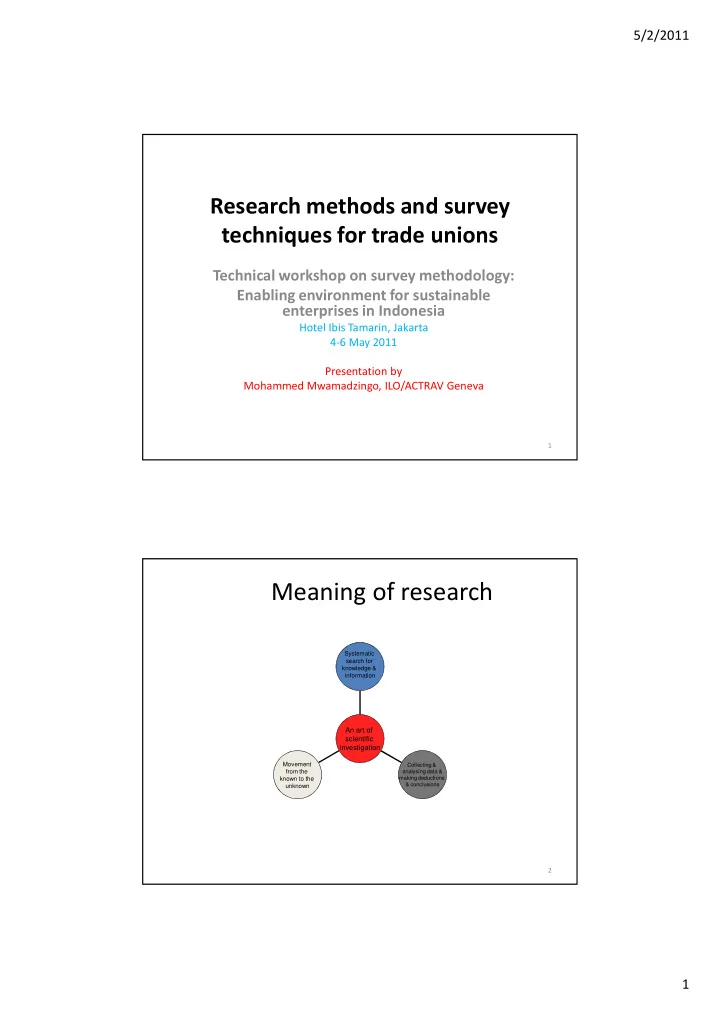
Meaning of research

Movement from the known to the unknown Collecting & analysing data & making deductions & conclusions Systematic search for knowledge & information

An art of scientific investigation

slide-2
SLIDE 2

5/2/2011 2

www.itcilo.org International Training Centre of the ILO 3

Purpose and objectives of research

Purpose:

Establish systematic, reliable and valid knowledge about

the social world. Objectives:

Discover answers to questions through the application of

scientific procedures.

Gain familiarity with a phenomenon or to achieve new

insights into.

www.itcilo.org International Training Centre of the ILO 4

Purpose and objective of research

  • Portray accurately the characteristics of a particular

individual, situation or group.

  • Determine the frequency with which something occurs or

with which it is associated with something else.

  • Test a hypothesis of a relationship between variables.
slide-3
SLIDE 3

5/2/2011 3

The research process

  • Topic
  • Statement of the problem
  • Objectives
  • Research Questions
  • Literature review
  • Data collection
  • Data Analysis
  • Report writing

5

Typologies of trade union research

  • Undertake research on employment and social

issues that are of relevance to trade unions.

  • Generate sound, up-to-date and credible labour

statistics on unemployment, non-standard employment, child labour, force labour, labour markets, women’s participation in the labour force, safety and health at work, social security, collective bargaining, organising and a broader range of other topics associated with the measurement of decent work.

  • Scrutinise public policies and prepare union

responses, comments and submissions.

6

slide-4
SLIDE 4

5/2/2011 4

Typologies of trade union research

  • Provide statistics which trade union leaders can

use to effectively communicate cogent arguments during policy-making and policy review exercises.

  • Collect, analyse and interpret information on

wages, conditions of employment, company productivity and profits, companies’ balance sheets, economic trends in the industry and country as a whole, job grading, cost of living, pension/provident funds, etc.

  • Make regular contacts with union branches and

shop stewards to assess progress and impact on CBAs.

7

Typologies of trade union research

  • Collect, analyse and interpret data on key

challenges facing the trade union movement e.g. membership decline, fragmentation and proliferation, gender inequality, organising informal economy workers, etc.

  • Coordinate statistical activities across the

affiliates of the national trade union centre and monitor their qualities.

  • Create reliable statistical database for trade

unions.

8

slide-5
SLIDE 5

5/2/2011 5

Ethical considerations for trade union research

  • Voluntary participation: participants should voluntarily decide to

participate in a research project after being explained as to what the research is about and what is expected from the participants.

  • No harm should be imposed to participants: the research process should

not involve any kind of emotional, psychological or physical harm.

  • Anonymity and confidentiality: the identity of the participants should be
  • protected. The researcher should promise not to identify the participant

publicly.

  • Deceiving participants: Researchers should never deceive the participants

about who they are, what they are doing and why they are conducting that research.

  • Analysis and reporting: researchers should always be ready to disclose

research methodology used and techniques of analysis. Limitations of the findings and the methodological constraints should be stated in the

  • report. Data should not be misrepresented.

9