
Intelligent Computer-Assisted Language Learning
Part III: Diagnosing Meaning Errors in ICALL Detmar Meurers (Universit¨ at T¨ ubingen)
based on joint research with Stacey Bailey. See: Bailey/Meurers (2009): “Diagnosing Meaning Errors in Short Answers to Reading Comprehension”. Proceedings of the Third ACL Workshop on Innovative Use of NLP for Building Educational Applications. http://purl.org/dm/papers/bailey-meurers-08.html European Summer School in Language, Logic, and Information- Bordeaux. July 27–31, 2009
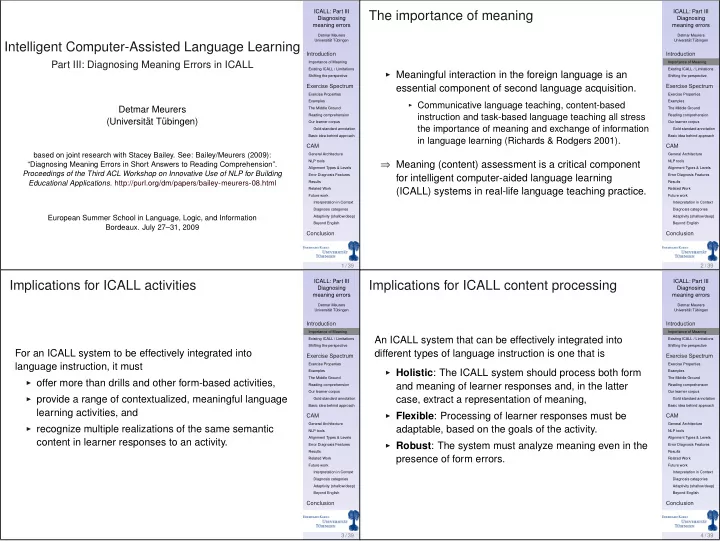
The importance of meaning
◮ Meaningful interaction in the foreign language is anessential component of second language acquisition.
◮ Communicative language teaching, content-basedinstruction and task-based language teaching all stress the importance of meaning and exchange of information in language learning (Richards & Rodgers 2001).
⇒ Meaning (content) assessment is a critical component for intelligent computer-aided language learning (ICALL) systems in real-life language teaching practice.
2 / 39 ICALL: Part III Diagnosing meaning errors Detmar Meurers Universit¨ at T¨ ubingen Introduction Importance of Meaning Existing ICALL / Limitations Shifting the perspective Exercise Spectrum Exercise Properties Examples The Middle Ground Reading comprehension Our learner corpus Gold standard annotation Basic idea behind approach CAM General Architecture NLP tools Alignment Types & Levels Error Diagnosis Features Results Related Work Future work Interpretation in Context Diagnosis categories Adaptivity (shallow/deep) Beyond English ConclusionImplications for ICALL activities
For an ICALL system to be effectively integrated into language instruction, it must
◮ offer more than drills and other form-based activities, ◮ provide a range of contextualized, meaningful languagelearning activities, and
◮ recognize multiple realizations of the same semanticcontent in learner responses to an activity.
3 / 39 ICALL: Part III Diagnosing meaning errors Detmar Meurers Universit¨ at T¨ ubingen Introduction Importance of Meaning Existing ICALL / Limitations Shifting the perspective Exercise Spectrum Exercise Properties Examples The Middle Ground Reading comprehension Our learner corpus Gold standard annotation Basic idea behind approach CAM General Architecture NLP tools Alignment Types & Levels Error Diagnosis Features Results Related Work Future work Interpretation in Context Diagnosis categories Adaptivity (shallow/deep) Beyond English ConclusionImplications for ICALL content processing
An ICALL system that can be effectively integrated into different types of language instruction is one that is
◮ Holistic: The ICALL system should process both formand meaning of learner responses and, in the latter case, extract a representation of meaning,
◮ Flexible: Processing of learner responses must beadaptable, based on the goals of the activity.
◮ Robust: The system must analyze meaning even in thepresence of form errors.
4 / 39