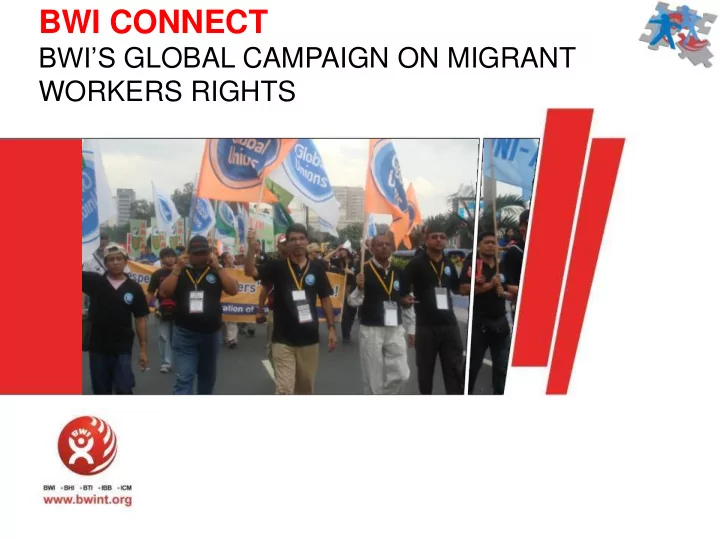
BWI CONNECT BWIS GLOBAL CAMPAIGN ON MIGRANT WORKERS RIGHTS - - PowerPoint PPT Presentation
BWI CONNECT BWIS GLOBAL CAMPAIGN ON MIGRANT WORKERS RIGHTS Definition 1. Internal migrants (China and India) 2. Cross-border migrants (Nepal and India) 3. Immigrants (permanent migrant workers) 4. Refugees and asylum seekers (Syria, Myanmar,
Definition
- 1. Internal migrants (China and India)
- 2. Cross-border migrants (Nepal and
India)
- 3. Immigrants (permanent migrant
workers)
- 4. Refugees and asylum seekers (Syria,
Myanmar, Sub-Saharan Africa)
- 5. Temporary employment migrants (467
visa, H-1B visa, EPS, employers sponsorship like kafala system)
Global Migration Flow
Projected Change in Labour Force
Top Migration Corridors
Labour Migration in Construction Industry
- 1. Within BWI Sectors, particularly in the
construction sector, there has been a history of migration.
- 2. Due to globalization taking different
forms.
- 3. Shift from Permanent to Temporary
Migration.
- 4. 40% of migrant workers hired through
recruiting agencies in developed countries are in manufacturing and construction.
BWI CONNECT
- 1. At the 3rd BWI World Congress in
Bangkok in 2013, BWI once again reaffirmed support for the BWI Global Campaign for Migrant Workers Rights in the frame of BWI Connect which was launched in 2010.
- 2. One of BWI’s Impact Priorities: Migrant
Rights.
- 3. Organize migrant workers on the basis
- f “equal pay and working conditions
for equal work in the same work place.”
Three Clusters
Organizing
- Strategic campaigns
- Internal trade union
development Policy Advocacy
- Global governance of
migration
- Bilateral and Regional
Free trade agreements
- Recruitment Policy
- Temporary
Employment schemes
- Pro-migrant worker
policies and programs
Communication and Essential services
- Public Campaigns
- Migrants Networks
- SMS Help line
- Migrants in Distress
- Fighting xenophobia
and racism
BWI CONNECT
BWI 2014-2017 Strategic Plan
Unions
- Organizing
workers in MNC
- Organizing
workers in Infrastructure projects
- Promoting
Forest Certification
- Global Sports
Campaign
Jobs
- Occupational
Safety and Health
- Campaigning
against Precarious Work
- Combating
illegal logging
Rights
- Campaign to
defend Trade Union Rights
- Global
Campaign for migrant workers rights
- Promoting
gender equality and youth employment.
2015 Key Expected Results and Outcomes
- 1. BWI Unions and Structures have recruited
20,000 migrant workers.
- 2. At least 15 affiliates have developed
migration policies and have started to recruit migrant workers
- 3. 6 Memorandum of understanding between
unions are operationalize
- 4. Kafalas system and employment
sponsorship program are reformed in for countries
- 5. Establishment of a Global Migration
Network
Major 2015 Actions and Activities
- 1. Asia-Pacific Seminar on “Migration and Trade
Unions: Potentials and Challenges” in Manila (8-9 April)
- 2. Latin America and the Caribbean Seminar on
“Migration and Trade Unions: Potentials and Challenges” in Managua (4-5 September)
- 3. Africa-MENA Seminar on “Migration and Trade
Unions: Potentials and Challenges” in Amman (16- 18 September)
- 4. Global Migration Conference in The Hague (5-7
October)
- 5. World Day on Decent Work Action: Focus on
Migration (7 October)
Regional Priorities
- 1. Mediterranean
- 2. Gulf Region
- 3. Southeast Europe
- 4. Central Asia
- 5. Southeast Asia
- 6. East Africa
- 7. Central America
- 8. Mercosur
Examples of Organizing Successes
Central Asia
- 3,625 members recruited mainly
from Tajikistan, Uzbekistan, and Kyrgyzstan in Russia.
- 200 migrant workers recruited by
Kazakhstan
- Tajikistan union has institutionalized
a program that address recruitment, provide information, and facilitate referral and service in Russia.
Asia and Pacific
- 10,000 members recruited in
Malaysia, Thailand, Hong Kong, South Korea, Nepal, and India.
- Mutual cooperation and regular
exchanges amongst unions .
Europe
- Organising campaigns
implemented throughout Europe (Germany, UK, Italy, Norway, Sweden, Netherlands)
- UNIA has a membership of
51% of immigrant workers and 37 of migrant workers.
Latin America and Caribbean
- Haitian migrant workers
- rganized in Brazil.
- Organizing of Nicaraguan
migrant workers in Qatar.
- Caribbean has a sub-regional
cooperation promoting organizing
- f workers in the region.
Gulf Region and Middle East
- Qatar Organizing Project has
- utreached to at least 1,000
migrant workers.
- Mutual cooperation between
unions in Jordan and Egypt
- Migrant workers network
established in Lebanon.
- Total work force: 11 million.
- Migrant workers 1.8 million to 3
million.
- Of this 1 million undocumented.
- Migrant workers from 20 countries.
- 300,000 domestic workers.
- 270,000 construction workers (60-80%)
- 150,000 furniture and wood processing
(90% )
Organizing Case Study: Malaysia
Case Study of Malaysia: Organizing Strategies
- 1. Placement of project organizer from Nepal
working with BWI affiliates in Malaysia recruiting migrant workers.
- 2. Advocating for legislative changes so that
migrant workers who join trade unions will not be deported.
- 3. Minimum Wage Campaign
- 4. Legal aid service for migrants in distress.
- 5. Regional Cooperation between BWI, PSI,
UNI and national centers in Malaysia, Nepal and Indonesia.
- 1. Connecting migrant workers with unions
- 2. Linking unions in countries of origin and
destination
- 3. One-stop-shop referral, advice and
assistance for migrant workers
- 4. Links with NGOs and support services
- 5. Initial pilot in Malaysia
- 6. Requests for advice or assistance will be
general and specific
SMS HELP LINE SYSTEM
SMS HELP-LINE OPERATIONS
- Worker sends SMS for assistance or
advice
- Union organiser can receive and respond
to SMS from anywhere
- Organiser can provide direct assistance
- r link workers with relevant union and
- rganisations for assistance
SMS Help Line
Tools for Organizing:
Migrant Workers Rights Guide
Case Study: Switzerland
1.Construction sector history of migrant
work force:
- 1890s: Italians for large infrastructure
projects
- 1910: 40% of the work force were foreign
and of this 44% were Italians
- 1960s and 1970s: Italy
- 1970s: Spain and Turkey
- 1980s and 1990s: Former Yugoslavia and
Portugal
- 1990s and 2000: Germany, Portugal, and
former Yugoslavia
Switzerland: Migrant Population
Migrant population composition in 2010 439'031 36'581 42'535 59'858 64'167 70'836 91'815 136'249 288'962 254'192 208'342 Italy Germany Portugal Serbia France Turkey Spain Macedonia Kosovo Austria Other 17%
15%
12%
8% 5% 4%
4% 4% 3% 2% 26%
Proportion of foreign residents is 22.5% In the EU comparison, formally higher proportion of migrants to the resident population. However: the naturalisation ratio at 2.8% is rather low in the EU comparison. About 600,000 migrants could request naturalisation according to current rules (however: procedure, costs)
Migrants Workers by Industries
UNIA Activities and Initiatives
- 1. Organizers from Migrant Communities
(Serbia, Kosovo, Germany, Italy, Portugal, Spain, and Poland)
- 2. Migrant Worker structures by language,
regional culminating as a national conference.
- 3. Migrant Worker training and leadership
skills development.
- 4. Production of information and publications.
- 5. Policy advocacy on pro-migrant worker
issues.
Nexus of Migrant Workers Rights and Sports Campaign for Decent Work
- 1. The upcoming major global sports
events work force will consist of migrant workers
- 2018 World Cup in Russia (Central Asia,
Ukraine, and Southeast Europe)
- 2022 World Cup in Qatar (South Asia and
Southeast Asia)
- 2018 Winter Olympics (Central Asia and
Southeast Asia)
- 2020 Summer Olympics (East Asia and
Southeast Asia)
Global Strategy
- 1. Engagement with International Sports
Agencies (FIFA and IOC)
- 2. Engagement with National
Governments
- 3. Engagement with Multinational
Construction Companies
- 4. Multi-media campaigns
National Organizing Strategy
- 1. Russia, South Korea, and Japan
- Developing and implementing organizing
strategies with BWI affiliates where there is inclusion of outreach to migrant workers.
2.
Qatar
- Country of origin organizing
- Engagement with MNCs to establish
workers committees
- Community organizing in Qatar
- Exploring direct organizing