6 th ASEAN Forum on Migrant Labour Enhancing Policy and Protection - - PDF document

6 th asean forum on migrant labour
SMART_READER_LITE
LIVE PREVIEW

6 th ASEAN Forum on Migrant Labour Enhancing Policy and Protection - - PDF document

6 th ASEAN Forum on Migrant Labour Enhancing Policy and Protection of Migrant Workers through Data Sharing, Adequate Access to the Legal and Judicial system during Employment, including Effective Complaints Mechanisms. Session 2: Information


slide-1
SLIDE 1

1

6th ASEAN Forum on Migrant Labour

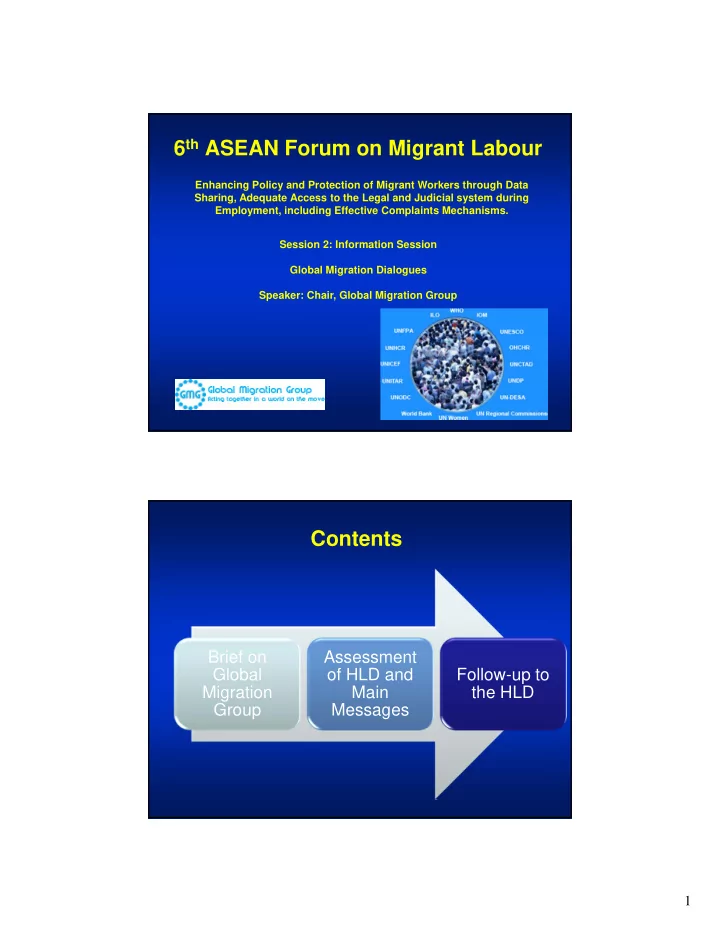
Enhancing Policy and Protection of Migrant Workers through Data Sharing, Adequate Access to the Legal and Judicial system during Employment, including Effective Complaints Mechanisms. Session 2: Information Session Global Migration Dialogues Speaker: Chair, Global Migration Group

Contents

Brief on Global Migration Group Assessment

  • f HLD and

Main Messages Follow-up to the HLD

slide-2
SLIDE 2

2

Brief on Global Migration Group

  • Established more than a decade ago:

– Grew from IOM –UNHCR Heads’ informal discussions, and then included ILO and United Nations Office of the High Commission of Human Rights (OHCHR) – Went through a stage as the Geneva Migration Group

  • Became Global Migration Group in 2006 and is now a 16-member network:

– Promotes international standards – Coordinates work programmes – Takes joint initiatives

  • Current troika: Regional Commissions, IOM, ILO

Assessment of HLD

  • Greater convergence of views
  • Less antagonism
  • Greater recognition of the relevance
  • f migration for all countries

and in relation to many issues.

slide-3
SLIDE 3

3

HLD demonstrated

1. That multilateral dialogue and consensus on migration issues are possible. 2. The impact of the Global Forum on Migration and Development (GFMD) and other efforts in the realm of international cooperation and dialogue. 3. That substance could trump politics and institutional questions. Member States agreed on a substantive declaration and there was a high degree of convergence on substantive issues evident from the statements in plenary and round tables. 4. That migration stakeholders have much more in common than is often

  • apparent. There was a great deal of convergence on key issues

including the statements of States, IOs, the GMG, CSOs and SG.

Main Messages

  • The centrality of the human rights of migrants.
  • The critical links between migration and development and

the relevance of migration for the post-2015 development agenda.

  • The concern for stranded migrants

and migrants caught in crisis; and the widespread hazards, distress and abuse which migrants suffer in transit and destination.

slide-4
SLIDE 4

4

Secretary-General’s 8 Points

  • 1. Protection of the rights of migrants
  • 2. Reduce the costs of labour migration
  • 3. Eliminate migrant exploitation including trafficking
  • 4. Address the plight of stranded migrants
  • 5. Improve the perception of migrants
  • 6. Integrate migration into the development agenda
  • 7. Strengthen the migration evidence base
  • 8. Enhance migration partnerships and cooperation.
  • Many elements coincide with CSOs 8 Point 5 year plan.

Follow-up to the HLD

  • How to make UN GA Declaration operational?
  • No formal follow-up mechanism
  • Link HLD Declaration & post-2015 Agenda

«Human mobility is a key factor for sustainable development which should be adequately considered in the elaboration of the post-2015 development agenda»

slide-5
SLIDE 5

5

GMG Priorities During IOM Chairmanship

Post-2015 Development Agenda preparations Improving migrants’ perception & image

  • including greater outreach to Member States

Coherence & communication

GMG Priorities Linked with HLD Outcomes

Decisions approved at the Principals’ Meeting 3 July, 2013:

  • GMG multi-annual work plan
  • Creation of additional working groups & task forces
slide-6
SLIDE 6

6

Post-2015 Development Agenda

Multi-Annual Work Plan (2013-2015) –

– 2 cross-cutting work streams (GMG coordination and visibility, migration and the post-2015 development agenda) – 5 thematic work streams (Mainstreaming migration in development planning, Data and research, Human rights gender and migration, Migration and decent work (TF), Capacity building (TF) ) – Key Outputs:

  • Key messages on migration & post-2015 DA
  • Strategic issues papers on migration & post-2015/SDGs
  • Side-events on migration and post-2015/SDGs

What will the GMG do?

GMG

  • Map how current work-plan will contribute to implementation of SG 8 Points.
  • Identify gaps which it can best add value to, especially where GMG working groups

and task forces are dedicated.

  • Identify how to maximize synergies with other actors (MS, CSOs, academia, private

sector).

  • First detailed brain storming on this at the Working Level was on the12th of

November 2013. IOM, as GMG Chair

  • SG request: meet with the GFMD Chair & SRSG.
  • End of year Report upon SG request: GMG thoughts on 8 points’ implementation.
slide-7
SLIDE 7

7

13

Colombo Process:

Dhaka Consultation 2011

  • Chairmanship from Indonesia to

Bangladesh in December 2010

  • Preceded by a Senior Officials’

Meeting

  • Draft regional study served as the

background

  • Constructive dialogue within the

member States and with others

  • Fine tuned the Operational

Modalities of the CP: Guidelines, structure for the future

  • Adopted the Dhaka Declaration

14

Outcome of the last Consultation

  • Theme: Migration with Dignity

– Promotion and protection of rights of migrants and their welfare – Possible institutionalized response during emergencies impacting migrant workers – Women labour migration

  • Dhaka declaration:

– Promoting rights, welfare and dignity of migrants – Capacity building of member States – Preparing emergency response – Enhancing cooperation and dialogue – Re-affirmed the need to continue meeting and for exchange – Closer ties with GFMD and related regional meetings

  • Follow up meeting held in Geneva on developing framework for

emergency response
slide-8
SLIDE 8

8

Abu Dhabi Dialogue

  • The Abu Dhabi Dialogue is a dialogue between the

Colombo Process countries of origin and nine Asian countries of destination

  • Priority: Identify roles and responsibilities of all actors

at each stage of contractual work cycle

  • The 2nd ADD produced the Framework of Regional

Cooperation which was deliberated and approved by the Labour Ministers of the ADD (April 2012)

  • Labour Mobility: Enabler for Sustainable Development,

Abu Dhabi, UAE (May 2013)

16

Asia-EU Dialogue

  • The meeting comprises of member countries of the

Colombo Process and all EU27 countries to discuss relevant issues of labour migration, particularly within the backdrop of a recuperating economy

  • Themes of the 2nd Asia-EU Dialogue:

– Labour supply and demand in both regions, with a view to labour matching – Challenges of irregular migration; – Regulatory frameworks for recruitment and good practice the concept of circular migration – Student mobility

slide-9
SLIDE 9

9

slide-10
SLIDE 10

10

Thank you!

Yuko Hamada

Senior Regional Labor Migration/Migration and Development Specialist International Organization for Migration (IOM) Regional Office for Asia and the Pacific E-mail: yhamada@iom.int Skype: yhamadajpjp