Proposed Radio Mandatory Zone (RMZ) Framework Briefing 7 th January - - PDF document

proposed radio mandatory zone rmz
SMART_READER_LITE
LIVE PREVIEW

Proposed Radio Mandatory Zone (RMZ) Framework Briefing 7 th January - - PDF document

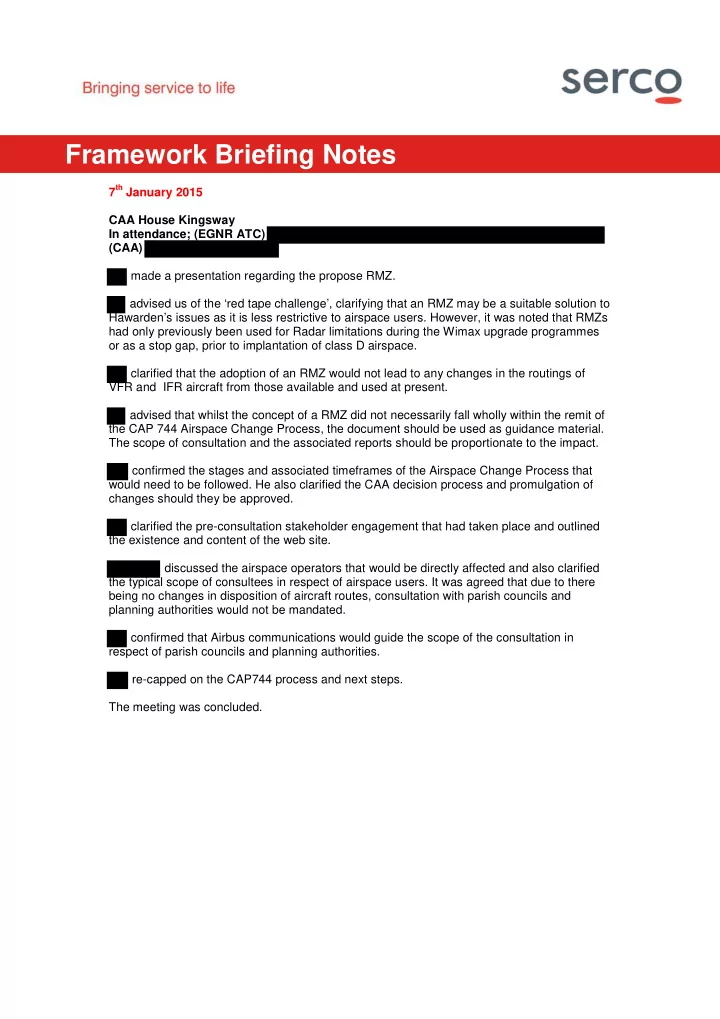
Framework Briefing Notes 7 th January 2015 CAA House Kingsway In attendance; (EGNR ATC) (CAA) made a presentation regarding the propose RMZ. advised us of the red tape challenge, clarifying that an RMZ may be a suitable solution to


slide-1
SLIDE 1

Framework Briefing Notes

7th January 2015 CAA House Kingsway In attendance; (EGNR ATC) (CAA) made a presentation regarding the propose RMZ. advised us of the ‘red tape challenge’, clarifying that an RMZ may be a suitable solution to Hawarden’s issues as it is less restrictive to airspace users. However, it was noted that RMZs had only previously been used for Radar limitations during the Wimax upgrade programmes

  • r as a stop gap, prior to implantation of class D airspace.

clarified that the adoption of an RMZ would not lead to any changes in the routings of VFR and IFR aircraft from those available and used at present. advised that whilst the concept of a RMZ did not necessarily fall wholly within the remit of the CAP 744 Airspace Change Process, the document should be used as guidance material. The scope of consultation and the associated reports should be proportionate to the impact. confirmed the stages and associated timeframes of the Airspace Change Process that would need to be followed. He also clarified the CAA decision process and promulgation of changes should they be approved. clarified the pre-consultation stakeholder engagement that had taken place and outlined the existence and content of the web site. discussed the airspace operators that would be directly affected and also clarified the typical scope of consultees in respect of airspace users. It was agreed that due to there being no changes in disposition of aircraft routes, consultation with parish councils and planning authorities would not be mandated. confirmed that Airbus communications would guide the scope of the consultation in respect of parish councils and planning authorities. re-capped on the CAP744 process and next steps. The meeting was concluded.

slide-2
SLIDE 2

Serco Internal

HAWARDEN AIR TRAFFIC CONTROL

In Partnership with

1

Framework Briefing 7th January 2015

Proposed Radio Mandatory Zone (RMZ)

slide-3
SLIDE 3

Serco Internal

Contents

  • Introductions
  • Why are we applying for

an airspace change?

  • Possible solutions.
  • Why an RMZ?
  • What have we done so

far?

  • What are we proposing?

2

In Partnership with

  • What would the effects

be to pilots?

  • FAQs
  • Next Step
  • Questions
slide-4
SLIDE 4

Serco Internal

Introductions

Serco

Provider of Air Traffic Control Services at Hawarden Airport for Airbus UK. at Hawarden Airport since 2006.

RMZ Project Team

Operational ATCOs & ATSAs;

3

In Partnership with

slide-5
SLIDE 5

Serco Internal

Why are we applying for an Airspace Change?

SAFETY & EFFICIENCY

  • Hawarden Airport is situated within Class G Airspace where two

way communication with Air Traffic Control is not mandatory providing aircraft remain outside of the Aerodrome Traffic Zone (ATZ).

  • The whole track of an IFR approach to Runway 04 and a

significant part of an IFR approach to Runway 22, aircraft

  • perate within Class G Airspace.
  • For both runways, aircraft departures are flown in Class G

Airspace before entering Class A (Controlled Airspace).

4

In Partnership with

slide-6
SLIDE 6

Serco Internal

Why are we applying for an Airspace Change?

  • Large and fast aircraft mixed with GA traffic.
  • Forecast national air traffic increases & known A3ST increased

activity.

  • Poor radar returns from small aircraft.
  • Variety of ATS agencies in area (Hawarden, Liverpool,

Shawbury, London FIS). If we know a/c intentions in advance, we will be able to vector our traffic to ensure the safety of all, whilst minimising the disruption to all flights.

5

In Partnership with

slide-7
SLIDE 7

Serco Internal

Why are we applying for an Airspace Change?

Airspace Infringements Complex controlled airspace in the vicinity of Hawarden has a history of airspace infringements. Hawarden can provide navigational assistance to help avoid these infringements.

Airspace infringements account for 20% of reportable incidents at Hawarden. Of the 22 reported Airspace infringements, 4 were Hawarden ATZ infringements, 8 were N864 infringements, 9 accounted for infringements of the Manchester TMA/CTA (one of these also infringed N864) and 2 were Liverpool CTA

  • infringements. Of the 22 reported Airspace infringements, only 4 were being

provided with a service from Hawarden ATC. (Review of Hawarden incidents 2013)

6

slide-8
SLIDE 8

Serco Internal

Possible solutions

CTR Class D Airspace Too restrictive to operators. More than is needed. TMZ This would provide most of the information we need but not all & would be an unreasonable demand on local airspace users. RMZ This would provide all of the information Hawarden needs & would aid aircrew awareness, providing reasonable alternative means of compliance can be incorporated.

7

slide-9
SLIDE 9

Serco Internal

Why an RMZ?

  • An RMZ is a piece of airspace of defined

dimensions wherein the carriage and operation of radio equipment is mandatory.

  • All flights operating in the airspace designated as

an RMZ, shall establish two way communication before entering the RMZ and maintain continuous voice communications with ATC unless in compliance with an alternative procedure.

8

In Partnership with

slide-10
SLIDE 10

Serco Internal

What must a pilot do?

Before entering the RMZ, an initial call containing:

  • call sign & type of aircraft.
  • position, level, the intentions of the flight.
  • Maintain a listening watch.

9

In Partnership with

slide-11
SLIDE 11

Serco Internal

What are we proposing?

  • RMZ Designs – design not finalised.
  • Revised Letter of Agreement with Liverpool Air Traffic Control (subject to

impact).

  • Revised Letter of Agreement with Llantisilio Gliding Site.
  • Letters with others within the RMZ.
  • Alternative means of compliance (excerpt from SN2014/007 – Southend RMZ

…. In essence, before entry to the RMZ, all aircraft are to establish two-way communication with Southend ATC, although aircraft not fitted with radios can still

  • perate in the RMZ provided the pilot is able to co-ordinate arrangements with

Southend ATC (+44 1702 538420) prior to departure)

  • Possible use of SSR ‘listening squawk’.

10

In Partnership with

slide-12
SLIDE 12

Serco Internal

RMZ Design 1 - Withdrawn

11

In Partnership with

slide-13
SLIDE 13

Serco Internal

RMZ Design 2 - Current

12

In Partnership with

slide-14
SLIDE 14

Serco Internal

Effects on operators

  • Comply with communication obligations
  • Increased awareness provided to aircraft by common frequency.
  • Aircraft may be asked if they can accept modified routing or level,

if not agreeable, Hawarden will work around.

  • Non-radio aircraft can be given an exemption provided the flight

details above are passed by phone.

  • RTF failures (inbound) may continue to land at Hawarden.
  • RTF failures (transit) having passed details may continue.

13

In Partnership with

slide-15
SLIDE 15

Serco Internal

What have we done so far?

  • Assessed options for Airspace classifications.
  • Discussions with Local ATSUs & some local airspace

users at open evening.

  • Letter to local flyers, and organizations.
  • Website www.hawardenrmz.co.uk.
  • Feedback from website.
  • RMZ design being prepared for consultation.

14

In Partnership with

slide-16
SLIDE 16

Serco Internal

FAQs

Frequently Asked Questions from the website feedback.

15

In Partnership with

slide-17
SLIDE 17

Serco Internal

FAQs

1) Will Hawarden Radar be able to cope with the increased radio traffic? 2) Why does Hawarden need such a large RMZ? 3) Can we see figures to justify the need for a RMZ?

16

In Partnership with

slide-18
SLIDE 18

Serco Internal

Hawarden Movement Data

17 5000 10000 15000 20000 25000 30000 2008 2009 2010 2011 2012 2013 2014 2015 2016 2017

Total movements

Total movements

slide-19
SLIDE 19

Serco Internal

Beluga Movements

18 100 200 300 400 500 600 700 2008 2009 2010 2011 2012 2013 2014 2015 2016 2017

Beluga movements

Beluga movements

slide-20
SLIDE 20

Serco Internal

ATC Service Breakdown (10nm of Hawarden)

19

Hawarden 27% Liverpool 47% Shawbury 3% London FIS 1% None (SSR) 13% None (Primary) 9%

Aircraft percentages

slide-21
SLIDE 21

Serco Internal

The Next Step

  • Launch Airspace Change Proposal consultation.
  • Complete consultation process, evaluate and issue

post consultation reports.

  • Compile Airspace Change Proposal.
  • If accepted, we are proposing a go-live date in late

2015 tbc (subject to SARG approval).

20

In Partnership with

slide-22
SLIDE 22

Serco Internal

Questions

?

21

In Partnership with