
SLIDE 1
First Nations Parents Club Conference ts'i'ts'uwatul’ “To Help One Another” 2015 Maddie Price FNESC/FNSA
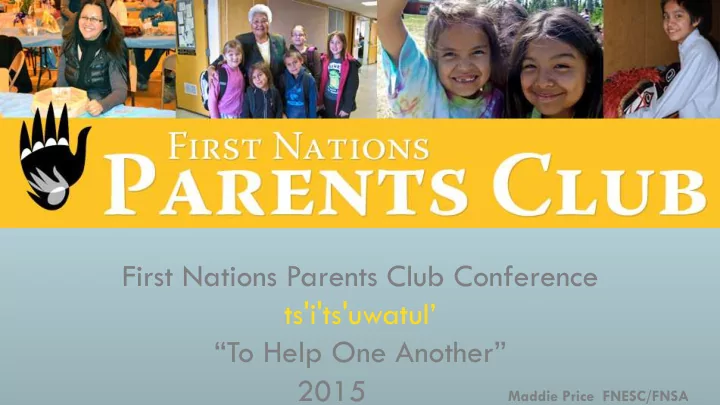
First Nations Parents Club Conference ts'i'ts'uwatul To Help One - - PowerPoint PPT Presentation
First Nations Parents Club Conference ts'i'ts'uwatul To Help One Another 2015 Maddie Price FNESC/FNSA How To Get Them All There Parents Club 2015 FNSA Goal AGE 8 GRADE 3 READING Graduation Ratio of Evergreens to Dogwoods in Public
First Nations Parents Club Conference ts'i'ts'uwatul’ “To Help One Another” 2015 Maddie Price FNESC/FNSA
2015
How To Get Them All There
Parents Club
Graduation
in Public Schools
Non-aboriginal 1:56 Aboriginal 1:10 Status On-reserve 1:5
¨ To learn the 5 Big Ideas of Reading ¨ To be able to use games and activities to help your children
learn to be good readers, speakers and writers.
¨ To understand the difference between “adaptations” and
“modifications”
¨ To ask the important questions at school
words
meat.. igh= high
the text
comprehension.
Phonological Awareness
Reading To Your Child
Hearing Rhyming Sounds/Word
Find the Rhyming Words Baby Beluga in the deep blue sea, Swim so wild and you swim so free. Heaven above, and the sea below, And a little white whale on the go.
Page_957.html
Hearing Rhyming Sounds/Words Phonological Awareness Do the Words Rhyme Or Not Rhyme?
sweet------ greet hair-----fair chair------couch meet------house hot------cold rug------mug
Hearing Rhyming Sounds/Words Phonological Awareness Make Up Your Own Rhymes J With a Starter Word bug----- match---- hat----- floor------ log------ make-----
Hearing and Clapping the Sounds Phonological Awareness
Phonological Awareness –listening to and manipulating sounds in words
Phonological Awareness
Phonological Awareness
Phonological Awareness
Read and spell the word l-o-g l o g
Mastering the sounds of letters is essential to learning how to readJ J
Read and spell the word c-a-t c a t
peak
Mastering the sounds of letters is essential to learning how to readJ J
Mastering the sounds of letters is essential to learning how to readJ J
The right practice is critical! Practice what has been taught in the classroom.
Big Idea
Fluency is not speed! It is reading smoothly with ease, and expression.
What does phonics practice look like?
1.
Adult reads the sounds or words or sentences
2.
Adult and child choral read the sounds or words or sentences
3.
Child reads on their own
The right practice is critical! Practice what has been taught in the classroom.
2015-01-27
24
How Many Words Do Children Need to Know?
… and this is based on 365 days of the year! Double these rates if your students are learning
vocabulary only when in school.
Grade 1 Grade 2 Grade 3 Grade 4+ 800+ per year 800+ per year 2,000/ 3,000 per year 2,000/ 3,000 per year 2 new words per day 2 new words per day 6–8 new words per day 6–8 new words per day
2015-01-27 25
(Stanovich, 2000)
Exposed to 1,800,000 words per year Exposed to 282,000 words per year Exposed to 8,000 words per year < 1 minute 4.6 minutes 20 minutes
Time spent reading each day
* p. 11
.
Children who enter school with limited vocabulary knowledge grow more discrepant over time from their peers who have rich vocabulary knowledge. (Baker, Simmons, & Kame’enui, 1997) Gap in word knowledge persists though the elementary years. (White, Graves, & Slater, 1990) The vocabulary gap between struggling readers and proficient readers grows each year. (Stanovich, 1986)
How Parents can Help their Children Learn New Words
Reading to your child every day and picking out a new word to learn- Listen to this expert teacher read a book out loud to her grade 2 class and how she teaches new words.
http://www.ldoceonline.come
https://www.youtube.com/watch?v=jdIsPJpvfNU
How Parents can Help their Children Learn New Words
Two Assumptions Necessary In Successful School Cultures
1.
All Children Can Learn
2.
All Children Will Learn Because of What We Do Anthony Muhammad
2015-01-27
Understand the Difference
Be cautious not to modify before Grade 10 unless……
Ministry of Education- A Guide to Adaptations and Modifcations August 2009
http://www.bced.gov.bc.ca/specialed/docs/adaptations_and_modifications_guide.pdf
It is important to ask the right questions to get the right information you need to know how your children are doing at school.
Madeline Price-SEP Manager madelinep@fnesc.ca 604-290-1282- cell 1-877-422-3672 (office)
https://www.youtube.com/watch?v=AS8M7dpvYjk
WORKING TOGETHER WE CAN SUPPORT HIGH LEVELS OF LEARNING FOR ALLJ J