1 Testing the Impact of Radio Testing the Impact of Radio Impact - - PDF document

1
SMART_READER_LITE
LIVE PREVIEW

1 Testing the Impact of Radio Testing the Impact of Radio Impact - - PDF document

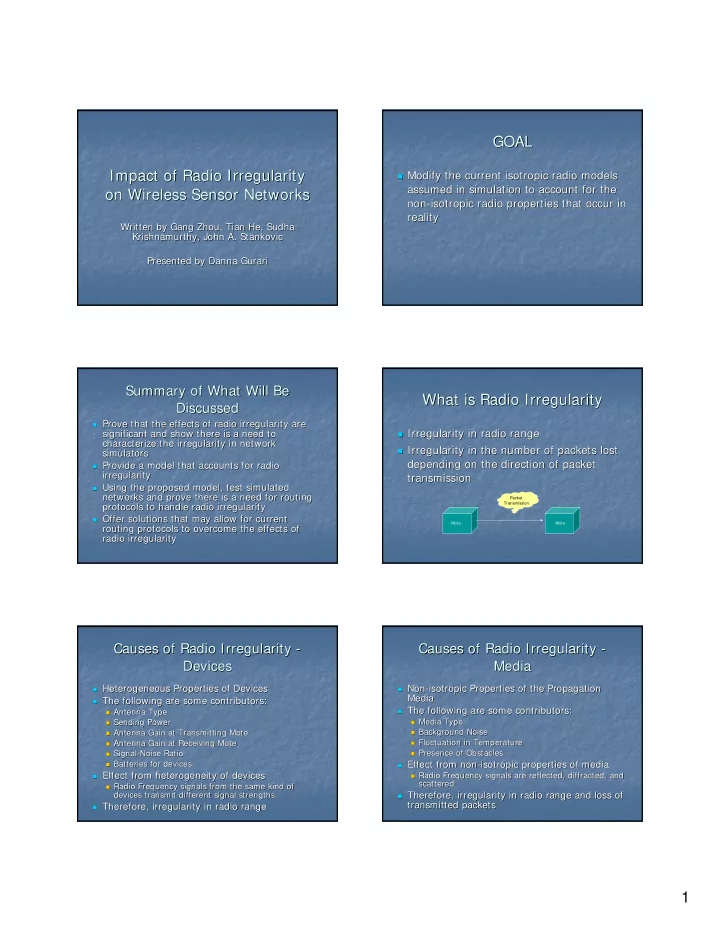
GOAL GOAL Impact of Radio Irregularity Impact of Radio Irregularity Modify the current isotropic radio models Modify the current isotropic radio models assumed in simulation to account for the assumed in simulation to account for the


slide-1
SLIDE 1

1 Impact of Radio Irregularity Impact of Radio Irregularity

  • n Wireless Sensor Networks
  • n Wireless Sensor Networks

Written by Gang Zhou, Written by Gang Zhou, Tian Tian He, He, Sudha Sudha Krishnamurthy, John A. Krishnamurthy, John A. Stankovic Stankovic Presented by Danna Gurari Presented by Danna Gurari

GOAL GOAL

  • Modify the current isotropic radio models

Modify the current isotropic radio models assumed in simulation to account for the assumed in simulation to account for the non non-

  • isotropic radio properties that occur in

isotropic radio properties that occur in reality reality

Summary of What Will Be Summary of What Will Be Discussed Discussed

  • Prove that the effects of radio irregularity are

Prove that the effects of radio irregularity are significant and show there is a need to significant and show there is a need to characterize the irregularity in network characterize the irregularity in network simulators simulators

  • Provide a model that accounts for radio

Provide a model that accounts for radio irregularity irregularity

  • Using the proposed model, test simulated

Using the proposed model, test simulated networks and prove there is a need for routing networks and prove there is a need for routing protocols to handle radio irregularity protocols to handle radio irregularity

  • Offer solutions that may allow for current

Offer solutions that may allow for current routing protocols to overcome the effects of routing protocols to overcome the effects of radio irregularity radio irregularity

What is Radio Irregularity What is Radio Irregularity

  • Irregularity in radio range

Irregularity in radio range

  • Irregularity in the number of packets lost

Irregularity in the number of packets lost depending on the direction of packet depending on the direction of packet transmission transmission

Packet Transmission Mote Mote

Causes of Radio Irregularity Causes of Radio Irregularity -

  • Devices

Devices

  • Heterogeneous Properties of Devices

Heterogeneous Properties of Devices

  • The following are some contributors:

The following are some contributors:

  • Antenna Type

Antenna Type

  • Sending Power

Sending Power

  • Antenna Gain at Transmitting Mote

Antenna Gain at Transmitting Mote

  • Antenna Gain at Receiving Mote

Antenna Gain at Receiving Mote

  • Signal

Signal-

  • Noise Ratio

Noise Ratio

  • Batteries for devices

Batteries for devices

  • Effect from heterogeneity of devices

Effect from heterogeneity of devices

  • Radio Frequency signals from the same kind of

Radio Frequency signals from the same kind of devices transmit different signal strengths devices transmit different signal strengths

  • Therefore, irregularity in radio range

Therefore, irregularity in radio range

Causes of Radio Irregularity Causes of Radio Irregularity -

  • Media

Media

  • Non

Non-

  • isotropic Properties of the Propagation

isotropic Properties of the Propagation Media Media

  • The following are some contributors:

The following are some contributors:

  • Media Type

Media Type

  • Background Noise

Background Noise

  • Fluctuation in Temperature

Fluctuation in Temperature

  • Presence of Obstacles

Presence of Obstacles

  • Effect from non

Effect from non-

  • isotropic properties of media

isotropic properties of media

  • Radio Frequency signals are reflected, diffracted, and

Radio Frequency signals are reflected, diffracted, and scattered scattered

  • Therefore, irregularity in radio range and loss of

Therefore, irregularity in radio range and loss of transmitted packets transmitted packets

slide-2
SLIDE 2

2 Impact of Radio Irregularity Impact of Radio Irregularity

  • Asymmetric links:

Asymmetric links:

  • Transmission of messages in both directions

Transmission of messages in both directions may be inhibited may be inhibited

  • Effect: networks that communicate in both

Effect: networks that communicate in both directions may become inefficient/ineffective directions may become inefficient/ineffective

  • Non

Non-

  • spherical radio range

spherical radio range

  • Protocols based on the assumption of

Protocols based on the assumption of spherical radio range are tainted spherical radio range are tainted

Testing the Impact of Radio Testing the Impact of Radio Irregularity on Protocol Irregularity on Protocol Performance Performance

  • On actual motes?

On actual motes?

  • No! Expensive to test with large quantities of motes.

No! Expensive to test with large quantities of motes. Challenging to obtain similar data in an uncontrolled Challenging to obtain similar data in an uncontrolled environment. environment.

  • In a simulator?

In a simulator?

  • Yes! Both problems in hardware are avoided when

Yes! Both problems in hardware are avoided when testing with a simulator. testing with a simulator.

  • Problem

Problem… … Current simulators do not account for Current simulators do not account for radio irregularity radio irregularity

Experiment Experiment

  • Before accounting for radio irregularity in

Before accounting for radio irregularity in simulation, testing was done to learn about simulation, testing was done to learn about radio irregularity radio irregularity

  • Experiment Requirements:

Experiment Requirements:

  • Mica2 Motes and Parking Lot

Mica2 Motes and Parking Lot

  • Experiments:

Experiments:

  • Received Signal Strength

Received Signal Strength

  • Packet Reception Ratio

Packet Reception Ratio

  • Communication Range

Communication Range

Experiment Results Experiment Results

  • Experiment Set Up: Position sender mote,

Experiment Set Up: Position sender mote, position receiver mote 10 feet away, and position receiver mote 10 feet away, and measure signal strength, packet loss ratio, and measure signal strength, packet loss ratio, and

  • range. Repeat this measurement from three
  • range. Repeat this measurement from three
  • ther directions
  • ther directions

Summary Summary

  • So far

So far… …

  • Proven that the effects of radio irregularity

Proven that the effects of radio irregularity are significant and have shown there is a are significant and have shown there is a need to characterize the irregularity in need to characterize the irregularity in network simulators network simulators

  • Next will

Next will… …

  • Provide a model that accounts for radio

Provide a model that accounts for radio irregularity irregularity

Isotropic Radio Model Isotropic Radio Model

  • Signal attenuation is the same in all

Signal attenuation is the same in all directions directions

Received Signal Strength Received Signal Strength =

= Sending power

Sending power – – Path Loss + Fading Path Loss + Fading

Signal’s energy loss as it travels to the receiver Determined by battery status, type of transmitter, amplifier, and antenna

slide-3
SLIDE 3

3 DOI Radio Model DOI Radio Model

  • Signal attenuation may vary in all directions

Signal attenuation may vary in all directions

Received Signal Strength = Sending power Received Signal Strength = Sending power – – DOI Adjusted Path Loss + Fading DOI Adjusted Path Loss + Fading Isotropic Path Loss x K; where K is coefficient that is calculated and varies for each direction (360 different values).

RIM Radio Model RIM Radio Model

  • An extension from DOI

An extension from DOI

  • In this model, the sending power value is

In this model, the sending power value is modified modified

Received Signal Strength = VSP Adjusted sending power Received Signal Strength = VSP Adjusted sending power – – DOI Adjusted Path Loss + Fading DOI Adjusted Path Loss + Fading

Isotropic Sending Power x (1 + Rand x VSP); where VSP is the maximum percentage variance of the signal sending power among different devices (variance of sending power)

Using RIM, they Analyzed Some Using RIM, they Analyzed Some Well Known Well Known… …

  • MAC protocols

MAC protocols

  • The impact of radio irregularity is insignificant

The impact of radio irregularity is insignificant

  • Routing protocols

Routing protocols

  • The impact of radio irregularity is significant

The impact of radio irregularity is significant

MAC Performance MAC Performance

  • Experiment Tools

Experiment Tools

  • GloMoSim

GloMoSim: a scalable discrete : a scalable discrete-

  • event simulator

event simulator

  • CSMA and 802.11 DCF (2 MAC protocols)

CSMA and 802.11 DCF (2 MAC protocols)

  • Experiment with varying DOI values

Experiment with varying DOI values

  • As DOI value increases, asymmetry of

As DOI value increases, asymmetry of communication increases communication increases

  • Experiment with varying VSP values

Experiment with varying VSP values

  • As DOI value increases, asymmetry of

As DOI value increases, asymmetry of communication increases communication increases

MAC Performance (Continued) MAC Performance (Continued)

  • In both experiments:

In both experiments:

  • Loss Ratio = # frames lost/# frames sent

Loss Ratio = # frames lost/# frames sent

  • Increasing the value of either VSP or DOI, resulted in

Increasing the value of either VSP or DOI, resulted in an increase of loss ratio an increase of loss ratio

  • Interesting Observation: Testing with AODV returned

Interesting Observation: Testing with AODV returned a smaller loss ratio than testing with GF a smaller loss ratio than testing with GF

  • AODV and GF are two different routing protocols

AODV and GF are two different routing protocols

  • Asymmetric links have a larger impact on GF than on AODV

Asymmetric links have a larger impact on GF than on AODV

  • Thus, the conclusion of this experiment was that

Thus, the conclusion of this experiment was that varying VSP and DOI values has a much larger varying VSP and DOI values has a much larger impact on routing protocols than on MAC impact on routing protocols than on MAC protocols protocols

3 Common Modes of Routing 3 Common Modes of Routing

  • Path

Path-

  • reversal

reversal

  • Assumed that if a path exists from node A to node B,

Assumed that if a path exists from node A to node B, a path also exists from node B to node A (symmetric a path also exists from node B to node A (symmetric connection) connection)

  • Multi

Multi-

  • round

round

  • Node A broadcasts its message through many paths

Node A broadcasts its message through many paths to node B. to node B.

  • Node B selects one of the senders to respond back to

Node B selects one of the senders to respond back to A through. A through.

  • If this path doesn

If this path doesn’ ’t work, node B will eventually try to t work, node B will eventually try to respond through the other paths until a response respond through the other paths until a response works (symmetric connection) works (symmetric connection)

slide-4
SLIDE 4

4

3 Common Modes of Routing 3 Common Modes of Routing (Continued) (Continued)

  • Neighbor

Neighbor-

  • discovery

discovery

  • Node A listens for packets from its neighbors

Node A listens for packets from its neighbors

  • Node A selects one of its neighbors to forward

Node A selects one of its neighbors to forward packets through packets through

  • If node A can ensure that node B can hear packets

If node A can ensure that node B can hear packets sent from node A, then this method avoids the effects sent from node A, then this method avoids the effects

  • f radio irregularity (ensure symmetry)
  • f radio irregularity (ensure symmetry)

Routing Performance Routing Performance

AODV + DSR = Multi AODV + DSR = Multi-

  • round Discovery

round Discovery GF = Neighbor Discovery GF = Neighbor Discovery Experiment with varying DOI values Experiment with varying DOI values

  • As DOI value increases, asymmetry of communication

As DOI value increases, asymmetry of communication increases increases

  • As a further result

As a further result… …

  • GF has a higher end to end loss ratio than AODV and DSR

GF has a higher end to end loss ratio than AODV and DSR

  • AODV and DSR have larger end to end delays (GF remains

AODV and DSR have larger end to end delays (GF remains the same) the same)

  • AODV and DSR need more control packets (GF remains the

AODV and DSR need more control packets (GF remains the same) same)

  • AODV and DSR have an increase in energy consumption and

AODV and DSR have an increase in energy consumption and GF has a decrease in energy consumption GF has a decrease in energy consumption

Routing Performance Routing Performance

  • Experiment with varying VSP values

Experiment with varying VSP values

  • As VSP value increases, asymmetry of communication increases

As VSP value increases, asymmetry of communication increases

  • As a further result

As a further result… …

  • Effects are the same as for the effects for DOI values. Why?

Effects are the same as for the effects for DOI values. Why?

  • Increasing VSP values causes radio irregularity to increase, whi

Increasing VSP values causes radio irregularity to increase, which in ch in turn results in greater link asymmetry turn results in greater link asymmetry

  • Conclusion: Increasing DOI and VSP values results in the

Conclusion: Increasing DOI and VSP values results in the impact of radio irregularity being greater. impact of radio irregularity being greater.

  • Multi

Multi-

  • round discovery protocols can handle radio

round discovery protocols can handle radio irregularity although there is a high overhead cost. irregularity although there is a high overhead cost.

  • Neighbor discovery protocols responds very poorly to

Neighbor discovery protocols responds very poorly to radio irregularity (if links are symmetric). radio irregularity (if links are symmetric).

6 Proposed Solutions to Deal With 6 Proposed Solutions to Deal With Radio Irregularity Radio Irregularity

  • Symmetric Geographic Forwarding

Symmetric Geographic Forwarding

  • Bounded Distance Forwarding

Bounded Distance Forwarding

  • Bidirectional Flooding

Bidirectional Flooding

  • Learning Function

Learning Function

  • RTS Broadcast

RTS Broadcast

  • High Energy Asymmetry Detection

High Energy Asymmetry Detection

Summary of What Has Been Summary of What Has Been Discussed Discussed

  • Proven that the effects of radio irregularity are

Proven that the effects of radio irregularity are significant and have shown there is a need to significant and have shown there is a need to characterize the irregularity in network characterize the irregularity in network simulators simulators

  • Provided a model that accounts for radio

Provided a model that accounts for radio irregularity irregularity

  • Used the proposed model to test simulated

Used the proposed model to test simulated networks and proved there is a need for routing networks and proved there is a need for routing protocols to handle radio irregularity protocols to handle radio irregularity

  • Offered solutions that may allow for current

Offered solutions that may allow for current routing protocols to overcome the effects of routing protocols to overcome the effects of radio irregularity radio irregularity

Comments Comments

  • Conduct tests on the motes and determine

Conduct tests on the motes and determine how close the simulation is to reality with how close the simulation is to reality with the RIM model (what DOI and VSP values the RIM model (what DOI and VSP values are closest to reality) are closest to reality)

  • Reconsider using current routing protocols

Reconsider using current routing protocols that depend on symmetric links that depend on symmetric links

  • Other solutions:

Other solutions:

  • Develop routing algorithms that utilize the

Develop routing algorithms that utilize the effects of radio irregularity effects of radio irregularity