Project: IEEE P802.15 Working Group for Wireless Personal Area - - PowerPoint PPT Presentation

project ieee p802 15 working group for wireless personal
SMART_READER_LITE
LIVE PREVIEW

Project: IEEE P802.15 Working Group for Wireless Personal Area - - PowerPoint PPT Presentation

May, 2009 doc.: IEEE 802.15-09-0321-00-0006 Project: IEEE P802.15 Working Group for Wireless Personal Area Networks ( etworks (WPANs WPANs) ) Project: IEEE P802.15 Working Group for Wireless Personal Area N Submission Title: [Distributed TDMA


slide-1
SLIDE 1

May, 2009

Seung-Hoon Park et al., Samsung Slide 1/23

doc.: IEEE 802.15-09-0321-00-0006

Submission

Project: IEEE P802.15 Working Group for Wireless Personal Area N Project: IEEE P802.15 Working Group for Wireless Personal Area Networks ( etworks (WPANs WPANs) )

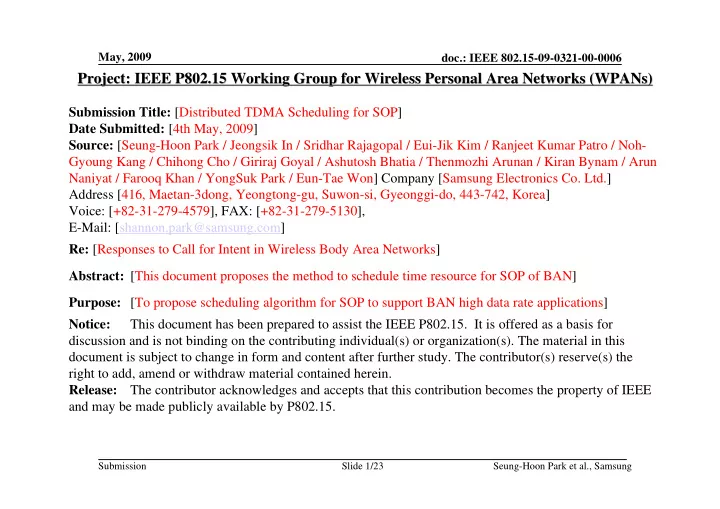
Submission Title: [Distributed TDMA Scheduling for SOP] Date Submitted: [4th May, 2009] Source: [Seung-Hoon Park / Jeongsik In / Sridhar Rajagopal / Eui-Jik Kim / Ranjeet Kumar Patro / Noh- Gyoung Kang / Chihong Cho / Giriraj Goyal / Ashutosh Bhatia / Thenmozhi Arunan / Kiran Bynam / Arun Naniyat / Farooq Khan / YongSuk Park / Eun-Tae Won] Company [Samsung Electronics Co. Ltd.] Address [416, Maetan-3dong, Yeongtong-gu, Suwon-si, Gyeonggi-do, 443-742, Korea] Voice: [+82-31-279-4579], FAX: [+82-31-279-5130], E-Mail: [shannon.park@samsung.com] Re: [Responses to Call for Intent in Wireless Body Area Networks] Abstract: [This document proposes the method to schedule time resource for SOP of BAN] Purpose: [To propose scheduling algorithm for SOP to support BAN high data rate applications] Notice: This document has been prepared to assist the IEEE P802.15. It is offered as a basis for discussion and is not binding on the contributing individual(s) or organization(s). The material in this document is subject to change in form and content after further study. The contributor(s) reserve(s) the right to add, amend or withdraw material contained herein. Release: The contributor acknowledges and accepts that this contribution becomes the property of IEEE and may be made publicly available by P802.15.

slide-2
SLIDE 2

May, 2009

Seung-Hoon Park et al., Samsung Slide 2/23

doc.: IEEE 802.15-09-0321-00-0006

Submission

Distributed TDMA Scheduling for SOP

slide-3
SLIDE 3

May, 2009

Seung-Hoon Park et al., Samsung Slide 3/23

doc.: IEEE 802.15-09-0321-00-0006

Submission

Motivation

High data rate service [1]

– Streaming service with see-through goggle – Video recording & storage

BAN piconet environment

– Frequent encounter with other piconets

Time resource sharing is required

– QoS requirement

Collision affects packet error rate

– UWB band opened globally is narrow [2]

A few number of frequency bands

slide-4
SLIDE 4

May, 2009

Seung-Hoon Park et al., Samsung Slide 4/23

doc.: IEEE 802.15-09-0321-00-0006

Submission

Possible Solutions for SOP

  • FDMA

– How to allocate bands ?

Frequent change of band makes the system complex

  • Direct spread spectrum, frequency hopping, or time hopping

– Only low data rate can be supported

  • Contention-based access (CSMA)

– Not delay bounded – Hidden node – Channel sensing is not easy at UWB, implant (MICS) or body shadowing condition

  • Contention free allocation (TDMA, polling)

– Bandwidth efficient with dynamic slot allocation

slide-5
SLIDE 5

May, 2009

Seung-Hoon Park et al., Samsung Slide 5/23

doc.: IEEE 802.15-09-0321-00-0006

Submission

Inter-piconet Collision

Collision types

– Piconet A ↔ Piconet B – TDMA ↔ TDMA

Can not avoid collision without any control

– TDMA ↔ CSMA

Piconet B can reduce collision ratio by channel sensing low receiver sensitivity is required

– CSMA ↔ CSMA

Same as the condition of CSMA in single piconet

slide-6
SLIDE 6

May, 2009

Seung-Hoon Park et al., Samsung Slide 6/23

doc.: IEEE 802.15-09-0321-00-0006

Submission

CSMA/CA Performance

1 2 3 4 5 1000 2000 3000 4000 5000 6000 7000 8000 9000 10000 CSMA/CA Throughput Performance # of piconets Throughput [kbps] Rx.Sen. -98 dBm Rx.Sen. -108 dBm Rx.Sen. -118 dBm 1 2 3 4 5 0.1 0.2 0.3 0.4 0.5 0.6 0.7 0.8 0.9 1 CSMA/CA PER Performance # of piconets PER Rx.Sen. -98 dBm Rx.Sen. -108 dBm Rx.Sen. -118 dBm

* Rx. Sensitivity of 802.15.4a UWB PHY is 85dBm (for 1Mbps) or 91dBm (for 250kbps).

slide-7
SLIDE 7

May, 2009

Seung-Hoon Park et al., Samsung Slide 7/23

doc.: IEEE 802.15-09-0321-00-0006

Submission

TDMA

Contention free allocation Pros

– Guaranteed QoS – High channel efficiency – Very low power consumption

Cons

– Inter-piconet collision induces much performance degradation

How to sync and schedule ?

slide-8
SLIDE 8

May, 2009

Seung-Hoon Park et al., Samsung Slide 8/23

doc.: IEEE 802.15-09-0321-00-0006

Submission

TDMA Performance

1 2 3 4 5 1000 2000 3000 4000 5000 6000 7000 8000 9000 10000 TDMA Throughput Performance # of piconets Throughput [kbps] TDMA 100% Duty Cycle TDMA 20% Duty Cycle 1 2 3 4 5 0.1 0.2 0.3 0.4 0.5 0.6 0.7 0.8 0.9 1 TDMA PER Performance # of piconets PER TDMA 100% Duty Cycle TDMA 20% Duty Cycle

slide-9
SLIDE 9

May, 2009

Seung-Hoon Park et al., Samsung Slide 9/23

doc.: IEEE 802.15-09-0321-00-0006

Submission

Centralized Piconet Merging

slide-10
SLIDE 10

May, 2009

Seung-Hoon Park et al., Samsung Slide 10/23

doc.: IEEE 802.15-09-0321-00-0006

Submission

Centralized Piconet Merging

Superframe CSMA TDMA Timer Offset Approach Sync Root Sync Root Superframe

Time sync unification

Unified Sync Root

TDMA reschedule

slide-11
SLIDE 11

May, 2009

Seung-Hoon Park et al., Samsung Slide 11/23

doc.: IEEE 802.15-09-0321-00-0006

Submission

Problems of Centralized Piconet Merging

BAN Piconet

– Piconet is moving – High density in the specific location

Fine synchronization is very difficult Centralized approach is apt to failed

– Sync root node is changed frequently – Low scalability

Long latency Large signal overhead

slide-12
SLIDE 12

May, 2009

Seung-Hoon Park et al., Samsung Slide 12/23

doc.: IEEE 802.15-09-0321-00-0006

Submission

Problems of Centralized Piconet Merging

slide-13
SLIDE 13

May, 2009

Seung-Hoon Park et al., Samsung Slide 13/23

doc.: IEEE 802.15-09-0321-00-0006

Submission

Resolving Approach

Distributed scheduling

– Only local consensus is required

No sync root

– Exchanging time information between neighboring piconets

Loose synchronization

– Just avoiding slot allocation over the slot duration allocated by neighboring piconet – No need to fitting at slot level

slide-14
SLIDE 14

May, 2009

Seung-Hoon Park et al., Samsung Slide 14/23

doc.: IEEE 802.15-09-0321-00-0006

Submission

Distributed TDMA Scheduling

Superframe

TDMA reschedule without Time sync unification

slide-15
SLIDE 15

May, 2009

Seung-Hoon Park et al., Samsung Slide 15/23

doc.: IEEE 802.15-09-0321-00-0006

Submission

Local Time Offset Exchange

A B C T1 T2 T3 STA STB STC DA DC DB Addr # hop 1 1 Offset T1 T2 Slot Start STA STB + T1 STC + T2 Slot Dur DB DA DC A B C Addr # hop 1 1 Offset Slot Start STA – T1 STB STC – T3 Slot Dur DB DA DC A B C Addr # hop 1 1 Offset T3 Slot Start STA – T2 STC Slot Dur DB DA DC A B C STB + T3 – T1 – T3 – T2 A TDMA schedule Table B C Addr # hop Slot Start Slot Dur TDMA Schedule Advertisement Message Seqno SNB SNA SNC Seqno SNB SNA SNC Seqno SNB SNA SNC Seqno TDMA schedule Table TDMA schedule Table

slide-16
SLIDE 16

May, 2009

Seung-Hoon Park et al., Samsung Slide 16/23

doc.: IEEE 802.15-09-0321-00-0006

Submission

Offset Calculation

Existing synchronization method

– IEEE 802.11

Time stamping

– IEEE 802.15.4

Beacon Tx. time control

Any method can be used

slide-17
SLIDE 17

May, 2009

Seung-Hoon Park et al., Samsung Slide 17/23

doc.: IEEE 802.15-09-0321-00-0006

Submission

TDMA Schedule Table Calculation

Addr # hop 1 Offset T1 Slot Start STA STB + T1 Slot Dur DA DC A B C A Seqno SNB SNC

Hop distance between A and B. ( TDMA sched info can be propagated in multi hop )

1

Timer value of A – Timer value

  • f C.

( Timer values can be communicated using any existing sync method )

T2

The slot start time received from C can be converted into the equivalent time of A’s timer by adding the

  • ffset with respect to C, T2.

Received from C

STC + T2

Slot duration does not change node to node.

DB

Sequence number is used to reject obsolete information delivered through another path.

SNA TDMA schedule Table

slide-18
SLIDE 18

May, 2009

Seung-Hoon Park et al., Samsung Slide 18/23

doc.: IEEE 802.15-09-0321-00-0006

Submission

Simulation Setup

10Mbps system # of nodes = 8 CSMA/CA parameters

– CCA threshold = 10dB – Rx. Sensitivity = -98dBm

Time information broadcasting

– Sent at beacon time with robust coding

slide-19
SLIDE 19

May, 2009

Seung-Hoon Park et al., Samsung Slide 19/23

doc.: IEEE 802.15-09-0321-00-0006

Submission

Simulation Results

1 2 3 4 5 1000 2000 3000 4000 5000 6000 7000 8000 9000 10000 Comparison of Throughput Performance # of piconets Throughput [kbps] TDMA 100% Duty Cycle TDMA 20% Duty Cycle CSMA Rx.Sen. -98 dBm proposed DTS 1 2 3 4 5 0.1 0.2 0.3 0.4 0.5 0.6 0.7 0.8 0.9 1 Comparison of PER Performance # of piconets PER TDMA 100% Duty Cycle TDMA 20% Duty Cycle Rx.Sen. -98 dBm proposed DTS

slide-20
SLIDE 20

May, 2009

Seung-Hoon Park et al., Samsung Slide 20/23

doc.: IEEE 802.15-09-0321-00-0006

Submission

Conclusion

TDMA

– Bandwidth efficient – Dynamic bandwidth allocation possible – Delay bounded – Mixable with other types of channel access mechanisms

CSMA, low duty cycle overlapping, or etc

Distributed TDMA scheduling

– Support dynamically changing multiple piconets

Uncoordinated interference problem

– When two piconets are out of the communication range while still in the interference range of each other – Partially solved with multi hop coordination – Fundamentally solved with two level Tx power control

slide-21
SLIDE 21

May, 2009

Seung-Hoon Park et al., Samsung Slide 21/23

doc.: IEEE 802.15-09-0321-00-0006

Submission

Welcome Merger

Super-frame

– CFP (Contention Free Period) – CAP (Contention Access Period)

Partial proposal

– Only SOP criteria is covered – Other companies are invited for collaboration

slide-22
SLIDE 22

May, 2009

Seung-Hoon Park et al., Samsung Slide 22/23

doc.: IEEE 802.15-09-0321-00-0006

Submission

References

  • [1] “802.15.6 Call for Applications - Response Summary”, 15-08-0407-05-0006-tg6-applications-

summary.doc

  • [2] “IEEE standard for information technology - telecommunications and information exchange

between systems - local and metropolitan area networks - specific requirement part 15.4: Wireless medium access control (MAC) and physical layer (PHY) specifications for low-rate wireless personal area networks (WPANs),” IEEE Std 802.15.4a-2007 (Amendment to IEEE Std 802.15.4-2006), pp. 1–203, 2007.

slide-23
SLIDE 23

May, 2009

Seung-Hoon Park et al., Samsung Slide 23/23

doc.: IEEE 802.15-09-0321-00-0006

Submission

Thank You!