
SLIDE 1
18TH INTERNATIONAL CONFERENCE ON COMPOSITE MATERIALS
- 1. Introduction
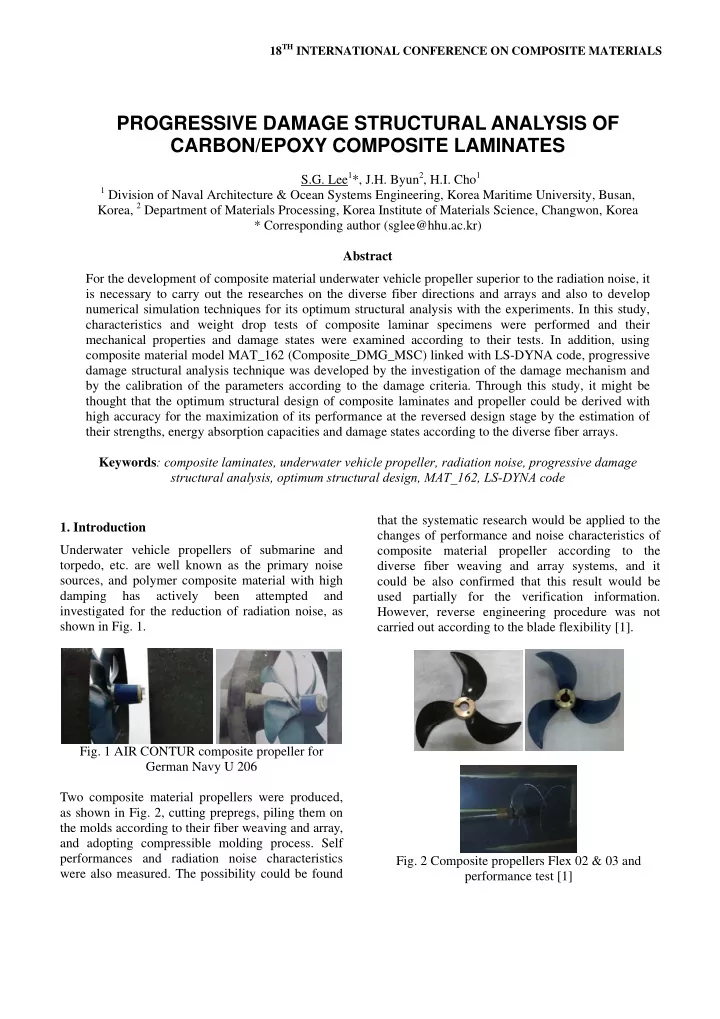
Underwater vehicle propellers of submarine and torpedo, etc. are well known as the primary noise sources, and polymer composite material with high damping has actively been attempted and investigated for the reduction of radiation noise, as shown in Fig. 1.
- Fig. 1 AIR CONTUR composite propeller for
German Navy U 206 Two composite material propellers were produced, as shown in Fig. 2, cutting prepregs, piling them on the molds according to their fiber weaving and array, and adopting compressible molding process. Self performances and radiation noise characteristics were also measured. The possibility could be found that the systematic research would be applied to the changes of performance and noise characteristics of composite material propeller according to the diverse fiber weaving and array systems, and it could be also confirmed that this result would be used partially for the verification information. However, reverse engineering procedure was not carried out according to the blade flexibility [1].
- Fig. 2 Composite propellers Flex 02 & 03 and
performance test [1]
PROGRESSIVE DAMAGE STRUCTURAL ANALYSIS OF CARBON/EPOXY COMPOSITE LAMINATES
S.G. Lee1*, J.H. Byun2, H.I. Cho1
1 Division of Naval Architecture & Ocean Systems Engineering, Korea Maritime University, Busan,