Prognostics for Systems Health Management - Model and Hybrid Based - - PowerPoint PPT Presentation

prognostics for systems health management model and
SMART_READER_LITE
LIVE PREVIEW

Prognostics for Systems Health Management - Model and Hybrid Based - - PowerPoint PPT Presentation

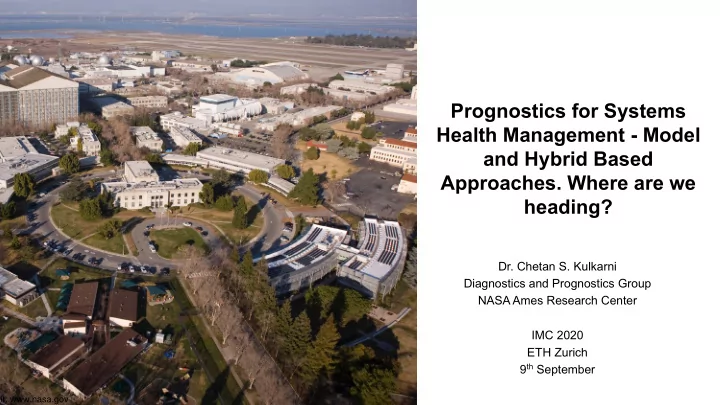
Prognostics for Systems Health Management - Model and Hybrid Based Approaches. Where are we heading? Dr. Chetan S. Kulkarni Diagnostics and Prognostics Group NASA Ames Research Center IMC 2020 ETH Zurich 9 th September Credits: NASA dit:


slide-1
SLIDE 1

Prognostics for Systems Health Management - Model and Hybrid Based

  • Approaches. Where are we

heading?

  • Dr. Chetan S. Kulkarni

Diagnostics and Prognostics Group NASA Ames Research Center IMC 2020 ETH Zurich 9th September

Credits: NASA

dit: www.nasa.gov

slide-2
SLIDE 2

Acknowledgement

Research Team – Diagnostics and Prognostics Group – NASA Ames Research Center Collaborators

  • Prof. Olga Fink, Manuel Chao – ETH Zurich
  • Dr. Kai Goebel – PARC
  • Prof. Felipe Viana, Renato Nascimento -

University of Central Florida

Credits: NASA

dit: www.nasa.gov

slide-3
SLIDE 3

! "#$%&'()*+$(#'&'$(,-./0#*1.'(&0(.(+0*/&2.&0)'0/3*'(/&0.#*$4*&'10,

  • ./0#*1.'(&0(.(+0

! 5%&'1.667*/+80#96'()*1.'(&0(.(+0 ! 5%&'1.667*%6.(('()*4$2*/%.20*+$1%$(0(&/ ! :0+$(4')92'()*&80*/7/&01*&$*.;$'#*9/'()*&80*+$1%$(0(&*-04$20*'&*4.'6/ ! <2$6$()'()*+$1%$(0(&*6'40*-7*1$#'47'()*8$=*&80*+$1%$(0(&*'/*9/0# ! 5%&'1.667*%6.(*$2*20%6.(*.*1'//'$( ! >7/&01*$%02.&'$(/*+.(*-0*$%&'1'?0#*'(*.*;.2'0&7*$4*=.7/

!"#$%#&'()&

slide-4
SLIDE 4

Credit: www.nasa.gov Credit: www.nasa.gov

slide-5
SLIDE 5

Credit: www.nasa.gov Credit: www.nasa.gov

slide-6
SLIDE 6

Credit: www.nasa.gov Credit: www.nasa.gov

slide-7
SLIDE 7

*+"",%'-.'/',-#0-'1,-2"'

Q Results tend to be intuitive Q Models can be reused Q If incorporated early enough in the design process, can drive sensor requirements Computationally efficient to implement Q Model development requires a thorough understanding of the system Q High-fidelity models can be computationally intensive Q Easy and Fast to implement Q May identify relationships that were not previously considered Q Requires lots of data and a “balanced” approach” Q Results may be counter(or even un-)intuitive Q Can be computationally intensive, both for analysis and implementation computationally intensive computationally intensive

! Paris-Erdogan Crack Growth Model ! Taylor tool wear model ! Corrosion model ! Abrasion model

and implementation and implementation

! Regression analysis ! Neural Networks (NN) ! Bayesian updates ! Relevance vector machines (RVM)

slide-8
SLIDE 8

Model-based prognostics

xk = Axk−1 + Buk−1 + wk−1 yk = Hxk + vk

Kalman Filter Health State Forecasting RUL Computation RUL(tp) {˜ α, ˜ β} D2 ˆ x(tp) {y(t0), . . . , y(tp)} {ˆ x(tp+1), . . . , ˆ x(tp+N)}

Failure Threshold

Accelerated Aging Degradation Modeling

Training Trajectories Test Trajectory

Parameter Estimation State-space Representation Prognostics

Dynamic System Realization Health State Estimation RUL Estimation { ˜ αi, ˜ βi} D D

! State vector includes dynamics of normal and degradation process

Offline Online

! EOL defined at time in which performance variable cross failure threshold

R(tp) = tEOL − tp

slide-9
SLIDE 9

! Tracking of health state based on measurements ! Forecasting of health state until failure threshold is crossed ! Compute RUL as function of EOL defined at time failure threshold is crossed

Model-based prognostics

110 120 130 140 150 160 170 180 190 5 10 15 20 Measured Filtered Predicted 110 120 130 140 150 160 170 180 190 5 10 15 20 110 120 130 140 150 160 170 180 190 5 10 15 20 110 120 130 140 150 160 170 180 190 5 10 15 20 Aging time (hr)

tp=116 tp=139 tp=149 tp=161

slide-10
SLIDE 10

Algorithm and Model Development TRL

TRL1 TRL2 TRL3 TRL4

slide-11
SLIDE 11

!"#$%&'()'"*&%&+(,&-'*./%&+(0$/1%#1( 0"*"2'3'* 4&-'*13"&-%&+("&-()'"*&%&+(,&-'*./%&+(( 5$/1%#1((67*(8720.'9(:/13'21

!"#$%&'"()*+,*-./'- 0.1/2*/*2(0'-/(3.4( !"#$%&'"()*+,*-./'-

slide-12
SLIDE 12

!"#$%&'()'"*&%&+(,&-'*./%&+(0$/1%#1( 0"*"2'3'* 4&-'*13"&-%&+("&-()'"*&%&+(,&-'*./%&+(( 5$/1%#1((67*(8720.'9(:/13'21

!"#$%&'"()*+,*-./'- !"#$%&'"()*+,*-./'- 0.1/2*/*2(0'-/(3.4(

slide-13
SLIDE 13

+

slide-14
SLIDE 14

!"(#"-3#"4

Overall architecture of the residual-based hybrid diagnostics (Rausch et al., 2005). (Hanachi et al., 2017).

slide-15
SLIDE 15

5,,6-7,/"%(%$-8-!19&()&-:#;,<-*/<(="/'(#%

IO'")..$)"4&0('4(-"'$2H$(&'$&PF"05$8"21*23(043$H");'R2"/$ H-30*1$8&P3043MF)3'5$)*5$5''8$.')"*0*1$;25'.3#$ Calibration Policy

Yuan Tian, Manuel Arias Chao, Chetan Kulkarni, Kai Goebel, Olga Fink, “Real-Time Model Calibration with Deep Reinforcement Learning”, arXiv:2006.04001

Manuel Arias Chao, Chetan Kulkarni, Kai Goebel, Olga Fink, “Fusing Physics-based and Deep Learning Models for Prognostics”, arXiv:2003.00732

slide-16
SLIDE 16

Physics + RNN

Overall architecture of the physics-informed recurrent neural network

  • Y. A. Yucesan and F. A. C. Viana, "A physics-informed neural network for wind turbine main bearing fatigue," International Journal of Prognostics and

Health Management, Vol. 11 (1), 2020. (ISSN: 2153-2648).

Physics-informed neural network framework for main bearing fatigue and grease degradation

Nascimento, R. G., & Viana, F. A. (2019). Fleet prognosis with physics-informed recurrent neural networks. In Structural health monitoring 2019: Enabling intelligent life-cycle health management for industry internet of things (iiot) - proceedings of the 12th international workshop on structural health monitoring (Vol. 2, pp. 1740–1747).

slide-17
SLIDE 17

Next Steps : Looking Ahead

Credit: www.nasa.gov

slide-18
SLIDE 18

>,?'-.',6&-@-7##4(%$-21,/;

  • High Model Granularity
  • Onboard/DM
  • Computational cost
  • Real time
  • System Complexity
  • Available Data

ML/Data Driven Physics Based

slide-19
SLIDE 19

>,?'-.',6&-@-7##4(%$-21,/;

Q +P3(';$%2;8.'S0(P Q T2R$>25'.$7")*-.)"0(P Q !)()$+8'4("-;$)O)0.)F0.0(P Q IHH.0*'UI*.0*' Q %2;8-()(02*).$423(

Physics Based ML/Data Driven

slide-20
SLIDE 20

! Prognostics helps enable

; Systems safe and efficient ; Decision making

! Hybrid Approaches

; Physics based methods can be combined with machine learning to determine and evaluate models for complex physical systems.

! High Fidelity simulation ! Field and Tests

; These models enable in verification and validation for autonomy in shorter period of time than current state of the art.

! Computational tools are two slow.

; With availability of test and field data, machine learning able to blend the digital data fabric for model update ; Uncertainty Quantification

! Framework still in early stages and needs maturation ! Requirements for autonomous systems

*#%)<+;(%$-A,B/"4&

!"

slide-21
SLIDE 21

Thank You

chetan.s.kulkarni@nasa.gov https://ti.arc.nasa.gov/tech/dash/groups/pcoe/