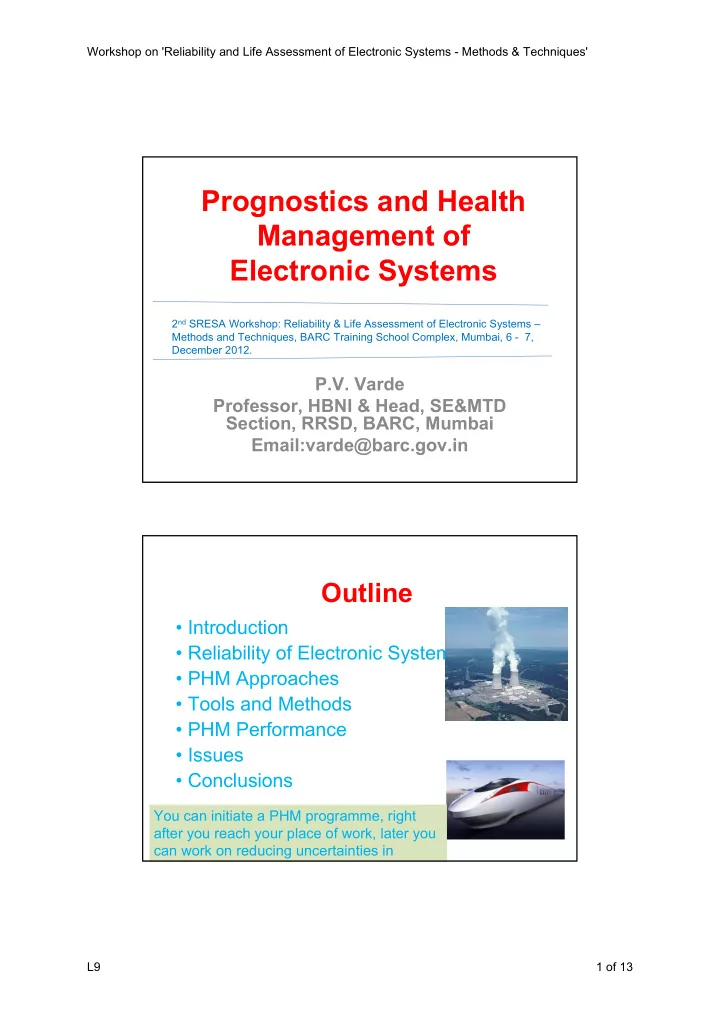
Prognostics and Health Management of Electronic Systems 2 nd SRESA - - PDF document

prognostics and health management of electronic systems
SMART_READER_LITE
LIVE PREVIEW

Prognostics and Health Management of Electronic Systems 2 nd SRESA - - PDF document

Workshop on 'Reliability and Life Assessment of Electronic Systems - Methods & Techniques' Prognostics and Health Management of Electronic Systems 2 nd SRESA Workshop: Reliability & Life Assessment of Electronic Systems Methods and


slide-1
SLIDE 1

Prognostics and Health Management of Electronic Systems

P.V. Varde Professor, HBNI & Head, SE&MTD Section, RRSD, BARC, Mumbai Email:varde@barc.gov.in

2nd SRESA Workshop: Reliability & Life Assessment of Electronic Systems – Methods and Techniques, BARC Training School Complex, Mumbai, 6 - 7, December 2012.

Outline

  • Introduction
  • Reliability of Electronic Systems
  • PHM Approaches
  • Tools and Methods
  • PHM Performance
  • Issues
  • Conclusions

You can initiate a PHM programme, right after you reach your place of work, later you can work on reducing uncertainties in

Workshop on 'Reliability and Life Assessment of Electronic Systems - Methods & Techniques' L9 1 of 13

slide-2
SLIDE 2

What the loud and fatal accidents whisper ....

  • The Washington Post - June 26, 2009
  • A Metro Train Control System Fails a Post-

Crash Test - Deadliest Crash in Metrorail History

  • Two Red Line Metrorail trains crashed June

22, 2009 between the Fort Totten and Takoma Park stations, killing nine, including one train

  • perator.
  • A train control system that should have

prevented Monday's deadly Metro crash failed in a test conducted by federal investigators,

  • fficials said yesterday, suggesting that a

crucial breakdown of technology sent one train slamming into another.

  • Metro Crash Investigation Turns Up

Electronic Control 'Anomalies‘

  • Federal investigators said yesterday that

they found "anomalies" in a key component

  • f the electronic control system along the

Metro track north of Fort Totten, suggesting that computers might have sent one Red Line train crashing into another.

Train Accident Target: To achieve reduction in rate

  • f accidents per million train kilometers from the

present level of 0.44 to 0.17 by the year 2013

In the last 10 years (1994-2004) on Indian Railways, 62% of the accidents have been caused due to failure of Railway staff, 22% have been caused due to failure of other than Railway staff, failure of equipment has contributed 8%, sabotage has contributed 3% and balance 5 % have been contributed by miscellaneous reasons.

More and more automation is required to prevent the human errors.

Most of the accidents due to human error are preceded by failure of asset.

Rail Transport

Workshop on 'Reliability and Life Assessment of Electronic Systems - Methods & Techniques' L9 2 of 13

slide-3
SLIDE 3

March 9, 1985 Athens, Alabama, USA; Instrumentation systems malfunction during start-up, which led to suspension of operations at all three Browns Ferry Units. Resulting Loss of 1.83 millions Manche, France - 21 Jan 2002: Control systems and safety valves fail after improper installation of condensers, forcing a two-month shutdown, - Wikipedia database, Loss 102 Million dollar Level 1 PSA Shows that Impact factor of Instrumentation on Plant Safety is very High compared to other safety and process systems

Nuclear Systems

Electronic devices may cause plane crashes - and older aircraft are especially vulnerable By DAILY MAIL REPORTER UPDATED: 17:29 GMT, 21 January 2011 Investigation: There is no definitive way to tell the effects of electronic device on aircraft instruments but it thought to be a factor in several crashes

Causes Of Aviation Accidents Pilot error and mechanical failures are by far the most common causes of aviation accidents. Other common causes of these devastating accidents include bad weather, air traffic control error, bird strikes, fires in the cargo hold or cabin, design flaws, sabotage, fuel starvation, high jacking, lighting problems, and pilot incapacitation. It is estimated that approximately 80 percent of commercial aviation accidents

  • ccur shortly before, during or after takeoff or landing. The

chance of a mid-flight collision is far more remote but these incidents do occur.

Aviation

Workshop on 'Reliability and Life Assessment of Electronic Systems - Methods & Techniques' L9 3 of 13

slide-4
SLIDE 4

Space electronics - Failure is not an option

Indian rocket explodes after take-off

Live television images showed the rocket exploding into plumes of smoke and fire less than a minute after it launched from the Sriharikota space center in Andhra Pradesh state this afternoon. The Indian Space Reserach Organisation said it believed the explosion was caused by an electronic failure seconds after take-off that led to the flight taking a higher angle. 11:02PM GMT 25 Dec 2010 http://www.telegraph.co.uk

Space

Similar other consequences …

On June 10th, 1999 a 16-inch diameter steel pipeline operated by the now-defunct Olympic Pipeline Co. ruptured near Bellingham, Washington, flooding two local creeks with 237,000 gallons of gasoline. The gas ignited into a mile-and-a-half river

  • f fire that claimed the lives of two 10-year-old boys and an 18-

year-old man, and injured eight others. Electronic-voting system failures lead to call for public clearinghouse - FCW: The business of federal technology , Sept. 15, 2010 A NEWLY INSTALLED electronic voting and microphone system at the Scottish Parliament crashed yesterday just before MSPs were about to cast their votes on the day's business. The £270,000 system, put in over the summer recess, went down minutes after …..

Workshop on 'Reliability and Life Assessment of Electronic Systems - Methods & Techniques' L9 4 of 13

slide-5
SLIDE 5

Reliability Prediction for Electronics

  • Qualification / Testing of

Components

  • Handbook Approaches

(e.g. MIL-217 series, etc)

  • System Specific Data
  • Physics-of Failure
  • Prognostics and Health Management

What is PHM

There are two elements of PHM “Prognostics” and “Health Management” Prognosis deals with prediction of Reliability of components /

products /systems considering life cycle loads postulated for actual conditions. The scope of prognostics covers sensing, recording, analysis considering

  • perational profile and assessment of health. The assessment of degradation

trends by precursor parameter monitoring over the life cycle of the components and predicting the incipient fault well in advance.

Health Management deals with optimizing & scheduling the

surveillance & test interval preventive maintenance management / condition monitoring programme keeping in view operational and safety objectives

Workshop on 'Reliability and Life Assessment of Electronic Systems - Methods & Techniques' L9 5 of 13

slide-6
SLIDE 6

Why PHM

  • Systems are becoming more and more

complex and miniaturised

  • automatic fault prediction
  • Recovery
  • Even though Safety is overriding aspects in

the open competitive market plant and system performance are critical factors to meet the bottom line

  • Advance health management can provide

required safety and availability targets

PHM – An Overview

Electronic / Control System Identified for PHM On-line Sensors for tracking precursor paramete r Design and Operation (Surveillan ce and CM) Data Prognostic Algorithms Pre- Parameter Time FT H

Legends : FTH : Failure Threshold PM : Preventive Maint. CM Condition Monitoring

Engineeri ng Statistical Analysis Life Prediction ttf Test / PM. / CM Strategies Level -1 Prognostics Level -1 Prognostics Health Manageme nt

  • Advanced warning
  • f failures
  • Fault detection and

identification

  • Stress profile

generation for design at conceptual design

Workshop on 'Reliability and Life Assessment of Electronic Systems - Methods & Techniques' L9 6 of 13

slide-7
SLIDE 7

How it works – is Monitoring the trick..

Life Consumption Time Designed Life Failure Life Consumption Designed Life Failure Life Consumption Failure D e s i g n e d s e v e r i t y H i g h s e v e r i t y

Potential Risk without monitoring

Actual Life Actual Life Designed Life Designed low severity Loss of useful life

CALCE Approach to PHM

Workshop on 'Reliability and Life Assessment of Electronic Systems - Methods & Techniques' L9 7 of 13

slide-8
SLIDE 8
  • Fuses are the traditional devices used to protect the electronic circuit from overloads

and transients

  • Similarly Relay based protections devices also used in modern electronic / electrical

systems

  • Monitoring and reasoning approach is very close to cognitive reasoning for in

incipient failure

  • The physics-of-failure and damage modelling approach aims to predicting the

remaining useful life based on the trend in precursor parameter indicating of level of degradation

Prognostics / PHM Implementation Fuses and Canaries Monitoring and reasoning Physics-of- Failure / Damage modelling Monitoring environment Monitoring Usage Conditions Selecting of Precursor parameter Life cycle loads : Thermal : temperature .. Mechanical: vibration, shock, stress… Chemical : Chemical environment … Physical: radiation, electromagnetic interference, EMPs Electrical: current , voltage, power, …

PHM Sensors

  • Sensor types: Thermal, Mechanical,

Humidity, Chemical Optical, Magnetic Sensor System: may be comprised of sensor element,

  • nboard

A/D convertor and memory, embedded computational capability, data transmission and power source. (Often WSN may be preferred) Sensor Performance: Accuracy, linearity, precision, response time, stabilization time, measurement range, etc. Specific Issues: very low resistance of the order of milli-ohms measurements require special arrangement / set up that too in on-line mode for series of contacts – It requires designing a circuit for this purpose.

Pt-100 miniature temperature sensors Thin Film Detector - Flat Pt100 Elements and Surface Probes

Workshop on 'Reliability and Life Assessment of Electronic Systems - Methods & Techniques' L9 8 of 13

slide-9
SLIDE 9

Failure precursor for electronics

Switching PS: DC current, Ripple, Pulse width duty cycle, Efficiency, feedback voltage and current levels, Leakage current, RF noise Cable and Connectors : Change in Impendence, Physicall damage / oxide deposition, change in contact resistance Electrolytic Capacitor: Leakage current / resistance, Dissipation factor, RF noise, Ripples CMOS IC : Supply leakage current, supply current veriation, Operating signature, Current noise, Logic level variations General Purpose Diod : Reverse leakage current, forward voltage drop, thermal resistance, power dissipation and RF noise

Approaches

Prognostics and health management for electronic systems aims to detect, isolate and predict the onset and source of degradation as well as time to system failure

PHM PoF Data Driven Integrated Probabilisti c Machine Intelligence

Workshop on 'Reliability and Life Assessment of Electronic Systems - Methods & Techniques' L9 9 of 13

slide-10
SLIDE 10

PHM for Nuclear Plants

  • Design &

P erforma nce Data

  • F

ailure characteri zation for S S C s On-line Data Acquisition Nuclear P lant Monitoring / S urveillance / diagnostics /C

  • ndition

Monitoring/ C

  • rrective

Action c P HM S ensors P rognostic Algorithms

  • P

robabilistic Models

  • P
  • erf. T

rend /patterns

  • P
  • F/ MoF
  • Integrated approach

F ME C A

  • Ident. & prion. of S

S C s P R A Degradation models P rediction T

  • ols
  • Bayesian Updating
  • ANN or S

VMs

  • K

alman filtering

  • P

article F iltering

  • S

P R T R eal-time Life / R eliability P rediction Input for R isk- based health management techniques Optimization of P rognostics P erformance indicators Existing Surveillan ce Setup in NPPs LCO

R eference Material P roperties and construction & geometric features O & M Data (P

  • stulated for

new and record for old components

Define item / comp. and identify elements and functions to be analyzed Identify potential failure modes Identify potential failure causes Identify potential failure mechanisms Identify failure models P rioritize the failure mechanisms

E stimated life cycle loads & Irradiation (n, ) dose R emaining useful life estimation Use C anary devices C hoose critical failure mechanisms and failure site Monitor life cycle environment and

  • perating loading

C

  • nduct data

reduction and load feature extraction

Physics-of-Failure

Workshop on 'Reliability and Life Assessment of Electronic Systems - Methods & Techniques' L9 10 of 13

slide-11
SLIDE 11

Data Driven

Probabilistic / Statistical Approach Symptom Based Approach

Trend monitoring Degradation trend – precursor monitoring Pattern Driven Knowledge Based Approach Maximum Likelihood Estimation Bayesian Estimation Chi-Square test

Machine Learning

Artificial Neural Netwrok Support Vector Machines Basic idea is to extract features

  • f precursor parameters so that

remaining life can be predicted Prognosti c Distance

PHM Performance Metrics

Precisio n The time when the prognosis predicts / detection incipient failure till time when the component fails is called prognostic distance. Prognosti c Distance Prediction pdf Actual failure pdf Accurac y Accuracy means correctness of the remaining life estimates. the correctness of the prediction of time determines the accuracy of prediction The width of the uncertainty band determines the precision of the

  • estimates. The shorter the band the

higher is the prediction and wider band carries low precision. Time

Workshop on 'Reliability and Life Assessment of Electronic Systems - Methods & Techniques' L9 11 of 13

slide-12
SLIDE 12

Limitation of the Prognostics Methods

Even though prognostics has evolved into a relatively new paradigm with applications into areas like space, aircraft and structural engineering, the development and deployment of prognostics in NPPs is very limited [40], this is particularly true for structural components. This because there are certain issues that need to be addressed and this calls for R&D efforts. Major challenges in implementation of prognostics are:

  • Sensor and associated network
  • Tin Whisker modelling
  • PoF / Damage models and failure criteria
  • Reliability of Lead-free solders
  • Uncertainty Characterization
  • Organizational framework

Whisker growth on Connector

Tin "Whisker”growing between pure tin-plated hook terminals of an electromagnetic relay

taf Time t0 tm td tep tmg taf= Time for actual failure (hypothetical estimate) t0 = 0; Time when component was put in service after test or maintenance td= detection of deviation by P rognostic algorithm tm= E poch of time when maintenance / recovery should complete tap= E arly prediction tmg - taf= Time available for repair / recovery /mitigation (referred as plant coping time) = B tm - td= Time required for reconfiguration / recovery action = A Time C DP Increase in C DP P rognostic Distance B=S afety Margin without P rognostic C =E nhanced S afety Margin with P rognostic td - tmg= Time available for repair / recovery /mitigation (referred as plant coping time)=C A=Time for advance recovery A B C AO T

PHM Performance Model

Workshop on 'Reliability and Life Assessment of Electronic Systems - Methods & Techniques' L9 12 of 13

slide-13
SLIDE 13

Major Set up Required to initiate a PHM Programme include:

Probabilistic / Statistical Analysis tool: Reliability analysis software, Design of Experiment Software Simulation Tools : Finite Element Software and Work Bench, Thermal analysis tool, Intelligent Tools : Artificial Neural Network, Support Vector Machine, Genetic Algorithm, Sequential Probability Ratio Test Software, Finite Element Software and Work Bench, Thermal analysis tool, Life Testing Facility: Accelerated Life Test and Thermal Cycling Chambers, Shaker Vibration test facility, Life Testing Software, Power Supplies and fixtures Micro-structure analysis : Optical Microscope, Scanning Electron Microscope, ..... For Root Cause Analysis , De-capsulation systems: Laser Etching, Chemical Etching facility Semiconductor parameter analyser, x-ray three – D tomography

Conclusions

  • The Complexities of the current generation system coupled with commutative market conditions

require that PHM technique should form integral part of system surveillance to meet safety and availability objectives.

  • In a system if human failure dominates the accident scene than it is clear indication to go for

automation and implementation of prognostics and diagnostics features for advanced warning and recovery

  • Extensive work is being done in Defence, Aviation, Space systems, etc, in nuclear plants

FITs based diagnostic features are extensively being used, however, prognostics are yet to find applications.

  • Focussed efforts are required in PoF and Damage modelling to reduce uncertainty in

prediction

  • Effective implementation of PHM can be realised only through organizational mandate.
  • Effective implementation of PHM can be realised only through organizational mandate.
  • Keeping in view the Nuclear Plant Control System Requirements a PHM Lab is being set

up in Reactor Group as part of 12th plan project. A budget of around 1 $million is earmarked.

  • IEEE Standards on PHM is expected to provide an effective reference for implementation
  • f PHM

Workshop on 'Reliability and Life Assessment of Electronic Systems - Methods & Techniques' L9 13 of 13