PROFITABLE ALTERNATIVE WORK PROGRAMS By Rick Albiero & Jennifer - - PDF document

profitable alternative work programs
SMART_READER_LITE
LIVE PREVIEW

PROFITABLE ALTERNATIVE WORK PROGRAMS By Rick Albiero & Jennifer - - PDF document

PROFITABLE ALTERNATIVE WORK PROGRAMS By Rick Albiero & Jennifer Verive For the NHRMA 71 st Annual Conference & Tradeshow This handout is a companion to the slide handout, providing more detailed content and information for some of the


slide-1
SLIDE 1

PROFITABLE ALTERNATIVE WORK PROGRAMS

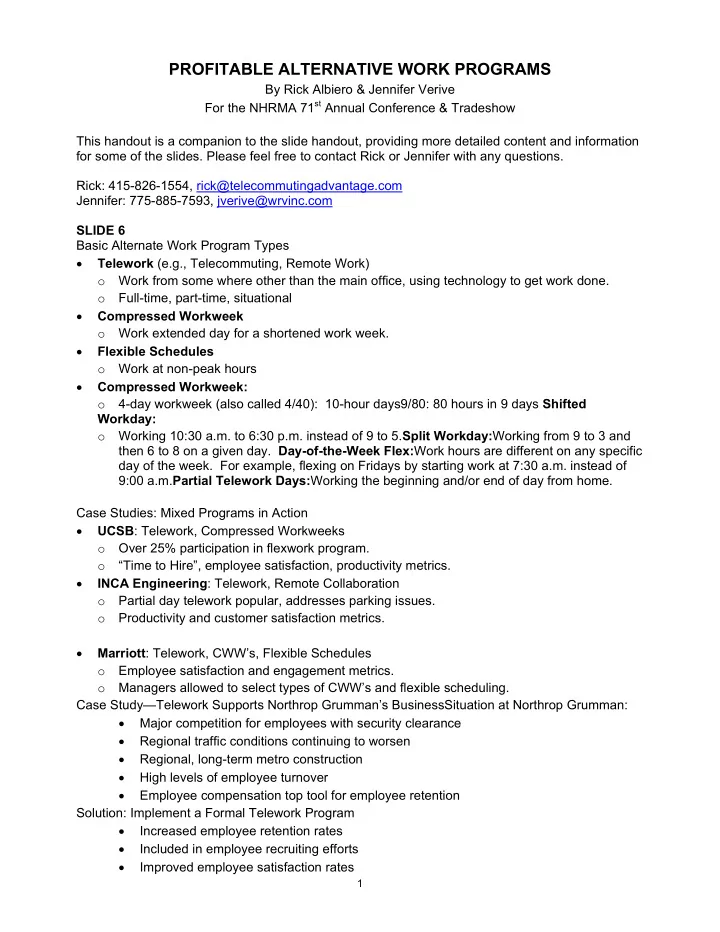
By Rick Albiero & Jennifer Verive For the NHRMA 71st Annual Conference & Tradeshow This handout is a companion to the slide handout, providing more detailed content and information for some of the slides. Please feel free to contact Rick or Jennifer with any questions. Rick: 415-826-1554, rick@telecommutingadvantage.com Jennifer: 775-885-7593, jverive@wrvinc.com SLIDE 6 Basic Alternate Work Program Types

  • Telework (e.g., Telecommuting, Remote Work)
  • Work from some where other than the main office, using technology to get work done.
  • Full-time, part-time, situational
  • Compressed Workweek
  • Work extended day for a shortened work week.
  • Flexible Schedules
  • Work at non-peak hours
  • Compressed Workweek:
  • 4-day workweek (also called 4/40): 10-hour days9/80: 80 hours in 9 days Shifted

Workday:

  • Working 10:30 a.m. to 6:30 p.m. instead of 9 to 5.Split Workday:Working from 9 to 3 and

then 6 to 8 on a given day. Day-of-the-Week Flex:Work hours are different on any specific day of the week. For example, flexing on Fridays by starting work at 7:30 a.m. instead of 9:00 a.m.Partial Telework Days:Working the beginning and/or end of day from home. Case Studies: Mixed Programs in Action

  • UCSB: Telework, Compressed Workweeks
  • Over 25% participation in flexwork program.
  • “Time to Hire”, employee satisfaction, productivity metrics.
  • INCA Engineering: Telework, Remote Collaboration
  • Partial day telework popular, addresses parking issues.
  • Productivity and customer satisfaction metrics.
  • Marriott: Telework, CWW’s, Flexible Schedules
  • Employee satisfaction and engagement metrics.
  • Managers allowed to select types of CWW’s and flexible scheduling.

Case Study—Telework Supports Northrop Grumman’s BusinessSituation at Northrop Grumman:

  • Major competition for employees with security clearance
  • Regional traffic conditions continuing to worsen
  • Regional, long-term metro construction
  • High levels of employee turnover
  • Employee compensation top tool for employee retention

Solution: Implement a Formal Telework Program

  • Increased employee retention rates
  • Included in employee recruiting efforts
  • Improved employee satisfaction rates

1

slide-2
SLIDE 2
  • Long-term goal of reducing new office-space needs
  • They relate to short, mid-, and long-term bottom-line goals.
  • Quantifying metrics provides major ROI
  • They’re specific to each organization. Want to match income opportunity ot organization issues,

program goals, & strategic vision.

  • They encourage formal, committed sources of funding and support within the organizational

culture. SLIDE 17

  • B. Metrics Get Buy-in
  • From Executives:
  • ROI and resolving issues motivates executives.
  • From Managers:
  • Input and measurement provides control as managers learn how AWP will support their

workgroup goals and allow them to maintain control over employees.

  • From Employees:
  • Metrics help “prove” employee is thriving.

SLIDE 20

  • C. Metrics Must Be Specific

What metrics are the most important to your organization?

  • Customer Satisfaction:
  • Percentage of repeat customers pre/post AWP
  • Employee Retention:
  • Number of open positions pre/post AWP
  • Workgroup Performance (Quality):
  • Number of complaints pre/post AWP

What numbers does your organization track?

  • Employee retention, recruiting costs, overhead costs.
  • Employee opinion surveys, PeopleSoft, benchmarking.
  • Other initiatives/programs you can piggy back off?

SLIDE 21 Examples of Tangible Metrics

  • Employee-Retention and Recruiting
  • Employee satisfaction survey and employee retention.
  • Employee recruiting costs and “time to hire”.
  • Real-Estate
  • Lease costs, potential rent, new buildings.
  • Real-estate flexibility.Overhead Costs
  • Costs of supporting employees at their desks
  • Parking and other facilities costs
  • Productivity
  • Output, creativity, quality

SLIDE 22 Examples of Intangible Metrics

  • Best Company” Lists/“Good Citizen” Status
  • Employee referrals & Applications submitted

2

  • Awards, article mentions, community recognition
slide-3
SLIDE 3
  • Employee Morale
  • Customer surveys
  • Employee surveys
  • HR complaints / grievances
  • Employee Effort
  • Time, energy saved getting to the workplace.

SLIDE 23 Case Studies: Choosing Metrics

  • UCSB – “Time to Hire” Recruiting Metric
  • TAC Engineering – Travel Cost Reductions
  • LUMEDX – Reduced Absenteeism
  • Inova Health – Reduced Parking Needs
  • Kaiser Permanente – Reduced Overhead Costs
  • City of Santa Barbara – Extended Office Hours
  • Marriott – Increased Employee Engagement

SLIDE 27 #2 Manager Concern: How Do I Stay In Control? Use a formal program, with clear policies and procedures, to provide managers control and support.

  • Employee Aspects of a Formal Program
  • Contract between employee and manager
  • Addressing individual strengths and weaknesses
  • Understanding personal goals and risks
  • Management Aspects of a Formal Program
  • Managing by output rather than effort
  • Team management skills
  • Breakdown identification skills
  • Bottom-line criteria and measurement reviews
  • WorkTeam Aspects of a Formal Program
  • Communication of needed performance metrics
  • Inclusion of remote, flex-schedule employees SLIDE 28

#3 Manager Concern: What About Workgroup Cohesion? Use technology to keep everyone connected and productive.

  • A formal program supports metrics that ensure that workgroup performance is monitored:
  • Job-tasks and collaboration considered.
  • Core hours are defined and communicated.
  • Scheduling is improved:
  • Regular meetings put on a predictable routine.
  • Face to face time is maximized.
  • Virtual meeting skills are improved.

SLIDE 34 Key Components of a Communication Plan

  • Define the “AWP Message”.
  • May have variations by stakeholder

3

slide-4
SLIDE 4
  • Set expectations for current phase of program
  • Identify specific methods and opportunities for communicating.
  • Brown bag lunches, corporate memo, web site, departmental meetings
  • Create a communication schedule.

SLIDE 35 Communication Model Phase 1: Investigation

  • The “AWP Message”:
  • What goals for the employees and organization are being investigated?
  • How are you investigating? (Project team, surveys)
  • Timeline and how decision will be made.
  • Methods for Communicating:
  • Ensure that you reach all employees.
  • Reiterate that it is an investigation phase.
  • Communication Schedule:
  • Prior to first effort to collect data from employees.
  • Report results of investigation to all employees.

SLIDE 36 Communication Model Phase 2: Design

  • The “AWP Message”:
  • Are you conducting a pilot or a full rollout?
  • Where will they access information on the program?
  • What training, tools and support will be provided?
  • Methods for Communicating:
  • Ensure that you reach all employees.
  • Messages from executive management showing support.
  • Messages from direct managers reiterating support.
  • Communication Schedule:
  • Multiple channels prior to launch.
  • On-line information, AWP portal preferred.

SLIDE 37 Communication Model Phase 3: Implementation

  • The “AWP Message”:
  • If it is a pilot what is the schedule?
  • Who can apply and when?
  • Gather ongoing metrics data.
  • Methods for Communicating:
  • Ensure that you reach all employees.
  • Messages from executive management showing support.
  • Messages from direct managers reiterating support.
  • Communication Schedule:
  • Direct manager communication prior to launch.
  • On-line information, AWP portal preferred.

SLIDE 38 Communication Model Phase 4: Support & Growth

4

slide-5
SLIDE 5

5

  • The “AWP Message”:
  • Is the program meeting its metrics goals?
  • Who is participating?
  • Methods for Communicating:
  • Periodical information about program via internet or newsletters.
  • Communication Schedule:
  • On-line information, AWP portal preferred.

SLIDE 39 Profitable AWPs are based on:

  • Choosing the right AWP mix for the organization.
  • Linking program goals to business goals.
  • Developing relevant, believable metrics.
  • Using metrics to gain managerial buy-in.
  • Implementing a formal program.
  • Assessing jobs, employees, & technology.
  • Communicating thru all program phases.