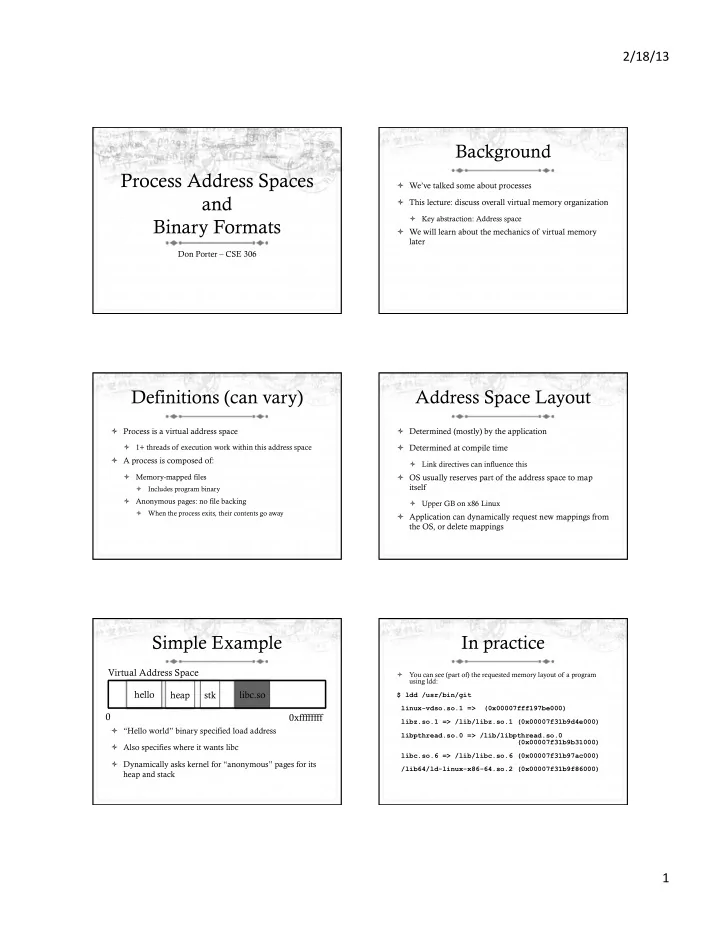

2/18/13 ¡ 1 ¡
Process Address Spaces and Binary Formats
Don Porter – CSE 306
Background
ò We’ve talked some about processes ò This lecture: discuss overall virtual memory organization
ò Key abstraction: Address space
ò We will learn about the mechanics of virtual memory later
Definitions (can vary)
ò Process is a virtual address space
ò 1+ threads of execution work within this address space
ò A process is composed of:
ò Memory-mapped files
ò Includes program binary
ò Anonymous pages: no file backing
ò When the process exits, their contents go away
Address Space Layout
ò Determined (mostly) by the application ò Determined at compile time
ò Link directives can influence this
ò OS usually reserves part of the address space to map itself
ò Upper GB on x86 Linux
ò Application can dynamically request new mappings from the OS, or delete mappings
Simple Example
Virtual Address Space 0xffffffff hello libc.so heap
ò “Hello world” binary specified load address ò Also specifies where it wants libc ò Dynamically asks kernel for “anonymous” pages for its heap and stack
stk
In practice
ò You can see (part of) the requested memory layout of a program using ldd: $ ldd /usr/bin/git linux-vdso.so.1 => (0x00007fff197be000) libz.so.1 => /lib/libz.so.1 (0x00007f31b9d4e000) libpthread.so.0 => /lib/libpthread.so.0 (0x00007f31b9b31000) libc.so.6 => /lib/libc.so.6 (0x00007f31b97ac000) /lib64/ld-linux-x86-64.so.2 (0x00007f31b9f86000)