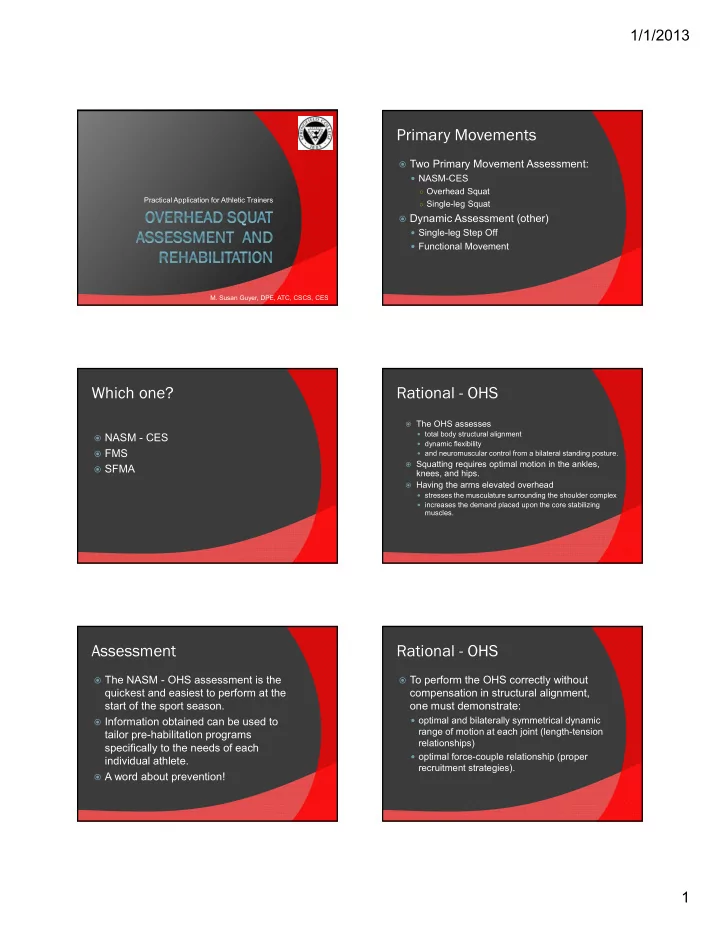
Primary Movements Two Primary Movement Assessment: NASM-CES - - PDF document

primary movements
SMART_READER_LITE
LIVE PREVIEW

Primary Movements Two Primary Movement Assessment: NASM-CES - - PDF document

1/1/2013 Primary Movements Two Primary Movement Assessment: NASM-CES Overhead Squat Practical Application for Athletic Trainers Single-leg Squat Dynamic Assessment (other) Single-leg Step Off Functional Movement M.


slide-1
SLIDE 1

1/1/2013 1

Practical Application for Athletic Trainers

  • M. Susan Guyer, DPE, ATC, CSCS, CES

Which one?

 NASM - CES  FMS  SFMA

Assessment

 The NASM - OHS assessment is the

quickest and easiest to perform at the start of the sport season.

 Information obtained can be used to

tailor pre-habilitation programs specifically to the needs of each individual athlete.

 A word about prevention!

Primary Movements

 Two Primary Movement Assessment:  NASM-CES

○ Overhead Squat ○ Single-leg Squat

 Dynamic Assessment (other)  Single-leg Step Off  Functional Movement

Rational - OHS

 The OHS assesses  total body structural alignment  dynamic flexibility  and neuromuscular control from a bilateral standing posture.  Squatting requires optimal motion in the ankles,

knees, and hips.

 Having the arms elevated overhead  stresses the musculature surrounding the shoulder complex  increases the demand placed upon the core stabilizing muscles.

Rational - OHS

 To perform the OHS correctly without

compensation in structural alignment,

  • ne must demonstrate:

 optimal and bilaterally symmetrical dynamic

range of motion at each joint (length-tension relationships)

 optimal force-couple relationship (proper

recruitment strategies).

slide-2
SLIDE 2

1/1/2013 2

Practicality

 Once compensations are found we will be able to

tell:

 Probable overactive muscles  Inhibit/Lengthen  Flexibility Exercises will be used

○ Self-Myofascial Release (SMR) ○ Static Stretching ○ Neuromuscular Stretching

 Probable underactive muscles  Activate/Integrate  Strengthening exercise will be used

○ Positional Isometrics ○ Isolated strengthening ○ Integrated Dynamic Movement Corrective Exercise Continuum Inhibit Lengthen Activate Integrate

Kinetic Chain Checkpoints

 Foot/Ankle  Knee  Lumbo-Pelvic-Hip

Compels (LPHC)

 Shoulder and Cervical

Spine (Upper Body)

Overhead Squat Assessment

Anterior Lateral Posterior

Set-up

 Feet straight ahead  Shoulder width apart  Arms raised above

their head as shown

Procedures

 Perform a series of

squats 5 times per view

 Squat to the depth of

an average chair height

slide-3
SLIDE 3

1/1/2013 3

Anterior View

 Kinematic check points  Feet  Knees  Feet  Should be straight ahead, 2nd metatarsal of each foot should be parallel to one another  Knees  Knees move inward  Knees move outward

Anterior View

View Anterior Checkpoint Compensation Probable Over-active Muscle Probable Under-active Muscle Feet Turn Out Soleus

  • Lat. Gastrocnemius

Biceps Femoris Tensor Fascia Lata (TFL)

  • Med. Gastrocnemius
  • Med. Hamstring

Gluteus Medius/Maximus Gracilis Popliteus Knees Move Inward Adductor Complex Bicep Femoris (short head) TFL

  • Lat. Gastrocnemius

Vastus Lateralis

  • Med. Hamstring
  • Med. Gastrocnemius

Vastus Medialis (VMO) Move Outward Piriformis Biceps Femoris TFL Gluteus Medius Gluteus Minimus Adductor Complex

  • Med. Hamstring

Gluteus Maximus

Lateral View

 Two main Checkpoints  LPHC

○ Excessive forward Lean ○ Back Rounds ○ Back Arches

 Upper body

○ Arms fall forward

Lateral View – Excessive Forward Lean

Lateral View

View Lateral Checkpoint Compensation Probable Overactive Muscle Probable Under-active Muscle Upper Body Arms Fall Forward Latissimus Dorsi Pectoralis Major/Minor Coracobrachialis Mid/Lower Trapezium Rhomboids Posterior Deltoid Rotator Cuff LPHC Excessive Forward Lean Soleus Gastrocnemius Hip Flexor complex Anterior Tibialis Gluteus Maximus Erector Spinae Low Back Arches Hip Flexor Complex Erector Spinae Latissimus Dorsi Gluteus Maximus Intrinsic Core Stabilizers Low Back Rounds Hamstrings Adducor magnus Rectus Abdominis External Obliques Gluteus Maximus Erector Spine Intrinsic Core Stabilizers

Posterior View

 Check Points  Feet

○ Flatten ○ Heels Rise

 LPHC

○ Asymmetrical Weight

Shift

slide-4
SLIDE 4

1/1/2013 4

View Posterior Checkpoint Compensation Probable Overactive Muscle Probable Under active Muscle Feet Flatten Peroneal Complex Toe extensor complex

  • Lat. Gastrocnemius

Biceps Femoris TFL Posterior Tibialis Anterior Tibialis

  • Med. Gastrocnemius

Gluteus Medius Heel Rise Soleus Gastrocnemius Anterior Tibialis LPHC Asymmetrical Weight Shift Adductor Complex (on same side of shift) TFL Piriformis Bicep Femoris Gluteus Medius (on

  • pposite side of shift)

Gluteus Medius (on side of shift) Adductor Complex (on opposite side

  • f shift)

Posterior View OHS Modifications

 Heals raised  Hands on Hips

Rational - SLS

 Assesses lower body dynamic flexibility and

neuromuscular control as well as balance form a unilateral standing position.

 Provides a grater challenge to the LPHC as the

base of support for the body has been reduced.

 This forces the core and the priprioception

mechanism to work harder.

 Also assesses functionally applicable movements

used in everyday activities.

Single-Leg Squat Assessment

 Starting Position  Feet straight ahead  Shoulder width apart  Hands on hip  Shift weight to one leg  Procedures  3 squats with hands on hips  Comfortable depth

LPHC – Hip Hike/Hip Drop

 Pelvis should remain level

in the frontal plane

 LPHC- Hip Hike or drop  Knee goes valgus

Single-Leg Step Off

 Added to OHS and SLS as a dynamic

evaluation of biomechanics and function.

 Most knee injuries occur in the valgus

knee position.

slide-5
SLIDE 5

1/1/2013 5

Right leg step off Left leg step off Functional Movement Scale

 Designed to evaluate athletic movement

  • f agility, power, speed and functional

strength

 No validity or reliability data as of date

Test

 Standing long jump  Vertical jump

Standig LJ Standing LJ

slide-6
SLIDE 6

1/1/2013 6

VJ VJ Most Common Findings

 Excessive forward lean (weak intrinsic

core)

 Knee Valgus with single leg stance

(weak gluteal region/poor balance)

 Foot Pronation (anterior/posterior tibialis

imbalance)

 Heel Rises (overactive soleus)  Correction with heal elevation (LPHC)  Erect landing (poor technique)

Excessive Forward Lean (Lateral

View)

 Overactive  Gastrocnemius  Soleus  Hip Flexor Complex  Abdominal Complex

○ Rectus abdominis

and External Oblique  Underactive  Anterior Tibialis  Gluteus Maximus  Erector Spinae  Intrinsic Core

Stabilizers

Sample Corrective Exercise Program for Excessive Forward Lean

Phase Modality Muscles(s) Acute Variables Inhibit SMR Gastrocnemius/soleus Hip flexor Complex (TFL/rectus femoris) Hold on tender area of 30 seconds Lengthen Static Stretching

  • r NMS

Gastrocnemius/soleus Hip flexor Complex 30-sec hold or 7- 10 sec. isometric contract, 30 sec. hold Activate Positional Isometrics and/or Isolated Strengthening Gluteus Maximus Core stabilizers 4 reps or increasing intensity 25, 50, 75, 100% OR 10-15 reps with 2 sec. isometric hold and 4 second eccentric Integrate Integrated Dynamic Movement Ball Wall Squat 10-15 reps under control

Knee Valgus

 Found on Anterior View

slide-7
SLIDE 7

1/1/2013 7

Foot Pronation

 Found on Posterior View

Heel Rises

 Found on Posterior View

Conclusion

 Movement assessments are the

cornerstone of an integrated assessment process

 Used to observe the length-tension

relationship, force-couple relationships, and joint motions of the entire kinetic chain.

 This process is only part of the

assessment we perform on the athletic prior to competing.

References

 NASM – CES Movement Assessment  NCAA – ISS data