Presenting a live 90-minute webinar with interactive Q&A - - PowerPoint PPT Presentation

presenting a live 90 minute webinar with interactive q a
SMART_READER_LITE
LIVE PREVIEW

Presenting a live 90-minute webinar with interactive Q&A - - PowerPoint PPT Presentation

Presenting a live 90-minute webinar with interactive Q&A Preparing Witnesses for Deposition: Overcoming Challenges With 30(b)(6) Representatives and Fact and Expert Witnesses Navigating Current Restrictions on Defending Counsel, Complying


slide-1
SLIDE 1

The audio portion of the conference may be accessed via the telephone or by using your computer's

  • speakers. Please refer to the instructions emailed to registrants for additional information. If you

have any questions, please contact Customer Service at 1-800-926-7926 ext. 10.

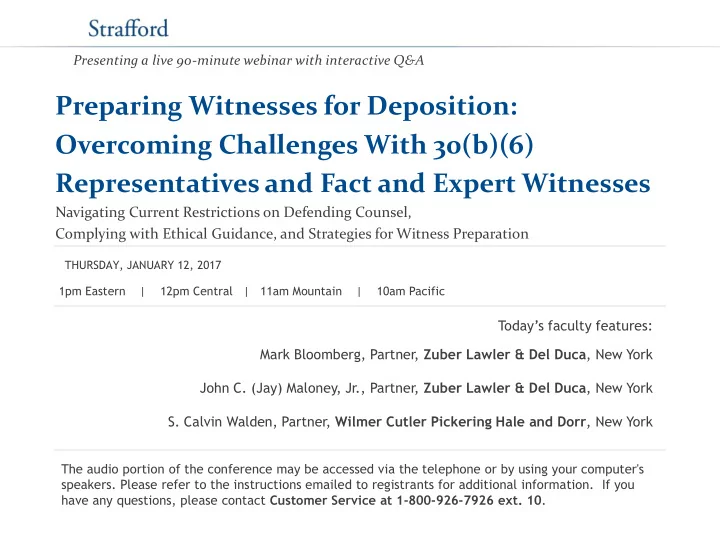
Presenting a live 90-minute webinar with interactive Q&A

Preparing Witnesses for Deposition: Overcoming Challenges With 30(b)(6) Representatives and Fact and Expert Witnesses

Navigating Current Restrictions on Defending Counsel, Complying with Ethical Guidance, and Strategies for Witness Preparation

Today’s faculty features:

1pm Eastern | 12pm Central | 11am Mountain | 10am Pacific

THURSDAY, JANUARY 12, 2017

Mark Bloomberg, Partner, Zuber Lawler & Del Duca, New York John C. (Jay) Maloney, Jr., Partner, Zuber Lawler & Del Duca, New York

  • S. Calvin Walden, Partner, Wilmer Cutler Pickering Hale and Dorr, New York
slide-2
SLIDE 2

Tips for Optimal Quality

Sound Quality If you are listening via your computer speakers, please note that the quality

  • f your sound will vary depending on the speed and quality of your internet

connection. If the sound quality is not satisfactory, you may listen via the phone: dial 1-866-869-6667 and enter your PIN when prompted. Otherwise, please send us a chat or e-mail sound@straffordpub.com immediately so we can address the problem. If you dialed in and have any difficulties during the call, press *0 for assistance. Viewing Quality To maximize your screen, press the F11 key on your keyboard. To exit full screen, press the F11 key again.

FOR LIVE EVENT ONLY

slide-3
SLIDE 3

Continuing Education Credits

In order for us to process your continuing education credit, you must confirm your participation in this webinar by completing and submitting the Attendance Affirmation/Evaluation after the webinar. A link to the Attendance Affirmation/Evaluation will be in the thank you email that you will receive immediately following the program. For additional information about continuing education, call us at 1-800-926-7926

  • ext. 35.

FOR LIVE EVENT ONLY

slide-4
SLIDE 4

Program Materials

If you have not printed the conference materials for this program, please complete the following steps:

  • Click on the ^ symbol next to “Conference Materials” in the middle of the left-

hand column on your screen.

  • Click on the tab labeled “Handouts” that appears, and there you will see a

PDF of the slides for today's program.

  • Double click on the PDF and a separate page will open.
  • Print the slides by clicking on the printer icon.

FOR LIVE EVENT ONLY

slide-5
SLIDE 5

5

STRAFFORD WEBINARS “Preparing Witnesses for Deposition: Overcoming Challenges with 30(b)(6) Representatives and Fact and Expert Witnesses”

By: John C. “Jay” Maloney, Jr., Esq. Zuber Lawler & Del Duca, LLP

  • S. Calvin Walden, Esq.

Wilmer Hale Mark H. Bloomberg, Esq. Zuber Lawler & Del Duca, LLP January 12, 2017

slide-6
SLIDE 6

6

Subjects:

I. The Importance of Planning and Preparation Based On The Type of Deposition Witness Involved II. Current Restrictions On Defending Counsel at a Deposition III. Ethical Guidance On Witness Preparation IV. Tips for Preparing The Fact Witness to Perform At His or Her Best V. The Special Rules for Preparing The Rule 30(b)(6) Witness or Corporate Representative VI. Tips for Preparing The Expert Witness For His or Her Deposition VII. Keeping The Videotaped Deposition In Mind During Preparation

slide-7
SLIDE 7

7

  • A. An Ethical Duty
  • 1. RPC 1.1 and 1.3
  • 2. “competence”
  • 3. “zealous advocacy”
  • 4. “reasonable diligence”
  • B. Importance of Depositions Generally:
  • 1. Common discovery tool to learn or confirm what you know

about the adversary’s case, and to prepare your attack

  • 2. Obtain useful admissions for use in a summary judgment

motion or at trial

  • 3. Assess witness’s credibility
  • 4. Usually a milestone in settlement process

I. The Importance of Planning and Preparation

slide-8
SLIDE 8

8

Deposition Witness Planning (continued)

C. Importance of Depositions to Your Case: 1. Your witness must know your case and be able to take advantage of opportunities at the deposition to advance your client’s position and trial themes

  • 2. Your witness must avoid damaging admissions, mistakes, or
  • missions at his or her deposition that you will have to deal

with for the rest of the case

slide-9
SLIDE 9

9

Deposition Witness Planning (continued)

D. Witness Assessment, Planning, Preparation and Rehearsal are essential to excellent performance at the deposition 1. You must know the personality type, personal characteristics, and role of the witness in your case so you can set reasonable goals for the witness’s performance 2. Planning and preparation are hard work and must continue throughout the entire deposition process from notice to the deposition transcript and submission of errata sheet 3. Intensive practice in Q&A over a prolonged period is essential to excellent performance at the deposition

slide-10
SLIDE 10

10

  • II. The Current Restrictions on Defending

Counsel at a Deposition

A. The Principal Areas of Restrictions 1. Attorney – witness communications during course of deposition i. What about breaks, lunch, interim periods before deposition resumes? ii. What about protecting the privileges? 2. Defending attorney’s objections and directions to witness not to answer

slide-11
SLIDE 11

11

  • B. Attorney – Witness Communications
  • 1. Attorney “shall not initiate a private conference with the

deponent while a deposition question is pending” except to determine whether a privilege should be asserted. SDNY/EDNY Civil Rule 30.4

  • 2. Judge Sheindlin (SDNY) Individual Rules
  • i. Attorney-initiated conference with questions pending

presumptively improper, except where there is a privilege issue

  • 3. Many federal courts, including New Jersey federal courts (Local

Civil Rule 26.1(6)(a)), “follow the restrictions against attorney- witness communications set down by Judge Gawthrop of the Eastern District of Pennsylvania in Hall v. Clifton Precision, 150 F.R.D. 525, 531-32 (E.D. Pa. 1993)

Current Restrictions (continued)

slide-12
SLIDE 12

12

Current Restrictions (continued)

4. New York State Courts i. Attorney shall not interrupt the deposition to communicate with deponent except to determine whether question should not be answered under Rule 221.2** ii. And reason for communication shall be stated on the record “clearly and succinctly” NYS Uniform Rules Section 221.1(b) ** privilege, court ordered limitation, question plainly improper and causes prejudice

slide-13
SLIDE 13

13

Current Restrictions (continued)

5. New Jersey State Courts

  • N.J. Ct. R. 4:14-3(f)

Once the deponent is sworn no conversations between deponent and counsel except regarding assertion of claim to privilege, a right to confidentiality or limitation pursuant to a previously entered court order. See, In Re PS&G Shareholder, Lit. 320 N.J. Super. 112, 118-119 (Ch.Div. 1998).

slide-14
SLIDE 14

14

  • C. Defending Attorney’s Objections and Directions
  • 1. Federal Courts

i.

  • Fed. R. Civ. P. 30(c)(2)

Objections: “An objection must be stated concisely in a non- argumentative and non-negative manner. A person may instruct a deponent not to answer only when necessary to preserve a privilege, to enforce a limitation ordered by the Court, or to present a motion under Rule 30(d)(3).”

Current Restrictions (continued)

slide-15
SLIDE 15

15

Current Restrictions (continued)

ii. Judge Sheindlin (SDNY) Individual Rules

  • Directions not to answer are presumptively improper,

appropriate only:

  • To protect privilege
  • Question intended to harass
  • Question “clearly irrelevant” causing “substantial prejudice”
  • Objections must not be suggestive
slide-16
SLIDE 16

16

Current Restrictions (continued)

2. New York State Courts i. Objections “stated succinctly and framed so as not to suggest an answer” i. Include a “clear statement of the defect in form or other basis of error or irregularity” i. Other than that “persons in attendance shall not make statements or comments that interfere with questioning.” NYS Uniform Rules Section 221.1(b)

slide-17
SLIDE 17

17

Current Restrictions (continued)

3. New Jersey State Courts i. Objections concerning the form of the question, the manner of taking the deposition or other matters that might have been corrected at that time are waived, if not made in a timely fashion during the deposition

  • N.J. Ct. R. 4:16 – 4(c)(2)

ii. Form objection must “include a statement … as to why form is objectionable so as to allow the interrogator to amend the question.”

  • N.J. Ct. R. 4:14 – 3(c)
  • iii. An attorney may instruct the deponent not to answer a

question only when necessary to preserve privilege, to enforce a limitation ordered by the court or to seek to terminate the deposition where it is being conducted in bad faith or in a manner that unreasonably annoys, embarrasses or oppresses the deponent.

  • N.J. Ct. R. 4:14 – 3
slide-18
SLIDE 18

18

  • D. Restrictions are Enforced by Sanctions
  • 1. See Security National Bank of Sioux City, Iowa v. Abbott

Laboratories, 299 F.R.D. 595 (N.D. Iowa 2014), rev’d on other grounds, 800 F.3d 936 (8th Cir. 2015)

  • 2. New Jersey State Courts
  • N.J. Cr. R. 4:14-4 and 4:23 et.seq.

Current Restrictions (continued)

slide-19
SLIDE 19

19

Attorney Objections (continued)

E. Defending Lawyer’s Response to These Constraints 1. Recognize that the witness must be able to fend for himself or herself at the deposition 2. Only extensive and careful preparation of the witness will provide the self-confidence and experience necessary for the witness’s performance excellence 3. You best defend your witness by preparing him or her in advance

slide-20
SLIDE 20

20

  • III. Ethical Guidance on Witness Preparations

A. You have an ethical duty to your client to prepare your deposition witness 1. RPC 1.1 and 1.3 i. “competence” ii. “zealous advocacy”

  • iii. “reasonable diligence”
slide-21
SLIDE 21

21

  • III. Ethical Guidance on Witness Preparations

(continued)

B. How far can you go during your deposition preparation? 1. Ethical Requirements: i. RPC 3.3 Candor Toward the Tribunal (a) a lawyer shall not knowingly… (4) offer evidence the lawyer knows to be false. If a lawyer has offered material evidence and comes to know of its falsity the lawyer shall take reasonable remedial measures… ii. RPC 4:1 Truthfulness in Statements to Others (a)In representing a client a lawyer shall not knowingly: (1) Make a false statement of material fact or law to a third person…

slide-22
SLIDE 22

22

Ethical Guidance (continued)

2. D.C. Bar Ethics Opinion 79-79

  • The lawyer may not assist in preparing testimony that she

knows or ought to know is false

  • But, if not false or misleading, a lawyer may: (i) suggest

words to the witness; ii) suggest favorable facts based on what other witnesses have said

slide-23
SLIDE 23

23

Ethical Guidance (continued)

3. Comment §116 Restatement (3rd) Law Governing Lawyering In preparing a witness to testify, a lawyer may:

  • Invite the witness to provide a truthful testimony favorable to

the lawyer’s client;

  • Discuss the role of the witness and effective courtroom

demeanor;

  • Discuss witness’s recollection and probable testimony;
  • Reveal to the witness other testimony or evidence that will

be presented;

  • Ask the witness to reconsider the witness’s recollection or

recounting of events in that light;

  • Discuss the applicability of law to the events in issue;
slide-24
SLIDE 24

24

Ethical Guidance (continued)

Comment §116 Restatement (3rd) Law Governing Lawyering (continued):

  • Review factual context into which the witness’s observations
  • r opinions would fit;
  • Review documents or other physical evidence that may be

introduced;

  • Discuss probable lines of hostile cross examination;
  • Rehearse testimony;
  • Suggest choice of words that may make the witness’s

meaning clear;

  • BUT MAY NOT assist the witness to testify falsely as to a

material fact.

slide-25
SLIDE 25

25

Ethical Guidance (continued)

  • 4. Case Law
  • RTC v. Bright, 6 F.3d 336 (5th Cir. 1993)

A lawyer may “attempt to persuade a witness, even aggressively, that the witness’ initial version of a certain fact situation is not complete or accurate.”

  • State v. McCormick, 298 N.C. 788, 259 S.E. 2d 880 (1979)

A lawyer may explain the law in a given situation and go over questions and answers, so long as the testimony is the witness’s own testimony, and not testimony placed by the lawyer in his or her mouth, and is not false or perjured

  • Ibarra v. Baker, 338 Fed. App’x 457 (5th Cir. 2009)

Attorney “crosses the line” when he/she influences the witness to alter testimony in a false or misleading way

slide-26
SLIDE 26

26

  • C. Conclusion:

Vigorous “sandpapering” by counsel of a witness’s potential testimony during preparation is ethical, so long as the deposition testimony is the witness’s and it is not false or perjured

Ethical Guidance (continued)

slide-27
SLIDE 27

27

IV. Tips for Preparing The Fact Witness to Perform at His or Her Best

A. Assessing the Witness 1. Experience 2. Personality type 3. Degree of nervousness/seriousness of purpose 4. How does this witness fit into your case? 5. What testimony do you need affirmatively from this witness? 6. How good is his or her memory of key events/documents? 7. How much time/effort (yours and the witness’) will be needed? 8. Set reasonable goals for the witness’ performance 9. Schedule your time to make sure you meet those goals (plan

  • n at least two separate preparation sessions)
slide-28
SLIDE 28

28

Tips for Preparing (continued)

B. Explain in simple terms the “nuts and bolts” of what goes on at a deposition 1. Oral examination of witness under oath 2. Examination will proceed using Q&A format 3. Usually deposition will be conducted at the adversary lawyer’s

  • ffice

4. Who can be present (including representatives of the adversary party) 5. What documents the witness is likely to be shown

slide-29
SLIDE 29

29

Tips for Preparing (continued)

6. What the witness is expected to do 7. What defending counsel can do to protect the record (given the constraints discussed above) 8. No judge is present to rule on objections 9. The informality of the environment belies the importance of the deposition itself

  • 10. A deposition transcript will be prepared by the court reporter

that the witness will review and correct, if necessary

slide-30
SLIDE 30

30

Tips for Preparing (continued)

C. Deciding what documents to show the deposition witness 1. How much should you educate/review documents with your witness? 2. What do the pleadings/documents/interrogatory answers, etc say about the role of this witness? 3. Where does this witness fit into your case? 4. What affirmative testimony do you need from this witness? 5. How much does this witness remember/how much can he/she remember about the case after your preparation?

slide-31
SLIDE 31

31

Tips for Preparing (continued)

D. The Preparation Process 1. What is your theory of the case/what is the adversary’s theory

  • f the case – use the pleadings, the interrogatory responses

and key documents 2. Discuss key players, roles, and trial themes 3. Prepare and use a chronology of events 4. Use a whiteboard to reinforce visually 5. Review all critical documents that the witness authored or received (directly or by “cc”) or documents that likely crossed his or her desk

slide-32
SLIDE 32

32

Tips for Preparing (continued)

6. Review documents line-by-line if necessary 7. Practice answering all types of questions: i. Open-ended questions ii. Leading questions

  • iii. “Hard questions”

8. Discuss and re-work the answers (remember the ethical line discussed earlier) i. Listen carefully to the vocabulary used by witness ii. Watch out for “sound bites,” flippant responses, or improper characterizations

slide-33
SLIDE 33

33

  • E. Maloney’s Ten Commandments for Preparing the Deposition

Witness**

  • 1. “Tell the truth:
  • i. First, last and always
  • ii. You are entitled to a fair, understandable question and the

examiner is entitled to a complete and accurate answer

  • 2. “Try to wait at least 3 seconds before responding to the

question:

  • i. Think before you begin to speak
  • ii. Give your attorney time to make an objection, if appropriate

** Quoted from John C. Maloney, Jr., “Ten Commandments for Preparing the Deposition Witness,” Today’s General Counsel, 54 (February/March 2015)

Tips for Preparing (continued)

slide-34
SLIDE 34

34

  • 3. “Listen carefully to the question and to your attorney’s
  • bjection:
  • i. Do not hesitate to ask that the question be read back by the

reporter

  • ii. Make sure you understand the question that was asked
  • iii. Are you sure of the time period?
  • iv. Are you sure of the context?

Tips for Preparing (continued)

slide-35
SLIDE 35

35

Tips for Preparing (continued)

4. “Do not hesitate to say you do not understand the question or ask the examiner to rephrase the question or to be more specific (as to time period/context): i. The examiner is not your friend ii. Be polite and civil, but wary

  • iii. Despite the comfortable surroundings, this is an

interrogation, not a conversation

  • iv. Watch any “off the record” chit chat
slide-36
SLIDE 36

36

  • 5. “Answer only the question that was asked (this is harder

than you think):

  • i. Do not volunteer unnecessary information (we will practice

this)

  • ii. The examiner should follow up and get further details if

he/she wants

Tips for Preparing (continued)

slide-37
SLIDE 37

37

Tips for Preparing (continued)

6. “Take the time to review every page of every document you are asked to look at or identify before responding to any question: i. Have I seen this document before? ii. Maybe you saw it only during witness prep

  • iii. How am I linked to this document?
  • iv. Did I write it?

v. Did I receive it (as addressee, cc or type of material that likely crossed my desk)?

  • vi. Is the document complete?
slide-38
SLIDE 38

38

  • 7. “Recognize and be aware of the difference between

responding “I do not know” and “I do not remember” or “I do not recall”:

i. “I do not remember” presumes you knew at one time and the examiner is entitled to try to refresh your recollection

  • ii. Be careful when saying “I do not know” since it is difficult to say

later that you do know

  • 8. “Be vigilant, and do not allow the examiner to put words

into your mouth:

i. Very few questions can be answered completely with a “yes” or “no” response

  • ii. Do not be afraid to say you cannot answer
  • iii. Do not accept examiner’s characterization, descriptions or

underlying assumptions if you are uncomfortable with any part of them

Tips for Preparing (continued)

slide-39
SLIDE 39

39

Tips for Preparing (continued)

  • iv. Before responding, you may need to break any question

down into manageable subparts (as in “that is not completely true,” or “that happened frequently, but not in this case…”) v. When asked leading questions such as “would it be true to state,” “is it correct that” or “isn’t it a fact that,” do not hesitate to respond by saying “it would not be entirely true,”

  • r “it would not be totally correct” or “it is not entirely true,” if

those are accurate responses. You are entitled to and should push back against the examiner, to resist total agreement or to refuse to provide requested “sound bites” if what follows the leading question is not entirely true or accurate

slide-40
SLIDE 40

40

  • 9. “Be wary of stating absolutes (as in “never,” “always”)

unless you are certain; so be modest in your recollection of events; you may need wiggle room later:

  • i. This event happened “a long time ago” or “more than five

years ago” or “I do not remember exactly but…” or “there are a lot of documents involved…” 10.“Protect the attorney-client privilege and attorney work product doctrine:

  • i. This is an exception to the “no conferences while a question

is pending” rule

  • ii. Do not hesitate to ask to confer with your counsel before

responding if you reasonably believe your response may involve any communication with your attorney.”

Tips for Preparing (continued)

slide-41
SLIDE 41

41

  • V. The Special Rules for Preparing the Rule

30(b)(6) Witness or Corporate Representative

I.

  • Fed. R. Civ. P. 30(b)
  • A. Requirements of A Notice and Subpoena Directed to An

Organization

1.

“must describe with reasonable particularity the matters for examination”

  • B. Response of Organization

1.

Objections to list of “matters for examinations”

2.

Designation of one or more deponents “who consent to testifying on its behalf”

3.

“[s]et out the matters on which each person designated will testify”

4.

“The persons designated must testify about information known or reasonably available to the organization”

slide-42
SLIDE 42

42

The Special Rules for Preparing The Rule 30(b)(6) Witness or Corporate Representative (continued)

II. Preparation of Rule 30(b) (6) Witness A. Designation of Witnesses

  • ne or more witnesses?
  • distinguish between person(s) most knowledgeable and

designated witnesses B. Scope of Duty of Designated Witness to Investigate, Learn and Be Able to Testify About “List of Matters” 1. duty extends beyond matters personally known to designee 2. location and review of organization’s documents 3. Interviews of current and former employees with personal knowledge C. Skill Set Required of Designated Witness 1. Remember his/her deposition responses will be binding on the organization 2. Can be asked to testify to more than just facts and may include the organization’s position(s), knowledge, subjective beliefs and opinions on given topics.

slide-43
SLIDE 43

43

The Special Rules for Preparing The Rule 30(b)(6) Witness or Corporate Representative (continued)

3. Thus, the organization needs as sophisticated a spokesperson as possible to designate

  • Careful and prudent
  • Capable and willing to learn
  • Has the support of the organization
  • Will devote significant time to preparation process

D. Responsibilities of Defending Counsel 1. Involvement in designation of witness 2. Education of witness

  • Documents
  • Interviews of current and former employees
  • Reviewed of pleadings, interrogatories, key documents to

identify organization’s position(s), support for position(s) and source(s) of knowledge for testimony

slide-44
SLIDE 44

44

The Special Rules for Preparing The Rule 30(b)(6) Witness or Corporate Representative (continued)

3. Thorough rehearsal and practice of Q & A 4. Insuring sufficient time for preparation E. Dealing with Hearsay Issues Throughout Process Including Trial 1. Keeping track of source(s) of important testimony of

  • rganization witness, particularly if they are former employees

2. Deciding whether testimony will be or should be deemed “corporate knowledge” 3. Use of Rule 30(b)(6) witness testimony at trial

slide-45
SLIDE 45

45

  • VI. Tips for Preparing The Expert

Witness For His or Her Deposition

Two Fundamental Differences For Experts

A. Scope of deposition limited by Rule 26(b)(4), not by privilege or work product B. Experts are not limited to knowledge of facts 1. Fact witness – may not know facts 2. Rule 30(b)(6) witness – may not know all facts (but should know facts in topics) 3. Expert witness i. Lack of knowledge of facts may hurt credibility ii. May be asked hypotheticals

slide-46
SLIDE 46

46

Limitations On Discovery – Rule 26(b)(4)

A. Experts that provide reports can be deposed only after report provided (Rule 26(b)(4)(A)) B. Draft reports are not discoverable (Rule 26(b)(4)(B)) C. Communications between attorney and expert are protected, except: 1. Expert’s compensation (Rule 26(b)(4)(C)(i)) 2. Facts or data provided by attorney that expert considered in forming opinion (Rule 26(b)(4)(C)(ii)) 3. Assumptions that attorney provided that expert relied on (Rule 26(b)(4)(C)(iii))

slide-47
SLIDE 47

47

Tips Dealing With Rule 26(b)(4)

A. Deposition preparation begins with first communication when you contact an expert – even if you don’t hire or use that expert 1. Facts, data and assumptions may be provided 2. Restrictions on discovery are never ironclad B. Always think carefully about how facts and assumptions are provided to experts throughout the case, however: 1. Must provide expert with everything expert requests (except for privileged or work product documents because of waiver) 2. Must provide expert with all relevant facts

i. Failure to provide facts may compromise opinion ii. Failure to provide facts may compromise expert’s credibility

slide-48
SLIDE 48

48

Preparing The Expert Witness For Deposition

What Are The Other Side’s Goals?

A. Exclude the expert through a Daubert challenge B. Tie the expert to his report C. Destroy credibility through overlooked facts D. Destroy credibility by attacking expert’s independence and delegation of analysis to others E. Destroy credibility by inconsistency 1. Within opinion 2. Testimony in other matters 3. Writings F. Set up summary judgment motion

slide-49
SLIDE 49

49

Preparing The Expert Witness For Deposition

What Are Your Goals?

Avoid A – F!

slide-50
SLIDE 50

50

Preparing The Expert Witness For Deposition

By The Time Of The Deposition, It May Be Too Late

A. Flawed expertise cannot be fixed B. A flawed report cannot be fixed C. Overlooked facts harm credibility, even if unimportant and subsequently reviewed D. Compromised independence cannot be fixed E. Inconsistent positions cannot be easily explained without compromising the expert’s credibility

Tip – Start Preparation When You First Hire Expert

slide-51
SLIDE 51

51

Tips for Preparing The Expert

What You Can – And Should – Do

A. Key – Know the other side’s case better than they do B. The expert must know: 1. His or her report 2. The other side’s report 3. The parties’ positions in the case 4. The key facts C. Know how you would attack your own expert D. Go over “hard” questions E. Unlike most fact witness, most experts have experience testifying

slide-52
SLIDE 52

52

Expert Witnesses – The Daubert Cases

A. Daubert v. Merrill-Dow Pharmaceuticals, Inc., 509 U.S. 579 (1993) B. Joiner v. General Electric Co., 522 U.S. 136 (1997) C. Kumho Tire Co. v. Carmichael, 526 U.S. 137 (1999)

slide-53
SLIDE 53

53

  • VII. Keeping The Videotaped Deposition

In Mind During Preparation

A. Notice is required B. Affects behavior of witness and counsel/length of deposition/protocols for breaks, etc. C. Witness’s Demeanor Will Be On Full Display

  • 1. Time lapse between question and answer
  • 2. Facial gestures and other “tells”
  • 3. Location of camera and maintaining eye

contact with examiner

  • 4. Manner of review of documents
slide-54
SLIDE 54

54

Keeping The Videotaped Deposition In Mind During Preparation (continued)

D. Tips for Preparation

  • 1. How to dress
  • Be specific
  • 2. Project knowledge and self-confidence
  • Rehearsal and familiarity with process are key
  • 3. Record portion of preparation session and review with witness
  • Focus on any distractions
  • Looking at camera and maintaining eye contact with

examiner

  • Practice reviewing and referring to documents by exhibit

names

  • Be aware of “open” microphones
slide-55
SLIDE 55

55

Thank You

John C. “Jay” Maloney, Jr., Esq. Zuber Lawler & Del Duca, LLP jmaloney@zuberlaw.com

  • S. Calvin Walden, Esq.

Wilmer Hale calvin.walden@wilmerhale.com Mark H. Bloomberg, Esq. Zuber Lawler & Del Duca, LLP mbloomberg@zuberlaw.com