
SLIDE 1
. Presentation of the National Institute of Magistracy The - - PowerPoint PPT Presentation
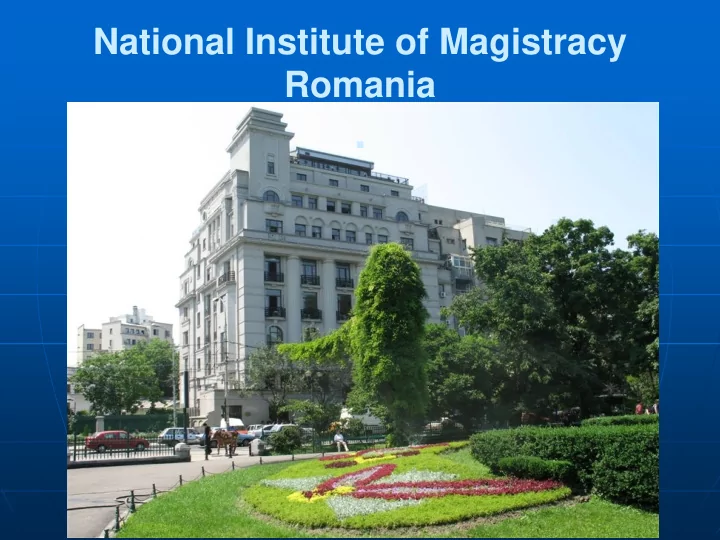
National Institute of Magistracy Romania . Presentation of the National Institute of Magistracy The National Institute of Magistracy (NIM or the Institute) is a public institution under the coordination of the Superior Council of
The National Institute of Magistracy (NIM or the Institute) is a public institution under the coordination of the Superior Council of Magistracy (SCM)
The Institute conducts the initial training of judges and prosecutors, the continuous professional training of acting judges and prosecutors, and also the training of trainers.
NIM does not belong to the national education system. It is an institution linked to the judicial system.
The Institute is headed by a director, two deputy directors and a Scientific Council formed of 13 members:
Cassation and Justice
Appeals
country
prosecutors
Cumulative conditions of admission: a) Romanian citizenship, domicile in Romania and full capacity of exercise; b) licensed in Law; c) lack of criminal record or fiscal record; d) knowledge of Romanian language; e) physically and psychologically apt for the exercise of the profession.
Multiple choice test Civil law Civil procedure Criminal law Criminal procedure Written test to verify legal knowledge III Interview I II
Period of initial training for judicial trainees - 2 years
In the first year, the training is organized at NIM premises, where the judicial trainees attend seminars and lectures. For the seminars, the trainees are divided in groups of maximum 17.
In the second year, the training is mainly organized in the Internship centers
The training program includes:
the disciplines of study (the study subjects)
the number of hours allocated to each discipline, including the distribution between seminars and lectures
the evaluation method for each discipline
the Internships to be performed
developed by the department of initial training of the NIM
submitted for endorsement to the Scientific Council of the NIM
submitted for approval to the SCM
The training program for judicial trainees
Based on the training program, the trainers elaborate the analytical programs for each discipline, specifying:
the topics
the number of hours allocated for each topic
the details regarding the specific evaluation of each discipline (the number and the type of written tests, the homeworks, etc.)
the bibliography
For each topic, the trainers elaborate a seminar plan to be followed by all groups of trainees, specifying:
For each seminar, the trainers establish the teaching materials (files, school cases, judgements etc.).
The training teaching staff of the Institute is formed of:
philosophy) that collaborate with the Institute
The recruitment of the trainers is done by a commission formed of the director of the Institute and two trainers specialized in a discipline in connection with the position to recruit
The candidate is interviewed by the commission, in order to asses his/her professional knowledge, the communication skills, the availability to collaborate with the Institute
The candidates have also to conduct a demonstrative seminar; the commission assesses the quality of the information transmitted, the teaching methods, the attitude towards the participants in the seminar.
In the first year of studies the professional training focuses on:
professions of judge and prosecutor
study a file, to listen, to interrogate, to demand evidence and to interpret them, to understand the psychology of different types of persons, to make a decision, to draft a decision or any other jurisdictional act)
Legal disciplines:
The practical character of the legal training
the study of the files
drafting decisions
The practical character of studying the Human rights and the European Law :
understanding the role and the impact of the ECHR and ECJ jurisprudence in national law;
familiarization with the specific notions of the ECHR and ECJ
the application of the ECHR and ECJ jurisprudence in specific fields
Non-legal disciplines:
The objectives of the study of these disciplines:
Ethics and the organization of the judiciary
knowledge of the behavioral standards specific to the function of judge and prosecutor
awareness of the responsibility of the judge and the prosecutor, as a provider of a public service, in the interest of the citizen
knowledge of the organization and functioning of the courts and prosecutor's offices
The interdisciplinary character of the training The acquired knowledge and skills have to be assimilated in an integrated way:
the analytical programs of the disciplines are corroborated
simulated trials, managed by mixed teams of trainers
personal development
subject of the file
Continuous evaluation: Oral participation in debates Written tests + written homework Final evaluation: Examination continuous evaluation + final evaluation
Grade =
The initial training trainers are assessed by:
The judicial trainees
The head of the discipline
The specialist in educational sciences
The director of the Institute The assessment criteria:
the quality of the information transmitted by the trainer
the teaching methods (the practical character, the interactivity, etc.)
the attitude towards participants (respect, openness, impartiality, etc.)
the usefulness of the feedback given by the trainer
the compliance of organizational duties
After graduating of the first year in the NIM, the judicial trainees make a formal choice for their future profession (judge or prosecutor), in order
Practical training:
profession (6 months)
courts for the future prosecutors (2 weeks)
choose between the police`s offices, the notary`s offices, the bailiff`s
judgments, Anti-discrimination (2 weeks)
The Internship in courts and prosecution offices is supervised by tutors (judges and prosecutors), who allocate each trainee to an experienced judge/prosecutor
The judicial trainee is like the shadow of this judge/prosecutor (studying the files, assisting to all sequences of the trial, drafting the decisions/other procedural acts)
The tutors evaluate the activity of the trainees during this Internship
It is mandatory for trainees to draft during this Internship a certain number and type of procedural acts, mentioned in the training program
The other Internships aim to rise awareness concerning the functioning of the main partners of magistrates in the justice system and to improve the collaboration between the juridical professions.
During the initial training, we organize extracurricular activities, in
Some of these extracurricular activities have an international dimension:
prosecutors
and human rights
magistracy
Written test, having a practical character
drafting the decision, after studying a file
answering a practical question
solving a case Examination disciplines
Trainee Judge or Prosecutor Graduation exam final grades of each of the two years + grade of the graduation exam
General grade =
Capacity exam