Preliminary measurements of carbon and oxygen energy spectra from - - PowerPoint PPT Presentation

preliminary measurements of carbon and oxygen energy
SMART_READER_LITE
LIVE PREVIEW

Preliminary measurements of carbon and oxygen energy spectra from - - PowerPoint PPT Presentation

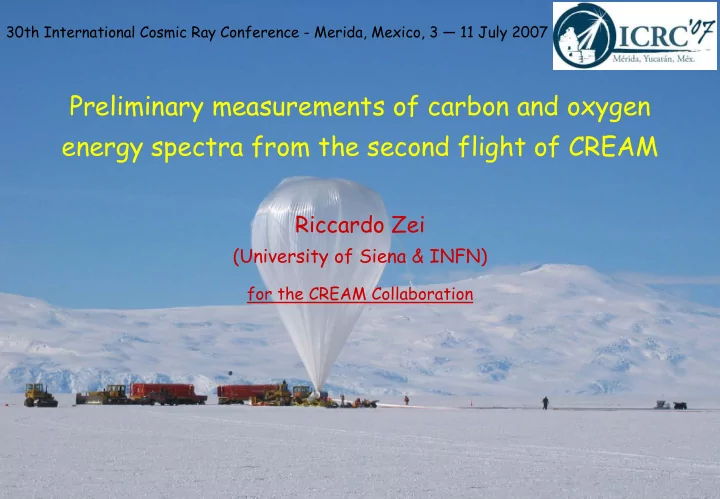
30th International Cosmic Ray Conference - Merida, Mexico, 3 11 July 2007 Preliminary measurements of carbon and oxygen energy spectra from the second flight of CREAM Riccardo Zei (University of Siena & INFN) for the CREAM Collaboration


slide-1
SLIDE 1

Slide 1

Riccardo Zei

ICRC 2007 (Merida - Messico) OG 1.1 CREAM-II C & O Spectra

Preliminary measurements of carbon and oxygen energy spectra from the second flight of CREAM

Riccardo Zei

(University of Siena & INFN)

for the CREAM Collaboration

30th International Cosmic Ray Conference - Merida, Mexico, 3 — 11 July 2007

slide-2
SLIDE 2

Slide 2

Riccardo Zei

ICRC 2007 (Merida - Messico) OG 1.1 CREAM-II C & O Spectra

H.S. Ahn1, O. Ganel1, J.H. Han1, K.C. Kim1, M.H. Lee1, A. Malinin1, E.S. Seo1,2, R. Sina1, P. Walpole1, J. Wu1, Y.S.Yoon1,2, S.Y. Zinn1

1 Institute for Physical Science and Technology, University of Maryland, College Park, MD 20742, USA 2 Department of Physics, University of Maryland, College Park, MD 20742, USA

N.B. Conklin, S. Coutu, S.I. Mognet

Department of Physics, Penn State University, University Park, PA 16802, USA

P.S. Allison, J.J. Beatty, T.J. Brandt

Department of Physics, Ohio State University, Columbus, OH 43210, USA

J.T. Childers, M.A. Duvernois

School of Physics and astronomy, University of Minnesota, Minneapolis, MN 55455, USA

M.G. Bagliesi, G. Bigongiari, P. Maestro, P.S. Marrocchesi, R. Zei

Department of Physics, University of Siena & INFN, Via Roma 56, 53100 Siena, Italy

J.A. Jeon, S. Nam, I.H. Park, N.H. Park, J. Yang

Department of Physics, Ewha Womans University, Seoul 120-750, Republic of Korea

  • S. Minnick

Department of Physics, Kent State University, Tuscarawas, New Philadelphia, OH 44663, USA

  • S. Nutter

Department of Physics, Northern Kentucky University, Highland Height, KY 41099, USA

  • L. Barbier

Astroparticle Physics Labroratory, NASA Goddard Space Flight Center, Greenbelt, MD 20771, USA
slide-3
SLIDE 3

Slide 3

Riccardo Zei

ICRC 2007 (Merida - Messico) OG 1.1 CREAM-II C & O Spectra

CREAM-II trajectory

For the present analysis, only a subset

  • f CREAM-II data was selected

Altitude 38—40 km. Average atmospheric overburden ~ 3.9 g/cm²

CREAM flights

CREAM-I: 2004/05 campaign

  • Total flight time ~ 42 days

~ 42M science events collected

CREAM-II: 2005/06 campaign

  • Total flight time ~ 28 days
  • ~ 27M science events collected

Record breaking flight

Effective Live Time ~ 17 days

slide-4
SLIDE 4

Slide 4

Riccardo Zei

ICRC 2007 (Merida - Messico) OG 1.1 CREAM-II C & O Spectra

Instrument configuration (2nd flight)

Timing Charge Detector (TCD)

  • scintillator paddles (2 charge measurements)
  • backscatter rejection by fast pulse shaping

Cherenkov Detector (CD)

  • acrylic radiator (charge measurement)
  • vetoes low energy particles

Silicon Charge Detector (SCD)

  • 2 layers of Si pixels (2 charge measurements)
  • backscatter rejection by fine segmentation

Target (T1,T2)

  • 19 cm densified Graphite (~ 0.5 λint , ~ 1 X0)
  • induces a hadronic interaction

Tungsten Sci-Fi Calorimeter (CAL)

  • 20 X0; 1 cm granularity (energy measurement)
slide-5
SLIDE 5

Slide 5

Riccardo Zei

ICRC 2007 (Merida - Messico) OG 1.1 CREAM-II C & O Spectra

Silicon Charge Detector (SCD)

  • 2 layers of sensors
  • 380 μm thick Si sensor
  • 16 pixels per sensor
  • pixel size ~ 2.1 cm2
  • 2496 channels/layer were readout
  • No dead area between sensors
  • Active area per layer ~ 0.52 m2
  • particle-ID by charge measurement from Z=1 to Z=33
slide-6
SLIDE 6

Slide 6

Riccardo Zei

ICRC 2007 (Merida - Messico) OG 1.1 CREAM-II C & O Spectra

Tungsten Sci-Fi Calorimeter

  • Active area 50x50 cm2
  • Longitudinal sampling: 3.5 mm W (1 X0) + 0.5 mm Sci-Fi
  • Transverse granularity: 1 cm (20 fibers ~ 1 Moliere radius)
  • Total of 20 layers (20 X0 , ~ 0.7 λint): alternate X-Y views
  • 2560 channels (3 gain ranges) readout by 40 HPDs

Tungsten Sci-Fi Calorimeter Optical fibers

slide-7
SLIDE 7

Slide 7

Riccardo Zei

ICRC 2007 (Merida - Messico) OG 1.1 CREAM-II C & O Spectra

Geometric Factor

Monte Carlo Generation: FLUKA 2005.6 with hadronic interaction package DMPJET-3 Carbon (Oxygen) nuclei isotropic generation according to power-law spectrum in the energy range 600 (800) GeV – 100 TeV

Accepted incoming particle

Geometrical Acceptance is calculated selecting events crossing both SCD Top Plane and CAL Top Layer Selected fiducial region: SCD top plane side = 78 cm CAL top plane side = 50 cm

GF ~ 0.46 m2 sr

Rejected incoming particle

slide-8
SLIDE 8

Slide 8

Riccardo Zei

ICRC 2007 (Merida - Messico) OG 1.1 CREAM-II C & O Spectra

Shower reconstruction & Charge-ID

  • Shower imaging (lateral/longitudinal) with CAL
  • Fit of the shower axis
  • Back-projection of CAL track to SCD
  • The track is matched with the SCD pixel hit by

the incoming particle

  • Rejection of backscattered particles
  • Charge identification of the incoming particle

(a consistent charge assignement from the 2 layers is required)

slide-9
SLIDE 9

Slide 9

Riccardo Zei

ICRC 2007 (Merida - Messico) OG 1.1 CREAM-II C & O Spectra

Observed charge distribution in SCD

0.7 1.3

Top Bottom

S S ≤ ≤

Consistency 30% cut:

2 Re

2

(

)

Top Bottom c

S S Z + ∝

Carbon & Oxygen: σ ~ 0.2e

O N C

pathlength correction applied

  • Indicative of charge resolution
  • NOT representative of elemental abundances
slide-10
SLIDE 10

Slide 10

Riccardo Zei

ICRC 2007 (Merida - Messico) OG 1.1 CREAM-II C & O Spectra

Charge Reconstruction Efficiency (Monte Carlo)

  • Charge Reconstruction Efficiency is

normalized to the number of triggered events

  • MC algorithm for charge identification with

SCD is the same as applied on flight data

  • Preliminary MC estimate of charge

reconstruction efficiency is ~ 70% (above 2 TeV) including effects of SCD masked sensors

Carbon Oxygen

slide-11
SLIDE 11

Slide 11

Riccardo Zei

ICRC 2007 (Merida - Messico) OG 1.1 CREAM-II C & O Spectra

Flight DATA: carbon and oxygen energy deposit in CAL

All reconstructed showers inside selected fiducial region 39390 After Consistency cut for SCD signals 10890 Nuclei Charge Selection 728 (Oxygen) 583 (Carbon) Carbon Oxygen

slide-12
SLIDE 12

Slide 12

Riccardo Zei

ICRC 2007 (Merida - Messico) OG 1.1 CREAM-II C & O Spectra

For events surviving the selection cuts, both distributions of energy deposit and primary

particle energy are divided into equidistant

logarithmic bins. Through their correlation plot, we can estimate the matrix elements Aij i.e. the probability that events in the deposited energy bin i come from the primary incident energy bin j.

Energy Deconvolution

( ) ( , ) ( )

d d

E A E E E dE ϕ = Φ

Deposited energy Primary energy A(Ed,E) is determined from Monte Carlo events Response function

slide-13
SLIDE 13

Slide 13

Riccardo Zei

ICRC 2007 (Merida - Messico) OG 1.1 CREAM-II C & O Spectra

Correction to TOI (Top of Instrument): Interaction fractions Correction to TOA (Top of Atmosphere)

Through MC simulation the correction factor η is calculated for an (average) residual atmosphere overburden of ~ 3.9 g/cm2.

Carbon = 0.86 Oxygen = 0.83

  • A correction for particles interacting in the

instrument was applied. Fraction of Carbon/Oxygen nuclei interacting in the apparatus

slide-14
SLIDE 14

Slide 14

Riccardo Zei

ICRC 2007 (Merida - Messico) OG 1.1 CREAM-II C & O Spectra

Absolute Flux

The unfolded counts Ninc, in each incident energy bin of size ∆E, are normalized to obtain the absolute differential fluxes at the top of atmosphere, given by

1 ( )

inc F l

N E E G T ε η Φ = × Δ ⋅ ⋅ ⋅

where

GF = Geometric factor Tl

= Live-time

ε

= product of efficiencies , correction for interaction fractions

η

= TOA correction

slide-15
SLIDE 15

Slide 15

Riccardo Zei

ICRC 2007 (Merida - Messico) OG 1.1 CREAM-II C & O Spectra

Preliminary Carbon & Oxygen energy spectra

slide-16
SLIDE 16

Slide 16

Riccardo Zei

ICRC 2007 (Merida - Messico) OG 1.1 CREAM-II C & O Spectra

Conclusions

Thanks to:

  • NASA
  • NSBF/CSBF
  • INFN/PNRA
  • WFF
  • NSF
  • A preliminary analysis of the data indicates an excellent charge-ID

from SCD and good performance of the imaging calorimeter and of the whole instrument

  • Preliminary carbon and oxygen energy spectra are found to be

consistent with previous measurements

  • Analysis is on-going... more to come!