Predictive RAIM for Federal Aviation Administration RNAV 1 and - - PDF document

predictive raim for
SMART_READER_LITE
LIVE PREVIEW

Predictive RAIM for Federal Aviation Administration RNAV 1 and - - PDF document

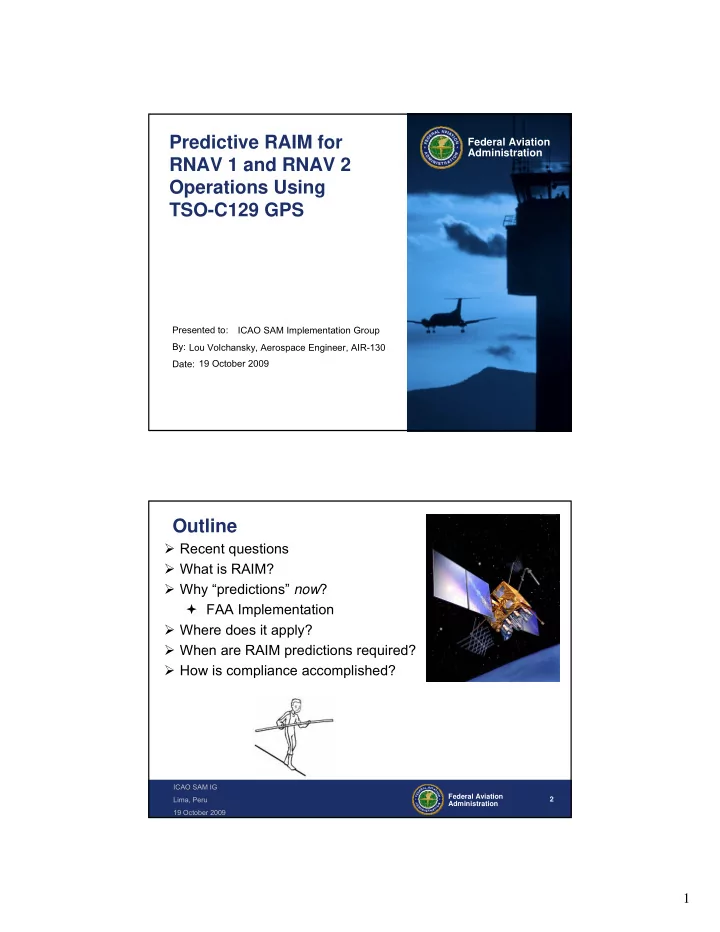
Predictive RAIM for Federal Aviation Administration RNAV 1 and RNAV 2 Operations Using TSO-C129 GPS Presented to: ICAO SAM Implementation Group By: Lou Volchansky, Aerospace Engineer, AIR-130 Date: 19 October 2009 Outline Recent


slide-1
SLIDE 1

1

Presented to: By: Date:

Federal Aviation Administration

Predictive RAIM for RNAV 1 and RNAV 2 Operations Using TSO-C129 GPS

ICAO SAM Implementation Group Lou Volchansky, Aerospace Engineer, AIR-130 19 October 2009

ICAO SAM IG Lima, Peru 19 October 2009 2 Federal Aviation Administration

Outline

Recent questions What is RAIM? Why “predictions” now? FAA Implementation Where does it apply? When are RAIM predictions required? How is compliance accomplished?

slide-2
SLIDE 2

2

ICAO SAM IG Lima, Peru 19 October 2009 3 Federal Aviation Administration

Questions from past 6 months

Why worry about working satellites? What about getting “fleet credit”? Why isn’t prior service history given more credit? Why can’t baro-aiding be used as a baseline?

ICAO SAM IG Lima, Peru 19 October 2009 4 Federal Aviation Administration

Recently Submitted Questions

What is the difference between: Global Navigation Satellite System (GNSS) monitoring status? Addressed through published GPS Notices to Airmen (NOTAMS). Who records? US Coast Guard Who gets data? Requesting user How is it used in flight operations? RAIM calculation GPS data recording? State requirement to record GPS data in case of incident/accident. How does US handle? Ground real-time monitoring status? What is difference from GNSS monitoring? RAIM prediction monitoring? Based on current GPS constellation status.

slide-3
SLIDE 3

3

ICAO SAM IG Lima, Peru 19 October 2009 5 Federal Aviation Administration

Is RAIM prediction done for fault detection (FD), fault detection and exclusion (FDE), and Performance Navigation for the operation en route, terminal and non-precision approach (NPA)? Fault Detection only, but also includes option for baro-aiding Is one RAIM prediction performed, or one for each case? U.S. Ops requirement for en route and terminal RAIM prediction. Non-precision approach (NPA) provided, but not required

Recently Submitted Questions

ICAO SAM IG Lima, Peru 19 October 2009 6 Federal Aviation Administration

Who conducts the RAIM prediction, the Service Provider or the Operator? What type of consideration is necessary to analyze at this respect? In the US, the FAA established 6 means of compliance (discussed in briefing) How will RAIM prediction consider solar phenomena? How will predictions be calculated? FAA's RAIM prediction does not focus on solar flare influence (discussed in briefing)

Recently Submitted Questions

slide-4
SLIDE 4

4

ICAO SAM IG Lima, Peru 19 October 2009 7 Federal Aviation Administration

What is RAIM?

Receiver Autonomous Integrity Monitoring

  • Means of providing GPS signal integrity monitoring
  • Need 5 satellites for fault detection (or 4 satellites and baro-aiding)
  • Need 6 satellites for fault detection and exclusion (or 5 satellites

and baro aiding). (With only 5 satellite vehicles in view, GPS with FDE reverts to basic RAIM)

  • Receiver predicts NPA RAIM, but not en route or terminal

TSO-C129() received “supplemental” approval

  • Supplemental limitation addressed four areas:

Limited availability of RAIM (geometry) Equipment not required to provide satellite exclusion Potential for interference to GPS Inadequate capability to predict RAIM availability during flight planning

  • Certain TSO-C129 receivers are approved for oceanic operations

ICAO SAM IG Lima, Peru 19 October 2009 8 Federal Aviation Administration

Predictive RAIM

Challenges No standardized method for RAIM prediction Difficult to construct a baseline model when current equipage involves several variables

  • Proprietary receiver algorithm
  • Proprietary antenna design
  • May use lower mask angle (< 5o)

Credit for baro-aiding should be given, if receiver and installation confirm this capability GPS frequently asked questions: http://pnt.gov/public/faq.shtml

slide-5
SLIDE 5

5

ICAO SAM IG Lima, Peru 19 October 2009 9 Federal Aviation Administration

Why RAIM, it’s never been a problem before…

Impact FD (or FDE, but no extra satellites): Loss of availability Spoiled by success (~30 satellites): Spare satellites improve availability of a particular “slot position”, but not necessarily the geometry Counting “operating” satellites does not guarantee proper geometry unless accounted in primary slot position RAIM prediction websites http://augur.ecacnav.com/augur/app/home http://www.raimprediction.net

ICAO SAM IG Lima, Peru 19 October 2009 10 Federal Aviation Administration

…but there will be periods of forecast non-availability

slide-6
SLIDE 6

6

ICAO SAM IG Lima, Peru 19 October 2009 11 Federal Aviation Administration

“Baro-aiding” (not baro-VNAV) adds another input

ICAO SAM IG Lima, Peru 19 October 2009 12 Federal Aviation Administration

Another feature: known interference testing

slide-7
SLIDE 7

7

ICAO SAM IG Lima, Peru 19 October 2009 13 Federal Aviation Administration

Standard Positioning Service Performance Standard – Sept 2008

ICAO SAM IG Lima, Peru 19 October 2009 14 Federal Aviation Administration

From GPS Program Update to 49th CGSIC, 21 Sep 09

slide-8
SLIDE 8

8

ICAO SAM IG Lima, Peru 19 October 2009 15 Federal Aviation Administration

FAA Initial RAIM Prediction Requirements

Demand for automated input/feedback

Initial meeting, 29 Oct 2007, with FAA (Air Traffic, Flight Standards, Certification) and industry (ALPA, AOPA, RAA, Boeing, USAF)

Upgraded web page www.raimprediction.net

Baro-aiding, interference, and non-precision approach options ICAO flight plan input for textual Pass/Fail Flight planning vendor access is accomplished outside of website

Ken A

ICAO SAM IG Lima, Peru 19 October 2009 16 Federal Aviation Administration

AC 90-100A Guidance

(US En Route and Terminal RNAV) Guidance AC 90-100A, para 10.a.(5): IF using TSO- C129() to solely satisfy RNAV requirement, RAIM availability must be confirmed using current GPS satellite information

slide-9
SLIDE 9

Slide 15 Ken A10 Suggest reference somewhere in presentatio to Augur site since it covers CARSAM and states can accept predictions from that site if they choose to allow its use!

DOT/FAA Ken Alexander, 10/17/2009

slide-10
SLIDE 10

9

ICAO SAM IG Lima, Peru 19 October 2009 17 Federal Aviation Administration

RNAV system compliance

AC 90-100A, US Terminal and En Route RNAV Operations, provides

  • perational and airworthiness guidance.

Accomplished via manufacturer statement of compliance

and placed in table:

http://www.faa.gov/about/office_org/headquarters_offices/avs/offices/afs /afs400/afs470/policy_guidance/

ICAO SAM IG Lima, Peru 19 October 2009 18 Federal Aviation Administration

RAIM Preflight Planning Procedures

List of AC 90-100A Compliant equipment:

http://www.faa.gov/about/office_org/headquarters_offices/avs/offices/afs/afs400/ afs470/media/AC90-100compliance.xls

Operator ensures RAIM availability exists Predicted, continuous loss of RAIM > 5 minutes for any part

  • f the intended flight:

Delay, cancel, or re-route where RAIM requirements can be met.

For multi-sensor equipment with operating GPS and DME/DME/IRU positioning, a RAIM check is not required as long as critical DME’s are functioning normally (Critical DME discussion two slides away)

slide-11
SLIDE 11

10

ICAO SAM IG Lima, Peru 19 October 2009 19 Federal Aviation Administration

Guidance

http://www.faa.gov/airports_airtraffic/air_traffic/publications/notices/

ICAO SAM IG Lima, Peru 19 October 2009 20 Federal Aviation Administration

  • DME/DME geometry solutions require the two DMEs

to be ≥ 30 and ≤ 150 degrees. Position estimation accuracy better or equal to 0.56 NM

OKAY 85 degrees Unacceptable 170 degrees OKAY 60 degrees Unacceptable 160 degrees

Multi-sensor aircraft using DME/DME/IRU RNAV: Critical DME

slide-12
SLIDE 12

11

ICAO SAM IG Lima, Peru 19 October 2009 21 Federal Aviation Administration

Critical DME

If required for DME/DME/IRU performance, listed on RNAV 1 procedures

By design, Q routes will not have critical DME’s

Geometry and SSV can result in several critical DME’s Unofficial list of critical DME’s recently developed Performance assumptions:

ICAO SAM IG Lima, Peru 19 October 2009 22 Federal Aviation Administration

Example: Critical DME - Geometry

slide-13
SLIDE 13

12

ICAO SAM IG Lima, Peru 19 October 2009 23 Federal Aviation Administration

Example: Critical DME

ICAO SAM IG Lima, Peru 19 October 2009 24 Federal Aviation Administration

DME #1 DME #2

Procedure design considerations

range1 range2

  • DME facilities in view
  • Overlay of RNAV routes
slide-14
SLIDE 14

13

ICAO SAM IG Lima, Peru 19 October 2009 25 Federal Aviation Administration

Monitor the status of each satellite in its plane/slot position

Account for the latest GPS constellation status (e.g., NOTAMs or NANUs), Compute RAIM availability using model-specific RAIM prediction software.

Use the FAA RAIM prediction website: www.raimprediction.net. Contact a Flight Service Station to obtain non-precision approach RAIM. Use a third party interface, incorporating FAA/VOLPE RAIM prediction data without altering performance values, to predict RAIM outages for the aircraft's predicted flight path and times. Use the receiver’s installed RAIM prediction capability to provide non- precision approach RAIM, accounting for the latest GPS constellation status (e.g., NOTAMs or NANUs).

Since receiver only required to predict NPA RAIM, will need to checked airports spaced at intervals not to exceed 60 NM along the RNAV 1 procedure’s flight

  • track. “Terminal” or “Approach” RAIM must be available at the ETA over each

airport checked.

Operators not using model-specific software or FAA/VOLPE RAIM data will need FAA operational approval.

Comply with any one of the following methods:

ICAO SAM IG Lima, Peru 19 October 2009 26 Federal Aviation Administration

RNP – performance based

Aircraft “system” performance Horizontal alert limit may not depend on manufacturer implementation in meeting same RNP level “Business as usual” is changing Ground infrastructure: navaids, surveillance Aircraft capability: New RNP procedures = greater capability, capacity, and fuel savings AC 90-105 captures this transition

slide-15
SLIDE 15

14

ICAO SAM IG Lima, Peru 19 October 2009 27 Federal Aviation Administration

Future Volpe work

O&M to continue current effort Continued prediction performance comparison against avionics manufacturer prediction Upgrades to support interoperable system with international prediction systems (e.g., AUGUR) Upgrades to support increased coverage volume beyond continental US, Alaska, and Hawaii Algorithm and web service support for TSO-C196 receiver

ICAO SAM IG Lima, Peru 19 October 2009 28 Federal Aviation Administration

Summary

RAIM Spoiled by success, let’s not become complacent What, Why, Where, When, and How Geometry more important than satellite count Enforcement began 28 Sept 2009 Future work

slide-16
SLIDE 16

15

ICAO SAM IG Lima, Peru 19 October 2009 29 Federal Aviation Administration

Thank you

Questions?

ICAO SAM IG Lima, Peru 19 October 2009 30 Federal Aviation Administration

Backup: Ionospheric Storm

Initial burst of noise (not predictable) Small and brief Worst case = loss of low elevation satellites, similar to banking. No effect on operations. Ionospheric scintillation (not predictable) Rapid fluctuations; GPS signal can split and cancel itself Satellites in different parts of sky. Typically impact one signal at a

  • time. Degradation in RAIM availability

Ionospheric delay (not predictable) Negligible with respect to non precision approach (NPA) or RNP 0.1. For LPV, corrected by WAAS (not a problem). Can disrupt LPV (~ 8 hours). Reason LPV not used for alternate capability