UCAR / COSMIC Program Office T. Meehan, T. Stecheson, A. Mannucci, - - PowerPoint PPT Presentation

ucar cosmic program office t meehan t stecheson a
SMART_READER_LITE
LIVE PREVIEW

UCAR / COSMIC Program Office T. Meehan, T. Stecheson, A. Mannucci, - - PowerPoint PPT Presentation

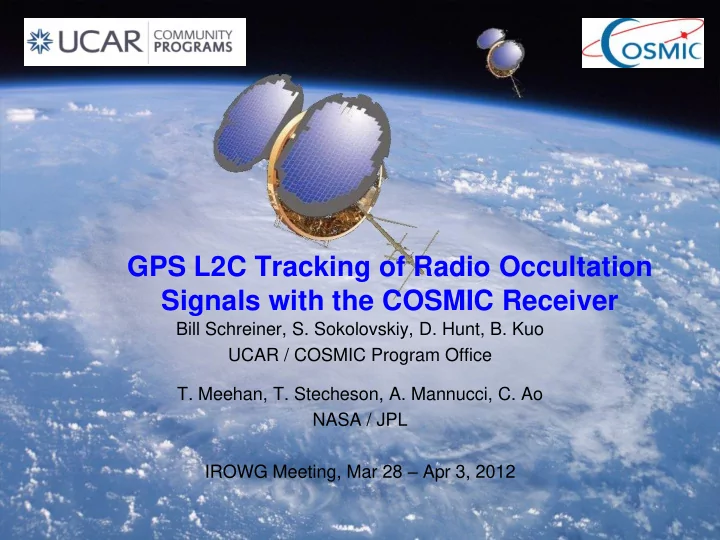
GPS L2C Tracking of Radio Occultation Signals with the COSMIC Receiver Bill Schreiner, S. Sokolovskiy, D. Hunt, B. Kuo UCAR / COSMIC Program Office T. Meehan, T. Stecheson, A. Mannucci, C. Ao NASA / JPL IROWG Meeting, Mar 28 Apr 3, 2012


slide-1
SLIDE 1

GPS L2C Tracking of Radio Occultation Signals with the COSMIC Receiver

Bill Schreiner, S. Sokolovskiy, D. Hunt, B. Kuo UCAR / COSMIC Program Office

  • T. Meehan, T. Stecheson, A. Mannucci, C. Ao

NASA / JPL IROWG Meeting, Mar 28 – Apr 3, 2012

slide-2
SLIDE 2

Upper stratosphere and lower troposphere are regions

  • f maximum uncertainty for GPS RO inversions

In the upper stratosphere: the signal reduces below noise level in terms of the phase (Doppler) In the lower troposphere: the signal reduces below noise level in terms of the amplitude

at what height to start using signal for inversion

?

slide-3
SLIDE 3

Benefits of L2C Tracking

  • Improves L2 SNR
  • Reduces BA noise in the stratosphere
  • Use of L2 down to lower heights for ionospheric correction
  • L2C Phase-Lock Loop tracking may allow significant

reduction of errors due to diffractional effects for occultations affected by the ionospheric scintillation

  • Combined use of L1CA and L2C Open-Loop signals may

reduce impact of noise in lower troposphere inversions

slide-4
SLIDE 4

Estimation of Bending Angle Noise

L2C results in lower noise of the bending angles (important for inversions in the stratosphere) Interval for noise estimation (60 – 80 km)

Histograms of STDV between 60 - 80 km 2012.001-068

L2P L2C

(rad)

Statistical comparison of COSMIC to ECMWF in the stratosphere

slide-5
SLIDE 5

Truncation of L2 Signal

Determination of L2 cut-off altitude 1) Mean deviation 2) Fluctuations Ionospheric calibration below cut-off Extrapolation of difference

฀ fL1

Dop c  fL2 Dop

 1Hz

฀ fL2

Dop  fL2 Dop

 6Hz

฀ iono

 free L1  C L1 L2

฀ denotes mean

฀ L1 L2

slide-6
SLIDE 6

L2 Truncation with COSMIC

Since Jan 2012, COSMIC receivers are configured to track L2C (setting occultations)

Higher stability to fluctuations L2C can be used down to lower heights than L2P (L2P often fails at sharp tropopause) Statistical Comparison with ECMWF L2 Cut-off Altitude vs Latitude

L2P L2C

L2C less noisy than L2P L2P ~ 18% fail QC L2C ~ 3% fail QC

slide-7
SLIDE 7

Examples of ionospheric scintillation on L1CA and L2C signals sporadic E-clouds scintillation

slide-8
SLIDE 8

Back propagation of RO signals

In case of localized ionospheric irregularities, the regions with minimum fluctuation of BP amplitude correspond to the regions with minimum diffractional effects on complex signals. BA should be calculated in these regions.

slide-9
SLIDE 9

BA from RO signals calculated

  • Directly and
  • After back propagation of complex signals

to the regions of minimum fluctuation of amplitude

slide-10
SLIDE 10

Combining L1CA and L2C BA in the lower troposphere by use of the amplitude of WO transform

  • largest BA spikes correspond to regions of small amplitude
slide-11
SLIDE 11

Combined BA is less responsive to noise on RO signal

slide-12
SLIDE 12

Summary

12

  • JPL implemented L2C tracking on COSMIC – Operational ~ Jan 2012
  • L2C data reduces BA noise in the stratosphere
  • L2C allows use of L2 signal down to lower heights for ionospheric

correction

  • L2C Phase-Lock Loop tracking allows significant reduction of errors due

to diffractional effects for some example occultations affected by the ionospheric scintillation. Statistical comparisons next.

  • Combined use of L1CA and L2C Open-Loop signals reduces impact of

noise in some example lower troposphere inversions. Statistical comparisons next.

slide-13
SLIDE 13

Acknowledgments

  • NSF
  • Taiwan’s NSPO
  • NASA/JPL, NOAA, USAF, ONR, NRL
  • Broad Reach Engineering