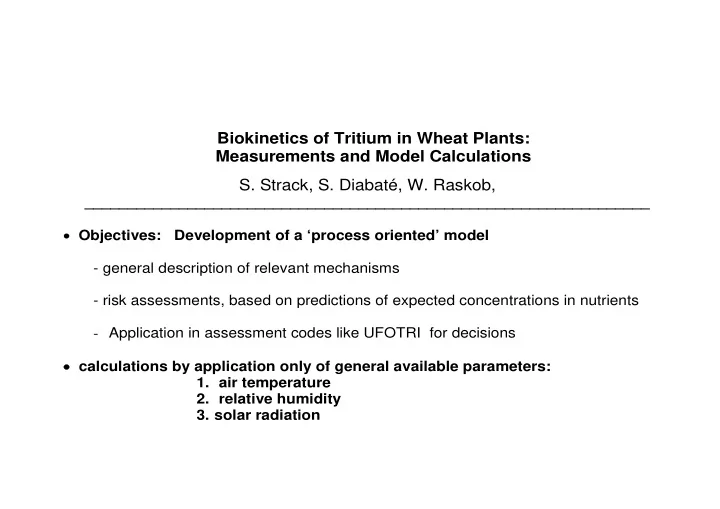
SLIDE 1 Biokinetics of Tritium in Wheat Plants: Measurements and Model Calculations
- S. Strack, S. Diabaté, W. Raskob,
__________________________________________________________________ Objectives: Development of a ‘process oriented’ model
- general description of relevant mechanisms
- risk assessments, based on predictions of expected concentrations in nutrients
- Application in assessment codes like UFOTRI for decisions
calculations by application only of general available parameters:
- 1. air temperature
- 2. relative humidity
- 3. solar radiation
SLIDE 2
SLIDE 3
SLIDE 4 Experiments:
- 1993 and 1994 Laboratory chamber experiments with potted spring wheat
- 1995 winter wheat in a small experimental field for short-term exposure
experiments during the grain-filling period.
- transparent plexi-glass box (30 x 30 cm, 100 cm height)
- tritiated water (HTO) evaporated by constantly heating
- homogeneous tritiated air humidity in the box with a fan
- concentration of HTO in the air humidity: detection by a calibrated bubbler
system (trapping in vials with a scintillation cocktail (for 5 minutes)
- Further parameters:
- Air temperature in °C
- Relative air humidity in %
- solar radiation inµE/m2s with a Quantum sensor (PPFD)
SLIDE 5
SLIDE 6 0.0% 0.1% 0.2% 0.3% 0.4% 0.5% 0.6% 0.7% 0.8% 0.9% 1.0% 5 10 15 20 25 30 35
days after beginning of anthesis O B T in g ra in %
OBT concentrations in grains at the time of harvest, given as percentage of the TWT concentrations in leaves at the end of the exposure (2 h), chamber experiments 1993
MEANgrain filling period = 0.62 % night experiments
SLIDE 7 Experiments:
- 1993 and 1994 Laboratory chamber experiments with potted spring wheat
- 1995 winter wheat in a small experimental field for short-term exposure
experiments during the grain-filling period.
- transparent plexi-glass box (30 x 30 cm, 100 cm height)
- tritiated water (HTO) evaporated by constantly heating
- homogeneous tritiated air humidity in the box with a fan
- concentration of HTO in the air humidity: detection by a calibrated bubbler
system (trapping in vials with a scintillation cocktail (for 5 minutes)
Air temperature in °C Relative air humidity in % solar radiation in µE/m2s with a Quantum sensor (PPFD)
SLIDE 8
SLIDE 9
SLIDE 10 Experiments:
- 1993 and 1994 Laboratory chamber experiments with potted spring wheat
- 1995 winter wheat in a small experimental field for short-term exposure
experiments during the grain-filling period.
- transparent plexi-glass box (30 x 30 cm, 100 cm height)
- tritiated water (HTO) evaporated by constantly heating
- homogeneous tritiated air humidity in the box with a fan
- concentration of HTO in the air humidity: detection by a calibrated bubbler
system (trapping in vials with a scintillation cocktail (for 5 minutes)
- Further parameters:
- Air temperature in °C
- Relative air humidity in %
- solar radiation in µE/m2s with a Quantum sensor (PPFD)
SLIDE 11
SLIDE 12 Monitor Bubbler Cuvette of gas exchange system Temperatur, rel. humidity Inlet for air flushing Fan Heating unit Outlets for:
- tritiated water (HTO) evaporated by constantly heating
- homogeneous tritiated air humidity in the box with a fan
- concentration of HTO in the air humidity: detection by a calibrated bubbler
system (trapping in vials with a scintillation cocktail (for 5 minutes)
SLIDE 13
SLIDE 14
SLIDE 15 Experiments:
- 1993 and 1994 Laboratory chamber experiments with potted spring wheat
- 1995 winter wheat in a small experimental field for short-term exposure
experiments during the grain-filling period.
- transparent plexi-glass box (30 x 30 cm, 100 cm height)
- tritiated water (HTO) evaporated by constantly heating
- homogeneous tritiated air humidity in the box with a fan
- concentration of HTO in the air humidity: detection by a calibrated bubbler
system (trapping in vials with a scintillation cocktail (for 5 minutes)
- Further parameters:
- Air temperature in °C
- Relative air humidity in %
- solar radiation in µE/m2s with a Quantum sensor (PPFD)
SLIDE 16
SLIDE 17
SLIDE 18
SLIDE 19
SLIDE 20
SLIDE 21
SLIDE 22
SLIDE 23
SLIDE 24
- TWT concentration after lyophilisation
- removing all exchangeable Tritium in a tritium-free humid atmosphere
- OBT concentration by combustion (Packard Oxidiser)
- cultivation of residual wheat plants under normal field conditions until
harvest
- in certain intervals: samples from leaves and ears
- 7 exposures at different time of day and during the night in 1995
(improvement of existing model)
- 1996: 7 experiments for validation the plant-OBT model.
SLIDE 25
SLIDE 26
SLIDE 27 7 7 8 9 10 11 11 14 15 15 20 20 23 23 F3 F14 F 7 F 2 F 4 F 10 F 15 F 1 F9 F 13 F 5 F 11 F6 F 12 leaf OBTr meas-1h 0.84 0.50 0.56 1.39 0.87 0.60 1.56 1.45 1.49 1.42 0.50 0.42 0.44 0.33 leaf OBTr meas-2h 0.80 0.68 0.62 1.01 0.98 0.66 1.23 1.16 1.29 1.48 0.64 0.48 0.39 0.33 leaf OBTr meas-4h 0.62 0.53 0.85 0.69 0.73 0.71 1.39 0.85 1.27 0.46 0.39 0.33 leaf OBTr meas-1d 0.20 0.11 0.28 0.28 0.41 0.34 0.39 0.35 0.42 0.22 0.36 0.16 seed OBTr meas-harv 0.23 0.14 0.30 0.19 0.29 0.19 0.23 0.20 0.23 0.28 0.35 0.25 0.34 0.20 0.0 0.2 0.4 0.6 0.8 1.0 1.2 1.4 1.6 1.8
% Rel.OBT leaf 1,2,4h,1d,harv.
leaf OBTr meas-1h leaf OBTr meas-2h leaf OBTr meas-4h leaf OBTr meas-1d seed OBTr meas-harv
SLIDE 28
Basic metabolism respiration gross- photosynth. photo- respiration
TWTgrain OBTgrain
TWTleaf
TRANS 1 rapid
OBTleaf
TRANS 2slow
ear 30%
atmos phere 1.part net-photosynthesis, basic metabolism and respiration
stem 10%
2.Teil Nettophotosynth. translokation
Plant-OBT Model leave 60%
SLIDE 29
Relative OBT-concentrations in the grains at harvest
0,0 0,1 0,2 0,3 0,4 0,5 0,6 0,7 0,8 0,9 1,0 6 8 10 12 14 16 18 20 22 24 time of the day (h) at the beginning of the exposure relative OBT concentrations, %
Korn OBTgemessen Korn OBT modelliert Polynom 2.Ordn. median 0,23 % ______________________________________________________________ Forschungszentrum Karlsruhe, Technik und Umwelt
SLIDE 30 OBTgrain at harvest, related to time integrated TWTinteg. in leaves and ears 50 100 150 200 250 300 350 400 100 200 300 400 500 600 700 800
TWTinteg (kBq* h/ml)
OBT in grains at harvest, Bq/ml
- TWTinteg. leaf + 0.5 (TWTinteg ear during day)
- and during night (f=0.2)
F 15, July 3
Forschungszentrum Karlsruhe, Technik und Umwelt
SLIDE 31
Thank you for your attention
SLIDE 32
0,00 0,50 1,00 1,50 2,00 2,50 3,00 3,50 1 10 100 1000
F15
ear OBTmeas earOBTmod leaf OBTmeas leaf OBTmod
SLIDE 33 0,00 0,10 0,20 0,30 0,40 0,50 0,60 0,70 0,80 1 10 100 1000
#F14
ear OBTmeas rel-meas earOBTmod rel-mod leaf OBTmeas rel-meas leaf OBTmod rel-mod
SLIDE 34
SLIDE 35 Die wichtigsten Prozesse im Pflanzenmodell: „plant-OBT“ mit allgem.verfügb.meteorolog.Daten: Luft-Temperatur, rel.Feuchte, Licht
Wachstum Aufnahme in Blatt, Ähre, Stengel (TWT) Bildung von OBT: Photosynthese, Photorespiration Grundumsatz, Respiration Translokation und Speicherung
In 1995 and 1996 we switched to field experiments:
- pportunity to use winter wheat
exposure more exactly for one hour (Plexiglas box) Uptake of HTO through Stomata: TWT
SLIDE 36 Die wichtigsten Prozesse im Pflanzenmodell: „plant-OBT“ mit allgem.verfügb.meteorolog.Daten: Luft-Temperatur, rel.Feuchte, Licht
Wachstum Aufnahme in Blatt, Ähre, Stengel (TWT) Bildung von OBT: Photosynthese, Photorespiration Grundumsatz, Respiration Translokation und Speicherung
In 1995 and 1996 we switched to field experiments:
- pportunity to use winter wheat
exposure more exactly for one hour (Plexiglas box) Uptake of HTO through Stomata: TWT