Precision medicine and personalizing Proteomics and Biomarkers in - - PowerPoint PPT Presentation

precision medicine and personalizing
SMART_READER_LITE
LIVE PREVIEW

Precision medicine and personalizing Proteomics and Biomarkers in - - PowerPoint PPT Presentation

4/20/2018 Precision medicine and personalizing Proteomics and Biomarkers in the therapy in pulmonary hypertension Analysis of Pulmonary Hypertension and Precision Medicine Approaches Allen D. Everett, MD Professor of Pediatrics/Cardiology


slide-1
SLIDE 1

4/20/2018

Proteomics and Biomarkers in the Analysis of Pulmonary Hypertension and Precision Medicine Approaches

Allen D. Everett, MD Professor of Pediatrics/Cardiology Director Pediatric Proteome Center

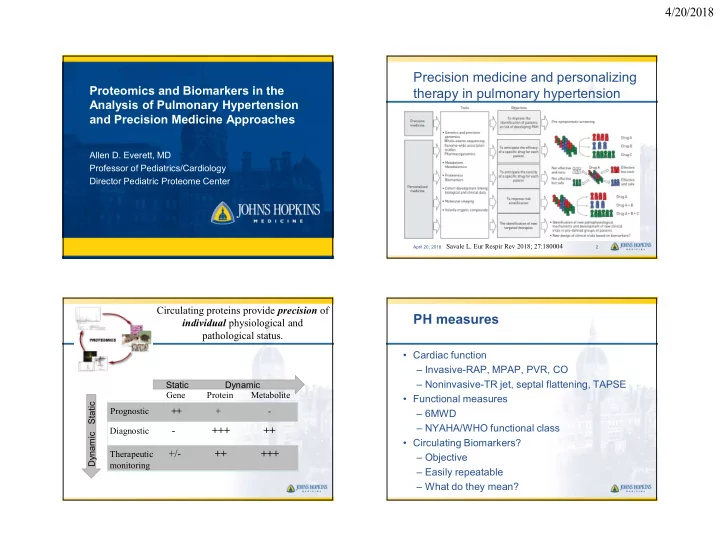
Precision medicine and personalizing therapy in pulmonary hypertension

April 20, 2018 2

Savale L. Eur Respir Rev 2018; 27:180004

Gene Protein Metabolite Diagnostic

  • +++

++

Therapeutic +/-

++ +++

monitoring Static Dynamic Dynamic Static

Circulating proteins provide precision of individual physiological and pathological status.

Prognostic ++ + -

PH measures

  • Cardiac function

– Invasive-RAP, MPAP, PVR, CO – Noninvasive-TR jet, septal flattening, TAPSE

  • Functional measures

– 6MWD – NYAHA/WHO functional class

  • Circulating Biomarkers?

– Objective – Easily repeatable – What do they mean?

slide-2
SLIDE 2

4/20/2018

Proteomics and Circulating Protein Biomarkers

  • Relationship of NTproBNP, ST2 and

Galectin 3 to PAH hemodynamics and functional outcomes in children and

  • adults. Do multiple markers add

precision?

  • Discovery of carbonic anhydrase 2 as a

new potential PAH therapeutic target.

April 20, 2018 5

Heart Failure Biomarkers for PH Monitoring

BNP

  • Indicator of cardiac stretch
  • Origin-atria and ventricles
  • Developmentally regulated

ST2

  • Circulating scavenger receptor for IL33
  • IL33 necessary for cardiac function
  • Origin: ubiquitous
  • Developmental regulation: none (2-17y)

Galectin 3

  • Lectin protein regulated by aldosterone
  • Linked to cardiac fibrosis
  • Origin: ubiquitous
  • KO inhibits PH in animals
  • Developmental regulation: none (2-17y)

Performance of Heart Failure Biomarkers in Adult PAH

NTproBNP ST2 Galectin 3

R (P) R (P) R (P)

Age

*0.423 (3.61E-11) 0.127 (0.056) *0.328 (4.71E- 07)

BSA

  • 0.041 (0.5516)

0.099 (0.155) 0.048 (0.486)

Heart Rate

0.121 (0.1396) 0.153 (0.062) 0.123 (0.135)

CO

*-0.233 (0.0004)

  • 0.088 (0.192)

0.021 (0.758)

CI

*-0.227 (0.0010)

  • 0.112 (0.109)

0.017 (0.803)

PVR (WU)

*0.258 (9.55E-05) 0.125 (0.062)

  • 0.036 (0.592)

Mean PAP

*0.153 (0.021) 0.103 (0.125)

  • 0.023 (0.732)

Mean RAP

*0.304 (4.11E-06) *0.321 (1.09E-06) *0.136 (0.044)

Mean PCWP

  • 0.070 (0.297)
  • 0.027 (0.691)

0.017 (0.804)

6MWD (M)

  • 0.005 (0.959)

*-0.358 (0.001) *-0.317 (0.001)

Mortality*

*0.001 *0.0000 *0.015

  • Cohort: NHLBI PAHBiobank
  • N=225
  • RHC < 6months of enrollment
  • IPAH/APAH-CTD: 87/88
  • Age: 57 (22-88)
  • Female (%): 79
  • FC I-II vs III-IV: 58 vs 94

Performance of Heart Failure Biomarkers in Pediatric PAH

NTproBNP ST2 Galectin 3

R (P) R (P) R (P)

Age *-0.27 (0.04) 0.09 (0.39) 0.16 (0.22) BSA

  • 0.09 (0.36)

0.12 (0.23) 0.15 (0.25) CO *-0.23 (0.02)

  • 0.02 (0.88)

0.12 (0.36) PVRI (WU*m2) 0.15 (0.25) *0.30 (0.02) 0.18 (0.17) Mean PAP 0.07 (0.48) *0.19 (0.046) 0.15 (0.26) Mean RAP 0.14 (0.18) 0.09 (0.37) 0.08 (0.55) Mean PCWP 0.035 (0.72)

  • 0.04 (0.69)

0.02 (0.89) 6MWD (M) *-0.43 (0.03) *-0.50 (0.01)

  • 0.02 (0.98)

Mortality NA NA NA

  • Cohort: NHLBI PAHBiobank

(N=50) and U. Colorado (DD. Ivy, N=61)

  • N=111
  • RHC <12 months of enrollment
  • % APAH-CHD: 60%
  • Age: 6 (0.083-20.64)
  • Female (%): 60
slide-3
SLIDE 3

4/20/2018

Heart Failure Biomarkers in PAH: What does it mean?

  • NTproBNP- Marker of cardiac hemodynamics (RAP,

PAP, CO, PVR)

  • ST2 and possibly Galectin 3-Marker of functional
  • utcomes (6MWD, Mortality)

– Chida A, et al. Circ J 2014. 60 children “elevated ST2 had significantly worse prognosis with eleveated NTproBNP” – Zheng YG, et al. Clin Cardiol 2014. 40 adults “ST2 correlated with severity and predicted clinical worsening”

Questions:

  • 1. If NTproBNP falls (improvement in hemodynamics)

with therapy, does ST2/Galectin 3 also decline (improved functional outcome, decreased risk of mortality)?

  • 2. If NTproBNP falls, but ST2/Galectin 3 doesn’t,

should we escalate treatment?

Mass Spectrometry Discovery of Circulating PAH Biomarkers

10 IPAH 10 Normal 480 hours of MS time Discovery Cohort Number of proteins identified

Plasma PH Discovery-Mass Spectrometry

Unsupervised Hierarchical Clustering

Univariant Volcano Plot Analysis

MS Spectral Counts

  • CA2 is member of a large family of 13 carbonic

anhydrase isoenzymes, which catalyzes reversible hydration of carbon dioxide.

  • CA2 is a cytoplasmic isoform of carbonic anhydrase

and expressed in lung Type 1 and Type 2 alveolar epithelial cells and capillary endothelial cells.

  • Acetazolamide, a sulfonamide diuretic, is a

pharmacologic CA inhibitor and used clinically for the treatment of glaucoma and high altitude pulmonary edema.

  • In the lungs, acetazolamide lowers normoxic

pulmonary artery pressure and markedly inhibits hypoxic pulmonary vasoconstriction in animals and humans.

Carbonic Anhydrase 2

slide-4
SLIDE 4

4/20/2018

CA2 in Adult PAH versus Controls

Discovery Spectral Counts ELISA

CA2 in Adult PAH versus Controls

AUROC ELISA

AUROC 0.85, P < 0.0001

Conclusions

  • FDA approved Heart Failure Biomarkers

and PAH

– NTproBNP with ST2 and Galectin 3 may be more informative for monitoring hemodynamic and functional outcomes

  • CA2

– CA2 is a sensitive and specific new biomarker for PAH – Biologically, CA2 could be a novel drug target for PAH.

Precision profiling using the NHLBI PAHBiobank (N=3000)

April 20, 2018 16

NTproBNP ST2 Gal3 HDGF IL6 Endostatin CA2 + 5 other proteins PH Type

Gene defect

Age Treatment

Sensitive diagnostic for screening Severity/Survival Response to Therapy

Design of trial based on Biomarkers

As of last week, >13,000 assays (7 analytes)

slide-5
SLIDE 5

4/20/2018

Acknowledgements

April 20, 2018 17

Pediatric Proteome Center

  • Dr. Allen Everett (Director)
  • Dr. Melanie Nies
  • Dr. Jun Yang
  • Dr. Zongming Fu

Stephanie Brandal Jie Zhu University of Colorado

  • Dr. Dunbar Ivy

JHU Pulmonary and Critical Care

  • Dr. Rachel Damico

NHLBI PAHBiobank

  • Dr. Bill Nichols

Vanderbilt University

  • Dr. Eric Austin

Funding: NHLBI R01HL135114, RC1HL099786, R03HL110830, CMREF, TEDCO