SLIDE 1
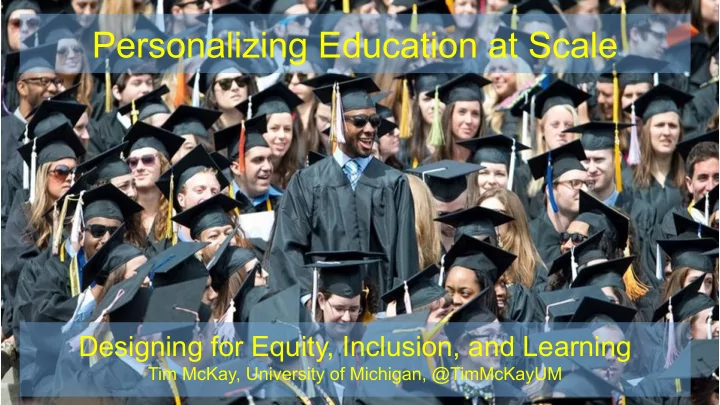
Personalizing Education at Scale
Designing for Equity, Inclusion, and Learning
Tim McKay, University of Michigan, @TimMcKayUM
SLIDE 2
SLIDE 3
SLIDE 4 Birth of the industrial university
- By 1900, enrollment had tripled, to
3482: the industrial era had begun
- By 1950, enrollment expanded by
more than 10x, to 43,683
- Michigan became a model for a
modern public research university
- Graduation indoors became
impossible…
- Today: students from all 50 US
states and 125 countries
1949 Graduation
SLIDE 5
SLIDE 6
SLIDE 7
SLIDE 8
SLIDE 9
SLIDE 11
…
SLIDE 12
SLIDE 13
#1: Data for decision support
Providing data to students helps to support better decision making.
SLIDE 14
SLIDE 15 Atlas provides students, faculty, and staff with historical data about courses, instructors, and academic majors. The goal is to support better decision making by all.
SLIDE 16 Atlas course reports describe who takes a course, how they do, what they take before and after, what they go on to major in...
SLIDE 17
SLIDE 18
SLIDE 19 Atlas major reports describe who majors in a subject, what they take along the way, how long it takes for them to complete their degree...
SLIDE 20
SLIDE 21
Data for decision support
How can we extend this beyond course and major selection to support decision making for life?
SLIDE 22
SLIDE 23
SLIDE 24
SLIDE 25
A caution about decision support...
Data like this can also be used to make forceful recommendations, as is regularly the case in the commercial world. We should be careful to preserve student exploration and support real freedom of choice.
SLIDE 26
#2: Data for personalization
How can use data and behavioral science to tailor messaging and shape more successful students, even when teaching thousands?
SLIDE 27
Large foundational courses present a challenge.
How to provide every student w/personalized feedback, encouragement, & advice?
SLIDE 29
SLIDE 30
SLIDE 31
SLIDE 32
Designing and testing research-based interventions
SLIDE 34
SLIDE 35
SLIDE 36
SLIDE 37
SLIDE 39
SLIDE 40
#3: Data for discovery
Careful analysis of prior student experiences can be used to explore student success and test learning environments for equity.
SLIDE 41
SLIDE 44
SLIDE 45
SLIDE 46 46
Intro Econ Lecture Course
SLIDE 47
…
SLIDE 48
#4: Data to drive change
Discoveries based on robust data can motivate change, both within an institution and across the landscape of higher education.
SLIDE 49
SLIDE 50
SLIDE 52
SLIDE 53
…
SLIDE 54