Personalizing Care Plans for Survivors Who Receive Hematopoietic - - PowerPoint PPT Presentation

personalizing care plans for survivors who receive
SMART_READER_LITE
LIVE PREVIEW

Personalizing Care Plans for Survivors Who Receive Hematopoietic - - PowerPoint PPT Presentation

Personalizing Care Plans for Survivors Who Receive Hematopoietic Cell Transplant for Cancer Treatment Karen L Syrjala, PhD ksyrjala@fredhutch.org Barry A Schatz bschatz@illinois.edu Member, Director of Biobehavioral Sciences Bone Marrow


slide-1
SLIDE 1

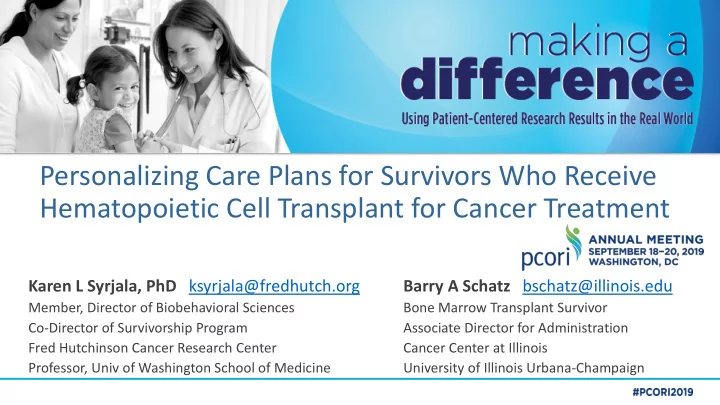
Personalizing Care Plans for Survivors Who Receive Hematopoietic Cell Transplant for Cancer Treatment

Karen L Syrjala, PhD ksyrjala@fredhutch.org

Member, Director of Biobehavioral Sciences Co-Director of Survivorship Program Fred Hutchinson Cancer Research Center Professor, Univ of Washington School of Medicine

Barry A Schatz bschatz@illinois.edu

Bone Marrow Transplant Survivor Associate Director for Administration Cancer Center at Illinois University of Illinois Urbana-Champaign

slide-2
SLIDE 2

2

Karen Syrjala & Barry Schatz

  • Have nothing to disclose
slide-3
SLIDE 3

3

What are we talking about?

  • The Big Picture
  • Why cancer survivorship care matters to all of us
  • The Up-Close, Personalized Picture
  • How is hematopoietic cell transplant (HCT) both unique and

relevant to other survivors’ health needs

  • Our national study that provided Survivorship Care Plans to

HCT survivors

  • Why and How we partner then and still
slide-4
SLIDE 4

4

41% lifetime cancer risk 1 in 2 men 1 in 3 women

5-year relative survival rate:

  • 80% of children
  • 69% of adults

if diagnosed 2006-2012

slide-5
SLIDE 5

5

41% lifetime cancer risk

67% were diagnosed 5 or more years ago

de Moor J S et al. Cancer Epidemiol Biomarkers Prev 2013;22:561-570 American Cancer Society. Cancer Treatment & Survivorship Facts & Figures. Atlanta: ACS; 2017 & 2018

slide-6
SLIDE 6

6

Ca Cancer & r & H HCT S Survivor Ch r Challenges

Wellness & PsychoSocial

Mental health Employment Education Social interactions/support Chronic symptoms: Fatigue, Cognition, Insomnia, Neuropathy Lifestyle Physical function

Environment & Finances

Family / Caregiver function Access to health & resources Insurance Financial toxicity

Organ Function

Cardiac

Endocrine Musculoskeletal Genitourinary GI/Hepatic Neurologic Pulmonary

Subsequent Malignancies

Recurrent cancer New cancers

Fertility & Reproduction

Fertility Health of offspring Sexual functioning

slide-7
SLIDE 7

7

HCT S Surviv ivor C Challe llenges

9-fold increased risk of dying continues for adult transplant recipients who survive 5-25 years

Median age 45 at HCT

  • 13.5% of allogeneic survivors
  • 19% of autologous survivors

Syrjala, JCO, 2012

slide-8
SLIDE 8

8

Ca Cancer & r & H HCT S Survivor Ch r Challenges

Unmet Needs among Cancer Survivors

Percentage of Survivors Percentage of Survivors Reporting Need, 4–14 Years Reporting Need, after 2–5 Years Postdiagnosisa Postdiagnosisb

Need Category Symptoms and side effects 76 63 Tests and treatment 72 71 Health promotion 65 68 Interpersonal and emotional 6 54 Insurance 39 42 Sexual functioning/fertility 35 31

Number of information needs is inversely related to mental well-being

aKent et al. Patient Ed Couns, 2012 & bBeckjord et al, 2008

slide-9
SLIDE 9

9

Cancer & HCT Survivors Why Do Survivors & Providers Need Survivorship Care Plans?

  • Many survivors do not know what they need: what is ‘normal’
  • Unaware of what tests and follow up visits they need
  • Unsure which health care specialists they should see and for what
  • Unsure how they ‘should feel’
  • Care Coordination is unclear
  • Health care providers may not know about transplant needs
  • If patients look fine and do not complain, health care providers assume all is well
  • Lack access to survivorship care
  • Services are not available or survivors cannot take advantage of services
slide-10
SLIDE 10

10

HCT Survivors

Transplant survivors are distinct from other cancer survivors and unique among themselves They may have lessons for other cancer survivors or people with living with chronic conditions

  • Transplant is a highly specific situation with great variability

in needs both medically and personally

  • Multitude of diseases treated with transplant
  • Challenge to adapt care to the diversity of pathways and care needs
  • Potential to translate methods to other diseases
slide-11
SLIDE 11

As Survivors: Can get lost on a confusing, unfamiliar journey Goal of Survivorship Care Plans: Provide a roadmap back to a fulfilled life, Powered to take care of health needs and know what to ask of providers

slide-12
SLIDE 12

12

Survivorship Care Plan Study

slide-13
SLIDE 13

13

Survivorship Care Plan Study

A National Multicenter Randomized Controlled Trial

  • Participating transplant centers (Site PI’s)

− Baylor University Medical Center (J Reynolds) − Cleveland Clinic (N Majhail) − Fred Hutchinson Cancer Research Center (KS Baker) − Kansas University Medical Center (J McGuirk) − Karmanos Cancer Institute (A Deol) − Loyola University (P Stiff) − Mayo Clinic, Arizona (N Khera) − Mayo Clinic, Rochester (S Hashmi) − Ohio State University (S Jaglowski) − Roswell Park Cancer Institute (T Hahn) − University of Florida (J Wingard) − University of Massachusetts (J Cerny) − University of Minnesota (S Holtan) − University of North Carolina (W Woods) − University of Pennsylvania (A Loren) − Vanderbilt University (B Savani)

  • Protocol Team Members
  • Patients and caregivers
  • National Marrow Donor Program/Be The Match

− Patient Services Advisory Group

  • CIBMTR

− Health Services Research Program − Resource for Clinical Investigation in Blood and Marrow Transplantation (RCI BMT)

  • Funding
  • PCORI award #CD-12-11-4062
slide-14
SLIDE 14

14

Survivorship Care Plan Study

Premise

  • Hematopoietic cell transplant (HCT) survivors are at high risk for late complications
  • Guidelines recommend life-long monitoring for screening and prevention of

HCT late effects

  • Followup recommendations based on: age, sex, HCT type, exposure to

total body irradiation or steroids, or chronic graft-versus-host disease (GVHD)

  • A Treatment Summary and Survivorship Care Plan (SCP) is a personalized tool

that may facilitate cancer survivor care

  • Provides summary of treatments, recommendations for monitoring for relapse,

screening and prevention of late effects, and other survivorship concerns

slide-15
SLIDE 15

15

Survivorship Care Plan Study

Study Concept: Centralized approach for SCP

Patient clinical data routinely submitted by transplant centers to CIBMTR HCT exposures

 Age  Sex  Auto vs Allo  TBI  Chronic GVHD  Steroids

Followup recommendations based on evidence-based guidelines

Personalized SCP, coordinated and mailed from national registry with call mechanisms in place for follow-up Test efficacy compared to usual care

slide-16
SLIDE 16

16

Survivorship Care Plan Study Patient & Other Stakeholder Contributions

  • Where we started with SCP
  • Where we ended up
slide-17
SLIDE 17

17

Survivorship Care Plan Study

Example of Original Treatment Summary and Care Plan

slide-18
SLIDE 18

18

Survivorship Care Plan Study

Example of Original Treatment Summary and Care Plan

slide-19
SLIDE 19

19

Survivorship Care Plan Study

Example of Revised Treatment Summary and Care Plan

slide-20
SLIDE 20

20

Survivorship Care Plan Study

Example of Revised Treatment Summary and Care Plan

slide-21
SLIDE 21

21

Survivorship Care Plan Study Randomized Study Primary Objective:

Change from baseline to 6 months in:

  • Confidence in Survivorship Information
  • HCT treatment distress assessment
  • Mental health score on SF-36
slide-22
SLIDE 22

22

Survivorship Care Plan Study Study Flow Diagram

slide-23
SLIDE 23

23

Survivorship Care Plan Study

Survivorship Care Plan Results in Brief

*P-value based on analysis of covariance model with center-level random effects

Majhail et al. Haematologica, 2018, PMID: 30514795

slide-24
SLIDE 24

24

Survivorship Care Plan Study

Qualitative Assessment Of Patient Feedback

  • Dominant themes from patients receiving the SCP:
  • Enhanced understanding of transplant treatments and effects
  • Helped survivors focus on overall health
  • Supported patients in communicating and making care decision with providers
  • Facilitated coping and emotional health

“It enabled me, or gave

me the knowledge to let local health providers know what they need to know … to

challenge them if they didn't think I needed certain followup” “They have made me aware of what I’ve been through and what is important for my well- being … the care plan

and summary have given me a lot of confidence”

“It really got me to go for my mammogram, blood work and I just scheduled a colonoscopy …

it made me look at the bigger picture of my health”

“Care plan has been helpful to me and my husband both … to

know that certain things are not unusual … to ‘not get

bent out of shape’”

slide-25
SLIDE 25

25

Survivorship Care Plan Study Lessons Learned, Implications & What’s Next

  • Survivorship Care Plans reduce distress in people who use the materials
  • One size does not fit all: Need personalized options to fit the materials into their own lives
  • Partnering: without patients/survivors in our survivorship program development and

research, the program may work for the health care system, but not for them

  • Need live, adaptable Survivorship Care Programs – survivorship is not a ‘phase’

it’s the rest of life

  • Need to extend the impact of survivorship care plans to improve health outcomes

Next:

  • INSPIRE Study: Mailed hard copy + Mobile App + Website to create a

living document that is interactive, personalized, updated in real time Plus ‘stepped care’: Telehealth follow-up for those who need it

slide-26
SLIDE 26

26

Questions? Discussion

Thank You!

Learn More:

PCORI website info@pcori.org Karen Syrjala ksyrjala@fredhutch.org Barry Schatz bschatz@illinois.edu