MOL2NET, 2017 , 3, doi:10.3390/mol2net-03-xxxx 2 Mycobacterium - - PDF document

mol2net 2017 3 doi 10 3390 mol2net 03 xxxx 2
SMART_READER_LITE
LIVE PREVIEW

MOL2NET, 2017 , 3, doi:10.3390/mol2net-03-xxxx 2 Mycobacterium - - PDF document

MOL2NET, 2017 , 3, doi:10.3390/mol2net-03-xxxx 1 MOL2NET, International Conference Series on Multidisciplinary Sciences MDPI http://sciforum.net/conference/mol2net-03 Synthesis and Anti-mycobacterial evaluation of coumarin derivatives Arajo,


slide-1
SLIDE 1

MOL2NET, 2017, 3, doi:10.3390/mol2net-03-xxxx 1

MDPI

MOL2NET, International Conference Series on Multidisciplinary Sciences http://sciforum.net/conference/mol2net-03

Synthesis and Anti-mycobacterial evaluation of coumarin derivatives

Araújo, R. S. A. (E-mail: rodrigobiologojp@gmail.com)a, Luna, K. P. O.(E-mail: karlaceatox@yahoo.com.br)b, Montenegro, L. M. L. (E-mail: lilian.lapamontenegro@hotmail.com)b, Lima, A. S.(E-mail: andreasantoslima@hotmail.com)b, Moura, R. O. (E-mail: ricardo.olimpiodemoura@gmail.com)a, Barbosa-Filho, J. M. (E-mail: jbarbosa@ltf.ufpb.br)c, Mendonça-Júnior, F. J. B. (E-mail: franciscojbmendonca@yahoo.com.br)a.

aSynthesis and Drug Delivery Laboratory, State University of Paraíba, Campus V, João Pessoa, PB,

Brazil.

bOswaldo Cruz Foundation, Aggeu Magalhães Research Center, Recife, PE, Brazil. cPostgraduate Program in Natural and Synthetic Bioactive Products, Federal University of Paraíba,

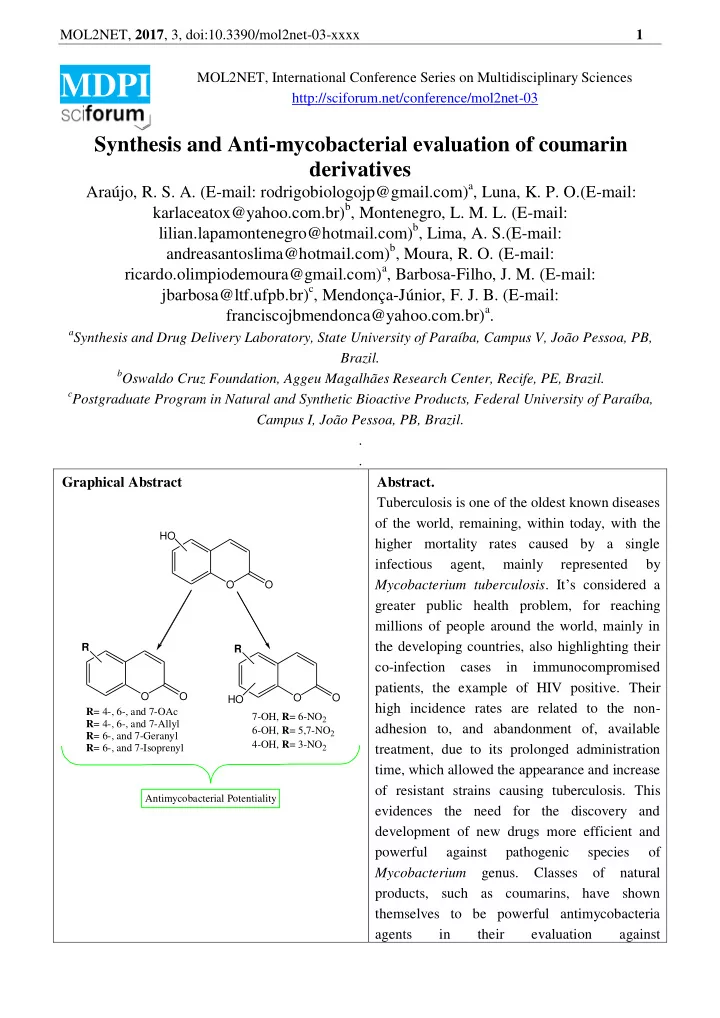
Campus I, João Pessoa, PB, Brazil. . . Graphical Abstract

O O HO O O R O O R HO R= 4-, 6-, and 7-OAc R= 4-, 6-, and 7-Allyl R= 6-, and 7-Geranyl R= 6-, and 7-Isoprenyl 7-OH, R= 6-NO2 6-OH, R= 5,7-NO2 4-OH, R= 3-NO2 Antimycobacterial Potentiality

Abstract. Tuberculosis is one of the oldest known diseases

  • f the world, remaining, within today, with the

higher mortality rates caused by a single infectious agent, mainly represented by Mycobacterium tuberculosis. It’s considered a greater public health problem, for reaching millions of people around the world, mainly in the developing countries, also highlighting their co-infection cases in immunocompromised patients, the example of HIV positive. Their high incidence rates are related to the non- adhesion to, and abandonment of, available treatment, due to its prolonged administration time, which allowed the appearance and increase

  • f resistant strains causing tuberculosis. This

evidences the need for the discovery and development of new drugs more efficient and powerful against pathogenic species

  • f

Mycobacterium genus. Classes of natural products, such as coumarins, have shown themselves to be powerful antimycobacteria agents in their evaluation against

slide-2
SLIDE 2

MOL2NET, 2017, 3, doi:10.3390/mol2net-03-xxxx 2 Mycobacterium strains. Thus, this work shows the synthesis, from protocols of O-Alkylation, O-Acetylation and Nitration well described in the literature, of coumarin derivatives, in good to greater yields, in most cases. This semi-synthetic derivatives, together with some commercial coumarins were evaluated according their antimycobacterial activities against M. tuberculosis H37Rv strains, where all compounds demonstrated actives against the tested strains, inhibiting the growth of M. tuberculosis after eight weeks of observation (in in 100 µg/mL), being more active than standard- drug used, Isoniazid, which non-inhibiting the growth of pathogens after the fourth week. Showing themselves as therapeutic alternatives in the development of new antimycobacterial active compounds. Introduction Historically, tuberculosis is one of the oldest known diseases, remaining, within today, with the higher mortality rates caused by a single infectious agent1, which is represented by species of the genus Mycobacterium, mainly by microorganisms of the Mycobacterium tuberculosis specie, and, secondarily, by M. bovis and M. africanum species1-5. This disease is characterized by affecting the airways of infected patients, being responsible for causing the death of about 2 million of people for year, all around the world6,7, besides 8 million additional cases annually, especially in developing

  • countries8. According to World Health Organization (WHO), these numbers should continue to grow

in the coming years, if control of this is not strengthened8. This high incidence rate of tuberculosis is often related to co-infection in immunocompromised patients, such as individuals afflicted with HIV9, to the point of being registered, by WHO, in the period from 2000 to 2006, about 700,000 cases of tuberculosis in Brazil, of which 60,000 infected they died, being 20% of these associated to patients co-infected with the HIV virus2,8. Their high incidence numbers made with that tuberculosis to be treated as a great public health problem, mainly by high rates of non-adherence to, and abandonment of, available treatments and/or by the appearance of multi-drug resistant strains of tuberculosis (MDR-TB)6. Failure to realization or complete treatment, considered as prolonged administration, appear as the main causes of the onset of mycobacterial resistance against the drugs used, as Isoniazid and Rifampicin, or combination of these with Ethambutol or Pyrazinamide, for example10,11. This facts reinforce the great need of development of potent new anti-tuberculosis agents more efficient and secure and with therapies of shorter duration when related at drugs currently utilized7,12. In this aspect, natural compounds and their derivatives has been shown as potent against Mycobacterium sp. Strains7,12, such as coumarins, which are characterized for being formed by the fusion between benzene and α-pyrone rings13, and are widely used according to their biological

slide-3
SLIDE 3

MOL2NET, 2017, 3, doi:10.3390/mol2net-03-xxxx 3 potentialities, highlighting as antibacterial14, antifungal15, anti-inflammatory16, antitumor17, anticoagulant18, antimycobacterial19, among others. In view of the greater need in the discovery of new compounds with antimycobacterial potentiality, and the greater variety of biological activities of coumarin compounds, the aim of this work was the synthesis and evaluation of the antimycobacterial potential of coumarin derivatives against M. tuberculosis strains. Materials and Methods Synthesis of coumarin derivatives The semi-synthetic coumarin derivatives was obtained through of standard procedures for O- alkylation, O-acetylation and Nitration of commercial coumarins (4-hydroxy-2H-1-benzopyran-2-one (1), 5-hydroxy-2H-1-benzopyran-2-one (2) and 7-hydroxy-2H-1-benzopyran-2-one (3)) (Figure 1), and previously described15. Figure 1. Synthesis of coumarin derivatives.

O O O O O O O O RO AcO HO O2N O

  • A

c e t y l a t i

  • n

O-Alkylation Nitration 4: 7-Alyl: 56,7% 5: 7-Geranyl: 45,5% 6: 7-Isoprenyl: 90% 7:6-Isoprenyl: 86% 8: 6-Geranyl: 13,5% 9:6-Alyl: 66,7% 10: 4-Alyl: 78% 11: 7-OAc: 90% 12: 6-OAc: 76,7% 13: 4-OAc: 86% 14: 7-OH, 6NO2: 84% 15: 6-OH, 5,7-NO2: 70% 16: 4-OH, 3-NO2: 53,3% 1: 4-OH 2: 6-OH 3: 7-OH HO Reagents and Conditions: Alkylation - K2CO3, Alkyl Halides (Alyl Bromide, Isoprenyl Bromide and Geranyl Bromide), Acetonitrile, reflux, 22-46h. Acetylation - Acetic Anhydride, Pyridine, ultradound, room temperature, 15-30 min. Nitration - Nitric/Acetic Acids, Ice bath - room temperature, 120 min.

All final compounds had their structures proven by 1H and 13C NMR and physicochemical characteristics described15. Commercial coumarin derivatives also were analyzed according to their antimycobacterial activity (Figure 2). Figure 2. Commercial coumarin derivatives analyzed.

O O 17: R1=R2=R3=R4=R5=H 18: R1=OH, R2=R3=R4=R5=H 19: R1=R2=R5=H, R3=R4=OH 20: R1=COOH, R2=R3=R4=R5=H 21: R1=Bis-4-OH-Coumarin, R2=OH,R3=R4=H 22: R1=R2=R5=H, R3=OMe, R4=OH 23: R1=R2=H, R3=OMe, R4=R5=OH R2 R3 R4 R5 R1

Antimycobacterial Activity Assays The antimycobacterial activity assays were performed using a concentration of 100 µg/mL of the test drugs in Löwenstein-Jensen medium. The H37Rv Mycobacterium tuberculosis strains were diluted in distilled water (Mc Farland scale – 3x10⁸ microrganisms/mL) and inoculated in the media containing the drugs to be tested. The controls were composed of simple and in the presence of

slide-4
SLIDE 4

MOL2NET, 2017, 3, doi:10.3390/mol2net-03-xxxx 4 isoniazide in the concentration to 0.2 µg/mL Löwenstein-Jensen medium. The containers were placed in stove at 37°C, where were observed once a week until the 8th week for the analysis of bacterial growth or not. The reference drug used was isoniazid. Results and Discussion The semi-synthetic coumarin derivatives were obtained from O-alkylation, O-acetylation and Nitration procedures since 4-, 6- and 7-hydroxylated commercial coumarins, as previously described15 in good to greater yields, in most cases, as demonstrated in Figure 1. As demonstrated in the Table 1, all coumarin derivatives analyzed were able of inhibit the growth of pathogenic strains of M. tuberculosis after the observation period of eight weeks, demonstrating values more active than the standard-drug used, Isoniazid, which did not inhibit the M. tuberculosis growth after the 4th week. Table 1. Inhibition of M. tuberculosis growth in the presence of the coumarin derivatives analyzed. This results demonstrated the antimycobacterial potential of coumarin derivatives as growth inhibitors of M. tuberculosis, main etiological agent causing tuberculosis in humans, can present themselves as an alternative for the treatment of infections by this pathogen. Confirming the potentiality of coumarins against Mycobacterium pathogen strains results showed in the literature. Conclusions These results allowed the synthesis of semi-synthetic coumarin derivatives by O-Alkylation, O- Acetylation and Nitration in good to excellent yields, in most cases, which were evaluated according to their antimycobacterial activity against Mycobacterium tuberculosis, where all semi-synthetic and

slide-5
SLIDE 5

MOL2NET, 2017, 3, doi:10.3390/mol2net-03-xxxx 5 commercial derivatives to be proved potential inhibitors of the M. tuberculosis growth. Can be an important alternative in the search of new antimycobacterial drugs. References

1Gale, G. A.; Kirtikara, K.; Pittayakhajonwut, P.; Sivichai, S.; Thebtaranonth, Y.; Thonqpanchang, C.;

Vichai, V. In search of cyclooxygenase inhibitors, anti-Mycobacterium tuberculosis and anti-malarial drugs from Thai flora and microbes. Pharmacology & Therapeutics. v. 115, p. 307-351, 2007.

2De Souza, M. V. N.; Facchinetti, V.; Cardinot, D.; Gomes, C. R. B. Produtos naturais com atividade

inibitória da Translocase I, uma promissora classe de compostos contra tuberculose. Boletín Latinoamericano y Del Caribe de Plantas Medicinales y Aromáticas. v. 9, n. 1, pp. 1-12, 2010.

3Xu, Z. Q.; Barrow, W. W.; Sulling, W. J.; Westbrook, L.; Barrow, E.; Lin, Y. M.; Flavin, M. T. Anti-

HIV natural product (+)-calanoide A is active against both drug-susceptible and drug-resistant strains

  • f Mycobacterium tuberculosis. Bioorganic & Medicinal Chemistry. v. 12, pp. 1199-1207, 2004.

4Brown, C. W.; Liu, S.; Klucik, J.; Berlin, K. D.; Brennan, P. J.; Kaur, D.; Benbrook, D. M. Novel

heteroarotinoids as potential antagonists of Mycobacterium bovis BCG. Journal of Medicinal

  • Chemistry. v. 47, pp. 1008-1017, 2004.

5Kossuga, M. H.; Lira, S. P.; Nascimento, A. M.; Gambardella, M. T. P.; Berlinck, R. G. S.; Torres, Y.

R.; Nascimento, G. G. F.; Pimenta, E. F.; Silva, M.; Thiemann, O. H.; Oliva, G.; Tempone, A. G.; Melhem, M. S. C.; Souza, A. O.; Galetti, F. C. S.; Silva, C. L.; Cavalcanti, B.; Pessoa, C. O.; Moraes,

  • M. O.; Hadju, E.; Peixinho, S.; Rocha, R. M. Isolamento e atividades biológicas de produtos naturais

das esponjas Monanchora arbuscula, Aplysina sp., Petromica ciocalyptoides e Topsentia

  • phiraphidites, da ascídia Didemnum ligulum e do octcoral Carijoa riisei. Química Nova. v. 30, n. 5,
  • pp. 1194-1202, 2007.
  • 6WHO. World Health Organization. Global tuberculosis control – surveillance, planning, financing.

2007.

7Pauli, G. F.; Case, R. J.; Inui, T.; Wang, Y.; Cho, S.; Fischer, N. H.; Franzblau, S. G. New

perspectives on natural products in TB drug research. Life Sciences. v. 78, pp. 485-494, 2005.

  • 8WHO. World Health Organization. Global tuberculosis control: a short uptake to the 2009 report.

2009.

9Corbett, E. L.; Watt, C. J.; Walker, N.; Maher, D.; Williams, B. G.; Raviglione, M. C.; Dye, C. The

growing burden of tuberculosis: global trends and interactions with the HIV epidemic. Archives of Internal Medicine. v. 163, pp. 1009-1021, 2003.

10De Souza, M. V. N. Tuberculose em pacientes HIV-positivos: um grave problema de saúde pública

  • mundial. Revista Brasileira de Farmácia. v. 87, pp. 42-44, 2006.

11De Souza, M. V. N. Currently status and future prospects for new therapies for pulmonar

  • tuberculosis. Current Opinion in Pulmonary Medicine. v. 12, n. 3, pp. 167-171, 2006.

12Okunade, A. L.; Elvin-Lewis, M. P. F.; Lewis, W. H. Natural antimycobacterial metabolites: current

  • status. Phytochemistry. v. 65, pp. 1017-1032, 2004.

13Borges, F.; Roleira, F.; Milhazes, N.; Santana, L.; Uriarte, E. Simple coumarins and analogues in

medicinal chemistry: Ocurrence, synthesis and biological activity. Current Medicinal Chemistry. v. 12,

  • pp. 887-916, 2005.

14Hamdi, N.; Al-Ayed, A. S.; Ben Said, R.; Fabienne, A. Synthesis and characterization of new

thiazolidinones containing coumarin moieties and their antibacterial and antioxidant activities.

  • Molecules. v. 17, pp. 9321-9334, 2012.
slide-6
SLIDE 6

MOL2NET, 2017, 3, doi:10.3390/mol2net-03-xxxx 6

15Araújo, R. S. A.; Guerra, F. Q.; Lima, E. O.; De Simone, C. A.; Tavares, J. F.; Scotti, M. T.; Aquino,

  • T. M.; Moura, R. O.; Mendonça-Junior, F. J. B.; Barbosa-Filho, J. M. Synthesis, structure-activity

relationships (SAR) and in silico studies of coumarin derivatives with antifungal activity. International Journal of Molecular Sciences. v. 14, pp. 1293-1309, 2013.

16Onuma, K.; Suenaga, Y.; Sakaki, R.; Yoshitome, S.; Sato, Y.; Ogawara, S.; Suzuki, S.; Kuramitsu,

Y.; Yokoyama, H.; Murakami, A.; Hamada, J.; Nicolson, G. L.; Kobayashi, M.; Fujii, J.; Okada, F. Development of a quantitative bioassay to assess preventive compounds against inflammation-based

  • carcinogenesis. Nitric Oxide-Biology and Chemistry. v. 25, pp. 183-194, 2011.

17Benci, K.; Mandić, L.; Suhina, T.; Sedić, M.; Klobucar, M.; Kraljević Pavelić, S.; Pavelić, K.;

Wittine, K.; Mintas, M. Novel coumarin derivatives containing 1,2,4-triazole, 4,5-dicyanoimidazole and purine moieties: Synthesis and evaluation of their cytostatic activity. Molecules. v. 17, pp. 11010- 11025, 2012.

18Stefanou, V.; Matiadis, D.; Melagraki, G.; Afantitis, A.; Athanasellis, G.; Igglessi-Markopoulou, O.;

McKee, V.; Markopoulos, J. Functionalized 4-hydroxycoumarins: Novel synthesis, Crystal structure and DFT calculations. Molecules. v. 16, pp. 384-402, 2011.

19Karali, N.; Kocabalkanli, .; Gürsoy, A.; Ates, O. Synthesis and antitubercular activity of 4-(3-

coumarinyl)-3-cyclohexyl-4-thiazolin-2-one benzylidenehydrazones. Farmaco. v. 57, n. 7, pp. 589- 593, 2002.