11/12/2013 Precision Medicine and Personalized Medicine Setting the - - PDF document

11 12 2013
SMART_READER_LITE
LIVE PREVIEW

11/12/2013 Precision Medicine and Personalized Medicine Setting the - - PDF document

11/12/2013 Precision Medicine and Personalized Medicine Setting the stage: Privacy, security, regulation, and voluntary data sharing within Precision Medicine UCSF Mini-Medical School November 7, 2013 Claire D. Brindis, Dr. P.H. Director,


slide-1
SLIDE 1

11/12/2013 1

Setting the stage: Privacy, security, regulation, and voluntary data sharing within Precision Medicine UCSF Mini-Medical School November 7, 2013

Claire D. Brindis, Dr. P.H. Director, Philip R. Lee Institute for Health Policy Studies Professor, Pediatrics and Health Policy

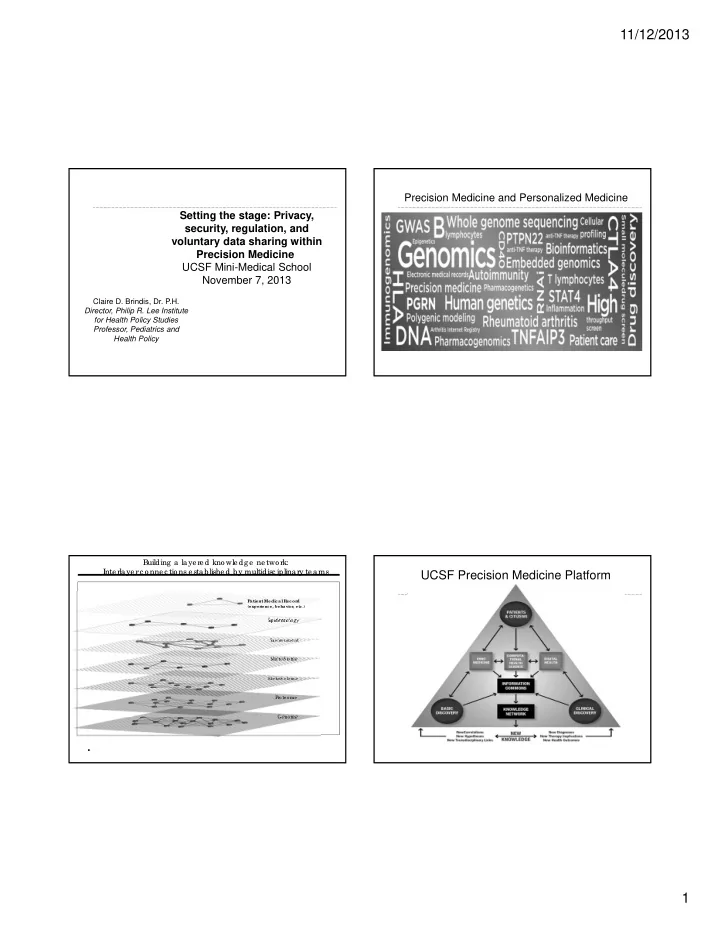
Precision Medicine and Personalized Medicine

Ge no me Me tabo lo me Mic r

  • bio me

E nviro nme nt E pidemiolo gy Patient Medic al R ec or d

(exper ience, behavior , etc.)

Pro teo me

Building a laye re d kno wle dge ne two rk: I nte rlaye r c o nne c tio ns e stablishe d by multidisc iplinary te ams

  • UCSF Precision Medicine Platform
slide-2
SLIDE 2

11/12/2013 2

UCSF Precision Medicine Platform

Regulatory Privacy Data Sharing Security

Consumer Engagement

Ability to Integrate practices and policies across three planes Ability to Integrate practices and policies across three planes

Biomedical continuum:

Build seamless links between basic discovery, translation, clinical care, patients, citizens

Biomedical continuum:

Build seamless links between basic discovery, translation, clinical care, patients, citizens

Transdisciplinary science:

Merge physics/chemistry/engineering/ Computation theory, concepts, methods into biomedical research

Transdisciplinary science:

Merge physics/chemistry/engineering/ Computation theory, concepts, methods into biomedical research

Stakeholder synergy:

Cooperate across .edu, .com, .org and .gov sectors and others Stakeholders

Stakeholder synergy:

Cooperate across .edu, .com, .org and .gov sectors and others Stakeholders

7

EMRs, diagnostic images Claims, revenue cycle Clinical trials, genomics Purchasing patterns, social media Geo-environmental, weather patterns, etc.

Table of Contents

slide-3
SLIDE 3

11/12/2013 3

Chinese Symbol for Change

Danger and Opportunity

From here to tomorrow: The Promise of Precision Medicine

What system infrastructure will be necessary? What health care systems will need to be in place to provide precision and personalized medicine? Along the continuum of health and illness, how could precision medicine be integrated? What will it take to create such a system?

slide-4
SLIDE 4

11/12/2013 4

Challenges in Implementation of Precision Medicine

1.

  • 1. Capacity to interpret genomic

sequence data? What genetic variants are ready for “translation with impact” on sufficiently large proportion of population?

Derive new insights from complex and large data sets.

Challenges in Implementation of Precision Medicine

  • 2. “$1,000 genome” -- Sequencing an

individual’s or a tumor’s entire genome can occur relatively inexpensively and can be offered as part of clinical care. Downstream interpretation will likely add significant costs (at least in the short term). Challenges in Implementation of Precision Medicine

  • 3. Are technological advances
  • utpacing our ability to use

information effectively?

  • 4. Are we as a society ready to make these

types of investments? Disparities?

Challenges in Implementation of Precision Medicine

  • 5. Regulatory issues - Examples

FDA Drug Approval Linking data from patient care with data from research. Precision Medicine needs to have identifiable data vs. basic and translational research use de-identified

  • r unidentifiable data.

Institutional Review Board requirements

slide-5
SLIDE 5

11/12/2013 5

Challenges in Implementation of Precision Medicine

  • 6. Determining Coverage and Reimbursement –
  • - Molecular testing codes
  • - Reimbursement concerns for patients
  • - Unclear value for payers

Challenges in Implementation of Precision Medicine

  • 7. Patient Confidentiality and Consent

Learning From the Past….. Challenges in Implementation of Precision Medicine

  • 8. System Capacity
  • Maintaining confidentiality and protection of

data

  • Standardized risk assessment tools
  • Integration of family health history into EMR
  • Develop capabilities (consent, interpretation,

counseling) for solving diagnostic dilemmas

  • Developing clinical decision support tools for

pharmacogenomics and diagnostic tests

slide-6
SLIDE 6

11/12/2013 6

Challenges in Implementation of Precision Medicine

  • 8. System Capacity (more….
  • Develop the policy agenda to support PPM
  • Assess genomic medicine literacy of patients

and providers

  • Education for the next generation of providers

and health care workforce

  • Active engagement of patients and their

families Challenges in Implementation of Precision Medicine –

  • 9. Intersection with Population Health?

Value

In the meantime…. Forecasting

slide-7
SLIDE 7

11/12/2013 7

Prediction is always difficult, especially about the future Niels Bohr

Ginsburg GS and Willard H Genomic and Personalized Medicine. Academic Press: 2012.

Time Cost Baseline Risk Preclinical Progression Clinical Disease and Progression Disease Burden

Treatment Prognosis Diagnosis Susceptibility Screening

The Opportunity for Genom e I nform ed Medical Care

Personal data value chain

Label Label Label

Dissemination

Processing and analysis Storage Data Collection

Establish Compatibility

The individual

  • Storage

protections may be different

  • Storage

location could be in different sovereign states

  • Storage

period can vary from

  • riginal

intent

  • Personal

data could be collected from the individual in either a passive or active manner

  • Collection of

data may be transferred to multiple stakeholders

  • Purpose of

analysis could change from

  • riginally

stated purpose * Intent of analysis and degree of anonymization) could change

  • Dissemination

could include transfer to different entities

  • r types of

entities

  • Levels of

protection and protection capacity can vary between parties

  • Different

purpose/use/ level of analysis

Questions in establishing a personal data value chain

Label Label Label

  • Who is the

collecting party?

  • What type of

entity are they?

  • What is the

purpose for which they are collecting data?

  • What type

and format is the data?

  • Where is the

data being stored?

  • What policies

are in place in the storage location

  • For how long?
  • What are the

protection methods (including technical and

  • rganizational?
  • How is the

data being processed?

  • At what level
  • f analysis?
  • In combination

with what

  • ther data

sets?

  • For what

purpose?

  • For whose

benefit?

  • Who is the data

being shared with?

  • Is it a different
  • rganization or

entity?

  • For what

purpose?

  • In what

location?

  • What security

mechanisms govern the transfer? Dissemination Processing and analysis Storage Collection

Establish Compatibility

Illustrative question set

The individual