A Primer on Precision Medicine: The Legal and Ethical Considerations - - PDF document

a primer on precision medicine
SMART_READER_LITE
LIVE PREVIEW

A Primer on Precision Medicine: The Legal and Ethical Considerations - - PDF document

A Primer on Precision Medicine: The Legal and Ethical Considerations Faced by Modern Medicines New Frontier By Elizabeth A. Scarola, Carlton Fields Tie National Institutes of Health (NIH) defjnes precision Precision medicine was thrust


slide-1
SLIDE 1

18 AHLA Connections April 2018

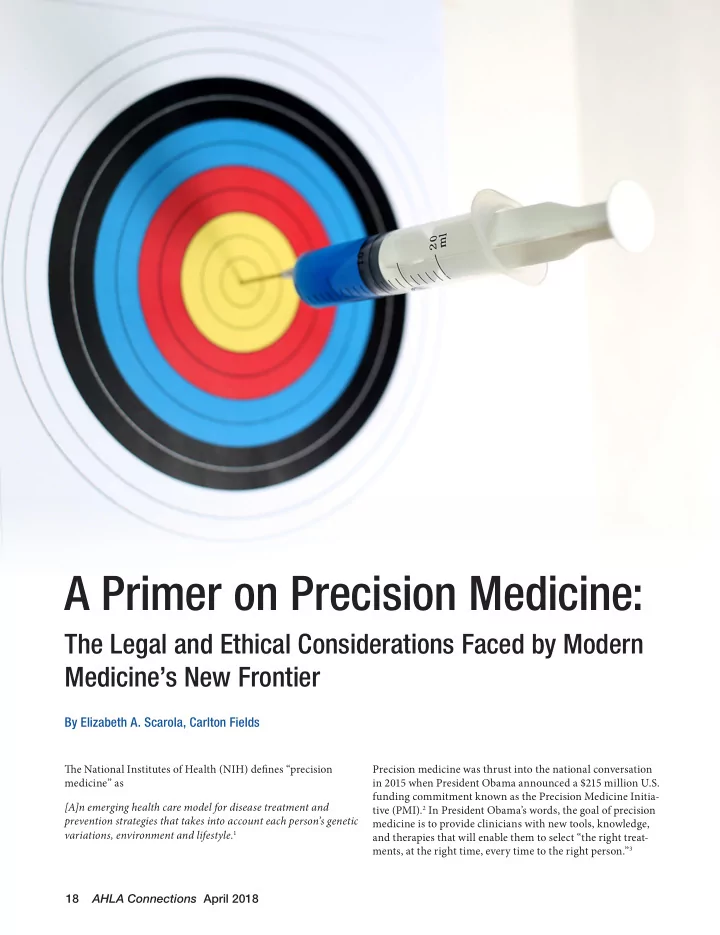
A Primer on Precision Medicine:

The Legal and Ethical Considerations Faced by Modern Medicine’s New Frontier

By Elizabeth A. Scarola, Carlton Fields

Tie National Institutes of Health (NIH) defjnes “precision medicine” as [A]n emerging health care model for disease treatment and prevention strategies that takes into account each person’s genetic variations, environment and lifestyle.1 Precision medicine was thrust into the national conversation in 2015 when President Obama announced a $215 million U.S. funding commitment known as the Precision Medicine Initia- tive (PMI).2 In President Obama’s words, the goal of precision medicine is to provide clinicians with new tools, knowledge, and therapies that will enable them to select “the right treat- ments, at the right time, every time to the right person.”3

slide-2
SLIDE 2

healthlawyers.org 19 PMI drastically expanded precision medicine’s presence in scientifjc research. As evidence, later this year, the PMI cohort program, “All of Us,” will begin enrolling participants in a million person data set of genetic, lifestyle, and health infor- mation for further study of the interaction of genetics, environ- ment, and lifestyle.4 Tiough scientists disagree about the extent to which precision medicine will translate into genuine improvements in health care delivery, even the most skeptical of experts cannot deny recent advancements in genetic testing and targeted ther- apeutics.5

Genetic Testing

Laboratories across the world assess risk and diagnose disease by analyzing genomes.6 Tie advent of 23andMe and other direct-to-consumer genetic testing products permit patients from their homes and personal computers to identify and assess their unique risk of developing disease.7 Although early genetic tests were developed to detect rare, relatively straightforward single-gene variations that were highly correlated with specifjc diseases, today’s genetic tests (e.g., next generation sequencing (NGS)) are able to detect a wide range of genetic variants from a single sample.8 NGS allows scientists to identify more common, complex diseases and provides patients information to assess their individual risk

  • f developing a myriad of diseases.9 In 2018, a single laboratory

can sequence an entire human genome in less than 24 hours for just under $1,000.10 For less than $200, 23andMe ofgers consumers “genetic health risk reports” that detect variants related to late-onset Alzheimer’s disease, Parkinson’s disease, alpha-1 antitrypsin defjciency, celiac disease, hereditary hemochromatosis, hereditary thrombophilia, and age-related macular degeneration.11

Targeted Therapeutics

Even more astounding is that scientists can now ofger certain patients targeted treatments for a variety of illnesses and condi- tions.12 Tiese targeted therapeutics provide medicines specifjed to treat individual genetic mutations with exactitude.13 Tie Food and Drug Administration (FDA) has approved a number of these medications.14 To name a few, targeted therapeutics are now made available for certain breast cancers, melanomas, colorectal cancers, leukemias, lymphomas, ovarian cancers, pancreatic cancers, rheumatoid arthritis, and lupus conditions. 15 In addition, recent advances in Clustered Regularly Inter- spersed Short Tandem Repeat (CRISPR) technology now allow scientists to artifjcially alter genes; the promise of CRISPR technology knows no bounds.16 Precision medicine’s emergence in modern day medicine is here; and, the potential that the fjeld ofgers is vast. However, its promise must manifest itself within our current legal and regulatory system; and, as every health care attorney knows, innovation is ofuen fraught with complex and sometimes novel legal and regulatory barriers.

Pre-Market Approval and Clinical Oversight: FDA and CMS

[T]he FDA is currently fjnding its regulatory foothold during [this] transition in the practice of medicine.17 Two federal regulatory agencies currently oversee the develop- ment of genetic diagnostic tests and targeted therapeutics: the FDA and the Centers for Medicare & Medicaid Services (CMS). Tie FDA is responsible for protecting and promoting public health by assuring “the safety, efgectiveness, [and] quality” of medical drugs and devices by the authority granted to it under the Federal Food, Drug and Cosmetic Act (FDCA) and the Medical Device Amendments of 1976.18 Consequently, the FDA is a gatekeeper to advances in precision medicine. For example, the FDA regulates in vitro diagnostic tests (IVDs) as a subset of medical devices.19 FDA approval of medical devices typically requires analytical and clinical validation.20 In the case of IVDs, manufacturers must prove that an IVD can (1) accurately identify a sample (i.e., accurately read a specifjc set of DNA bases in the human genome) and (2) link particular genetic variants to specifjc diseases (i.e., provide meaningful clinical information).21 Tiough this regulatory threshold seems simple enough, a narrow interpretation of the pre-market approval regulatory framework could lead to an unintended absurdity: namely that because the FDA typically bases its pre-market approval decision on evidence dependent

Though scientists disagree about the extent to which precision medicine will translate into genuine improvements in health care delivery, even the most skeptical of experts cannot deny recent advancements in genetic testing and targeted therapeutics.

slide-3
SLIDE 3

20 AHLA Connections April 2018 upon large, randomized clinical trials, the FDA could arguably require separate analytical studies to prove the analytical and clinical validation of each of the many billion nucleotides in the human genome.22 Congress recognized the barriers that the FDA’s regulatory policies posed to the technological advances anticipated by precision medicine. Tieir response was the 21st Century Cures Act (Act), which encouraged the FDA to develop new regula- tory approaches for the oversight of genetic technologies.23 Following the Act, the FDA issued two drafu guidances intended to address “issues that may arise when co-devel-

  • ping a therapeutic product and a corresponding companion

diagnostic.”24 Tie drafu guidances “recommend approaches to streamline the submission and review of data supporting the clinical and analytical validity” of genetic tests.25 Tie fjrst drafu guidance, the Use of Public Human Genetic Variant Databases to Support Clinical Validity for Next Genera- tion Sequencing-Based in Vitro Diagnostics, proposes to “allow developers to use data from FDA-recognized public databases

  • f genetic variants to support a test’s validity.”26 Tie second

drafu guidance, the Use of Standards in FDA Regulatory Over- sight of Next Generation Sequencing-Based In Vitro Diagnostics Used for Diagnosing Germline Diseases, proposes to “allow test developers to cite data and assertions from FDA-recognized public genome databases as valid scientifjc evidence to support clinical claims for their tests.”27 Tiough these drafu guidances are a start to streamlining regulations associated with pre-market approval of precision medicine devices, they are not the federal agency’s fjnal word

  • n precision medicine oversight. Tie FDA proclaims that their

recommendations may change, “as technology advances, stan- dards can be updated to help ensure test accuracy.”28 In addition to FDA oversight of precision medicine drugs and devices, the Clinical Laboratory Improvement Amend- ments of 1988 (CLIA) grants CMS regulatory oversight of clinical laboratories, including those operating with precision medicine devices and/or drugs.29 Unlike FDA requirements, CMS requirements do not address clinical validity. Instead, CLIA standards ensure the reliability and accuracy of labora- tory test results and address the overall operation of the labo- ratory by assessing the training of lab personnel, profjciency testing, and quality control.30 CLIA regulations “establish quality standards for laboratory testing performed on speci- mens from humans . . . for the purpose of diagnosis, preven- tion, or treatment of disease, or assessment of health.”31 Researchers and manufacturers must ensure that they adhere to and comply with FDA and CLIA standards; but, the buck does not stop there. Within the space of precision medi- cine, legal considerations associated with intellectual property abound.

Intellectual Property

In Moore v. Regents of California,32 Washington University

  • v. Catalona,33 and Greenberg v. Miami Children’s Hospital

Research Institute, Inc.,34 federal courts declined to recognize individual property interests in information obtained through analysis of their biological material.35 Tie courts reasoned that the recognition of personal property rights in genetic data would “cripple medical research.”36 Tiough these cases suggest that researchers and manufac- turers are no longer at risk of losing potential property interests in precision medicine to genetic donors, they must consider whether they will be able to obtain property interests, at all— especially when attempting to patent genetic information. In Ass’n for Molecular Pathology v. Myriad Genetics, Inc., the U.S. Supreme Court redefjned legal requirements for patent- able subject matter when it held that the sequence of naturally

  • ccurring DNA was not subject to patent protection.37 Efgec-

tively, the Court eliminated what some biopharma companies had seen as a risk of patent infringement. Alleviating this risk will likely open the diagnostic testing market to new entrants, which means that consumer protection regulations will be even more important to ensure product safety and prevent false or misleading marketing in the preci- sion medicine space.

Consumer Protection: Consent, Privacy, and Confjdentiality

Tiough bulk collection of our personal data is increasingly common, the linkage of genetic information, past medical history, lifestyle, and other personal information raises concerns about consent, privacy, and confjdentiality. Unlike credit card information, that can be modifjed if stolen, genetic information cannot. Genetic information is arguably the most personal of all data—we have one genome, for life. Scholars have identifjed concerns regarding the possibility that genetic information could be used for insurance rating, setting job qualifjcations, or marketing to specifjc individuals. However, as the promise of precision medicine is vast, patients will likely be willing to participate in precision medi- cine initiatives to the extent that they can rely on strong privacy and security protections.

[O]ne of the principal risks

  • f precision medicine is the

possibility that de-identifjed data would be re-identifjed and associated with the individuals that supplied such information.

slide-4
SLIDE 4

healthlawyers.org 21 Patients may be surprised that current Health Insurance Portability and Accountability Act (HIPAA) regulations do not require individual consent for data that has been “de-identi- fjed” so that it cannot be traced back to the original research participant.38 Some scholars argue that such “de-identifjed” research should be presumptively permitted without individual consent to eliminate regulatory hurdles to precision medicine research.39 Tiey argue that researchers should be deterred from immoral or illegal use of genetic information by common law liability.40 However, at least one scholar has noted a partic- ular weakness with this approach; that individuals who are more likely to carry genetic anomalies meriting study may be particularly sensitive to risks associated with re-identifjcation and less likely to participate in research, which would lead to systematic consent bias.41 Scholars subscribing to philosophies grounded in patient autonomy believe that all precision medicine initiatives should promote patient choice and trust through a dynamic and

  • ngoing informed consent process. Tiey argue that partici-

pants should be informed of how data will be collected and used, along with the potential risks and benefjts of participa- tion, including privacy and security risks.42 Afuer all, one of the principal risks of precision medicine is the possibility that de-identifjed data would be re-identifjed and associated with the individuals that supplied such information. Today, there is no general legal prohibition on re-identifjcation

  • f individuals from their genetic data. Tie ramifjcations of

re-identifjcation of de-identifjed data are concerning whether re-identifjcation is nefarious or accidental. Today, the HIPAA Privacy Rule permits all uses and disclosures of individually identifjable health information for treatment purposes without any consent or authorization by the patient.43 Tiis means that providers are permitted to access and disclose comprehensive and longitudinal genetic health information for treatment without any minimum limit.44 Tiat beings said, PMI’s “All of Us” research initiative recommends that participants must consent to collection of identifying information, with the understanding that it will be kept securely, and that they must provide permission to use identifjers, link data across disparate sources, and share data for future research uses.45 Patients may assume that they should have access to their full genetic reports. However, they may be surprised to know that in 2016, complaints were fjled with the Department of Health and Human Services (HHS) when patients alleged a leading diagnostic company refused to provide their full genetic reports.46 Tiough patients might assume that when new information is available regarding their genetic data, it will be made available to them; laws related to this idea have yet to be

  • developed. Tiese concerns are notable. As science advances,

there are inherent risks that companies may discover months afuer revealing genetic diagnosis to patients that initial genetic interpretations were incorrect. Will they have a duty to disclose the new information? In addition to concerns related to undeveloped privacy laws and regulations, the issue of whether targeted therapy and diagnostics is reimbursable by third-party payers is yet another unknown.

Reimbursement

As an approach that is playing an increasingly important role in

  • btaining genetic information from patients, [reimbursement for

precision medicine diagnostics and therapeutics] may be viewed by the public and private payors either positively, as an enabler of the promised benefjts of personalized medicine, or as “the perfect storm” resulting from the confmuence of high market demand, an unproven technology, and an unprepared delivery system.47 It is no secret that payers require persuasive scientifjc evidence to support claims of clinical utility before approving payment for diagnostic tests and targeted therapies. Seeking reimburse- ment for precision medicine diagnostics and therapeutics will require consideration of the value of such tests and treatments in meeting our broader health system needs. Tiough historically Medicaid has covered molecular diag- nostic tests for cancer, and Medicare now covers NGS reim- bursement, many other commercial payers have yet to follow suit.48 Reimbursement considerations are a substantial barrier to precision medicine’s growth. As recently as this January, one pharmaceutical company proposed a precision medicine drug should cost $850,000 per treatment.49 Separately, the Institute

Though these draft guidances are a start to streamlining regulations associated with pre-market approval of precision medi- cine devices, they are not the federal agency’s fjnal word on precision medicine

  • versight.
slide-5
SLIDE 5

22 AHLA Connections April 2018 for Clinical and Economic Review (IECR), an independent nonprofjt that evaluates drug efgectiveness, approved new CAR-T cancer therapies that genetically modify a patient’s own immune cells at $475,000 per treatment.50 Tie economic costs of developing targeted treatments matched to individual genomes are likely enormous.51 However, targeted treatments ofgered to individuals with certain genetic mutations may be cost-efgective, depending upon their costs.52 Reimbursement in the area of precision medicine is simply anyone’s guess—which brings to mind the multitude of ethical issues associated in the precision medicine industry.

Ethical Issues

Tie regulatory challenges presented by precision medicine are reformulations of old tensions: community welfare versus individual liberty, risk versus benefjt, autonomy versus paternalism.53 Many assume that precision medicine will be available to all

  • f us, with unrestricted access; but, this is unlikely the case.54

Tiough precision medicine ofgers great promise to those sufgering from disease, it has the potential to worsen existing disparities in health care delivery.55 Tiis could increase the gap between the least and most educated of health care consumers, and cannot be ignored as we develop policies related to the industry going forward.

Conclusion

Although signifjcant scientifjc advancements have been made, much is still unknown about the implications that precision medicine will have on our wellbeing and health care delivery

  • model. Tie voice of skeptics is heard. Many more clinical

trials will need to be designed and targeted therapies approved to truly reap the promises of the industry. Tie design and approval process is not without its legal and regulatory consid- erations; many of which have yet to be developed. Tiough it would be an ofgense to humankind for legal and regulatory requirements to obstruct the advancement and promise of precision medicine, the absence of such standards would inevitably pose grave risks to human life. All health care attorneys should invest time to consider the legal issues that overwhelm the scientists, providers, and tech companies entrenched in the promise of diagnosing and curing

  • disease. Each of us must promote the advent of medical innova-

tion by providing the requisite professional and legal guidance to leaders in the precision medicine industry. It is our profes- sional duty to assist these leaders in the navigation of complex and ever-evolving laws and regulations. Together, we promote safe, quality, effjcient health care delivery to all. Elizabeth (“Beth”) Scarola is an Associate in the health care practice group of Carlton

  • Fields. Ms. Scarola brings an insider’s perspec-

tive to her health care practice, and to the topic of precision medicine. In addition to her extensive work on strategic and operational projects for a large, statewide clinically integrated network, she has hands-on scientifjc research experience, having conducted research in pediatric endocrinology. As a BRCA+ “previvor” and health care law enthusiast, Ms. Scarola is passionate about navigating the complexity of health care regulation and policy to promote the promise of precision medicine. Ms. Scarola holds a Master in Medical Sciences from Boston University School of Medicine, a Master in Health Services Administra- tion from the University of Michigan School of Public Health, and law and undergraduate degrees from the University of Notre Dame. Thanks go out to the leaders of the Life Sciences Practice Group for sponsoring this feature article: Stefanie A. Doebler, Covington & Burling LLP, Washington, DC (Chair); Ryan S. Johnson, Fredrikson & Byron PA, Minneapolis, MN (Vice Chair—Publications); Sharon O. Small, Porzio Bromberg & Newman, Morris- town, NJ (Vice Chair—Membership); Leah G. Brownlee, Squire Patton Boggs, Cleveland, OH (Vice Chair—Stra- tegic Planning and Special Projects); Nicole A. Liffrig Molife, Latham & Watkins LLP, Washington, DC (Vice Chair—Research & Website); and Jackie Olson, Apple, Sunnyvale, CA (Vice Chair—Educational Programs). For more information about the Life Sciences Practice Group, visit www.healthlawyers.org/PGs. Follow us on Twitter @ AHLA_LS.

Though historically Medicaid has covered molecular diagnostic tests for cancer, and Medicare now covers NGS reim- bursement, many other commercial payers have yet to follow suit.

slide-6
SLIDE 6

healthlawyers.org 23

Endnotes

1 NAT’L INSTS. OF HEALTH, Precision Medicine (Jan. 11, 2018), available at http:// ghr.nlm.nih.gov/handbook/precisionmedicine?show=all. 2 Dianne Nicol, Tania Bubela, Don Chalmers, et. al., Precision medicine: drowning in a regulatory soup?, J. LAW AND THE BIOSCIENCES (May 4, 2016), available at https://www.researchgate.net/profjle/Jennifer_Fleming4/publi- cation/301913566_Precision_Medicine_Drowning_in_a_Regulatory_Soup/ links/572ff82e08aee022975b7023/Precision-Medicine-Drowning-in-a- Regulatory-Soup.pdf. 3 Remarks by the President on Precision Medicine (Jan. 30, 2015), available at https://obamawhitehouse.archives.gov/the-press-offjce/2015/01/30/ remarks-president-precision-medicine. 4 The Precision Medicine Initiative Cohort Program—Building a Research Foundation for 21st Century Medicine (Sept. 17, 2015), available at https:// www.nih.gov/sites/default/fjles/research-training/initiatives/pmi/pmi-work- ing-group-report-20150917-2.pdf. 5 Richard Harris, Will Gathering Vast Troves of Information Really Lead to Better Health?, NPR (Dec. 28, 2017), available at https://www.npr.org/ sections/health-shots/2017/12/28/572677879/will-gathering-vast-troves-of- information-really-lead-to-better-health. . 6 Id. 7 George J. Annas and Sherman Elias, 23andMe and the FDA, N. ENG. J.

  • MED. (Mar. 13, 2014), available at http://www.nejm.org/doi/full/10.1056/

nejmp1316367. 8 Francis S. Collins & Margaret A. Hamburg, First FDA Authorization for Next- Generation Sequencer, 369 N. ENG. J. MED. 2369, 2369 (2013), available at http://www.nejm.org/doi/full/10.1056/NEJMp1314561. 9 Francis S. Collins & Harold Varmus, A New Initiative on Precision Medicine, 372 N. ENG. J. MED. 793 (2015), available at http://www.nejm.org/doi/ full/10.1056/NEJMp1500523. 10 Peter Dockrill, You Can Now Sequence Your Entire Genome For Under $1,000 (Mar. 9, 2016), available at https://www.sciencealert.com/ you-can-now-sequence-your-entire-genome-for-under-1-000. 11 23andMe Genetic Health Risk Reports: What you should know, available at https://www.23andme.com/test-info/genetic-health/. 12 Hait, William N., Targeted cancer therapeutics, CANCER RESEARCH 69.4 (2009): 1263-1267, available at https://www.ncbi.nlm.nih.gov/ pubmed/19208830. 13 Id. 14 Examples of FDA-approved drugs tailored to individuals with specifjc molecular profjles include Imanitib, Dasatinib, Nilotinib, Bosutinib, Pontatinib, Erlotinib, Afatinib, Tramatenib, Crizotinib, Cetuximab, etc. See generally Overview of Targeted Therapies for Cancer, available at https://www.mycan- cergenome.org/content/molecular-medicine/overview-of-targeted-thera- pies-for-cancer/. . 15 Id. 16 Cong, Le, et al. Multiplex genome engineering using CRISPR/Cas systems, SCIENCE 339.6121 (2013): 819-823, available at https://www.ncbi.nlm.nih. gov/pubmed/23287718. 17 Kwon, Sarah Y., Regulating Personalized Medicine, BERKELEY TECH. L.J. 31 (2016): 931, available at https://scholarship.law.berkeley.edu/cgi/viewcontent. cgi?referer=https://www.google.com/&httpsredir=1&article=2129&context=btlj. 18 U.S. FOOD & DRUG ADMIN., FDA Fundamentals, available at http:///www.fda. gov/AboutFDA/Transparecy/Basics/ucm192695.htm. 19 FDCA defjnes IVDs as “an instrument, apparatus, implement, machine, contrivance, implant, in vitro reagent, or other similar or related article, including a component part, or accessory which is . . . intended for use in the diagnosis of disease or other conditions, or in the cure, mitigation, treat- ment, or prevention of disease.” 21 U.S.C. § 321 (h)(2)(2012). See U.S. FOOD & DRUG ADMIN., Draft Guidance for Industry, Clinical Laboratories, and FDA Staff: Framework for Regulatory Oversight of Laboratory Developed Tests (LDTs) 5 (Oct. 3, 2014), available at http://www.fda.gov/downloads/medical- devices/deviceregulationandguidance/guidancedocuments/ucm416685.pdf. 20 21 U.S.C. ch. 9 § 301 et seq. 21 Olsen, Dana, and Jan Trøst Jørgensen, Companion diagnostics for targeted cancer drugs–clinical and regulatory aspects, FRONTIERS IN ONCOLOGY 4 (2014), available at https://www.ncbi.nlm.nih.gov/pmc/articles/PMC4032883/. 22 Lander, Eric S, Cutting the Gordian helix—regulating genomic testing in the era of precision medicine, N. ENGL. J. MED. 372.13 (2015): 1185-1186, available at http://www.nejm.org/doi/full/10.1056/NEJMp1501964. 23 Pub. L. No. 114 – 255. 24 U.S. FOOD & DRUG ADMIN., Webinar – Draft Guidance on “Principles for Codevelopment of an In Vitro Companion Diagnostic Device with a Therapeutic Product” (Aug. 18, 2016), available at https://www.fda.gov/ MedicalDevices/NewsEvents/WorkshopsConferences/ucm511178.htm. 25 See U.S. FOOD & DRUG ADMIN., Precision Medicine (Dec. 21, 2017), available at https://www.fda.gov/medicaldevices/productsandmedicalprocedures/ invitrodiagnostics/precisionmedicine-medicaldevices/default.htm. 26 U.S. FOOD & DRUG ADMIN., Use of Public Human Genetic Variant Databases to Support Clinical Validity for Next Generation Sequencing (NGS)-Based In Vitro Diagnostics: Draft Guidance for Stakeholders and Food and Drug Administration Staff (2016). 27 U.S. FOOD & DRUG ADMIN., Use of Standards in FDA Regulatory Oversight of Next Generation Sequencing (NGS)-Based In Vitro Diagnostics (IVDs) Used for Diagnosing Germline Diseases (2016). 28 U.S. FOOD & DRUG ADMIN., Precision Medicine (Feb. 5, 2018), available at https://www.fda.gov/medicaldevices/productsandmedicalprocedures/invit- rodiagnostics/precisionmedicine-medicaldevices/default.htm 29 42 C.F.R. § 493 - Laboratory Requirements. 30 Id. 31 CTRS. FOR DISEASE CONTROL & PREVENTION, CLIA Law & Regulations (Mar. 16, 2015), available at http://wwwn.cdc.gov/clia/Regulatory/default.aspx. 32 793 P.2d 479 (Cal. 1990). 33 437 F. Supp. 2d 985 (E.D. Mo. 2006). 34 264 F. Supp. 2d 1064 (S.D. Fla. 2003). 35 Contreras, Jorge L., Genetic property, GEORGETOWN L.J. (2016), available at https://georgetownlawjournal.org/articles/196/genetic-property. 36 Greenberg, 264 F. Supp. 2d 1076. 37 Ass’n for Molecular Pathology v. Myriad Genetics, Inc., 133 S. Ct. 2107, 2111 (2013). 38 45 C.F.R. §§ 164.502(d)(2), 164.514(a) and (b). 39 Supra note 35. 40 Id. 41 Id. at 46 (citing INST. OF MED., Beyond the HIPAA Privacy Rule: Enhancing Privacy, Improving Health through Research 31 (Sharyl J. Nass et al. eds., 2009) at 209). 42 Id. at 18. 43 42 C.F.R. § 164.501. See also 42 C.F.R. § 164.506. 44 Rothstein, Mark A., Access to sensitive information in segmented electronic health records (2012), available at https://papers.ssrn.com/sol3/papers. cfm?abstract_id=2066120. 45 Precision Medicine Initiative: Data Security Policy Principles and Framework (May 25, 2016), available at https://allofus.nih.gov/sites/default/ fjles/security-principles-framework.pdf. 46 Joe Williams, Patients complain to HHS after fjrm denies them genetic test results, CQ ROLL CALL, 2016 WL 2941197 (May 20, 2016). 47 Deverka, Patricia A., et al., Special Supplement: Clinical Integration of Next Generation Sequencing: A Policy Analysis: Clinical Integration of Next Generation Sequencing: Coverage and Reimbursement Challenges, J.L.

  • MED. & ETHICS 42 (2014): 22-595.

48 Harkins, Megan, A Value-Based Approach to Insurer Coverage and Reimbursement for Molecular Diagnostic Tests, ANN. HEALTH L. ADVANCE DIRECTIVE 26 (2016): 1-43. 49 Caroline Hummer, Drugmakers see a pricing blueprint in an $850,000 gene therapy (Jan.12, 2018), available at https://www.reuters.com/article/ us-healthcare-conference-pricing-analysi/drugmakers-see-a-pricing-blue- print-in-an-850000-gene-therapy-idUSKBN1F11D2. 50 Bill Berkrot, Spark’s price for Luxturna blindless gene therapy too high: ICER, REUTERS, Jan. 12, 2018, available at https://www.reuters.com/article/ us-spark-icer/sparks-price-for-luxturna-blindness-gene-therapy-too-high- icer-idUSKBN1F1298. 51 Lyman, Gary H., and Harold L. Moses, Biomarker tests for molecularly targeted therapies—the key to unlocking precision medicine, NEW ENG. J.

  • MED. 375.1 (2016): 4-6, available at http://www.nejm.org/doi/full/10.1056/

NEJMp1604033. 52 Id. 53 Dianne Nicol, Tania Bubela, Don Chalmers, et. al., Precision medicine: drowning in a regulatory soup?, J.L. & BIOSCIENCES (May 4, 2016), available at https://academic.oup.com/jlb/article/3/2/281/1751241. 54 Rothstein, Mark A., and Phyllis Griffjn Epps, Ethical and legal implications of pharmacogenomics, NATURE REVIEWS GENETICS 2.3 (2001): 228-231, available at www.biology.ualberta.ca/courses.hp/gen418/nrg_pharmaco.pdf. 55 Kyle Brothers & Mark Rothstein, Ethical, Legal, and Social Implications of Incorporating Personalized Medicine into Healthcare, 11 PERS. MED. 43 (2015), available at https://www.ncbi.nlm.nih.gov/pmc/articles/PMC4296905/. .