Practical Experience with State-of-the-Art Surge Arrester Monitoring - - PowerPoint PPT Presentation

practical experience with state of the art surge arrester
SMART_READER_LITE
LIVE PREVIEW

Practical Experience with State-of-the-Art Surge Arrester Monitoring - - PowerPoint PPT Presentation

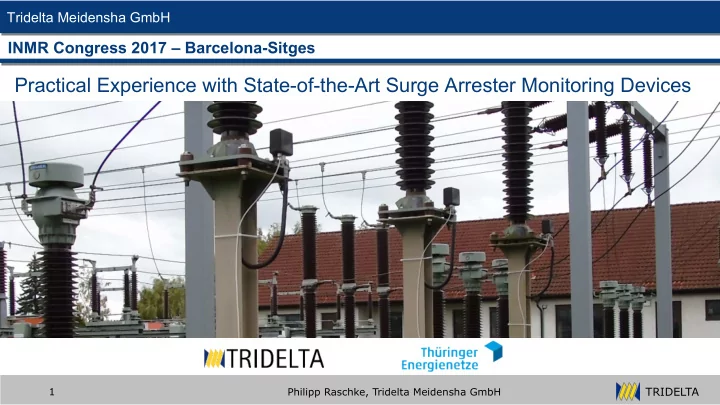
Tridelta Meidensha GmbH INMR Congress 2017 Barcelona-Sitges Practical Experience with State-of-the-Art Surge Arrester Monitoring Devices TRIDELTA 1 Philipp Raschke, Tridelta Meidensha GmbH Tridelta Meidensha GmbH INMR Congress 2017


slide-1
SLIDE 1

TRIDELTA

Tridelta Meidensha GmbH

Practical Experience with State-of-the-Art Surge Arrester Monitoring Devices

1 Philipp Raschke, Tridelta Meidensha GmbH

INMR Congress 2017 – Barcelona-Sitges

slide-2
SLIDE 2

TRIDELTA

Tridelta Meidensha GmbH

Leakage Current Evaluation - Questions to Solve How can I identify arrester defects using leakage current monitors? How do I differentiate between arrester defects and side effects? How can I reduce mistakes and misinterpretations in leakage current monitoring?

2 Philipp Raschke, Tridelta Meidensha GmbH

INMR Congress 2017 – Barcelona-Sitges

slide-3
SLIDE 3

TRIDELTA

Tridelta Meidensha GmbH

3 Philipp Raschke, Tridelta Meidensha GmbH

smartCOUNT Fieldtest 2017

Fieldtest 2017 – testing smartCOUNT surge arrester monitor under real conditions

  • Stage 1: Substation Hermsdorf (solved)
  • Stage 2: Substations in South America, Asia, Europe – 12 Substations

(running)

slide-4
SLIDE 4

TRIDELTA

Tridelta Meidensha GmbH

4 Philipp Raschke, Tridelta Meidensha GmbH

smartCOUNT Fieldtest 2017

  • 1. Experiences about arrester current behaviour under various conditions
  • Ambient temperature and sunlight radiation
  • Poor voltage quality
  • Outages, earth fault conditions
  • Fog, rain, humidity
  • Surface pollution
  • Humidity ingress
  • Varistor degradation
  • 2. Recommendations for arrester current interpretation and decision making

123rf.com

slide-5
SLIDE 5

TRIDELTA

Tridelta Meidensha GmbH

5 Philipp Raschke, Tridelta Meidensha GmbH

Leakage current - Temperature influences

MOV current is highly temperature sensitive

  • Influences of ambient temperature falsifies the significance of surge arrester health assessment
  • Temperature compensation is possible but depends on precise compensation models
  • Every MOV differs in it´s compensation model according to brand, class, diameter
  • Wrong compensation models lead to overcompensation (partial shading as well)

Overcompensated current values Current drops at high temperature Good compensation model à Stable values

slide-6
SLIDE 6

TRIDELTA

Tridelta Meidensha GmbH

6 Philipp Raschke, Tridelta Meidensha GmbH

Leakage current – Voltage influences

MOV current is highly voltage sensitive

  • Voltage fluctuations falsify the significance of surge arrester health assessment
  • Error ranges of >80% are possible
  • Voltage harmonics increase the error range in the calculated resistive current
  • Voltage fluctuation influences can be compensated by a voltage correction model
  • Voltage harmonic influences can be compensated by means of a field probe

Fluctuating resistive current due to fluctuating voltage and 3rd harm. Content in voltage

slide-7
SLIDE 7

TRIDELTA

Tridelta Meidensha GmbH

7 Philipp Raschke, Tridelta Meidensha GmbH

Leakage current – Fog, rain and humidity influences

Impact of Fog, rain and humidity on the arrester current

  • Light rain doesn´t influence the total arrester current
  • Heavy rain, fog and humidity produce wet surface layers on the insulater; surface current impacts the total

arrester current Total current affected by heavy rain and humidity Rain and Humidity during recorded leakage current fluctuatio

slide-8
SLIDE 8

TRIDELTA

Tridelta Meidensha GmbH

8 Philipp Raschke, Tridelta Meidensha GmbH

Leakage current – Surface pollution influences (lab test)

Impact of surface pollution on the arrester current (results from test-lab)

  • Reoccuring salt fog fastly creates a conductive salt layer on the arrester housing (coastal climate)
  • Wet salt layers conduct high surface currents, dry salt layers conduct a smaller but still significant current
  • Arrester current is influences by the resulting surface current and affects the arrester condition assessment
  • Peak current is heavily influenced, minor effects on resistive current (surface current is sinusoidal)
  • High peak currents during salt spray periods, rising drop-off value

hour

2 4 6 8 10 12 14 16 18 20 22 24 2 4 6 8 10 12 14 16 18 20 22 24 2 4 6 8 10 12 14 16 18 20 22 24

Voltage (24kV)

x x x x x x x x x x x x x x x x x x x x x x x x x x x x x x x x x x x x

saltfog (conc. 10g/L)

x x x

temperature (50°C)

x x x x x x x x x x x x x x x

Test cycle in weather chamber

  • Rising temperature, Humidity and salt spray in the morning
  • High temperature and dry condition during the day
  • Low temperature at night
slide-9
SLIDE 9

TRIDELTA

Tridelta Meidensha GmbH

9 Philipp Raschke, Tridelta Meidensha GmbH

Leakage current – Surface pollution influences (lab test)

Porcellain housed SA

High pollution level High surface current High impact on total arrester current False arrester condition assessment Easily determine grade of pollution

Silicone housed SA

Low pollution level No surface current No impact on total arrester current Correct arrester current assessment

slide-10
SLIDE 10

TRIDELTA

Tridelta Meidensha GmbH

10 Philipp Raschke, Tridelta Meidensha GmbH

Leakage current – humidity ingress influences (lab test)

Impact of humidity ingress on the arrester current (results from test-lab)

  • Humidity ingress is most common reason for arrester breakdown
  • Simulation in testlab: 4cl water inside arrester; accelerated humidification in heat chamber (40°C); arrester

current logging

slide-11
SLIDE 11

TRIDELTA

Tridelta Meidensha GmbH

11 Philipp Raschke, Tridelta Meidensha GmbH

Leakage current – humidity ingress influences (lab test)

High effect on peak current Highly fluctuating values Low effect on resistive current

slide-12
SLIDE 12

TRIDELTA

Tridelta Meidensha GmbH

12 Philipp Raschke, Tridelta Meidensha GmbH

Leakage current – degradation effect (lab test)

Stage 1 Stage 2 Stage 3 Stage 4 Ur total [kV] 41,70 39,05 33,83 28,49 Uc [kV] 33,36 31,24 27,06 22,79 Utest [kV] 25,50 25,50 25,50 25,50 U/Uc 0,76 0,82 0,94 1,12 Stage 1 Stage 2 Stage 3 Stage 4 Ur MOV 6 [kV] 6,95 4,30 4,30 4,30 Ur MOV 5 [kV] 6,95 6,95 1,73 1,73 Ur MOV 4 [kV] 6,95 6,95 6,95 1,61 Ur MOV 3 [kV] 6,95 6,95 6,95 6,95 Ur MOV 2 [kV] 6,95 6,95 6,95 6,95 Ur MOV 1 [kV] 6,95 6,95 6,95 6,95

  • Significant effect on resistive current
  • Noteble effect on peak value
  • Steady rise of current without regression
slide-13
SLIDE 13

TRIDELTA

Tridelta Meidensha GmbH

13 Philipp Raschke, Tridelta Meidensha GmbH

Cases and Recommendations

Case A Case B Case C Case D Case E

Sudden spike in peak curent Later fall back to drop-off value Arrester is ok Affected by heavy rain, humidity Check for pollution Periodical spikes in peak current fall back, rising drop-off value Surface is polluted Check and clean the arrester Current goes back à Arrester ok Cyclic resistive current swing Temperature or voltage fluctuation Imprecize compensation model Check the monitoring device setup Arrester ok Very high fluctuating peak currents Low change in resistive current Arrester surface is clean Humidity ingress immediate replacement Succesive rising values of resistive And peak current MOV degradation Check more frequent, call the Manufacturer, replace preemtively

slide-14
SLIDE 14

TRIDELTA

Tridelta Meidensha GmbH

smartCOUNT

14 Philipp Raschke, Tridelta Meidensha GmbH

Thank you for your attention M.Sc. Philipp Raschke

Tridelta Meidensha GmbH Research & Development pras@tridelta-hermsdorf.de Meet me at our booth