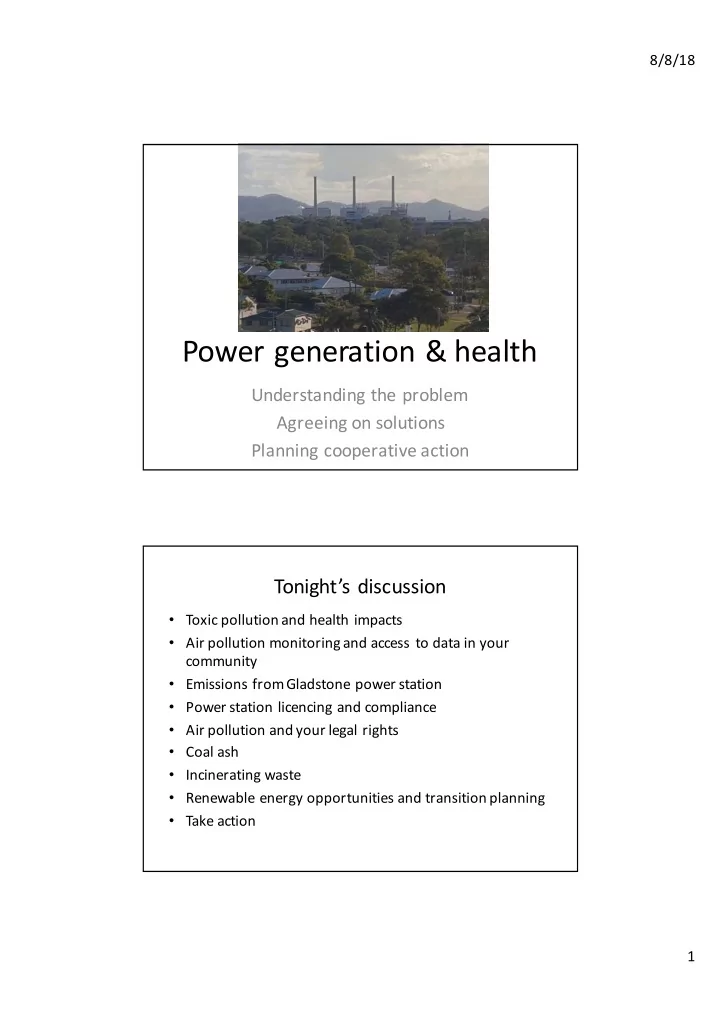
Power generation & health Understanding the problem Agreeing on - - PDF document

power generation health
SMART_READER_LITE
LIVE PREVIEW

Power generation & health Understanding the problem Agreeing on - - PDF document

8/8/18 Power generation & health Understanding the problem Agreeing on solutions Planning cooperative action Tonights discussion Toxic pollution and health impacts Air pollution monitoring and access to data in your community


slide-1
SLIDE 1

8/8/18 1

Power generation & health

Understanding the problem Agreeing on solutions Planning cooperative action

Tonight’s discussion

  • Toxic pollution and health impacts
  • Air pollution monitoring and access to data in your

community

  • Emissions from Gladstone power station
  • Power station licencing and compliance
  • Air pollution and your legal rights
  • Coal ash
  • Incinerating waste
  • Renewable energy opportunities and transition planning
  • Take action
slide-2
SLIDE 2

8/8/18 2

  • The Qld Department of Environment and Heritage Protection
  • perates 6 air pollution monitoring stations in Gladstone.
  • Fine particle pollution (PM2.5) concentrations recorded at these

sites is generally below the national standard (25ug/m3 averaged

  • ver 24 hours).
  • Concentrations as high as 122ug/m3 have been recorded during

recent months (Boat Creek 2/11/17). On 29/9/17, four of Gladstone’s monitoring stations recorded PM2.5 concentrations over the national standard.*

slide-3
SLIDE 3

8/8/18 3

2014-15 2015-16 2016-17 Ammonia (total) 866 839 799 Arsenic & compounds 16 9 10 Beryllium & compounds 2 1 1 Boron & compounds 10,201 74,304 81,305 Cadmium & compounds 6 4 3 Carbon monoxide 781,130 754,400 718,110 Chlorine & compounds 8 20 15 Chromium (III) compounds 107 74 82 Chromium (VI) compounds 3 2 2 Cobalt & compounds 2 1 1 Copper & compounds 40 21 22 Cumene (1-methylethylbenzene) 11 11 11 Fluoride compounds 232,014 225,011 214,017 Hydrochloric acid 637,000 617,000 588,000 Lead & compounds 28 32 30 Manganese & compounds 603 455 274 Mercury & compounds 85 72 58 Nickel & compounds 113 77 86 Oxides of Nitrogen 27,908,780 30,001,040 28,800,845 Particulate Matter 10.0 um 234,100 146,800 150,200 Particulate Matter 2.5 um 88,033 49,664 48,452 Sulfur dioxide 21,500,010 22,800,004 24,400,003 Sulfuric acid 227,000 240,000 257,000 T

  • tal Volatile Organic Compounds

93,940 90,329 85,990 Xylenes (individual or mixed isomers) 60 59 56 Zinc and compounds 128 88 87 T

  • tal

51,714,286 55,000,316 55,345,458

Fine particle pollution (PM2.5) by source (NPI 2016-17)

Boyne Smelters Ltd, 360,000 , 55% Rio Tinto Aluminium Yarwun, 65,198 , 10% Queensland Alumina Ltd, 54,080 , 8% Gladstone Power Station, 48,452, 8% Curtis Island LNG Plant, 47,348 , 7% Gladstone Ports Corporation - (water transport), 44,520 , 7% Curtis Island GLNG Plant, 30,489 , 5%

slide-4
SLIDE 4

8/8/18 4

Oxides of Nitrogen (NOx) by source (NPI 2016-17)

Gladstone Power Station, 28,800,845, 60% QAL, 7,367,200 , 15% Curtis Island GLNG Plant, 4,960,629 , 10% Fishermans Landing, 3,162,760 , 7% RT A Yarwun Pty Ltd, 2,456,821 , 5% APLNG Facility - Curtis Island, 1,120,438 , 2% BSL, 577,000 , 1%

Sulfur dioxide (SO2) by source (NPI 2016-17)

Gladstone Power Station, 24,400,003, 55% Boyne Smelters, 12,550,300 , 28% Queensland Alumina Ltd , 4,830,071 , 11% Rio Tinto Aluminium Yarwun, 2,555,710 , 6% Northern Oil Refinery, 101,061 , 0% APLNG Facility - Curtis Island, 57,401 , 0%Curtis Island LNG Plant , 14,801 , 0%

slide-5
SLIDE 5

8/8/18 5

Health impacts

  • Fine particle pollution (PM2.5) causes premature death
  • Sulfur dioxide contributes to asthma, infant birth weight,

cardiovascular and repiratory illness, hospital admissions

  • Oxides of nitrogen effect lung function, asthma and

allergies even at low levels

  • Mercury has toxic effects on the nervous, digestive and

immune systems, and on lungs, kidneys, skin and eyes

  • Coal ash contains arsenic, lead, mercury, cadmium,

chromium and other toxic pollutants.

slide-6
SLIDE 6

8/8/18 6

slide-7
SLIDE 7

8/8/18 7

Reducing emissions – some options

  • Fabric filters (bag houses) to reduce PM2.5
  • Flue gas desulfurisation and low sulfur coal to reduce

SO2

  • Selective Catalytic Reduction to reduce NOx

emissions

  • Coal washing to reduce mercury emissions
  • Ultrasupercritical power stations
  • Electrostatic precipitators
  • Planned retirement, transition to renewables

“Selective Catalytic Reduction (SCR) is the most effective NOx control technology and is the dominant post-combustion NOx control method presently in use.” AGL Liddell NOx Reduction report, 2017

slide-8
SLIDE 8

8/8/18 8

Legal framework -Qld

Regulating power station emissions

  • Department of Environment and Science

–"Our job is to support industry growth and ensure the prosperity of Queensland’s environment."

  • Environmental Protection Act
  • Environmental authorities
slide-9
SLIDE 9

8/8/18 9

Environmental Protection Act 1994

Environmental Protection Act

  • Chief pollution legislation in QLD
  • Imposes general duty not to cause environmental harm –

section 319

» 'any adverse effect (whether temporary or permanent and of whatever magnitude, duration or frequency) on an environmental value and includes an environmental nuisance'

  • Duty to notify environmental harm
  • Must not wilfully and unlawfully cause serious or material

environmental harm

  • Must not wilfully and unlawfully cause an environmental

nuisance

– unreasonable/likely interference with an environmental value

Power station operations are notifiable activities so need an environmental authority

Environmental authorities

  • Chapter 5 EP Act 1994
  • Imposes conditions for operation
  • Must be complied with
  • "licences to pollute" - imposes limits for air pollution,

water discharges, land contamination, ash management

  • Gladstone Power Station Agreement Act

1993 imposes additional obligations

slide-10
SLIDE 10

8/8/18 10

Gladstone Power Station pollution licence conditions [EPPR00973013]

  • A1: The release of noxious or offensive odours or any other

noxious or offensive airborne contaminants from the activity must not cause a nuisance at any odour sensitive place

  • A6: Solid particles must not be released from the dry ash

system dust collector(s) in excess of a concentration that would cause visible air emissions

  • N1: Noise from activities must not cause an environmental

nuisance at any noise-affected premises

  • L1: Contaminants must not be released to land

What is unusual about the Gladstone Power Station pollution licence?

  • No SO2 or mercury stack emission limit
  • No continuous monitoring requirement in EA
  • Extraordinarily high limit for the allowable NOx concentration

emitted from stacks

  • A3: Coarse particle pollution (PM10) standard of 150ug/m3 is

three times the national standard

  • No licence limit for fine particle pollution PM2.5
  • W9: Used ion exchange resin, used diatomaceous earth oil

absorbent and spent demineralisations plant carbon granules, used oil filter cartridges, silica gel and oily rags may be burnt in the boiler furnaces.

slide-11
SLIDE 11

8/8/18 11

Coal ash

  • EA and GPSA Act impose conditions for ash

management

  • Ash Management Agreement – currently

subject to RTI request

  • No financial assurances imposed:

– The costs associated with post-closure management will be borne by the operator, and no liability removed until authorised by the department.

  • Council reclamation of one of the sites, more

in future

slide-12
SLIDE 12

8/8/18 12

slide-13
SLIDE 13

8/8/18 13

Your legal rights

  • DES should be chief environmental regulator
  • Civil enforcement options under EP Act

– Any person can seek order in Planning and Environment Court to remedy or restrain a breach of the Act, EA condition breach, activity without approval – Easier process if your interests are affected by the

  • ffence, e.g. health impacts from air pollution

– Where interests are not affected, need leave from the Planning and Environment Court to obtain standing

  • EDO Queensland factsheet

Waste incineration

  • Feedstock consistency
  • Air quality and EU Standards
  • What doesn't go up definitely goes down
slide-14
SLIDE 14

8/8/18 14

Opportunities and Transition

Matt Rose Economics Program Manager and Economist

"we have to factor in a carbon- constrained future"

slide-15
SLIDE 15

8/8/18 15

Coal Closing

Name State Y ear Closed Capacity Collinsville QLD 2012 190 MW Munmorah NSW 2012 1400 MW Swanbank B QLD 2012 480MW Wallerawang NSW 2014 1000MW Energy Brix VIC 2014 170MW Redbank NSW 2014 151MW Kwinana WA 2014 240MW Playford SA 2015 240MW Anglesea VIC 2015 150MW Callide A QLD 2015 520MW Northern SA 2016 120MW Hazelwood VIC 2017 1600MW Muja AB WA 2018 240MW

slide-16
SLIDE 16

8/8/18 16

22 Solar Plants

12 Wind Farms

0 Coal Fired Power Stations

5,769 MW

Under Construction end 2017

By 2037 under a business as usual scenario

to to in Coal – 68% Renewables – 24% Renewables

  • vertake coal

22% of NEM 72% of NEM 2032

slide-17
SLIDE 17

8/8/18 17

“You can resist change as much

as you like, but the reality is, if you’re in a community that has a coal-fired power station, its days are numbered.”

  • Plan ahead
  • Support Communities
  • Clean up the mess
slide-18
SLIDE 18

8/8/18 18

Renewable Energy Zone.

  • Aldoga Solar Farm
  • Rodds Bay Solar Farm
  • Raglan Solar Farm
  • 100 sites for pumped hydro
slide-19
SLIDE 19

8/8/18 19

“My advice is: learn from the Port Augusta experience. I wish the federal government would.”

slide-20
SLIDE 20

8/8/18 20

Take action

  • Report air pollution incidents 1300 130 372 (DEHP)
  • Communicate pollution concerns and complaints to

NRG 07 4976 5211

  • Read Gladstone Power Station’s permit
  • Subscribe for EJA’s fortnightly email updates
  • Like our Facebook page
  • Organise a talk on air pollution control with your

group or organisation