Power Generation and The Tug/Barge Power Generation and The - - PowerPoint PPT Presentation

power generation and the tug barge power generation and
SMART_READER_LITE
LIVE PREVIEW

Power Generation and The Tug/Barge Power Generation and The - - PowerPoint PPT Presentation

Ocean Tug & Barge Engineering Corp. Ocean Tug & Barge Engineering Corp NAVAL ARCHITECTS & MARINE ENGINEERS MAIN OFFICES * * * * MILFORD COMMON PROFESSIONAL OFFICE BUILDING * * * * * * * * 258 MAIN STREET - SUITE 401 MILFORD,


slide-1
SLIDE 1

Ocean Tug & Barge Engineering Corp Ocean Tug & Barge Engineering Corp.

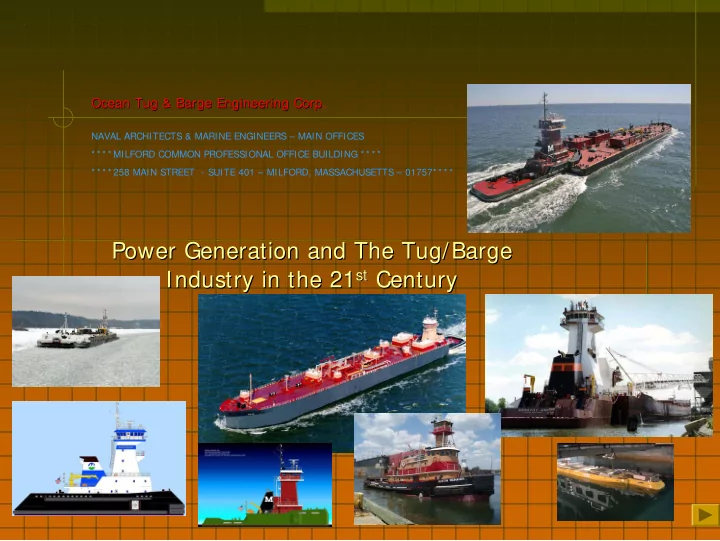
Power Generation and The Tug/Barge Power Generation and The Tug/Barge Industry in the 21 Industry in the 21st

st Century

Century

NAVAL ARCHITECTS & MARINE ENGINEERS – MAIN OFFICES * * * * MILFORD COMMON PROFESSIONAL OFFICE BUILDING * * * * * * * * 258 MAIN STREET - SUITE 401 – MILFORD, MASSACHUSETTS – 01757* * * *

slide-2
SLIDE 2

Presented By: Presented By:

  • Mr. Robert Hill, N.A.

Ocean Tug & Barge Engineering Corp.

Background: Background:

The author and his firm, provide the observations, technical data, and opinions included in this paper, based on 25 years of experience in the AT/ B marketplace. Currently, the firm has either directly designed, or been a fully participating engineering partner, for 38 operational AT/ B’s in the US market. We are also engaged in six newbuild projects in the US in 2006, and one overseas. This means the firm will have had a hand in over 70% of the operational AT/ B’s in service in America – including, nearly 80% of those built or converted since 1994. The experience encompasses connection systems of all kinds, including I ntercon, of which the Author is co-inventor; Bludworth, Hydraconn, Articouple. The firm has also now entered the I nternational marketplace, with units under design for service in the Far East, and Eastern Europe, and is pioneering the application of alternative “gree” power sourcs for the tug/ barge marketplace worldwide. The firm has also expanded its’ product range with the introduction of new, high technology harbor and offshore tug designs.

slide-3
SLIDE 3

Acknowledgements: Acknowledgements:

Nothing we do in engineering, is a solitary effort. The author would like to acknowledge the invaluable input of the following individuals and organizations, in the preparation of this paper. Reinauer Transportation, Inc.; CT Marine (Mr. Corning Townsend, N.A.) ; Allied Transportation, Inc.; Bay Shipbuilding, inc.; Penn Maritime, inc.; Moran Towing, inc.; Mr. Trey Leblanc, formerly of Alabama Shipyard; Intercontinental Engineering and Manufacturing Corp.; John Cook of J. Cook Marine, Mr. Timo Rentlala of Beacon Naval Architects, , Oceanic Consulting, of St. John’s, NF; Maritrans; The late Mr. Elliott Clemence, of INTERCON; Mr. T. Yamaguchi, of Taisei Engineering; All of the members of the Tugboats newsgroup on Yahoo, who contributed historical photographs as well as current

  • nes; The crews of the AT/B’s whose observations and suggestions over the years, have been invaluable;

Washburn & Doughty Associates; Atlantic Marine, inc., J. M. Martinac Shipbuiding; Mr. John VanBuskirk, formerly

  • f Maritrans, now with Vessel Management Services; Mr. Bonnie Bonnebell; Gulf Marine Repair, Inc.; International

Ship Repair; Bender Shipbuilding; Mr. John W. Gilbert, N.A. Also Tom Hagner of Maritrans, Bender Shipbuilding, and countless others for whom the AT/B has been a solution for their transportation planning. I’d also like to dedicate this presentation to the Memory, of the late Mr. Larry Hoefler, who passed away in 2004. Larry’s knowledge, friendship and willingness to share his vast and practical experience in engineering, has enriched everyone with whom he interacted – especially, the Author. Godspeed, my friend.

I also dedicate this to the crewmen whose lives ended in the loss of the towing tug VALOUR off the Carolina coast this January, 2006.

slide-4
SLIDE 4

What Is the What Is the Tug and Barge Industry Tug and Barge Industry? ?

The tug and barge industry is the healthiest segment of the U. S. Merchant Marine. Developing

  • ver decades to replace ships in domestic trade river

and coastal as well as international trades, and employing ever-increasing levels of technology in the traditional areas of harbor tug and workboat design.

slide-5
SLIDE 5

Where Are The Power Generation Opportunities Where Are The Power Generation Opportunities in the Growing in the Growing Tug and Barge Industry Tug and Barge Industry? ?

The tug and barge industry relies more than ever on both traditional and advanced power generation installations in its’ vessels. There are four major market segments to explore:

  • 1. Ship service power generation for tugs and workboats.
  • 2. Power generation for cargo handling equipment aboard barges.
  • 3. Traditional diesel-electric propulsion systems.
  • 4. Advanced diesel electric, and hybrid drive systems.
slide-6
SLIDE 6

Where Are The Major Groupings of the Where Are The Major Groupings of the Tug and Tug and Barge Industry Barge Industry? ?

The tug and barge industry can be broken down into four major types of operating groups:

  • 1. Harbor and assist tugs.
  • 2. Ocean and coastwise tug/barge transportation systems.
  • 3. River towboats and transportation.
  • 4. The general workboat and specialized vessel services.
slide-7
SLIDE 7

What other market forces were at work to help the tug What other market forces were at work to help the tug and barge industry grow vs. ships? and barge industry grow vs. ships? Some examples…

In America, where the movement of petroleum products was one of the most important uses for tugs and barges, there was a steady reduction in the number of marine terminals, and in the amount of inventory kept on hand at those which remained. Towed barges provided very low rates, but were very unreliable schedule-wise, and subject to extensive weather delays. The cost to operate tankers and other U.S. flag self-propelled vessels was increasing past the point where coastwise operation became less and less profitable. Both the crewing and regulatory environment favored tug/barge.

slide-8
SLIDE 8

How did the need change? How did the need change?

Despite large increases in refined product retail prices, rates for water transport

  • f those products did not increase proportionately. Tankers were increasingly

priced out of the low-rate market. Operation of terminals at razor-thin inventory margins, required reliable, on-time replenishment from the transportation system. Towed barges were very slow and not as reliable as ships were, schedule-wise. Towed barges did not provide the weather-reliable transportation needed to work with reduced terminal inventories – but low rates excluded tankers from competing. The weather was not going to change, tankers were not going to get cheaper to build or to crew/operate. Somehow, the tug and barge solution had to be improved. There was a shift, in transport patterns. Less and less refined product moved from the Gulf to East coasts on the water, rendering the higher speed of a tanker, less important.

slide-9
SLIDE 9

AT/B Vs. Ship AT/B Vs. Ship – – Why the AT/B? Why the AT/B?

The early “notched” barge, then ITB, and now AT/B - all grew out of the demand for low cost, safe, reliable, and more rapid marine transportation. While transportation using the conventional towed barges was less expensive than a ship, they were extremely weather dependent making them unreliable in some conditions and they were also much slower than the ships they often replaced. Towed petroleum and petrochemical barges have historically suffered horrendously as far as weather-induced

  • delays. In some operations in the Gulf, annualized weather delays for long-term operations of some tug/barge

fleets averaged 30% or more. In the Northeast, it ran as high as 40 to 50%, especially in the winter. The primary reason transportation using conventional, hawser towed tug and barges was less expensive than a ship, was related to things like crew and construction costs (especially in the United States Jones Act Trade). As an example a typical U.S. flag, Jones Act Tanker without a large amount of automation to reduce the overall manning requirements would have a crew of about 19 to 27 people. Whereas a typical U.S. flag, Jones Act conventional tug and barge or for that matter an AT/B with a tank barge, with the same cargo carrying capability can operate with as few as 7 people, but seldom more than 10. The difference in crew cost alone is quite large. Now the task was to develop a design where you could both reduce the crewing (and costs) and get more speed and reliability, the ultimate goal being something akin to ship-like reliability. The initial attempt to solve this problem was the development of the ITB. When that concept fell on hard times, in both the technical and regulatory environs, the response was the continued development of the AT/B. What the AT/B did, was to solve most of the technical impediments to being ship-competitive, while maintaining the crew and capital cost advantage of the tug and barge. What you have, is weather reliability, in a REAL tug and barge. An AT/B is not a rule beater. So for many types of services, the AT/B shines, as compared to a ship. But what ARE those services? How does the AT/B fill that mission? That is the purpose of this presentation, to show through real-world experience, how the AT/B can be used to fill a transportation need, efficiently, vs other modes of transport, including other marine systems.

slide-10
SLIDE 10

AT/B Vs. Ship AT/B Vs. Ship – – Why the AT/B? Why the AT/B?

  • Individual units for insurance purposes - loss of one does not mean a unit

CTL.

  • As compared to a ship, a wider availability of shipyard sites for drydocking

the powerplant.

  • Ability of both tug and barge to function as fully independent units when
  • ne or the other requires shipyarding.
  • Smaller crew and different , more efficient crew culture.
  • Ability to build both vessels in specialized shipyards, lowering costs.
  • Ship-reliable ETA’s at greatly reduced operating costs.
slide-11
SLIDE 11

The AT/B Regulatory Environment The AT/B Regulatory Environment

The purpose of building an AT/B is to create a flexible, safe, and economical marine transportation system. The purpose should not to compromise safety by avoiding regulation. USCG NVIC 2-81 is the US flag-state guide for the classification of tug/barge units for regulatory purposes. The ABS Rules for Building & Classing Steel Vessels Under 90M, and the Ocean Barge Rules, govern AT/B tug and barge design in most cases. The USCG stability and loadline regulations govern AT/B loadline and stability issues. Gross Tonnage of the AT/B tug governs the regulations applied to the tug, provided, the AT/B qualifies for “Dual Mode” designation under NVIC 2-81. An AT/B can be built to meet full SOLAS regulation/certification on the tugboat. SOLAS rules do not apply to unmanned or permissively- manned barges.

The AT/B Is NOT and SHOULD Not be…a “Rule Beater”

slide-12
SLIDE 12
  • Practical Layout and Design on Tug & Barge

Power System Design Power System Design – – What is Important What is Important

  • Because a tug must work with a smaller crew than a comparably sized ship, it is

doubly important that both the tug and the barge, be designed with ergonomics in mind. The living and working environment must be as well-designed as possible, given the constraints present in the design of this type vessel generally. This extends as well to the shipboard engineering systems and the most critical is power generation.

  • Systems that provide power must be reliable, redundant and simple. Because

workboats and tugs work in a very demanding environment, they must be rugged as well.

  • Power systems must provide for ease of maintenance. While elaborate schemes

may be developed for power generation, the KISS principle must apply here on a broad basis.

slide-13
SLIDE 13

AT/B AT/B’ ’s and s and “ “Drop & Swap Drop & Swap” ”

It is the dream of every tug and barge operator, to find a trade where one can build less tugs and more barges. Obviously, as my friend Mr. Yamaguchi often reminded me – the barge is the “Earning part” – the tug is the “Expense-part”. We have investigated more than a few possibilities where we had more barges than tugs. However, it is important to remember that even the best-built tug can have unexpected downtime. If you run a 3-barge, one tug system, you’re golden – until the tug breaks down. For one project we investigated, we suggested the Owner build 6 barges, and three tugs. One pair of tugs was always working the 3-barge/1-tug

  • trade. The third tug was a swing tug, able to step in if one of the other boats went
  • down. It also allowed other tugs to be taken out of service and cycled for routine

maintenance. The counter-argument is, that by the very flexibility of having a barge notch another tug can fit into – even a conventional one – the lack of need for a “swing-tug” is part

  • f the very attraction of an AT/B system.
slide-14
SLIDE 14

What are some examples of the types of boats which inhabit the various groups in the tug and barge industry?

  • Ocean Towing and AT/B Tugs. – Power Generation 3 -5 generators, 460 VAC, 100-500 kW
  • perating loads.
  • Harbor Tugs - Power Generation 2 -3 generators, 460 VAC, 65-125 kW operating loads.
  • Escort Tugs - Power Generation 2 -3 generators, 460 VAC, 100-200 kW operating loads.
  • River Towboats - Power Generation 2 -3 generators, 460 VAC, 100-250 kW operating

loads.

  • River Switchboats - Power Generation 1-2 generators, 220 VAC, 2-60 kW operating loads.
  • Self Unloading Bulk Barges - Power Generation 3 -6 generators, 460 to 600 VAC, 100-3000

kW operating loads

  • Large Ocean Tank Barges - Power Generation 3 -6 generators,460 to 600 VAC, 100-3000

kW operating loads

  • Small Ocean Tank Barges - Power Generation 3 -6 generators,460 to 600 VAC, 100-150

kW operating loads

  • River Tank Barges – Power Generation 2-3 generators, 220 to 460 VAC, 20 to 100 kW
  • perating loads.
  • Dredge Tenders – Power Generation 1-2 generators, 220 VAC, 20 to 50 kW operating

loads.

  • ATB PSV’s – Power Generation 1-6 generators, 460 VAC to 600 VAC, 100 to 1200 kW
  • perating loads.
  • Ocean Container Barges – Power Generation 1-4 generators – 100 to 1600 kW operating

loads.

  • Large Ocean ShuttleTank Barges - Power Generation 3 -6 generators,460 to 600 VAC,

100-3000 kW operating loads

slide-15
SLIDE 15

The AT/B As a Shuttle Tanker

OT&BE was part of the original BP Mardi Gras Transportation Team and did the AT/B design for that proposal. Though a pipeline was chosen, AT/B research for this application was advanced significantly and a 500,000 bbl unit was designed and model tested, to satisfactory result. The unit was designed for bow loading, and DP-2 classification. The COSTWISE design for the Caspian Sea is also a bow loader, though it is moored, and not equipped beyond basic DP

  • capability. This capability to meet DP-2 can be built into the COASTWISE design as well. We

have also designed large shuttle AT/B’s for GOM service for two other clients, as well as a smaller shuttle ot offload other products from an FPSO. We have done extensive research in this market and understand it well both technically and business-wise.

slide-16
SLIDE 16

Introducing The Introducing The “ “PROVIDER PROVIDER” ” Class AT/B PSV/OSV Class AT/B PSV/OSV

Ocean Tug & Barge Engineering Corp., is pleased to present the first major rethink of the offshore supply vessel concept in over 40 years – the “PROVIDER” class AT/B supply vessel. Designed to bring the same cost savings and flexibility to the offshore supply business, as it has brought to other sectors of the transportation business, the PROVIDER is a true revolution in offshore supply vessel design. The new concept is based on proven AT/B and OSV technology, married for the first time in a vessel whose flexibility and application is almost without limit. The major improvements over a conventional OSV and the design goals that brought us here, are numerous and highly attractive:

  • I ncreased Deadweight Capacity Per Unit Length
  • I ncreased Deck Area, Virtually Unobstructed Over A Longer Length
  • Reduced Building Cost Per DWT
  • Reduced Crew Cost
  • Wider Number of Shipyard Choices
  • Sizes For Both Deepwater and I nshore Operations
  • Lighter Drafts, Allowing Access To Less I mproved Ports
  • High Residual Value
  • Total Flexibility in Size To Suit Mission, With Navy-I nspired Deck Mounting Capability for Different Equipment
  • I ncreased Flexibility During Business Slowdowns
  • Easily Modified for I ncreasing or Decreasing Size
  • Multiple Barges, A Smaller Number of Tugs Possible – Lower Capital/ DWT By 60%
  • Multiple Specialty Barges Can Be Built Without Building New Engine Rooms
  • Extremely and Quickly Adaptable to The Changing Marketplace
  • Power Unit/ Crew Keeps Moving For A Higher Utilization of the Expense Portion of The Unit
  • Reduced Crew Size for Easier Manning/ Hiring
  • High End Accommodation
  • Diesel-Electric/ Hybrid Capable Drive Featuring ASD Tugs
  • Speeds 12 Knots and Upward Possible
  • Simpler Drydocking and Repair/ Replacement of Damaged Unit
  • Seaworthiness to 8M Significant Height Seas
  • Fully Functional Ocean Tugs That Are Tow-Capable
  • Barges Adaptable to Many Services Outside the Offshore I ndustry
  • Lower Regulatory Burden
  • Fully DP-2 Capable
  • I ncreased Maneuverability, Especially I n Heavy Weather
slide-17
SLIDE 17

Introducing The Introducing The “ “PROVIDER PROVIDER” ” Class AT/B PSV/OSV Class AT/B PSV/OSV

slide-18
SLIDE 18

Hybrid Tug Drive Systems

I n 2005, Ocean Tug & Barge Engineering Corp. signed a long term agreement with Railpower Technologies, of Vancouver, B.C. to assist in the development and application of their patented locomotive hybrid drive systems to marine service worldwide. This paper is presented to give a first look at that technology to the marine industry and discuss the various configurations available and how they can be applied in our industry, to further and put into practice, the concept of the “green” tugboat/ workboat.

Other Innovations We Are Working ON Other Innovations We Are Working ON

slide-19
SLIDE 19

What Is the What Is the Hybrid Drive Hybrid Drive? ?

The hybrid drive, as we will work with, is a marine drive system based on locomotive-type diesel electric propulsion, mechanical with diesel electric assist, or a combined battery/diesel electric drive

  • system. Each type has its’ correct application for a

marine drive arrangement as might be found in a workboat.

slide-20
SLIDE 20
  • Potential Fuel Savings of 30-40%
  • Greatly Reduced Emissions
  • Potential for Reduced Maintenance Costs
  • Flexibility of Operation
  • Improved Vessel Environment With Regard To Noise

Levels and Onboard Sound Level Reduction

Hybrid Propulsion Design Hybrid Propulsion Design – – What Can It Bring? What Can It Bring?

slide-21
SLIDE 21
  • Proper Configurations
  • Class Society Issues
  • Adapting the Equipment to the Marine Environment
  • Crew Orientation

Hybrid Propulsion Design Hybrid Propulsion Design – – What Are The Challenges? What Are The Challenges?

slide-22
SLIDE 22

The Equipment The Equipment – – A Basic Principle A Basic Principle

MORE GENERATOR MORE BATTERY

MULTI-ENGINE GREEN GOAT

slide-23
SLIDE 23

The Equipment The Equipment – – The The “ “Green Goat Green Goat” ”

THE “GREEN GOAT” SWITCHER

THIS ORIGINAL HYBRID DESIGN RELIES PRIMARILY ON A 1000 OR 2000HP EQUIVALENT BATTERY PACK, CHARGED BY A SMALL INDUSTRIAL GENERATOR. IT HAS FOUND GREAT SUCCESS ON AMERICAN AND CANADIAN RAILROADS. THIS BATTERY CONFIGURATION SAVES FULE LARGELY BECAUSE OF THE DUTY CYCLE THIS TYPE OF LOCOMOTIVE SEES.

slide-24
SLIDE 24

The Equipment The Equipment – – The The “ “Green Goat Green Goat” ”

slide-25
SLIDE 25

The Equipment The Equipment – – The The “ “Green Goat Green Goat” ”

slide-26
SLIDE 26

The Equipment The Equipment – – The The “ “Green Goat Green Goat” ”

slide-27
SLIDE 27

The Equipment The Equipment – – The The “ “Green Goat Green Goat” ”

slide-28
SLIDE 28

The Equipment The Equipment – – Switcher Duty Cycle Switcher Duty Cycle

THE “GREEN GOAT” SWITCHER – FUEL CONSUMPTION VS DUTY CYCLE

slide-29
SLIDE 29

The Equipment The Equipment – – The The “ “Green Goat Green Goat” ”

slide-30
SLIDE 30

The Equipment The Equipment – – The The “ “Green Goat Green Goat” ”

This design represents the “more battery, less generator option, and is more suitable for low hp to medium HP workboats and other

  • vessels. Dredge tenders, for

example, or small tugs and research vessels.

slide-31
SLIDE 31

The Equipment The Equipment – – The RP Series Road Locomotive

The RP Series Road Locomotive

slide-32
SLIDE 32

The Equipment The Equipment – – The RP Series Operation Principle

The RP Series Operation Principle

slide-33
SLIDE 33

The Equipment The Equipment – – The RP Series Operation Principle

The RP Series Operation Principle

The RP-Concept – Comparison to the Basic Railpower Switcher Hybrid Concept

  • The battery pack is not the “featured” concept and becomes a supportive

power source as opposed to “the” source for propulsion.

  • Multiple smaller generators (AC) are provided, but utilize railroad-type

bridge rectifiers to create DC power. Therefore, they need not run at synchronous speed.

  • Only the requisite generators are run, with the DC power created able to

be fed to the motors as AC, via a variable speed control, or DC via a chopper arrangement.

  • The battery functions as a power boost for short durations, or to power

the unit for short movements or overnight storage.

slide-34
SLIDE 34

The Equipment The Equipment – – The GG/RP Series Applied to Workboats The GG/RP Series Applied to Workboats

Harbor Tugs: The GG (mainly battery) and the RP (mainly generator) are both applicable and should be decided based on load profile and horsepower. Dredge Tenders and Small Tugs to 2000 HP : The GG system is an ecellent choice for dredge tenders and tugs with light duty cycles. The RP is a better choice for consistent load or longer trips. The “switcher” vs. “road switcher”

  • analogy. A dredge tender for example, can be plugged in to the dredge and

its’ battery charged there. Research Vessels: An excellent choice for main propulsion would be the RP series along with a larger batter pack for quiet ship operation. River Switchboats: Again, either the GG or RP series could reduce fuel consumption quite substantially by using the battery for short load profiles and the battery as well for peak load shaving and running only on the number

  • f gensets needed.

Crewboats and Supply Boats: Using the RP system to allow for lower fuel consumption when low propulsion loads are present such a standing by a rig

  • r using minimal propulsion to hold station.
slide-35
SLIDE 35

Financing The Green Option Financing The Green Option

Workboat operators seeking assistance in financing conversions to Hybrid drives can work through state funded programs in many parts of the country. In particular, extensive programs in California and Texas are in place, and

  • ther states are working on similar programs.
slide-36
SLIDE 36

Other Hybrid Technologies Being Developed By Other Hybrid Technologies Being Developed By Railpower Railpower Which Which OT&BE Will Be Offering To The Marine Industry OT&BE Will Be Offering To The Marine Industry

Although RailPower's current focus is the commercialization of its existing hybrid products, at the appropriate time, RailPower will look to develop new products including the CINGLTM, a natural gas mainline freight locomotive, and rDirectTM, a conditioning technology and enabling component for the CINGL, which is destined for the global distributed power marketplace. Both of these technologies have a direct applicability to the marine marketplace.

slide-37
SLIDE 37

CINGL CINGL TM

TM

RailPower has patented a design for a compressed integrated natural gas locomotive (the "CINGL"). The CINGLTM is a patented gas turbine locomotive fueled by compressed natural gas. This technology has the potential to revolutionize the mainline freight locomotive industry in North America. In a study co-authored with Rolls-Royce and AlliedSignal it was concluded that the CINGLTM would save the railroads 25- 33% over the life of owning and operating the locomotive. Additionally the CINGLTM would reduce harmful NOx Emissions by

  • ver 99% and eliminate cancer causing diesel particulate. Railway experts rate the safety of Compressed Natural Gas as

roughly equivalent to that of Diesel fuel. To understand how we achieve these results one must analyze the elements of our design:

Compressed: The difference in price between compressed and liquefied natural gas is substantial. In many applications all

the cost benefits of natural gas evaporate when the cost of liquification is factored in. RailPower has received confirmation from Trillium, North America's largest builder and operator of turn-key natural gas fueling stations of infrastructure costs that are slightly less per unit of fuel than used in our study.

I ntegrated: The Gas Research Institute concluded, in a study, that to recover the cost of the lost revenue due to one fuel

storage car, fuel savings would have to be 25%. For that reason it is important that the CINGLTM carry the correct amount

  • f fuel in one unit without the need for a tender.

RailPower has done this by replacing a bulky diesel engine with all its auxiliaries such as radiators, with a turbine made even smaller by eliminating the need for a gearbox with a specially designed high-speed alternator. This allows room to add 44 storage cylinders for the natural gas equivalent of 5,500 US gallons of diesel fuel. This will give the unit a range of 40 plus hours in the medium duty (in motion) cycle, the same as the existing locomotives. The design, featured above, has a 5,500 h.p. recuperated industrial turbine made by Solar Turbine, a subsidiary of Caterpillar, with a thermal efficiency of about 40%. Turbines have made great efficiency improvements over time relative to a slower improvement in the efficiencies of the diesel engine.

Turbines were previously used in Locomotives in the '50s and '60s by the Union Pacific and run on inexpensive bunker C fuel. However, when bunker C rose in cost the then lower efficiency of the turbine, combined with problems in handling the thick bunker C, eliminated their use.

Natural Gas: RailPower is learning from the independent power business and adopting the cheapest and cleanest fuel that

is readily available. The cheaper price of natural gas than diesel, while maintaining similar thermal efficiencies, is what drives the cost savings on the CINGLTM.

Locomotive: The resulting locomotive is an operator's dream. While eliminating over 99% of the harmful NOx Emissions

and diesel particulate the CINGLTM achieves the current industry goal of high horsepower locomotive units. The customer can request the CINGLTM in versions of up to 10,000 h.p. (+ 7MW), a power level used in electric locomotives in Europe where the physical constraint of diesel technology is not a problem.
slide-38
SLIDE 38

rDirect rDirect TM

TM

In designing the CINGL TM , RailPower developed an enabling technology to convert mechanical energy delivered by a gas turbine into a useful form of AC

  • electricity. RailPower has labeled the power conversion technology rDirect TM .

This power conditioning technology is destined for the global distributed power industry. A study undertaken for RailPower at the University of Waterloo confirms that rDirectTM has the potential to be more efficient, while reducing capital costs by up to 50%, when compared to existing competing technologies. RailPower has filed patents to cover its rDirectTM technology

slide-39
SLIDE 39

Hybrid drive technology has been embraced wholly by the rail industry. With over 300 locomotives on order, including large orders for most of the major Class 1 railroads, the rail industry has made a strong statement regarding its’ position on protecting the environment. The technology in the GG and RP series designs is proven technology that has been embraced by an industry which may be the only transport industry more conservative than the marine marketplace. It is technology that is adaptable to the marine market and it is here now. Future developments such as CINGL TM is also realistic in concept and will soon be

  • available. It too is adaptable to our industry.

Funding mechanisms are in place today and there are now compelling reasons to look at turning older, fuel-inefficient electric drive and mechanical drive workboats, into “green”, fuel efficient, emissions-sensitive and economically viable vessels, as well as adapting this technology to new harbor tug designs. OT&BE is moving forward with a new concept in Z-Drive tugs that will be unveiled along with our latest concept in AT/B’s in July, 2006. OT&BE will under its’ agreements with RailPower, assist Owners, Architects and

  • thers with the future application of this evolving technology.

I thank you for your time today.

Summary Summary

slide-40
SLIDE 40

Thank you, for your time and attention.