The Science Barge is not only an invitation to ideas and learning, - - PowerPoint PPT Presentation

the science barge is not only an invitation to ideas and
SMART_READER_LITE
LIVE PREVIEW

The Science Barge is not only an invitation to ideas and learning, - - PowerPoint PPT Presentation

The Science Barge is not only an invitation to ideas and learning, but to change. - Dr. Jeffrey Sachs, Director of the Earth Institute at Columbia University and Special Economic Advisor to the United Nations History Ted Caplow designed


slide-1
SLIDE 1

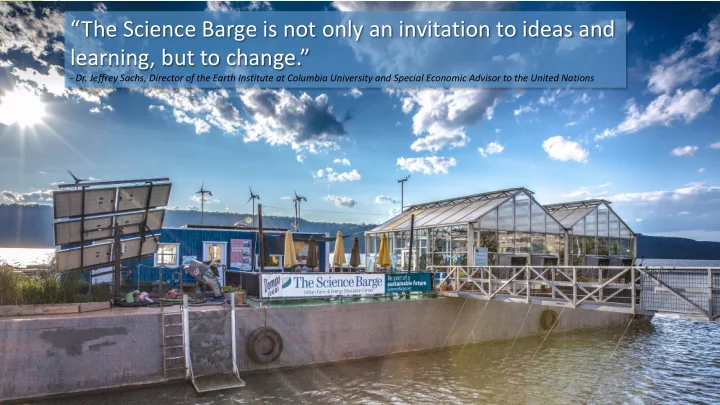
“The Science Barge is not only an invitation to ideas and learning, but to change.”

  • Dr. Jeffrey Sachs, Director of the Earth Institute at Columbia University and Special Economic Advisor to the United Nations
slide-2
SLIDE 2

History

  • Ted Caplow designed and directed the construction of the Barge in 2006 and

launched the Barge on the Manhattan waterfront in 2007

  • The exhibits and ecological experiments that comprise the Barge float on a a

steel deck barge, approximately 115 feet long, constructed in the 1940’s

  • In 2009, the Science Barge was voted the Best Class Trip by New York Magazine
  • Now in Yonkers, NY the Barge is easily accessible from public transportation

and has contributed to the reinvigoration of the downtown Yonkers community

slide-3
SLIDE 3

Press

“…an educational lab for both schoolchildren in the New York City area and adults interested in learning about the technologies onboard.” “Promoting high-yield, safe, and sustainable urban food production, the Science Barge educates students of all ages about how it is done.” “There are plenty of ways to learn about science within the city proper, but they’re likely not as concentrated or as exciting as they are on this floating classroom.” “Operating all year round, the barge could grow 20 times more than could have been produced by a field of the same size…” “…innovating today, while educating the innovators of tomorrow.”

slide-4
SLIDE 4

Commercial Success

slide-5
SLIDE 5
slide-6
SLIDE 6
slide-7
SLIDE 7

Why does Miami need the Science Barge?

The Miami Science Barge is a Marine Innovation Lab. It’s a floating test bed and environmental education center that will provide an urban link to marine conservation and sustainability on Miami’s Biscayne Bay. Its unique platform brings students onto the Bay and promotes experiential learning through the lens of marine science. Its curriculum will focus on:

  • Health of the local and global environment
  • Sustainable food supply
  • Monitoring and data collection

The goal of the Miami Science Barge is to stimulate the sustainable development of

  • Miami. A city that can generate its own power, grow its own food, and recycle its own

waste, helps secure our common future and sets the standard for cities around the world.

slide-8
SLIDE 8

Program

Marine Innovation Lab Restoration Ecological Systems Citizen Science Technology

slide-9
SLIDE 9

Learn about our education impact – click here!

slide-10
SLIDE 10

Restoration

  • Stewardship and understanding of Miami’s ecosystems and local

species is fostered by the restoration program

  • Endangered organisms such as mangroves, seagrasses, and corals are

cultivated on the Barge

  • New methods and theories of growth are tested to investigate new,

more effective methods

  • Dynamic, changing exhibits encourage continued visitorship and will

include an aquaculture hatching tank, coral nursery, and aquaponic plants

  • Curriculum includes: local threatened species, tracking of population

trends, human impact on the environment, roles of mangroves and seagrass in the ecosystem, biodiversity

slide-11
SLIDE 11
slide-12
SLIDE 12
slide-13
SLIDE 13
slide-14
SLIDE 14
slide-15
SLIDE 15
slide-16
SLIDE 16
slide-17
SLIDE 17

Technology

  • Renewable energy
  • The Barge will acquire the majority of its energy from solar using passive

tracking arrays

  • Additional energy needs may be met with wind turbines and biofuel
  • Hydroponic Systems
  • Hydroponic and aquaponic systems provide the opportunity to learn about

engineering and biomimicry

  • Showcase Technologies
  • Innovations from the Investors in Residence programs as well as technologies

from other marine innovation competitions will be exhibited on the Barge

  • Curriculum includes: energy storage in batteries, electricity and

electromagnetism, U.S. energy profile, energy conservation actions, food production, and sustainable fishing

slide-18
SLIDE 18
slide-19
SLIDE 19
slide-20
SLIDE 20
slide-21
SLIDE 21
slide-22
SLIDE 22
slide-23
SLIDE 23
slide-24
SLIDE 24

Ecological Systems

  • Food
  • Different feeds and hydroponic methods are tested in order to increase yield

and sustainability

  • Water
  • The Barge’s hydroponic system as well as use of naturally provided freshwater

make it an exemplary example of water conservation

  • The rainwater cistern system provides the freshwater needed to fill aquaculture

tanks and water all plants

  • Natural Cycles
  • The closed-water-loop demonstrates the earth’s ability to reuse nutrients and

the chemistry necessary to make it happen

  • Compost is a live demonstration of the nitrogen cycle and decomposition
  • Curriculum includes: how hydroponics works, beneficial and bothersome

local fauna, native plants, health benefits of fruits and vegetables, “food- print”, global share of available freshwater

slide-25
SLIDE 25
slide-26
SLIDE 26
slide-27
SLIDE 27
slide-28
SLIDE 28
slide-29
SLIDE 29

Citizen Science

  • The Barge activates the under-utilized waterfront, providing a unique

teaching platform for learning about the conservation of Miami’s underwater ecosystems

  • Hands-on activities will include water quality testing, microorganism

investigation via microscopes, growing barnacles and seagrass, etc.

  • Students will observe underwater activity with live video and learn

about native species

  • Partners from local research institutions facilitate research projects for

students to contribute to

  • Curriculum includes: scientific method, the metric system, proper

measurement techniques, sampling bias, data collection methods

slide-30
SLIDE 30
slide-31
SLIDE 31
slide-32
SLIDE 32

Programming

  • Day long field trips for K-12 students with Core Curriculum aligned

materials

  • Public weekend tours led by high school interns
  • Evening and weekend workshops and lectures for adults
  • Networking events to connect Miami’s green workers
slide-33
SLIDE 33
slide-34
SLIDE 34
slide-35
SLIDE 35
slide-36
SLIDE 36
slide-37
SLIDE 37

The Miami Science Barge

slide-38
SLIDE 38
slide-39
SLIDE 39
slide-40
SLIDE 40

Project Status

  • 120’ x 30’ barge secured from Grady Marine
  • Site approval for Museum Park
  • Permitting:
  • City of Miami
  • Miami Dade County, DERM
  • State of Florida, DEP
  • Army Corps of Engineers
  • Anticipated launch: early 2016
  • Systems build out and outfitting, Summer 2015
  • Curriculum development, Fall 2015
slide-41
SLIDE 41
slide-42
SLIDE 42

Our Team

Nathalie Manzano-Smith Project Lead Karlisa Callwood Educational Programming & Curriculum Alissa Farina Program Manager

slide-43
SLIDE 43

Advisors

Ted Caplow, PhD

Creator NY Science Barge

Gillian Thomas

CEO Frost Science

Dan Benetti, PhD

Director of Aquaculture UM, RSMAS

Kenny Broad, PhD

Chair UM, Abess Center Nat Geo Explorer

Rachel Silverstein, PhD

Executive Director Biscayne Bay Waterkeeper

Asha Loring

CEO Health in the Hood James Jiler Executive Director Urban Greenworks Andrew Baker Professor UM, RSMAS Fran Bohnsack Director, South Atlantic Gateway US DOT

slide-44
SLIDE 44

Partnerships

District 3 Commissioner Audrey Edmonson District 2 Commissioner Marc Sarnoff

Allen Family Foundation

slide-45
SLIDE 45

For questions please contact: Nathalie Manzano-Smith Director of Innovation CappSci nathalie@cappsci.org (305)467-2987