Post-transplant DSA Monitoring Shiang Cheng Kung MBBCh Clinical - - PDF document

post transplant dsa monitoring
SMART_READER_LITE
LIVE PREVIEW

Post-transplant DSA Monitoring Shiang Cheng Kung MBBCh Clinical - - PDF document

9/20/2016 In 1954 These Identical Twins Made Kidney Transplant History Post-transplant DSA Monitoring Shiang Cheng Kung MBBCh Clinical Professor of Medicine Division of Transplantation University of California, San Francisco Skin allografts


slide-1
SLIDE 1

9/20/2016 1

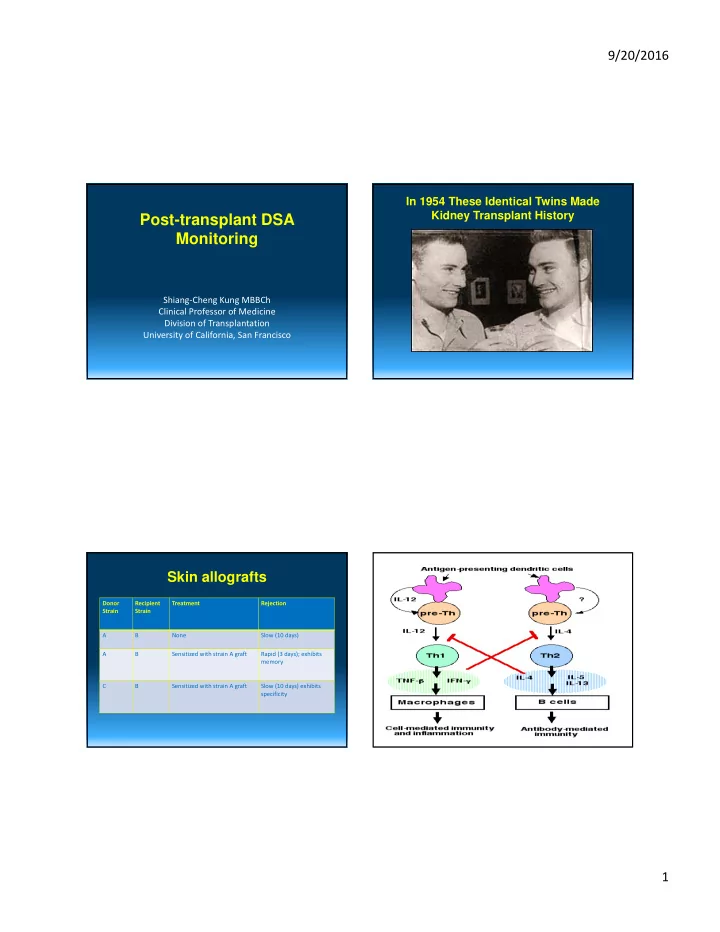
Post-transplant DSA Monitoring

Shiang‐Cheng Kung MBBCh Clinical Professor of Medicine Division of Transplantation University of California, San Francisco

In 1954 These Identical Twins Made Kidney Transplant History

Skin allografts

Donor Strain Recipient Strain Treatment Rejection A B None Slow (10 days) A B Sensitized with strain A graft Rapid (3 days); exhibits memory C B Sensitized with strain A graft Slow (10 days) exhibits specificity

slide-2
SLIDE 2

9/20/2016 2

Li XC, Jenvikar AM: Transplant Immunology; Fig 8.2. Wiley Blackwell.

The Complement Cascade

Li XC, Jenvikar AM: Transplant Immunology; Fig 10.2. Wiley Blackwell.

slide-3
SLIDE 3

9/20/2016 3

11

Anti-HLA antibody

  • Detection method

– Cell based – Solid phase

  • Preformed
  • De novo

Li XC, Jenvikar AM: Transplant Immunology; Fig 5.7. Wiley Blackwell.

slide-4
SLIDE 4

9/20/2016 4

Li XC, Jenvikar AM: Transplant Immunology; Fig 5.8. Wiley Blackwell.

14

Evidence for Antibody-Mediated Injury as a Major Determinant of Late Kidney Allograft Failure

Robert S. Gaston, J. Michael Cecka, Bert L. Kasiske, Ann M. Fieberg, Robert Leduc, Fernando C. Cosio, Sita Gourishankar, Joseph Grande, Philip Halloran, Lawrence Hunsicker, Roslyn Mannon, David Rush, and Arthur J Matas Clinical and Translational Research Transplantation Volume 90: 68-74

15

Methods

  • One hundred seventy-three subjects transplanted

before October 1, 2005 (mean time after transplant) 7.3±6.0 years) had a baseline serum creatinine level

  • f 1.4±0.3 mg/dL before January 1, 2006 and

underwent biopsy for new onset graft dysfunction after that date (mean creatinine at biopsy 2.7 ± 16 mg/dL).

16

Kaplan-Meier analysis of the impact of primary or secondary local diagnosis of calcineurin inhibitor (CNI) nephrotoxicity on kidney allograft survival after for-cause biopsy

slide-5
SLIDE 5

9/20/2016 5

17

Kaplan-Meier analysis of the impact of presence or absence of C4d and donor-specific antibody (DSA) on allograft survival after for cause biopsy, by group

18

0% 20% 40% 60% 80% 100%

22 117 153 63 25 159 47 161 73 162 458 160 88 204 153 27 109 92 77 54 159 136 259 108 78 79 65 30

N= Centers

Prevalence of anti-HLA Ab Kidney Tx Recipients N=3858

Terasaki, Ozawa, Am J Transpl 4:438,2004

19

At Year 2 193 Graft Failures in Ab + ve

Graft failure Ab +ve 478 15.1% Ab -ve 1743 6.8%

Terasaki,Ozawa, Transplantation, 2005

20

The Role of Antibody-Mediated Rejection and Nonadherence in Kidney Transplant (N = 315)

Sellarés J, et al. Am J Transplant. 2012;12(2):388-399. PMID: 22081892

Distribution of attributed causes of failure

Almost half of Antibody-Mediated Rejection (ABMR) is due to nonadherence

slide-6
SLIDE 6

9/20/2016 6

Summary

  • Acute antibody mediated rejection accounts

for approximately only 20% of the early acute rejection (in first 6 months)

  • Chronic antibody mediated rejection is a

major factor accounting for the allograft loss

  • Multiple factors may lead to emergency of

DSA after the transplant including immunosuppression minimization and poor medication adherence.