Transplant Debate: How Old is Too Old for Kidney Transplant Chris - - PDF document

transplant debate how old is too old for kidney transplant
SMART_READER_LITE
LIVE PREVIEW

Transplant Debate: How Old is Too Old for Kidney Transplant Chris - - PDF document

9/26/2018 Transplant Debate: How Old is Too Old for Kidney Transplant Chris E. Freise, M.D UCS F Professor of S urgery Interim Chief of Transplant More Difficult Decision What if no living donor ? L.D., 86 yo male, ESRD from HTN,


slide-1
SLIDE 1

9/26/2018 1 Transplant Debate: How Old is Too Old for Kidney Transplant

Chris E. Freise, M.D UCS F Professor of S urgery Interim Chief of Transplant

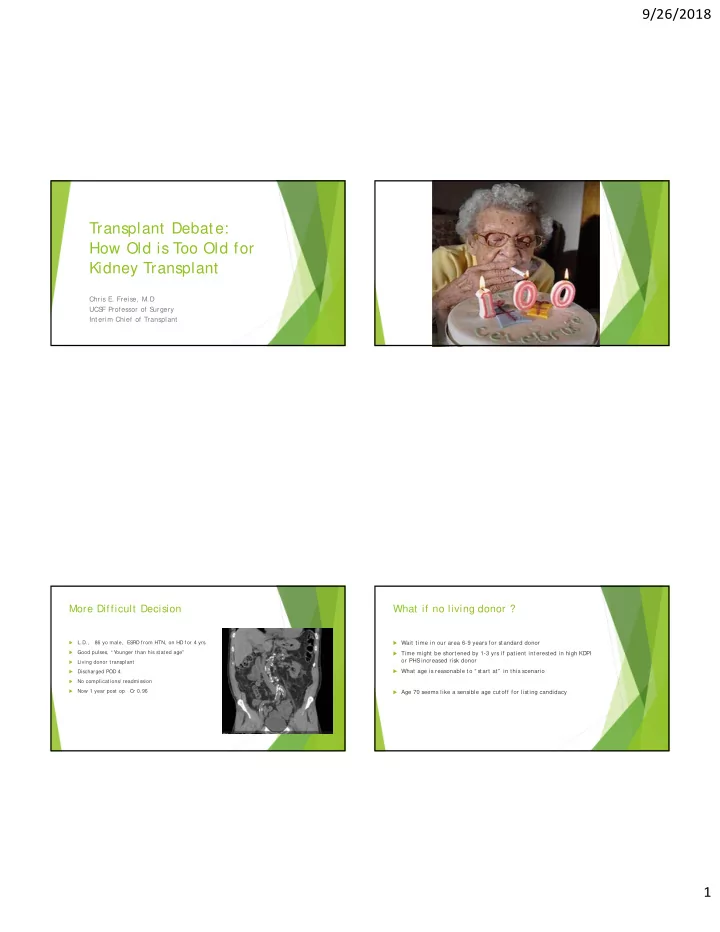
More Difficult Decision

L.D., 86 yo male, ESRD from HTN, on HD for 4 yrs.

Good pulses, “ Y

  • unger t han his st ated age”

Living donor transplant

Discharged POD 4

No complications/ readmission

Now 1 year post op Cr 0.96

What if no living donor ?

 Wait time in our area 6-9 years for standard donor  Time might be shortened by 1-3 yrs if patient interested in high KDPI

  • r PHS

increased risk donor

 What age is reasonable to “ start at” in this scenario  Age 70 seems like a sensible age cutoff for listing candidacy

slide-2
SLIDE 2

9/26/2018 2

S hould There Be an Age Cutoff for Listing ? ?

YES

 Considerations  Deceased donor kidneys are a scarce resource  Need to choose recipients that will maximize UTILITY of kidney  Outcomes as patients age are less good  Transplant cares utilize more resources in higher risk patients  Difficult to use other measures, and by default age is a reasonable

surrogate to determine candidacy

The Aging ESRD population: Difficult Decisions

48%

  • f all new ES

RD patients >65

30% are >70

Over 500,000 patients on dialysis never make it to transplant listing

The need far outstrips the supply

Of listed patients > age 60, 47% removed within 3 years

Patients over age 60 do not tolerate waiting

2017 Annual Data Report Volume 2, Chapter 6 7

vol 2 Figure 6.3 Percentage of incident patients who were wait‐listed

  • r received a kidney transplant within one year of ESRD initiation,

by age, 1998‐2014

Data Source: Reference Table E.5(2). Waiting list or transplantation among incident ESRD patients by age (0‐74 years). Note that trends may be influenced by changes to the kidney allocation system (KAS) policy that were implemented in December 2014. Abbreviation: ESRD, end‐stage renal disease.

The Seattle Artificial Kidney Center Admissions and Policy Committee

slide-3
SLIDE 3

9/26/2018 3

Justice vs. Utility

The principle of utility, applied to the allocation of organs, thus specifies that allocation should maximize the expected net amount of overall good (that is, good adj usted for accompanying harms.

Justice, as used here, refers to fairness in the pattern of distribution of the benefits and burdens of an organ procurement and allocation program. Thus, we are concerned not exclusively with the aggregate amount of medical good that is produced, but also with the way in which that good is distributed among potential beneficiaries. This does not mean treating all patients the same, but it does require giving equal respect and concern to each patient.

Sometimes the principle of j ustice will be in conflict with the principle of utility; in such cases both are worthy of equal consideration and play a role in shaping a decision about the morally preferable allocation. Ethical Principles in the Allocation of Human Organs (1) Shall be based on sound medical j udgment; (2) Shall seek t o achieve t he best use of donat ed

  • rgans;

(5) Shall be designed to avoid wasting organs, to avoid futile transplants, to promote patient access to transplantation, and to promote the efficient management

  • f organ placement;

Final Rule 2000: Organ Allocation

2017 Annual Data Report Volume 2 ESRD, Chapter 11 11

vol 2 Figure 11.1 Geographic variations in the incidence rate of treated ESRD (per million population/year), by country, 2015

Data source: Special analyses, USRDS ESRD Database. Data presented only for countries from which relevant information was

  • available. All rates are unadjusted. United Kingdom: England, Wales, Northern Ireland (Scotland data reported separately). Data

for Italy include five regions. Data for Indonesia represent the West Java region. Data for France exclude Martinique. Data for Canada excludes Quebec. Japan includes dialysis patients only. Abbreviation: ESRD, end‐stage renal disease. NOTE: Data collection methods vary across countries, suggesting caution in making direct comparisons.

2017 Annual Data Report Volume 2 ESRD, Chapter 11 12

vol 2 Figure 11.16 Kidney transplantation rate, by country, 2015

Data source: Special analyses, USRDS ESRD

  • Database. Data presented only for

countries from which relevant information was available. All rates are unadjusted. ^United Kingdom: England, Wales, & Northern Ireland (Scotland data reported separately). Data for France exclude

  • Martinique. Data from Italy represent five
  • regions. Data for Sri Lanka is from seven

government hospitals. Data for Canada excludes Quebec. Abbreviation: sp.,

  • speaking. NOTE: Data collection methods

vary across countries, suggesting caution in making direct comparisons. (b) Per 1,000 Dialysis Patients
slide-4
SLIDE 4

9/26/2018 4

Listing Practices

2017 Annual Data Report Volume 2, Chapter 5 16

vol 2 Table 5.4 Expected remaining lifetime (years) by age, sex, and treatment modality of prevalent dialysis patients and transplant patients, and the general U.S. population, 2013

ESRD patients 2013 General U.S. population 2013 Dialysis Transplant Age Male Female Male Female Male Female 0‐14 23.8 23.1 59.3 60.3 70.7 75.4 15‐19 21.8 19.1 47.6 48.7 59.7 64.4 20‐24 18.8 16.1 43.4 44.5 55.0 59.5 25‐29 16.2 14.1 39.4 40.7 50.3 54.6 30‐34 14.1 12.6 35.1 36.6 45.7 49.7 35‐39 12.6 11.5 31.1 33.0 41.0 45.0 40‐44 11.0 10.3 27.2 28.9 36.5 40.3 45‐49 9.3 8.8 23.3 25.2 32.0 35.6 50‐54 7.9 7.7 19.9 21.8 27.7 31.1 55‐59 6.6 6.6 16.7 18.4 23.7 26.8 60‐64 5.5 5.7 13.9 15.4 19.9 22.6 65‐69 4.6 4.8 11.4 12.7 16.2 18.6 70‐74 3.8 4.0 9.4 10.3 12.8 14.8 75‐79 3.2 3.5 7.6a 8.6a 9.8 11.4 80‐84 2.6 2.9 7.1 8.4 85+ 2.1 2.3 3.8 4.4 Data Source: Reference Table H.13; special analyses, USRDS ESRD Database; and National Vital Statistics Report. “Table 7. Life expectancy at selected ages, by race, Hispanic origin, race for non‐Hispanic population, and sex: United States, 2013 (2016).” Expected remaining lifetimes (years) of the general U.S. population and of period prevalent dialysis and transplant patients. aCell values combine ages 75+. Abbreviation: ESRD, end‐stage renal disease.

slide-5
SLIDE 5

9/26/2018 5

Legeai, et.al. AJT 2018

Other Resource Considerations

 Resources utilized for evaluations  Resources for workup of patients  Hospital costs and readmission rates

TX Center Resources: UCS F DATA

UCS F Referrals FY 2018 2373

UCSF Evaluations FY 2018 1303

Last three years Referrals over age 70 786 Evals

  • ver age 70

306

Listed Patients 21

Transplants Deceased Donor 1 Living Donor 7

slide-6
SLIDE 6

9/26/2018 6

Mortality and Readmission Rates

Other Measures of S uitability

Frailty measurements

 Weight Loss  Weakness  Slow Gait  Low Physical Activity  Easily exhausted  ESRD patients

< 40 yo 44% met criteria > 70 yo 78% met criteria

Age 70 Cutoff For Deceased Donor Listing

Age > 70 will not tolerate wait ing times more than 3 years

Outcomes are less good than in younger patients

Resources are further stretched in all phases of care

Other measures besides age lack validation with outcome

Living donor transplant can and should be considered

slide-7
SLIDE 7

9/26/2018 7

May you stay-- forever young Bob Dylan

2017 Annual Data Report Volume 2, Chapter 6 28

vol 2 Table 6.3 Unadjusted kidney transplant rates, all donor types, by age, sex, race, and primary cause of ESRD, per 100 dialysis patient years, 2006‐2015

2006 2007 2008 2009 2010 2011 2012 2013 2014 2015 Age 0‐21 38.6 32.7 33.1 35.3 33.6 32.2 32.9 32.2 33.1 34.7 22‐44 10.9 10.1 9.3 9.2 8.6 8.3 8.1 7.9 7.8 9.3 45‐64 5.9 5.6 5.3 5.1 4.9 4.7 4.4 4.4 4.2 4.2 65‐74 2.7 2.6 2.6 2.6 2.6 2.6 2.5 2.5 2.5 2.2 75 and older 0.3 0.4 0.3 0.4 0.4 0.4 0.4 0.3 0.4 0.3 Sex Male 5.6 5.1 4.8 4.6 4.4 4.3 4.0 4.0 3.8 3.9 Female 4.3 4.0 3.8 3.8 3.7 3.5 3.3 3.3 3.2 3.3 Race White 6.0 5.5 5.2 5.0 4.7 4.5 4.3 4.3 4.1 4.0 Black/African American 3.3 3.1 2.9 3.0 3.0 2.9 2.6 2.6 2.5 2.8 American Indian/Alaska Native 3.9 2.9 3.6 3.7 2.9 3.0 2.5 2.2 2.7 3.2 Asian 5.9 5.3 5.5 5.1 5.1 4.8 4.7 4.8 4.7 5.2 Primary Cause of ESRD Diabetes 3.2 3.1 2.9 2.8 2.6 2.5 2.3 2.3 2.2 2.0 Hypertension 3.2 3.1 3.0 2.9 2.8 2.6 2.6 2.5 2.5 2.6 Glomerulonephritis 9.9 9.0 8.7 8.6 8.7 8.2 7.9 7.8 7.5 8.3 All 5.0 4.6 4.4 4.3 4.1 3.9 3.7 3.7 3.6 3.6 Data Source: Reference Table E.9. Note that trends may be influenced by changes to the kidney allocation system (KAS) policy that were implemented in December 2014. Abbreviation: ESRD, end‐stage renal disease.

slide-8
SLIDE 8

9/26/2018 8