Post-Mastectomy Pain Syndrome Pathophysiology: poorly defined - - PowerPoint PPT Presentation

post mastectomy pain syndrome
SMART_READER_LITE
LIVE PREVIEW

Post-Mastectomy Pain Syndrome Pathophysiology: poorly defined - - PowerPoint PPT Presentation

3/7/2015 Post-Mastectomy Pain Syndrome Pathophysiology: poorly defined Variation in onset/duration Post-Operative Pain: New Tricks Variation in presentation That Make a Difference PMPS encompasses multiple pain processes


slide-1
SLIDE 1

3/7/2015 1

Post-Operative Pain: New Tricks That Make a Difference

Mikki Seagren DO Breast Surgery Fellow University of California San Francisco

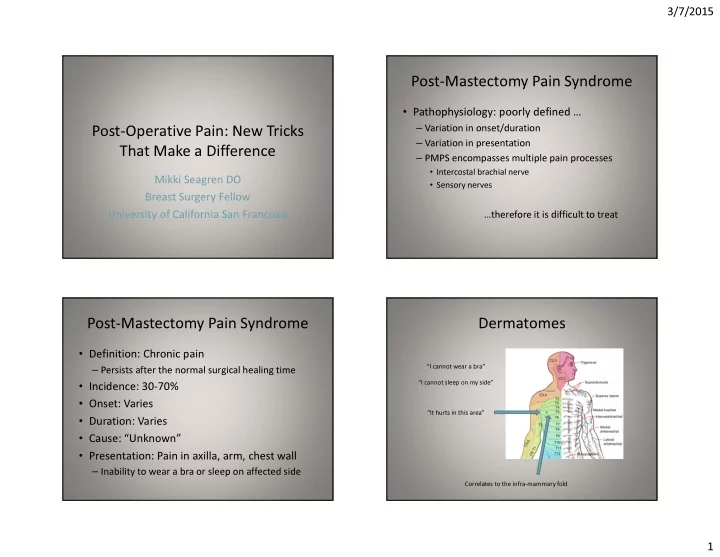
Post-Mastectomy Pain Syndrome

  • Pathophysiology: poorly defined …

– Variation in onset/duration – Variation in presentation – PMPS encompasses multiple pain processes

  • Intercostal brachial nerve
  • Sensory nerves

…therefore it is difficult to treat

Post-Mastectomy Pain Syndrome

  • Definition: Chronic pain

– Persists after the normal surgical healing time

  • Incidence: 30-70%
  • Onset: Varies
  • Duration: Varies
  • Cause: “Unknown”
  • Presentation: Pain in axilla, arm, chest wall

– Inability to wear a bra or sleep on affected side

Dermatomes

“I cannot wear a bra” “I cannot sleep on my side” “It hurts in this area” Correlates to the infra-mammary fold

slide-2
SLIDE 2

3/7/2015 2

Intercostal Nerves

3:00/9:00 6:00

  • Arise from the anterior divisions of the thoracic spinal nerves
  • Anterior and Lateral Cutaneous Branches

Post-mastectomy Pain Syndrome

  • Hypothesis: neurogenic pain due to damage

to the cutaneous branches of T4/T5 sensory nerves as they exit the chest wall

  • Cauterized in conjunction with the accompanying

vessels during dissection of the breast tissue

T4/T5 branches Cautery Inflammatory mediators Neuroma Trigger point tenderness PMPS

Trigger Point Injection

  • Trigger points correlate with the egress of the

T4/T5 cutaneous branches

– Infra-mammary fold at 6:00 and 3:00/9:00

  • Perineural infiltration of 2 mL mixture of equal

parts 0.5% bupivacaine and 4 mg/mL dexamethasone

Since 2011: 54 sites treated (35 patients) 65 injections (59/65) with 90% technically successful

6 1 9 1 10 10 38 48 54

PAIN RELIEF Injection #1 Injection #2 Injection #3

Our Experience

Pain resolved in 88.9% of sites treated with trigger point injections

slide-3
SLIDE 3

3/7/2015 3

Summary

  • PMPS is common
  • Ask your patients if they have pain

– Inability to sleep on affected side – Inability to wear a bra

  • Focused examination for trigger points
  • www.ucsfbreastcarecenter.org