
SLIDE 1
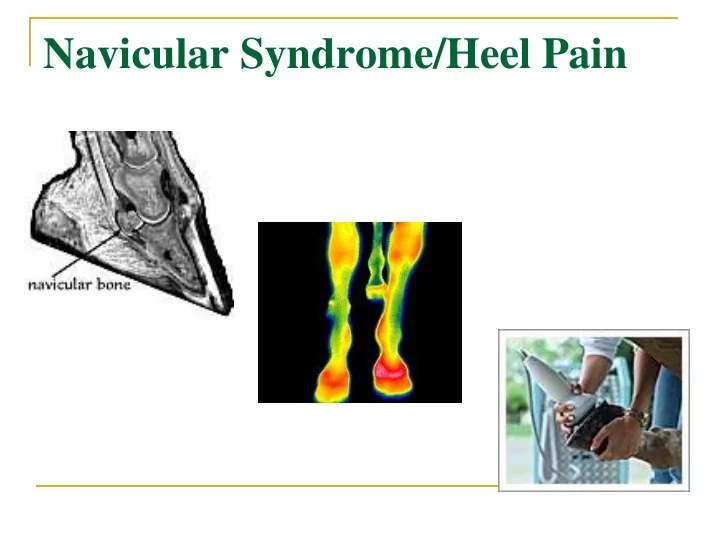
Navicular Syndrome/Heel Pain Navicular Syndrome/Heel Pain Clinical - - PowerPoint PPT Presentation
Navicular Syndrome/Heel Pain Navicular Syndrome/Heel Pain Clinical signs: Forelimb lameness, intermittent, progressive and insidious onset, usually bilateral. Stumbling Pointing toes to relieve pressure on DDFT Packing shavings
Clinical signs:
Forelimb lameness, intermittent, progressive and insidious onset,
usually bilateral.
Stumbling Pointing toes to relieve pressure on DDFT Packing shavings under front feet Decreased performance/stopping Short, stiff gait Chronic sequela-contracted heels, increased concavity of sole, toe
bruising, may have enlarged digital vessels and increased digital pulses.
Associated structures:
Navicular/distal sesamoid bone
30% of distal articular surface, acts as a fulcrum with DDFT
Navicular bursa Deep digital flexor tendon (DDFT) Coffin joint Collateral (suspensory) ligament of navicular bone Distal sesamoidean impar ligament
Impar ligament Coffin joint Navicular bursa
Conformation:
Low/under run heels Small feet Long toes
Improper shoeing Hard work on concussive
Nutrition imbalances
1.
2.
3.
Syndrome most likely a mixed etiology:
Age related changes-degenerative change in
Adaptive remodeling of bone due to tendon stresses-
Edema, congestion and fibrosis of marrow-cyst like-
Loss of proteoglycans in articular cartilage Bursitis Adhesions between DDFT and navicular bone
Puncture wounds to foot Fracture of navicular bone or distal
Bruised sole Pedal osteitis Arthritis of coffin joint Corns Soft tissue injury such as lesions in the distal
Navicular bone
Lameness exam Hoof testers-pain over center 1/3 of
Distal limb flexion test/toe extension Palmar digital nerve block Intra-thecal analgesia of navicular
Coffin joint intra-articular analgesia
Radiographs
5 standard views
most sensitive view 45° palmar proximal-palmarodistal
Most significant changes likely to reflect navicular
Cyst like lesions in medulla Medullary sclerosis, and reduced cortico-medullary
demarcation
New bone growth/erosion on flexor surface Mineralisation in ligaments
Nuclear scintigraphy
Can see increased bone turnover
MRI/CT
More sensitive than radiographs Detects abnormal amount of fluid in coffin joint and
Detects changes in bone such as fluid/edema
Endoscopic evaluation of navicular bursa
Aim: balance the feet and straighten the pastern-hoof axis.
Raise heels, shorten and roll toe to facilitate break-over
Support across center 1/3 of frog
Shoes: egg-bar, heart-bar, straight bar, natural balance
1.
1.
2.
1.
2.
3.
4.
5.
Chemical “neurectomy”/cryoneurectomy-ablation
Sarapin Clinical improvement lasts 2-3 months Unreliable
Palmar digital neurectomy
Last choice option Careful selection of case, only if peri-neural analgesia
Successful in 65-70% of horses and lasts
Complications:
Incomplete desensitization Regeneration of nerves Damage to DDFT Neuroma formation Change in hoof growth
Multifactorial and controversial etiology No treatment is 100% successful Prognosis is always guarded:
Many horses can continue to be useful if managed well,