Down Syndrome by Birth Order and Moms Age 3/20/2017 V0 - - PDF document

down syndrome by birth order and moms age 3 20 2017 v0
SMART_READER_LITE
LIVE PREVIEW

Down Syndrome by Birth Order and Moms Age 3/20/2017 V0 - - PDF document

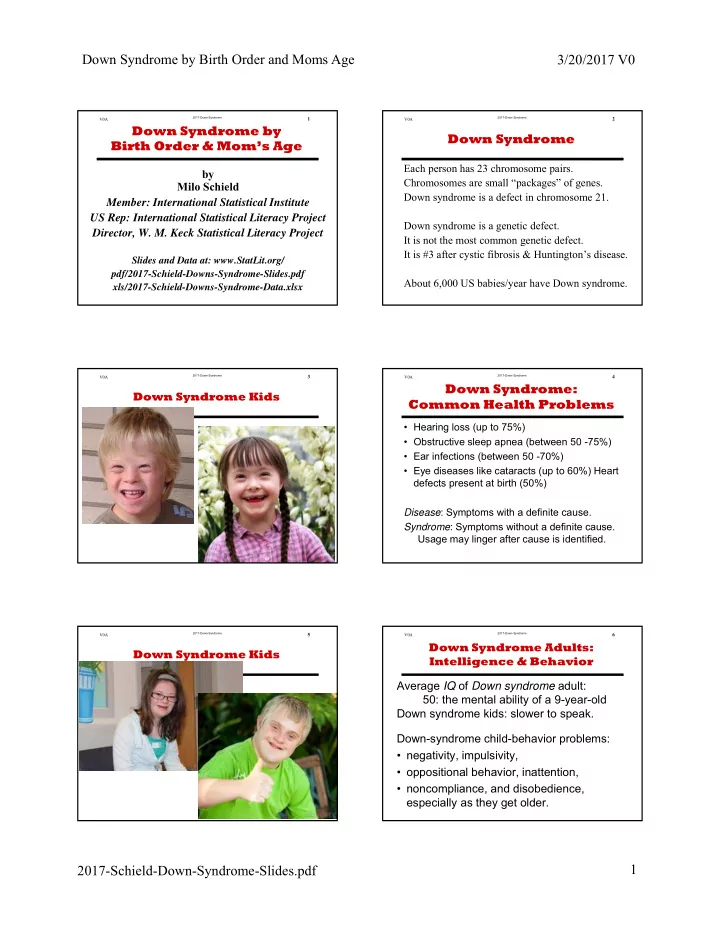
Down Syndrome by Birth Order and Moms Age 3/20/2017 V0 2017-Down-Syndrome 1 2017-Down-Syndrome 2 V0A V0A Down Syndrome by Down Syndrome Birth Order & Moms Age Each person has 23 chromosome pairs. by Chromosomes are small


slide-1
SLIDE 1

Down Syndrome by Birth Order and Moms Age 3/20/2017 V0 1 2017-Schield-Down-Syndrome-Slides.pdf

V0A

2017-Down-Syndrome

1

by Milo Schield Member: International Statistical Institute US Rep: International Statistical Literacy Project Director, W. M. Keck Statistical Literacy Project

Slides and Data at: www.StatLit.org/ pdf/2017-Schield-Downs-Syndrome-Slides.pdf xls/2017-Schield-Downs-Syndrome-Data.xlsx

Down Syndrome by Birth Order & Mom’s Age

V0A

2017-Down-Syndrome

2

Down Syndrome

Each person has 23 chromosome pairs. Chromosomes are small “packages” of genes. Down syndrome is a defect in chromosome 21. Down syndrome is a genetic defect. It is not the most common genetic defect. It is #3 after cystic fibrosis & Huntington’s disease. About 6,000 US babies/year have Down syndrome.

V0A

2017-Down-Syndrome

3

Down Syndrome Kids

.

V0A

2017-Down-Syndrome

4

Down Syndrome: Common Health Problems

  • Hearing loss (up to 75%)
  • Obstructive sleep apnea (between 50 -75%)
  • Ear infections (between 50 -70%)
  • Eye diseases like cataracts (up to 60%) Heart

defects present at birth (50%) Disease: Symptoms with a definite cause. Syndrome: Symptoms without a definite cause. Usage may linger after cause is identified.

V0A

2017-Down-Syndrome

5

Down Syndrome Kids

.

V0A

2017-Down-Syndrome

6

Down Syndrome Adults: Intelligence & Behavior Average IQ of Down syndrome adult: 50: the mental ability of a 9-year-old Down syndrome kids: slower to speak. Down-syndrome child-behavior problems:

  • negativity, impulsivity,
  • oppositional behavior, inattention,
  • noncompliance, and disobedience,

especially as they get older.

slide-2
SLIDE 2

Down Syndrome by Birth Order and Moms Age 3/20/2017 V0 2 2017-Schield-Down-Syndrome-Slides.pdf

V0A

2017-Down-Syndrome

7

Some Down Syndrome Kids Excel

Actors: Chris Burke played Corky in Life Goes On Lauren Potter plays Becky Jackson on Glee

V0A

2017-Down-Syndrome

8

Average Survival Age and Sex Ratio

Due to advances in medical technology, individuals with Down syndrome are living longer.

  • Before antibiotics, average survival age was nine.
  • With antibiotics, average survival age was 19.
  • With antibiotics and corrective heart surgery,

80% of adults with Down syndrome reach age 60. Among infants with Down syndrome, males are 24% more prevalent than females. Among moms 20-24, the male-female sex ratio is 1.73. The sex-ratio decreases as the age of the mother increases.

V0A

2017-Down-Syndrome

9

Down Syndrome Rate by Birth Order

.

V0A

2017-Down-Syndrome

10

Down Syndrome Rate by Mom’s Age .

V0A

2017-Down-Syndrome

11

Down Syndrome Rates: Combine into Two Groups Combine birth orders into two groups. Combine mom’s ages into two groups. Conceptually simpler. Facilitates simple arithmetic comparisons. Check conditions for Simpson’s paradox

V0A

2017-Down-Syndrome

12

Down Syndrome Rate by Birth Order and Mom’s Age

Later children are twice as likely to have Down syndrome as [are] earlier children. Older moms are seven times as likely to have Down syndrome child as [are] younger moms.

slide-3
SLIDE 3

Down Syndrome by Birth Order and Moms Age 3/20/2017 V0 3 2017-Schield-Down-Syndrome-Slides.pdf

V0A

2017-Down-Syndrome

13

Down Syndrome Rate by Birth Order and Mom’s Age

Later children are 112% more likely to have Down syndrome than [are] earlier children. Among younger moms, later children are 14% more likely to have Down syndrome than earlier children. Among older moms, later children are 16% more likely to have Down Syndrome than earlier children.

V0A

2017-Down-Syndrome

14

Down Syndrome Rate: Controlling for Moms Age

Before controlling for Mom’s age, “Later children are 112% more likely to have Down syndrome than earlier children [more than twice as likely as earlier children]. After controlling for mom’s age, “Later children are 14 to 16% more likely to have Down syndrome than earlier children.

V0A

2017-Down-Syndrome

15

Down Syndrome Cases:

Association between birth order and mom’s age. Earlier children: more likely to have younger moms. Later children: more likely to have older moms. Mom’s age confounds influence of birth order on chance of a child having Down syndrome.

V0A

2017-Down-Syndrome

16

Down Syndrome Rate by Birth Order and Mom’s Age .

V0A

2017-Down-Syndrome

17

Down Syndrome: Most Common vs. Most Likely 54% of children with Down syndrome are born to women under 35 years of age. Children with Down syndrome are most common for Moms under 35 years old. Children with Down syndrome are most likely for Moms over 35 years old.

V0A

2017-Down-Syndrome

18

Conclusion

Being a statistician involves searching for the strongest – the most fundamental – factors that influence an association. Ignoring stronger factors can lead to Simpson’s paradox or simply misunderstanding the relevant statistical associations that might better serve as a basis for identifying causal connections.

slide-4
SLIDE 4

V0A

2017-Down-Syndrome

1

by Milo Schield Member: International Statistical Institute US Rep: International Statistical Literacy Project Director, W. M. Keck Statistical Literacy Project

Slides and Data at: www.StatLit.org/ pdf/2017-Schield-Downs-Syndrome-Slides.pdf xls/2017-Schield-Downs-Syndrome-Data.xlsx

Down Syndrome by Birth Order & Mom’s Age

slide-5
SLIDE 5

V0A

2017-Down-Syndrome

2

Down Syndrome

Each person has 23 chromosome pairs. Chromosomes are small “packages” of genes. Down syndrome is a defect in chromosome 21. Down syndrome is a genetic defect. It is not the most common genetic defect. It is #3 after cystic fibrosis & Huntington’s disease. About 6,000 US babies/year have Down syndrome.

slide-6
SLIDE 6

V0A

2017-Down-Syndrome

3

Down Syndrome Kids

.

slide-7
SLIDE 7

V0A

2017-Down-Syndrome

4

Down Syndrome: Common Health Problems

  • Hearing loss (up to 75%)
  • Obstructive sleep apnea (between 50 -75%)
  • Ear infections (between 50 -70%)
  • Eye diseases like cataracts (up to 60%) Heart

defects present at birth (50%) Disease: Symptoms with a definite cause. Syndrome: Symptoms without a definite cause. Usage may linger after cause is identified.

slide-8
SLIDE 8

V0A

2017-Down-Syndrome

5

Down Syndrome Kids

.

slide-9
SLIDE 9

V0A

2017-Down-Syndrome

6

Down Syndrome Adults: Intelligence & Behavior Average IQ of Down syndrome adult: 50: the mental ability of a 9-year-old Down syndrome kids: slower to speak. Down-syndrome child-behavior problems:

  • negativity, impulsivity,
  • oppositional behavior, inattention,
  • noncompliance, and disobedience,

especially as they get older.

slide-10
SLIDE 10

V0A

2017-Down-Syndrome

7

Some Down Syndrome Kids Excel

Actors: Chris Burke played Corky in Life Goes On Lauren Potter plays Becky Jackson on Glee

slide-11
SLIDE 11

V0A

2017-Down-Syndrome

8

Average Survival Age and Sex Ratio

Due to advances in medical technology, individuals with Down syndrome are living longer.

  • Before antibiotics, average survival age was nine.
  • With antibiotics, average survival age was 19.
  • With antibiotics and corrective heart surgery,

80% of adults with Down syndrome reach age 60. Among infants with Down syndrome, males are 24% more prevalent than females. Among moms 20-24, the male-female sex ratio is 1.73. The sex-ratio decreases as the age of the mother increases.

slide-12
SLIDE 12

V0A

2017-Down-Syndrome

9

Down Syndrome Rate by Birth Order

.

slide-13
SLIDE 13

V0A

2017-Down-Syndrome

10

Down Syndrome Rate by Mom’s Age .

slide-14
SLIDE 14

V0A

2017-Down-Syndrome

11

Down Syndrome Rates: Combine into Two Groups Combine birth orders into two groups. Combine mom’s ages into two groups. Conceptually simpler. Facilitates simple arithmetic comparisons. Check conditions for Simpson’s paradox

slide-15
SLIDE 15

V0A

2017-Down-Syndrome

12

Down Syndrome Rate by Birth Order and Mom’s Age

Later children are twice as likely to have Down syndrome as [are] earlier children. Older moms are seven times as likely to have Down syndrome child as [are] younger moms.

slide-16
SLIDE 16

V0A

2017-Down-Syndrome

13

Down Syndrome Rate by Birth Order and Mom’s Age

Later children are 112% more likely to have Down syndrome than [are] earlier children. Among younger moms, later children are 14% more likely to have Down syndrome than earlier children. Among older moms, later children are 16% more likely to have Down Syndrome than earlier children.

slide-17
SLIDE 17

V0A

2017-Down-Syndrome

14

Down Syndrome Rate: Controlling for Moms Age

Before controlling for Mom’s age, “Later children are 112% more likely to have Down syndrome than earlier children [more than twice as likely as earlier children]. After controlling for mom’s age, “Later children are 14 to 16% more likely to have Down syndrome than earlier children.

slide-18
SLIDE 18

V0A

2017-Down-Syndrome

15

Down Syndrome Cases:

Association between birth order and mom’s age. Earlier children: more likely to have younger moms. Later children: more likely to have older moms. Mom’s age confounds influence of birth order on chance of a child having Down syndrome.

slide-19
SLIDE 19

V0A

2017-Down-Syndrome

16

Down Syndrome Rate by Birth Order and Mom’s Age .

slide-20
SLIDE 20

V0A

2017-Down-Syndrome

17

Down Syndrome: Most Common vs. Most Likely 54% of children with Down syndrome are born to women under 35 years of age. Children with Down syndrome are most common for Moms under 35 years old. Children with Down syndrome are most likely for Moms over 35 years old.

slide-21
SLIDE 21

V0A

2017-Down-Syndrome

18

Conclusion

Being a statistician involves searching for the strongest – the most fundamental – factors that influence an association. Ignoring stronger factors can lead to Simpson’s paradox or simply misunderstanding the relevant statistical associations that might better serve as a basis for identifying causal connections.