10/20/17 Disclosures of Financial Relationships Managing Pain in - - PDF document

10 20 17
SMART_READER_LITE
LIVE PREVIEW

10/20/17 Disclosures of Financial Relationships Managing Pain in - - PDF document

10/20/17 Disclosures of Financial Relationships Managing Pain in the Hospital Post-Operative Pain Acute Pain, Chronic Pain, Cancer Ramana K. Naidu, MD Pain has disclosed relationships with an entity producing, marketing, reselling, or


slide-1
SLIDE 1

10/20/17 1

Managing Pain in the Hospital

Post-Operative Pain… Acute Pain, Chronic Pain, Cancer Pain

Ramana K. Naidu, MD Director of Pain Management at Marin General Hospital Mt Tam Orthopedics & Spine Center ramonaidu@me.com

October 20, 2017

1

Ramana K. Naidu, MD has disclosed relationships with an entity producing, marketing, reselling, or distributing health care goods or services consumed by,

  • r used on, patients.

Speaker’s Honoraria Halyard Health Abbott

Disclosures of Financial Relationships

2 3

Heckert J. The Hazards of Growing Up Painlessly. NYTimes Magazine. Nov 15, 2012.

BLISSFUL INSENSATION? CONGENITAL INSENSITIVTY TO PAIN DENTAL ABSCESSES CORNEAL ABRASIONS BONE FRACTURES INFECTIONS

3

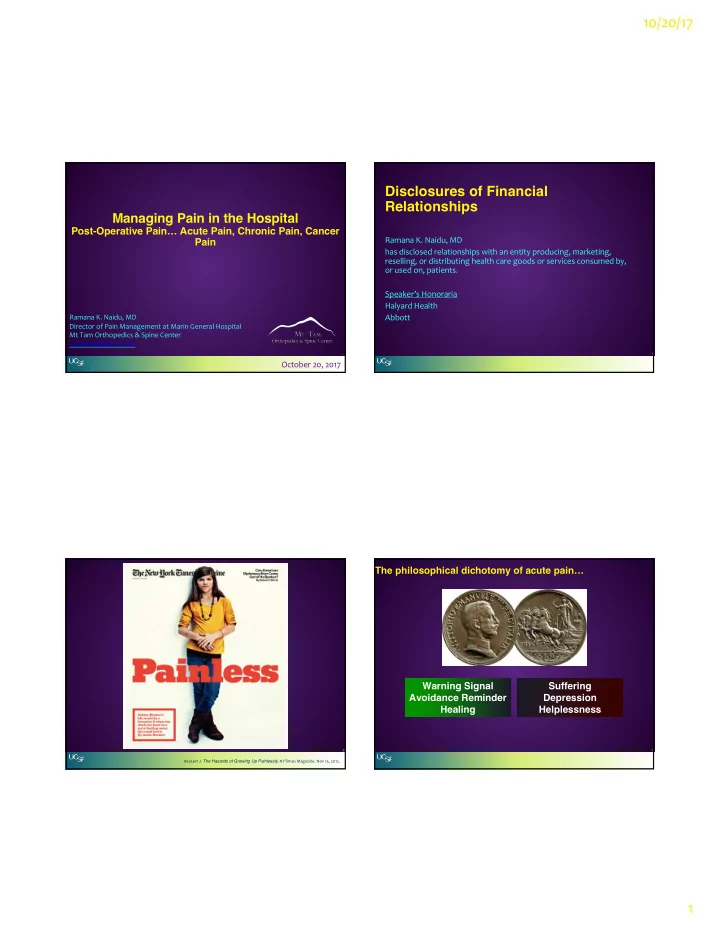
The philosophical dichotomy of acute pain… Suffering Depression Helplessness Warning Signal Avoidance Reminder Healing

4

slide-2
SLIDE 2

10/20/17 2

Definitions

Pain: an unpleasant sensory and emotional experience associated with actual or potential tissue damage, or described in terms of such damage.

Acute Pain:

  • Pain that is limited to the expected period of healing.
  • Temporal definitions vary. <1 month. <3 months. <6 months.

Subacute Pain:

  • A transitional period between acute and chronic pain where one is concerned the acute pain is

becoming persistent.

  • Temporal definitions vary. 1-6 months.

Chronic Pain:

  • Pain that persists beyond the expected period of healing.
  • Temporal definitiions vary. >3 months. >6 months.

Cancer Pain End-Of-Life Pain

Merskey, H. (1964), An Investigation of Pain in Psychological Illness, DM Thesis, Oxford

5

Pain Assessment and Risk Screening

6

Intensity/Severity:

  • Verbal Rating Scale (VRS)
  • Numerical Rating Scale (NRS)
  • Visual Analog Scale (VAS)
  • Wong-Baker (Faces)
  • FLACC
  • Pain Assessment in Advanced

Dementia Scale (PAINAD) “Objective”

  • fMRI
  • Biological Pattern Algorithms

Quality:

  • Descriptors
  • Brief Pain Inventory
  • McGill Pain Questionnaire

Function:

  • Oswestry Disability Index
  • World Health Organization Disability Assessment Scale
  • Timed Up and Go
  • PROMIS, KOOS, WOMAC (location-specific)

Psychological:

  • Hospital Anxiety and Depression Scale
  • Pain Catastrophization Scale
  • Beck Depression Inventory

Substance Use/Misuse/Abuse:

  • Opioid Risk Tool
  • SOAPP-R
  • COMM
  • CAGE-AID
  • Pasero Opioid Sedation Scale

Surgery Trauma Bone Fractures Burns Weapons Acute Medical Illness Dental Caries Infectious Sequelae Lumbago Headache Abdominal Pain Types of Acute Non-Cancer Pain

7

  • Lumbago

Headaches Neck Pain/Cervicalgia Abdominal Pain Joint Pain Neuropathy Post-Surgical Pain Syndromes Pelvic Pain Psychological Syndromes Other Syndromes Types of Chronic Non-Cancer Pain

8

Rice, A. S. C., Smith, B. H. & Blyth, F. M. Pain and the global burden of disease. Pain 157, 791–6 (2016).

Global burden of disease: Pain 4.3% of the the world’s population is free of disease, injury, or sequelae. Global prevalence of Dental Caries: 2.4 billion individuals Global prevalence of Tension-Type Headaches: 1.6 billion individuals Greatest cause of years lived with disability is: Low back pain

slide-3
SLIDE 3

10/20/17 3

Tumor-Related Mass Effect, Swelling, Nerve Irritation, Bony Mets Surgery Post-Surgical Pain Syndromes Radiation Neuritis and Neuropathy Chemotherapy Headache, Peripheral Neuropathy Acute Pain Non-Cancer Chronic Pain Conditions Types of Cancer Pain

9

Do we need to manage pain?

Rich, B. Physicians’ legal duty to relieve suffering. West. J. Med. 175, 151–2 (2001). * end-of-life cancer pain cases

Consequences of untreated/unmanaged pain for the provider:

  • Empathetic distress
  • Ethical consequences
  • IASP Declaration of Montréal
  • Legal Consequences
  • James, 1991, North Carolina*
  • Chin, 1998, California*
  • What is standard of care in pain management today?
  • What is the goal of acute pain management?

Consequences of untreated/unmanaged acute pain for the patient:

  • Autonomic changes
  • Endocrinological changes: increased cortisol, insulin resistance, etc.
  • Psychological distress
  • Development of chronic pain —> all of the above
  • 1. Manage pain
  • 2. Prevent

chronification

10

Chronification… yes, it’s a word. the process by which acute pain becomes chronic pain

A neologism ubiquitous in the pain literature; commonest use in regards to migraine.

Ossipov, M. H., Morimura, K. & Porreca, F. Descending pain modulation and chronification

  • f pain. Curr. Opin. Support. Palliat. Care 8, 143–51 (2014).

11

PROCEDURE Approx Incidence PPSP Approx Incidence of Severe PPSP Approx Number

  • f Cases

Annually in USA Approx Maximal Number of Patients at Risk for PPSP per year Lower Limb Amputation 30-80% 5-10% 159,000 127,000 Sternotomy 30-50% 5-10% 598,000 299,000 Thoracotomy 30-40% 10% 280,000 112,000 Breast Surgery 20-30% 5-10% 479,000 144,000 Inguinal Herniorraphy 10-50% 2-4% 609,000 304,000 Total Hip Replacement 12-28% 5% 400,000 112,000 Total Knee Replacement 8-13% 5% 605,000 78,000 Cesarean Section 10% 4% 220,000 22,000

Persistent Post-Surgical Pain (PPSP)

National Inpatient Sample (NIS) 2007 Data http://www.hcup-us.ahrq.gov/nisoverview.jsp Kehlet et al. The Lancet. 2006

12

slide-4
SLIDE 4

10/20/17 4

acute post-operative pain pre-operative pain chronic or persistent post-

  • perative

pain surgical technique anesthetic technique psychology genetics age adjuvant analgesics anti-hyperalgesics regional anesthesia nerve-sparing technique infection prevention anxiety depression catastrophization

Modified from Macrae

Persistent Post-Surgical Pain (PPSP)

13

Analgesia vs Hyperalgesia

14

COX- Inhibitors Acetaminophen Alpha-2 Agonists Lidocaine Low-dose Ketamine Magnesium Analgesia NO anti-hyperalgesia Analgesia BUT Hyperalgesia Opioids Anti-Hyperalgesia NO analgesia Regional Anesthesia Analgesia and Anti- Hyperalgesia Analgesia vs Anti-Hyperalgesia

15

The management of pain must involve both analgesia and anti-hyperalgesia

Analgesia will address acute physiological and psychological adverse effects. Anti-hyperalgesia will address the chronification of pain and the resultant long duration of physiological and psychological adverse effects.

Pearl: Analgesia vs Anti-Hyperalgesia

16

slide-5
SLIDE 5

10/20/17 5

Overview of Anatomy: Nociception

Basbaum, A. I., Bautista, D. M., Scherrer, G. & Julius, D. Cellular and Molecular Mechanisms of Pain. Cell 139, 267–284 (2009).

1662 RENÉ DESCARTES TREATISE OF MAN

17

Overview of Anatomy: Pathological Nociception

Peripheral sensitization Dorsal Root Ganglion (DRG) modulation Dorsal Horn: Rexed Laminae II, V Descending facilitation Attenuation of Descending Inhibition Sympathetic response Emotional response Memory formation Tissue Chemokines Central sensitization Hypothalumus-Pituitary-Adrenal response

18

Basbaum, A. I., Bautista, D. M., Scherrer, G. & Julius, D. Cellular and Molecular Mechanisms of Pain. Cell 139, 267–284 (2009).

Biological

Pharmacologics: Opioids

19

Biological

Pharmacologics: Opioids

4,000 BCE -1840

20

Brownstein MJ. A Brief History of Opiates, Opioid Peptides, and Opioid Receptors. Proc National Acad Sci (PNAS). June 1993.

slide-6
SLIDE 6

10/20/17 6

Biological

Pharmacologics: Opioids

Brownstein MJ. A Brief History of Opiates, Opioid Peptides, and Opioid Receptors. Proc National Acad Sci (PNAS). June 1993.

1840-1975

21

Biological

Pharmacologics: Opioids

Brownstein MJ. A Brief History of Opiates, Opioid Peptides, and Opioid Receptors. Proc National Acad Sci (PNAS). June 1993.

1970-2007

22

Biological

Pharmacologics: Opioids

2000-2017

23

2000

DECLARATION OF MONTREAL

2010

PURDUE LAWSUIT

2007 2014

DEA CHANGES ACETAMINOPHEN- CONTAINING OPIOIDS to SCHEDULE II from SCHEDULE III

CDC RAISES CONCERNS 5th VITAL SIGN 2016 CDC GUIDELINES

Biological

Pharmacologics: Opioids. America today.

  • Americans constitute 4.6% of the world’s population and consume approximately 80% of

the world’s opioids.

  • Americans consume 99% of the world’s hydrocodone
  • There are enough prescribed opioids for each American to take a prescription opioid

every 4 hours for a month.

  • Estimated 2.1 million Americans with prescription opioid substance use disorder in 2012
  • Estimated 467,000 addicted to heroin in 2012.

American Society of Interventional Pain Physicians (ASIPP). Manchikanti L, Pain Physician National Institute on Drug Abuse (NIDA)

24

slide-7
SLIDE 7

10/20/17 7

Natural and Semi-synthetic opioid analgesics Methadone Synthetic opioid analgesics excluding methadone Heroin All Opioids

Number of Deaths per year from Opioids in the United States: 2000-2016

Deaths

CDC Wonder Data 2000-2015. Poisoning-Related Deaths stratified by drug grouping August 6, 2017: https://www.cdc.gov/nchs/data/health_policy/monthly-drug-overdose-death-estimates.pdf

25 26

  • 1. Limiting opioids dispensed for new acute prescriptions to 7 days.
  • 2. Reducing the dispensation of stronger and long-release opioids.
  • 3. Enhancing pharmacist counseling for new opioid patients.
  • 4. Adding 750 new medication disposal kiosks (doubling the current

footprint)

  • 5. Contributing $2 million in additional funds to opioid abuse treatment

charities.

Biological

Pharmacologics: Opioids. Remember, you have them within you.

Miller's Anesthesia, Volumes 1 and 2, 7th Edition. By Ronald D. Miller, M.D. (Editor), Lars I. Eriksson, M.D., Ph.D., Lee A. Fleisher, M.D., Jeanine P. Wiener-Kronish, M.D., and William L. Young, M.D. (Associate Editors). Philadelphia, Churchill Livingstone, 2009. Pages: 3,084 (volumes 1 and 2 combined).

Effect Receptors Agonists Antagonists Analgesia Supraspinal u,d,k analgesia no effect Analgesia Spinal u,d,k analgesia no effect Respiratory Function u decrease no effect Gastrointestinal Tract u,k decrease no effect Psychotomimesis k increase no effect Feeding u,d,k increase decrease Sedation u,k increase no effect Prolactin u increase decrease Growth Hormone u/d increase decrease u d k nociceptin Endogenous Ligand Endorphin Enkephalin Dynorphin Nociceptin Exogenous Agonist Morphine Methadone Fentanyl Deltorphin Pentazocine Nalbuphine Butorphanol Exogenous Antagonist Naloxone Naltrexone Naloxone Naloxone

27

Biological

Pharmacologics: Opioid Adverse Effects

HYPOGONADISM IMMUNOSUPPRESSION INCREASED FEEDING INCREASED GROWTH HORMONE WITHDRAWAL TOLERANCE, DEPENDENCE ABUSE, ADDICTION HYPERALGESIA IMPAIRMENT WHILE DRIVING RESPIRATORY DEPRESSION NAUSEA/VOMITING PRURITUS URTICARIA CONSTIPATION URINARY RETENTION DELIRIUM SEDATION MYOCLONUS SEIZURES

ADVERSE EFFECTS WITH CHRONIC USE ADVERSE EFFECTS WITH ACUTE USE

Track naloxone respiratory depression event data at your institution as a quality measure

28

slide-8
SLIDE 8

10/20/17 8

Biological

Pharmacologics: Opioid-Induced Hyperalgesia (OIH)

It is the very notion we should NOT use opioids in pain management as it leads to a paradoxical increase in pain.

The Health & Retirement longitudinal cohort saw an increase in severe, moderate, and mild pain from 1998- 2010. The odds of recovery from chronic pain were 4 times higher for non-opioid users than for chronic opioid users.

MS, A. & Clark, J. A Qualitative Systematic Review: Opioid-Induced Hyperalgesia. Anesthesiology 570–587 (2006) Sjøgren, P., Grønbæk, M., Peuckmann, V. & Ekholm, O. A population-based cohort study on chronic pain: the role of opioids. Clin. J. Pain 26, 763–769 (2010) Grol-prokopczyk, H. Sociodemographic disparities in chronic pain , based on 12-year longitudinal data. 158, (2017). 29

Biological

Pharmacologics: Opioids The standard unit for opioid risk stratification: Oral Morphine Equivalents (OMEs, MEQs)

Calculate your patient’s OMEs prior to admission, daily during admission, and monitor trends. Use a table, app, spreadsheet, EMR, etc. Risk associated with

  • utpatient use of opioids is

directly related to daily dose. Acute can become chronic. The unit is becoming part of regulation.

Dunn, K. M. et al. Overdose and prescribed opioids : Associations among chronic non-cancer pain patients. Ann. Intern. Med. 152, 85–92 (2010). 30

Biological

Pharmacologics: Opioids Opioid Metabolism

HYDROCODON E OXYCODONE MORPHINE-3-GLUCURONIDE MORPHINE-6-GLUCURONIDE

CYP4502D6 glucuronidation

UDP- glucuronosyltransferase- 2B7

MORPHIN E HYDROMORPHONE HYDROMORPHONE-3-GLUCURONIDE OXYMORPHONE OXYMORPHONE-3-GLUCURONIDE TRAMADOL O- DESMETHYL- TRAMADOL CODEINE

31

Celecoxib Citalopram Codeine, Hydrocodone, Oxycodone, Tramadol

PHENOTYPES % POPULATION 2C9 % POPULATION 2C19 % POPULATION 2D6 ULTRA RAPID METABOLIZER UM N/A 30% 7% EXTENSIVE METABOLIZER EM 60% 14-44% 48% INTERMEDIATE METABOLIZER IM >35% 24-36% 35% POOR METABOLIZER PM 2-4% 2-20% 10%

Biological

Pharmacologics: Opioids Opioid Metabolism

Janicki P. Chapter 2: Pharmacogenomics in Pain Management. Comprehensive Treatment of Chronic Pain by Medical, Interventional, and Integrative Approaches. Springer. 2013.

32

slide-9
SLIDE 9

10/20/17 9

Biological

Pharmacologics: Opioids Transitions in Care

What are the best practices for transitions from inpatient to outpatient pain management?

Dunn, K. M. et al. Overdose and prescribed opioids : Associations among chronic non-cancer pain patients. Ann. Intern. Med. 152, 85–92 (2010).

1) Reiterate the message that the patient needs to get off of opioids sooner than later. If they are on them for longer than 7-10 days, there is something “awry,” and they should seek expert opinion. Provide the CDC Guidelines as a reference. 2) Patients should understand how much they are on (OMEs) and monitor trends. 3) Provide patients with information on risks and benefits of use. 4) Patients should be given information about how controlled substances 1) should be locked/secured 2) how they may not be given to others and used only as prescribed 3) where controlled substances should be disposed 4) summary of the state’s laws with regards to driving or operating machinery 5) Provide patients and their primary care providers with outpatient pain and addiction clinic information in case they are concerned about the development of chronic pain, or addiction.

33

Biological

Pharmacologics: Opioids Efficacy in Acute Pain

Richards, D. The Oxford Pain Group League table of analgesic efficacy. Evid. Based. Dent. 5, 22–23 (2004).

Opioids are…

“powerful” “painkillers” “strong”

Opioids can be effective for static pain, but are that not effective for dynamic pain. Most acute pain is dynamic pain- pain associated with movement. Consider the importance of dynamic pain management for:

  • DVT/PE prophylaxis
  • Atelectasis/pneumonia prophylaxis
  • Urinary catheterization removal

34

Biological

Pharmacologics: Opioids Efficacy in Acute Pain Analgesic and dose People in comparison (n) Proportion with 50% pain relief (%) NNT Lower CI Higher CI

Etoricoxib 180/240 248 77 1.5 1.3 1.7 Etoricoxib 100/120 500 70 1.6 1.5 1.8 Valdecoxib 40 473 73 1.6 1.4 1.8 Dipyrone 113 79 1.6 1.3 2.2 Ibuprofen 800 76 100 1.6 1.3 2.2 Ketorolac 20 69 57 1.8 1.4 2.5 Ketorolac 60 (intramuscular) 116 56 1.8 1.5 2.3 Diclofenac 100 411 67 1.9 1.6 2.2 Piroxicam 40 30 80 1.9 1.2 4.3 Paracetamol 1000 + codeine 60 197 57 2.2 1.7 2.9 Oxycodone IR 5 + paracetamol 500 150 60 2.2 1.7 3.2 Bromfenac 25 370 51 2.2 1.9 2.6 Rofecoxib 50 675 54 2.3 2.0 2.6 Diclofenac 50 738 63 2.3 2.0 2.7 Naproxen 440 257 50 2.3 2.0 2.9 Oxycodone IR 15 60 73 2.3 1.5 4.9 Ibuprofen 600 203 79 2.4 2.0 4.2 Ibuprofen 400 4703 56 2.4 2.3 2.6 Aspirin 1200 279 61 2.4 1.9 3.2 Oxycodone IR 10 + paracetamol 650 315 66 2.6 2.0 3.5 Ketorolac 10 790 50 2.6 2.3 3.1 Ibuprofen 200 1414 45 2.7 2.5 3.1 Oxycodone IR 10 + paracetamol 1000 83 67 2.7 1.7 5.6 Piroxicam 20 280 63 2.7 2.1 3.8 Diclofenac 25 204 54 2.8 2.1 4.3 Richards, D. The Oxford Pain Group League table of analgesic efficacy. Evid. Based. Dent. 5, 22–23 (2004). Morphine 10 (IM) 946 50 2.9 2.6 3.6

35

Biological

Pharmacologics: Cyclo-Oxygenase Inhibitors (COX-inhibitors)(historically known as NSAIDs)

ARACHIDONIC ACID

COX-1

PGI2 TXA2 PGE2

COX-2

PGD2 PGF2 PGE2 PGI2 Vasodilator Hyperalgesic Inhibits Platelet Aggregation Sleep/Wake Cycle Vasodilator Inhibits Platelet Aggregation Bronchoconstrictor Myometrial Contraction Decreased Stomach Acid Increased Mucous Vasodilator Hyperalgesic Vasodilator Hyperalgesic Inhibits Platelet Aggregation Platelet Aggregation Vasoconstrictor

  • Constitutive. Found in

all tissues esp GI tract

  • Inducible. Kidney, GI tract,

CNS, endothelium

36

Decreased Stomach Acid Increased Mucous Vasodilator Hyperalgesic

slide-10
SLIDE 10

10/20/17 10

Biological

Pharmacologics: Cyclo-Oxygenase Inhibitors (COX-inhibitors)(historically known as NSAIDs)

Schmidt, M. et al. Cardiovascular safety of non-aspirin non-steroidal anti-inflammatory drugs: Review and position paper by the working group for Cardiovascular Pharmacotherapy of the European Society of Cardiology. Eur. Heart J. 37, 1015–1023 (2016).

Bleeding Gastritis Renal Injury Cardiovascular Adverse Events

37

Biological

Pharmacologics: Cyclo-Oxygenase Inhibitors (COX-inhibitors)(historically known as NSAIDs)

Schmidt, M. et al. Cardiovascular safety of non-aspirin non-steroidal anti-inflammatory drugs: Review and position paper by the working group for Cardiovascular Pharmacotherapy of the European Society of Cardiology. Eur. Heart J. 37, 1015–1023 (2016)

Out-of-Hospital Cardiac Arrest (OHCA) associated with NSAID use in the prior 30 days.

Statistically significant:

  • Use of diclofenac OR 1.5
  • Use of ibuprofen OR 1.3

Not statistically significant:

  • Use of naproxen OR 1.29
  • Use of celecoxib OR 1.13
  • Use of rofecoxib OR 1.28

Sondergaard, K. B. et al. Non-steroidal anti-inflammatory drug use is associated with increased risk of out-of-hospital cardiac arrest: a nationwide case–time–control study. Eur. Hear. J. - Cardiovasc. Pharmacother. pvw041 (2016)

38

Steroids (glucocorticoids) reduce pain by reducing prostaglandin synthesis. However, their side effect profile is significant and should not be used for non- surgical, acute non-cancer pain unless other options are not effective or possible. They should not be used chronically. Dexamethasone is routinely used in the peri-operative arena for post-operative nausea and vomiting. It is associated with a reduction in NRS/VAS and opioid consumption, 8mg > 4 mg.

Side effects:

Increased weight gain Proximal muscle weakness Insomnia Gastrointestinal side effects Gastrointestinal bleeding Psychatric side effects Osteoporoses with long-term use Infections Hyperglycemia Cushing Syndrome Thromboembolism

Biological

Pharmacologics: Steroids

Vyvey, M. Steroids as pain relief adjuvants. Can. Fam. Physician 56, 1295–7, e415 (2010) De Oliveira GS Jr.; Almeida MD; Benzon HT;McCarthy RJ. Perioperative Single Dose Systemic Dexamethasone for. Anesthesiology 115, 575–588 (2011) 39

Biological

Pharmacologics: Acetaminophen/Paracetamol Aniline analgesic. Mechanism of action remains unknown. The proposed COX-3 mechanism is controversial. Safety: 4 grams/day limit is safe in adults. Lean-body weight based: 60mg/kg/day Prospective trials involving central pain related to stroke shows safety up to 6g/day

  • Hepatitis: if indolent, 4 g/day ok
  • Alcoholism: if not drinking >2 drinks /day, 4g/day ok
  • Combination Hepatitis and Alcoholism: depends. 2g/day limit or avoid?

Caution in combination with CYP450 3A4 /2E1 inhibitors: consider effect of coumadin, anticonvulsants, and antipsychotics Efficacy: Single dose oral paracetamol/acetaminophen provides effective pain relief for about half of patients after surgery. (Cochrane, 2008). Intravenous paracetamol provided pain relief for 36% of patients after

  • surgery. (Cochrane, 2016).

Cost: Oral acetaminophen is OTC and costs pennies. Intravenous acetaminophen, depending on your contract, $100s/day

  • Lachiewicz, P. F. The Role of Intravenous Acetaminophen in Multimodal Pain Protocols for Perioperative Orthopedic Patients. Orthopedics 36, 15–19 (2013)
  • Toms, L. et al. Single dose oral paracetamol ( acetaminophen ) for postoperative pain in adults ( Review ) Single dose oral paracetamol ( acetaminophen ) for postoperative

pain in adults. 4–6 (2012).

  • Tzortzopoulou, A. et al. Single dose intravenous propacetamol or intravenous paracetamol for postoperative pain. Cochrane database Syst. Rev. CD007126 (2011).

40

slide-11
SLIDE 11

10/20/17 11

Clonidine Effective in animal model analgesic trials. While it can be effective in reducing pain and opioid consumption, it is limited by its side effect of bradycardia and hypotension.

Biological

Pharmacologics: Alpha-2 Agonists

Dexmedetomidine: (alpha-2 agonist) 1620: 1 (alpha-1 agonist) can be used for both analgesic and sedative properties. It is particularly useful in patients with heroin abuse because it helps with withdrawal symptoms, provides analgesia, and calms/sedates. The drug crosses the BBB and has been studied via several routes of administration: IM/IV/IN/Regional though not PO. It is expensive, and can only be used intravenously in monitored settings due to the same concerns regarding bradycardia and hypotension. Still early in our experience as far as the literature. We have support for its use, particularly in the ICU or in pediatrics. Its benefit remains during the infusion, and does not seem to provide longer- term benefit due to an elimination half-live of 2 hours.

41

Gabapentinoids (Gabapentin and Pregabalin): MOA: alpha-2-delta ligand antagonists (calcium channel membrane stabilizer). Useful in peri-operative pain management resulting in reduce opioid consumption and potentially in reducing the development of chronic pain after surgery. Use is limited with side effects which include sedation, cognitive impairment, tremor, hallucinations, swelling, visual changes, dry mouth, etc. Use particular caution in the geriatric population and in patients with renal impairment. More benefit and adverse effects seen with higher dosing.

Biological

Pharmacologics: Neuropathic Analgesics

  • Clarke, H. et al. The prevention of chronic postsurgical pain using gabapentin and pregabalin: A combined systematic review and meta-analysis.
  • Anesth. Analg. 115, 428–442 (2012)
  • Wong, K. et al. Antidepressant Drugs for Prevention of Acute and Chronic Postsurgical Pain. Anesthesiology 121, 591–608 (2014).

SNRI/SSRI Antidepressants (Duloxetine, Venlafaxine, Desvenlafaxine, Milancipran, etc.) Have not been proven to be useful in acute pain.

Ca-channel Membrane Stabilizers

e.g. gabapentinoids

Na-channel Membrane Stabilizers

  • eg. carbamazepine

Tricyclic Antidepressants

e.g. amitriptyline

SNRI/SSRI Antidepressants

e.g. duloxetine

Anti-Epileptic Drugs (AEDs) Antidepressants

42

Biological

Pharmacologics: NMDA-antagonists: Ketamine

Ketamine is an anesthetic drug (Controlled Substance III). It exerts various effects depending on the dose and has many mechanisms of action:

  • NMDA antagonist
  • Kappa opioid agonist
  • Potentiates antinociception of mu-opioid effect
  • Inhibits alpha-6 nicotinic receptors

In addition to its impact on anti-hyperalgesia, it is also being widely studied for anti- depression and may play a role in the affective component of pain perception. Do not use, or exercise caution in individuals with schizophrenia, schizoaffective disorder, post-traumatic stress disorder, Cluster A personality disorders. USE DOSE ANESTHETIC 2-5 mg/kg DISSOCIATIVE (PEDI) 1-2 mg/kg CHRONIC PAIN INFUSION 0.5 - 1 mg/kg/hr LOW-DOSE INFUSION for OIH 0.1-0.2 mg/kg/hr 1-3 mcg/kg/min

43

Biological

Pharmacologics: NMDA-antagonists: Ketamine

Nystagmus Tremor Psychomotor Agitation Hallucinations Hypersalivation Dissociative State Coma Sympathomimetic Effects

44
slide-12
SLIDE 12

10/20/17 12

17 studies, with variable timing and dosing, demonstrated statistically significant reductions in the development of persistent post- surgical pain at 3 and 6 months. Comparisons of pain severity did not reach statistical significance.

ANTI-HYPERALGESIA ANALGESIA

Biological

Pharmacologics: NMDA-antagonists: Ketamine

39 clinical trials, 5 meta-analyses, were included. Variable timing and dosing, demonstrated statistically significant reductions in opioid consumption by 40%

45

Biological

Pharmacologics: Voltage-Gated Sodium Channel Blockade: Lidocaine Infusion.

Lidocaine is an anti-arrhythmic and local anesthetic drug. It relieves pain at doses from 1-2 mg/kg/hr It has been widely studied in colectomy, laparoscopic surgery, and reduces opioid

  • consumption. In chronic pain, it has been studied for CRPS, headache, and other neuropathic

pain conditions such as erythromelalgia, where it can be the “cure” for sodium channelopathy. Its effect lasts during the infusion and shortly wears off. Do not use, or exercise caution in individuals where sodium channel cardiac blockade would be problematic, e.g. sinoatrial block or 2nd or 3rd degree block.

Dunn, L. K., Ph, D., Durieux, M. E. & Ph, D. Perioperative use of Lidocaine. Anesthesiology (2017)

46

Biological

Multi-Modal Analgesia in spite of Polypharmacy

Analgesia Resp Depression Sedation Delirium N/V Constipation Pruritus Gastritis Renal Dysfunction Platelet Inhib LAST

47

Biological

Multi-Modal Analgesia

Analgesia Resp Depression Sedation Delirium N/V Constipation Pruritus Gastritis Renal Dysfunction Platelet Inhib LAST

Michelet D, 2012. Anesth Analg De Oliveira, 2012. Anesth Analg

48

slide-13
SLIDE 13

10/20/17 13

Biological

Multi-Modal Analgesia

Analgesia Resp Depression Sedation Delirium N/V Constipation Pruritus Gastritis Renal Dysfunction Platelet Inhib LAST

Tiippana E, 2007. Anesth Analg

49

Biological

Multi-Modal Analgesia

Analgesia Resp Depression Sedation Delirium N/V Constipation Pruritus Gastritis Renal Dysfunction Platelet Inhib LAST

Blaudszun, 2012. Anesthesiology

50

Biological

Multi-Modal Analgesia

Analgesia Resp Depression Sedation Delirium N/V Constipation Pruritus Gastritis Renal Dysfunction Platelet Inhib LAST

Kehlet, 2005. Anesthesiology Koppert, 2004. Anesth Analg

51

Biological

Multi-Modal Analgesia

Analgesia Resp Depression Sedation Delirium N/V Constipation Pruritus Gastritis Renal Dysfunction Platelet Inhib LAST

52

slide-14
SLIDE 14

10/20/17 14

Biological

Multi-Modal Analgesia

Analgesia Resp Depression Sedation Delirium N/V Constipation Pruritus Gastritis Renal Dysfunction Platelet Inhib LAST

RECEPTOR MEDICATION EXAMPLES ADVERSE EFFECTS alpha-2 Dexmedetomidine, Clonidine Bradycardia, Dry Mouth COX-inhibition Ketorolac, Ibuprofen, Celecoxib, APAP GI Ulcers, Renal Dysn, Bleeding Mu-Opioid Morphine Fentanyl N/V, Constipation, Resp Depression, Pruritus, Urinary Ret, Delirium, Kappa-Opioid Nalbuphine GABA-A Diazepam Lorazepam Sedation, Delirium, Resp Dep c Op Na-Channel Local Anesthetics LAST NMDA-Antagonism Ketamine Memantine

  • Depends. Psychomimetic FX

Glucocorticoid Dexamethasone Hyperglycemia, Acute Angle Glaucoma, Perineal Dysesthesia Ca-Channel Neuropathic Gabapentin Pregabalin Sedation, Impaired Cognition Na-Channel Neuropathic Topiramate Carbamazepine Sedation, Nephrolithiasis SNRI Antidepressant Duloxetine Venlafaxine Insomnia, Malaise, Stomatitis,

Biological

Regional Anesthesia

NEURAXIAL Intrathecal Epidural, Caudal PARA-NEURAXIAL Paravertebral Lumbar Plexus PROXIMAL PERIPHERAL NERVE Interscalene, Supraclavicular, Infraclavicular Intercostal Transversus Abdominis Plane (TAP) DISTAL PERIPHERAL NERVE Median, Radial, Ulnar Femoral, Saphenous Sciatic, Tibial, Common Peroneal

54

Regional anesthesia is the most impactful modality of acute pain

  • management. It can eliminate acute pain.

Regional anesthesia can significantly reduce opioid consumption Regional anesthesia reduces the development of chronic pain after surgery.

Epidural analgesia reduces persistent post-surgical pain after thoracotomy Paravertebral analgesia redues persistent post-surgical pain after mastectomy

Risks include nerve injury, hematoma, infectious complications, local anesthetic systemic toxicity, cardiovascular collapse, anaphylaxis

Biological

Regional Anesthesia

Andreae, M. H. & Andreae, D. A. Regional anaesthesia to prevent chronic pain after surgery: A Cochrane systematic review and meta-analysis. Br. J. Anaesth. 111, 711–720 (2013).

55

Biological

Complementary and Integrative Medicine

MUSIC TOUCH MASSAGE ACUPUNCTURE ACUPRESSURE HYPNOSIS BIOFEEDBACK GUIDED IMAGERY DISTRACTION CREATIVE ARTS HERBAL THERAPY HOMEOPATHY

56

slide-15
SLIDE 15

10/20/17 15

Psychological

57

CATASTROPHIZATION: characterized by the tendency to magnify the threat value of pain stimulus and to feel helpless in the context of pain, by a relative inability to inhibit pain-related thoughts in anticipation of, during or following a painful encounter. (Quartana, Expert Review Neurotherapeutics, 2009) 16/29 studies demonstrate a significant impact of catastrophization on the development of chronic post-surgical pain (CPSP). The rest are not

  • significant. No study demonstrated improvement in CPSP. Estimated OR

1.55-2.1 with greater OR in MSK surgeries. (Theunissen, Clin J of Pain, 2012)

Pain Catastrophization Scale (PCS) Catastrophization Assessment Scale (CAS) Hospital Anxiety & Depression Scale (HADS)

Cancer Pain Management (in 1 minute)

58

Cancer Pain Conditions Prognosis Function Goals & Expectations Risks and Benefits The Role of Opioids in Neoplasia

Opioids COX-inhibitors Gabapentinoids Lidocaine Infusion Ketamine Infusion Magnesium Infusion Steroids External Beam Radiation Radionuclide Therapy Epidurals Spinal Cord Stimulation Intrathecal Drug Delivery Neurolytic Blocks Regional Anesthesia Acupuncture & Traditional Chinese Medicine Ayurvedic Medicine Biofeedback Pain Psychology

The Future of Pain Medicine

General Medical Education in Pain Medicine

Mezei, L. & Murinson, B. B. Pain education in North American medical schools. J. Pain 12, 1199–208 (2011).

What are the median number of hours devoted to pain education in American medical schools over 4 years? IT IS A CONTRIBUTING COMPONENT TO OUR OPIOID EPIDEMIC THIS MUST CHANGE. United States: 9 hours Canada: 19.5 hours ACGME Fellowship in Acute Pain Medicine and Regional Anesthesia Starting in July 2017. 1 year duration after a residency in anesthesiology.

59

The Future of Pain Medicine

The need for long-term outcomes. Morbidity vs Mortality.

QUALITY-ADJUSTED LIFE YEARS (QALYs)

100%

40 20 60 80 AGE (YEARS)

QUALITY OF LIFE

0%

Trauma

60

Surgery

slide-16
SLIDE 16

10/20/17 16

Conclusion

61

Pharmacologic Regional Anesthesia & Interventional Pain Management Pain Psychology Rehabilitation/ PT Complementar y & Integrative Medicine

Understand the differences between analgesia and anti-hyperalgesia.

  • Opioids have a role in acute pain medicine, but… they are not the solution to
  • pain. They, in fact, can make pain worse over time.
  • Multimodal Analgesia is important to reduce consequential side effects
  • Non-Pharm and Non-Interventional modalities should always be used.
  • Regional anesthesia can be impactful, though must weigh risks.
  • Goals are to MANAGE PAIN so that it does not interfere with function and

PREVENT CHRONIC PAIN Future efforts:

  • Public health education
  • Healthcare provider eduction
  • Legislation/Regulation
  • Non-pharm, Non-interventional resources
  • Outcomes

Thank You