Subjective Exam Asterisks Subjective Exam Asterisks (contd) - - PDF document

subjective exam asterisks subjective exam asterisks cont d
SMART_READER_LITE
LIVE PREVIEW

Subjective Exam Asterisks Subjective Exam Asterisks (contd) - - PDF document

Property of VOMPTI, LLC www.vompti.com I NTEGRATION OF P AIN S CIENCE INTO P ATIENT M ANAGEMENT Dhinu Jayaseelan, DPT, OCS, FAAOMPT Orthopaedic Manual Physical Therapy Series Charlottesville 2017-2018 Orthopaedic Manual Physical Therapy Series


slide-1
SLIDE 1

Property of VOMPTI, LLC For Use of Participants Only. No Use or Reproduction Without Consent 1

www.vompti.com

Orthopaedic Manual Physical Therapy Series 2017-2018

Orthopaedic Manual Physical Therapy Series Charlottesville 2017-2018

INTEGRATION OF PAIN SCIENCE INTO PATIENT MANAGEMENT

Dhinu Jayaseelan, DPT, OCS, FAAOMPT

Orthopaedic Manual Physical Therapy Series 2017-2018 www.vompti.com Orthopaedic Manual Physical Therapy Series 2017-2018 www.vompti.com

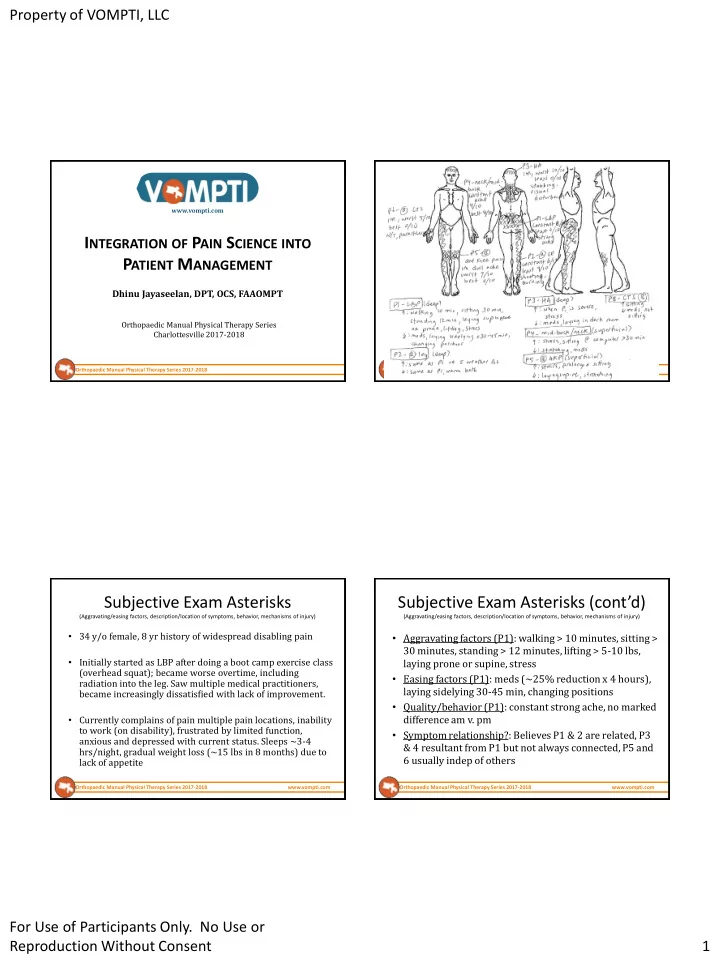
Subjective Exam Asterisks

(Aggravating/easing factors, description/location of symptoms, behavior, mechanisms of injury)

  • 34 y/o female, 8 yr history of widespread disabling pain
  • Initially started as LBP after doing a boot camp exercise class

(overhead squat); became worse overtime, including radiation into the leg. Saw multiple medical practitioners, became increasingly dissatisfied with lack of improvement.

  • Currently complains of pain multiple pain locations, inability

to work (on disability), frustrated by limited function, anxious and depressed with current status. Sleeps ~3-4 hrs/night, gradual weight loss (~15 lbs in 8 months) due to lack of appetite

Orthopaedic Manual Physical Therapy Series 2017-2018 www.vompti.com

Subjective Exam Asterisks (cont’d)

(Aggravating/easing factors, description/location of symptoms, behavior, mechanisms of injury)

  • Aggravating factors (P1): walking > 10 minutes, sitting >

30 minutes, standing > 12 minutes, lifting > 5-10 lbs, laying prone or supine, stress

  • Easing factors (P1): meds (~25% reduction x 4 hours),

laying sidelying 30-45 min, changing positions

  • Quality/behavior (P1): constant strong ache, no marked

difference am v. pm

  • Symptom relationship?: Believes P1 & 2 are related, P3

& 4 resultant from P1 but not always connected, P5 and 6 usually indep of others

slide-2
SLIDE 2

Property of VOMPTI, LLC For Use of Participants Only. No Use or Reproduction Without Consent 2

Orthopaedic Manual Physical Therapy Series 2017-2018 www.vompti.com

Self-Reported Outcomes

  • ODI

– 39/50; 78% (crippling back pain)

  • FABQ

– W: did not complete – PA: 23/24

  • PHQ-2

– 6/6 (little interest & feeling depressed nearly every day)

Orthopaedic Manual Physical Therapy Series 2017-2018 www.vompti.com

Previous Treatment(s)

Year: Type Treatment / Notable Memories Response 2008: PT

  • Cert-MDT
  • Repeated Extensions
  • Told ‘back is vulnerable’, ‘don’t

bend’, ‘jelly doughnut’ metaphor Symptoms worsened, became constant 2010: PT

  • ‘Aggressive’ lumbar stabilization

‘Created leg pain’ 2012: PT

  • Cert-MDT
  • ‘Need to keep the lordosis’, ‘your

spine is fragile because of the chronicity’ Headaches started Irritability elevated 2013 – 2016: Chiro

  • 2-3x / wk, x 3 years

‘Feels better after being adjusted’, ‘helps to be aligned’, ‘lasts ~ 6 hrs) 2014: PT

  • Thoracic manipulation
  • Dry needling (‘I love the needling,

it’d help for a couple hours, I think I need more of it’) Upper back pain began

Orthopaedic Manual Physical Therapy Series 2017-2018 www.vompti.com

Previous Treatment (Con’t)

  • Med list:

– Gabapentin, Phentynol patches, Tramadol, Oxycodone, Flexeril, Ibuprofen, Zoloft, Xanax, Relistor

  • Injections:

– R L4-5 facet CSI x 3 in 2013, no effect – Trigger point injections every ~4-6 months L-spine, hip, minimal temporary benefit (1 week)

  • Ketamine infusion:

– No benefit

  • Also trialed: acupuncture, herbal supplements, ‘detoxification

weekend’, marijuana, alcohol

– No lasting benefit

  • Imaging: MRI (+) mod disc bulge at L3,4 on R, otherwise

unremarkable; Radiographs (+) DDD L-spine

Orthopaedic Manual Physical Therapy Series 2017-2018 www.vompti.com

Structure(s) at fault

Joints in/refer to painful region Myofascial tissue in/refer to painful region Non-contractile tissue in/refer to painful region Neural tissue in/refer to painful region Other structures to be examined (non-MSK)

slide-3
SLIDE 3

Property of VOMPTI, LLC For Use of Participants Only. No Use or Reproduction Without Consent 3

Orthopaedic Manual Physical Therapy Series 2017-2018 www.vompti.com

Structure(s) at fault (P1)

  • Primary hypothesis after subjective: chronic pain with central

sensitization

  • Differential (rank order): fibromyalgia, chronic fatigue

syndrome, lupus

Joints in/refer to painful region Myofascial tissue in/refer to painful region Non-contractile tissue in/refer to painful region Neural tissue in/refer to painful region Other structures to be examined (non-MSK) L2-3,3-4,4-5,5- S1 facets SIJ Hip Paraspinals, glute max/med/ min, piriformis L3-S2 discs Interspinsous ligaments Sciatic n. L3-S2 n. roots Liver

Orthopaedic Manual Physical Therapy Series 2017-2018 www.vompti.com

Physical Exam Asterisks

(Special tests, movement/joint dysfunction, posture, palpation, etc)

  • Observation: flexed posture in sitting, general sense of malaise
  • ROM:

– 25% limitation all planes, pain all directions, primarily extension

  • Symptoms ↑ in flexion with added cervical flexion ( baseline with cervical ext)

– (+) Gower’s sign – Did not assess overpressures or quadrants

  • Neuro Exam:

– Myotomes – invalid secondary to pain with testing – 1+ DTRs bilateral C5,6,7,L3-4,S1 – (-) clonus, Babinski, Hoffman’s, ataxic gait

  • Palpation:

– widespread hyperalgesia, allodynia at lumbar spine

  • Accessory motion:

– unable to assess secondary to guarding

  • Quantitative sensory testing:

– ↓ PPTs at local and remote sites

Orthopaedic Manual Physical Therapy Series 2017-2018 www.vompti.com

Rate your assessment of severity/irritability

Justify your assessment with examples from the subjective and/or objective exam

  • Severity:

None Min

Mod

Max

– Impacts ability to do daily tasks, self-report of severe disablement

  • Irritability: None

Min

Mod Max

– Symptoms aggravated rapidly, take extended durations to return to baseline

Stage and stability?

  • Acute

Subacute

Chronic

Acute on chronic

– 8 yr history, no recent MOI or trauma

  • Stable

Improving Worsening Fluctuating Red flags?

– Spread of symptom location, increased intensity, severity, functional decline

Orthopaedic Manual Physical Therapy Series 2017-2018 www.vompti.com

  • Are the relationships between the areas on the body

chart, the interview, and physical exam consistent? “Do the features fit” a recognizable clinical pattern? If YES, what? ‘Chronic pain syndrome’

  • Identify any potential risk factors (yellow, red flags,

non-MSK involvement, biopsychosocial) Depression, anxiety/stress, fear of movement, weight loss, a number of other treatments without benefit

slide-4
SLIDE 4

Property of VOMPTI, LLC For Use of Participants Only. No Use or Reproduction Without Consent 4

Orthopaedic Manual Physical Therapy Series 2017-2018 www.vompti.com

Chronic Pain

(including Central Sensitization)

  • Background (Institute of Med Report, 2011)

– Affects ~100 million Americans annually ( > DM, heart disease, stroke, CA combined) – Annual cost (2010) between $560-635 billion

  • Subjective

– Pain persisting > 3 months – Often associated with 2+ major body areas of symptoms (late stage) – Pain is disproportionate to tissue injury, severe – Elevated stress, anxiety, fear of movement, depression

  • Objective Examination

– Not well defined, due to diagnostic variability – Altered movement patterns (fear of movement/unwilling to move), not always consistent with mechanical dysfunction – Reduced threshold to touch/pressure, often widespread

Orthopaedic Manual Physical Therapy Series 2017-2018 www.vompti.com

Treatment Planning

  • What is your primary objective after intial eval?

– Education: pain neuroscience, stability of the human body, expectations with PT, benefit of multidisciplinary approach – Manual therapy: hands off day 1 – Exercise prescription: submaximal aerobic activity, graded exposure – Referral: psychologist Impairments Functional Limitations Goals

  • Decreased lumbar

AROM all planes

  • Impaired posture
  • Impaired muscle

performance

  • Widespread pain
  • Reduced sitting,

standing, walking tolerance

  • Decreased sleep
  • Unable to lift

min/moderately heavy objects

  • Increase willingness

to move

  • Pt to understand pain

science/mechanisms

  • Patient to be indep

with aerobic activity program

Orthopaedic Manual Physical Therapy Series 2017-2018 www.vompti.com

Pain: An Ongoing Area of Research.

  • Entire journal issues devoted to management of chronic

pain

– JMMT

  • 2017. 25(3)

– Medical Clinics of North America

  • 2016. 100(1)
  • Pathophys, acute v. chronic pain, pharm mgmt,

biopsychosocial/ multimodal mgmt, headaches, neuropathic pain, etc

– Physiotherapy Theory and Practice

  • 2016. 32(5)
  • Pain neuroscience education

Orthopaedic Manual Physical Therapy Series 2017-2018 www.vompti.com

What is Pain?

  • “An unpleasant sensory and emotional experience

associated with actual or potential tissue damage, or described in terms of such damage.” – IASP

  • Interpreted by the brain
  • Can be protective, can also be disabling
  • Chronic pain – pain persisting beyond expected tissue

healing timelines

  • SUBJECTIVE
slide-5
SLIDE 5

Property of VOMPTI, LLC For Use of Participants Only. No Use or Reproduction Without Consent 5

Orthopaedic Manual Physical Therapy Series 2017-2018 www.vompti.com

  • Chronic LBP very complex, determining a specific tissue at

fault challenging (aging/degeneration/imaging ≠ symptoms)

  • “As pain becomes centralized (an initial peripheral trigger

resulting in persistent alterations in the CNS) and more widespread over time, it becomes increasingly difficult and less relevant to identify the initial source”

Orthopaedic Manual Physical Therapy Series 2017-2018 www.vompti.com

How Can We Identify Pain Mechanisms?

  • Subjective exam, body diagram
  • Quantitative Sensory Testing
  • Classifications of musculoskeletal pain / evolving

research

– Central Sensitization – Peripheral Neuropathic Pain – Nociceptive Pain

Orthopaedic Manual Physical Therapy Series 2017-2018 www.vompti.com

Subjective Exam

  • Pain location(s) and relationships, SINSS
  • Body diagram (Visser, Pain Pract 2016)

– > 20% pain surface area associated with:

  • Pain sensitization (p = 0.0002)
  • ‘Severe’ or ‘extremely severe’ anxiety scores (p = 0.0270)
  • ≥ 5 psychosocial stressors (p = 0.0022)
  • ≥ 5 significant life events (p = 0.0098)
  • Use of ≥ 7 pain management strategies (p = 0.0001)

– Widespread Pain Index score ≥ 7 independently associated with sensitization (OR: 11.36)

Orthopaedic Manual Physical Therapy Series 2017-2018 www.vompti.com

Widespread Pain Index

ACR, Arthritis Care Res 2010

slide-6
SLIDE 6

Property of VOMPTI, LLC For Use of Participants Only. No Use or Reproduction Without Consent 6

Orthopaedic Manual Physical Therapy Series 2017-2018 www.vompti.com

  • Clinical method for detecting changes in nociceptive

pathways potentially undetectable by other testing (NCV)

  • May aid in identifying conditions where joint or muscle

insult has induced changes in neural processing

– Helps direct treatment to musculoskeletal tissue, central nociceptive mechanism, or psychosocial contribution (biopsychosocial model)

  • Can be used as an outcome measure

Orthopaedic Manual Physical Therapy Series 2017-2018 www.vompti.com

Courtney CA, JOSPT 2010

Orthopaedic Manual Physical Therapy Series 2017-2018 www.vompti.com

Quantitative Sensory Testing (QST)

  • Commonly used methods:

– Pressure pain thresholds* – Vibration detection threshold – Thermal detection threshold

  • Taken locally and at a remote site, compare bilaterally,

mean of 3 trials

Orthopaedic Manual Physical Therapy Series 2017-2018 www.vompti.com

slide-7
SLIDE 7

Property of VOMPTI, LLC For Use of Participants Only. No Use or Reproduction Without Consent 7

Orthopaedic Manual Physical Therapy Series 2017-2018 www.vompti.com

  • Patients classified as CS dominant reported the

following, compared to neuropathic of nociceptive dominant:

– More severe pain – Poorer physical and mental health related quality of life – Greater levels of back pain-related disability, depression, and anxiety

  • Similar pattern repeated when comparing neuropathic

to nociceptive dominant patients

Smart KM, 2012 Man Ther

Orthopaedic Manual Physical Therapy Series 2017-2018 www.vompti.com

  • 4 items in a ‘diagnostic’ cluster

– Disproportionate, non-mechanical, unpredictable pattern

  • f pain in response to multiple/non-specific

aggravating/easing factors – Pain disproportionate to the nature and extent of injury or pathology – Strong association with maladaptive factors (ie negative emotions, poor self-efficacy, etc) – Diffuse/non-anatomic areas of tenderness on palpation

  • Presence of the cluster has high levels of classification

accuracy:

– Sensitivity: 91.8 (95% CI: 84.5-96.4) – Specificity: 97.7 (95% CI: 95.6-99.0)

Smart KM, 2012 Man Ther

Orthopaedic Manual Physical Therapy Series 2017-2018 www.vompti.com

Nijs, JOSPT 2016

Orthopaedic Manual Physical Therapy Series 2017-2018 www.vompti.com

Central Sensitization Inventory

  • 2 part questionnaire intended to identify the presence
  • f central sensitization
  • Part A: 25 questions, 0-4 Likert scale, higher scores

indicate greater impact of sensitization

  • Part B: not scored, asks about previous diagnoses
  • Statistical metrics:

– Test-retest reliability: 0.82 – Specificity: 0.75 – Sensitivity: 0.81

Neblett, J Pain 2016

slide-8
SLIDE 8

Property of VOMPTI, LLC For Use of Participants Only. No Use or Reproduction Without Consent 8

Orthopaedic Manual Physical Therapy Series 2017-2018 www.vompti.com Orthopaedic Manual Physical Therapy Series 2017-2018 www.vompti.com

  • 3 items in the ‘diagnostic’ cluster

– Pain referred in a dermatomal or cutaneous distribution – History of nerve injury, pathology, or mechanical compromise – Pain/symptom provocation with mechanical/ movement tests (active/passive, neurodynamic) that move/load/compress neural tissue

  • Presence of the cluster has high levels of classification

accuracy:

– Sn: 86.3 (95% CI: 78.0-92.3) – Sp: 96.0 (95% CI: 93.4-97.8)

Smart KM, 2012 Man Ther

Orthopaedic Manual Physical Therapy Series 2017-2018 www.vompti.com

PainDETECT

(Screening Questionnaire for Neuropathic Pain)

  • 1 (minimum) to 38

(maximum)

  • ≤ 12, a neuropathic

component is unlikely

  • ≥ 19, a neuropathic

component is likely

  • Between 13-18,

uncertain

  • Sn. 84%
  • Sp. 84%

Freynhagen, Curr Med Res Opin 2006

Orthopaedic Manual Physical Therapy Series 2017-2018 www.vompti.com

  • 7 items in a ‘diagnostic’ cluster

– Pain localized to the area of injury/dysfunction – Clear, proportionate mechanical/anatomical nature to aggravating and easing factors – Usually intermittent and sharp with movement/mechanical provocation; may be a more constant dull ache or throb at rest – Absence of:

  • Pain in association with other dysesthesias
  • Night pain/disturbed sleep
  • Antalgic postures/movement patterns
  • Pain described as burning/shooting/sharp/electric-shock-like
  • Presence of the cluster has high levels of classification accuracy:

– Sensitivity: 90.9 (95% CI: 86.6-94.1) – Specificity: 91.0 (95% CI: 86.1-94.6)

Smart KM, 2012 Man Ther

slide-9
SLIDE 9

Property of VOMPTI, LLC For Use of Participants Only. No Use or Reproduction Without Consent 9

Orthopaedic Manual Physical Therapy Series 2017-2018 www.vompti.com

  • Enhanced excitation, reduced inhibition
  • Chronic pain is a continuum

– Peripherally driven  completely centrally augmented – Must understand where patients fit on this continuum to apply appropriate treatment (ie NSAIDs v. anti-depressants)

  • Centrally augmented pain not likely to benefit from

treatment for acute pain or inflammation of tissues (ie NSAIDs, injections, surgery)

Orthopaedic Manual Physical Therapy Series 2017-2018 www.vompti.com 15% 25% 60%

Pain Mechanisms Pie Chart

Nociceptive Neuropathic Centrally Mediated

Orthopaedic Manual Physical Therapy Series 2017-2018 www.vompti.com

HOW DO WE TREAT ALTERED CENTRALLY MEDIATED PAIN PROCESSING MECHANISMS?

Orthopaedic Manual Physical Therapy Series 2017-2018 www.vompti.com

(Weekend 4)

  • Therapeutic Neuroscience Pain Education

Reduce fear, Improve coping ability

Improve understanding, Ergonomics, Back school

Encourage confrontation

  • Empower patient
  • Multi Disciplinary approach
  • Treatment Based Classification
  • Graded Exposure (time not symptom based)

Early active mobility

Return to normal activity levels - modified without increasing pain

  • Graded Exercise

Exercise to pain limit

Restore function, improve disc/cartilage nutrition, promote bone/muscle strength, increased endorphin levels and reduce pain sensitivity

slide-10
SLIDE 10

Property of VOMPTI, LLC For Use of Participants Only. No Use or Reproduction Without Consent 10

Orthopaedic Manual Physical Therapy Series 2017-2018 www.vompti.com Orthopaedic Manual Physical Therapy Series 2017-2018 www.vompti.com Orthopaedic Manual Physical Therapy Series 2017-2018 www.vompti.com

  • Moderate quality evidence that multidisciplinary

treatment results in larger improvements in pain and daily function than usual care or treatment aimed only at physical factors

  • Moderate evidence that multidisciplinary treatment

doubled the likelihood that people were able to work in the next 6 to 12 months compared to treatments aimed at physical factors

Orthopaedic Manual Physical Therapy Series 2017-2018 www.vompti.com

Hooten W, 2016

slide-11
SLIDE 11

Property of VOMPTI, LLC For Use of Participants Only. No Use or Reproduction Without Consent 11

Orthopaedic Manual Physical Therapy Series 2017-2018 www.vompti.com

Recommendations from the Italian Consensus Conference on Pain in Neurorehabilitation

  • B level evidence:

– Depression is a predictive factor of pain associated with neurological conditions and the two factors are correlated – Depression, anxiety, anger, and cognitive factors, such as self-efficacy and pain catastrophizing, predict worse

  • utcomes for multidisciplinary, surgical, physical and

psychological treatments and are mediating factors in pain reduction

Orthopaedic Manual Physical Therapy Series 2017-2018 www.vompti.com

  • 106 patients with work-related injuries and symptoms
  • f depression
  • Received 7 sessions of PT, followed up to 1 yr
  • Depressive symptoms resolved in 40% of patients
  • Persistence of depression predicted by elevated levels
  • f depressive symptoms and pain-catastrophizing at

pre-treatment, and lack of improvement in pain self- efficacy at midtreatment

Orthopaedic Manual Physical Therapy Series 2017-2018 www.vompti.com

WHAT ABOUT OUR BREAD AND BUTTER?

http://www.kingofthegym.com/56-yo-lifting-weights-and-trying-to-lose-fat-weight-lifting-q-and-a/

Orthopaedic Manual Physical Therapy Series 2017-2018 www.vompti.com

  • Pain neuroscience education associated with

decreased pain, pain catastrophizing, disability, and improved physical performance

  • PNE: mischaracterized as needing to be hand’s off,

education only

  • Adding manual therapy to PNE can provide additive

local mechanical/neurophysiological effects, meet patient expectations, and refresh/sharpen body schema maps

slide-12
SLIDE 12

Property of VOMPTI, LLC For Use of Participants Only. No Use or Reproduction Without Consent 12

Orthopaedic Manual Physical Therapy Series 2017-2018 www.vompti.com Orthopaedic Manual Physical Therapy Series 2017-2018 www.vompti.com

Manual Therapy Associated With..

  • Enhanced descending pain modulation (Vigotsky, Pain Res Treat

2015)

  • Enhanced mechanisms of conditioned pain

modulation (Courtney, JOSPT 2016)

  • Reduction in bilateral hyperalgesia following

unilateral joint mobilization (Sluka, J Pain 2006)

  • Improved remote site pain sensitivity (Coronado, J Electromyogr

Kinesiol 2012) and temporal sensory summation (Bishop, Spine J 2011) following spinal manipulation

  • Among others… (Bialosky 2009, 2017)

Orthopaedic Manual Physical Therapy Series 2017-2018 www.vompti.com

Courtney CA. Mechanisms underlying the effects of manual therapy: a new look at an

  • ld concept (Invited Review). Manuelletherapie. 2013;17:68-72.

Orthopaedic Manual Physical Therapy Series 2017-2018 www.vompti.com

Movement Diagram

R2 R1 100 25 50 75

TISSUE RESISTANCE (%)

INTENSITY (%) 100 25 50 75 INTENSITY (%) 100 25 50 75

TISSUE RESISTANCE (%)

INTENSITY (%)

slide-13
SLIDE 13

Property of VOMPTI, LLC For Use of Participants Only. No Use or Reproduction Without Consent 13

Orthopaedic Manual Physical Therapy Series 2017-2018 www.vompti.com

Pain Dominant Patient

TISSUE RESISTANCE (%)

R2 R1 P1 P2 100 25 50 75 INTENSITY (%)

Manual Therapy

100 25 50 75

TISSUE RESISTANCE (%)

INTENSITY (%) R2 R1 P2 P1

Orthopaedic Manual Physical Therapy Series 2017-2018 www.vompti.com

Practice

  • Assess R1 and R2 for the following

– PA at L4 – Inf glide at PFJ

  • Can you consistently treat at gr I and II?

Orthopaedic Manual Physical Therapy Series 2017-2018 www.vompti.com

Effects of Exercise

  • Cochrane review. Resistance exercise training for fibromyalgia.

2013.

– Mod-mod/high intensity resistance training improved function, pain, tenderness, and strength in women with fibro – 8 wks of aerobic exercise superior to mod-mod/high intensity resistance training in pain reduction

  • Naugle, KM. A meta-analytic review of the hypoalgesic effects of
  • exercise. J Pain 2012.

– Exercise induced hypoalgesia noted in chronic pain populations after submax aerobic activity (large – moderate effect size) – Hyperalgesia may be seen with vigorous aerobic activity

  • Schuch FB. Exercise as a treatment for depression: A meta-

analysis adjusting for publication bias. J Psychiatr Res 2016.

– Mod/vigorous intensity aerobic activity has a large and significant antidepressant effect in people with depression (including MDD)

Orthopaedic Manual Physical Therapy Series 2017-2018 www.vompti.com

  • 26 y/o male, 3 yr history of CLBP, 1 yr hx of LE pain
  • PMHx: left sided hemiparesis 2o stroke, pancreatic kidney

transplant, left sided blindness, osteoporosis 2o hyperparathyroidism

  • 20 visits over 6 months
  • ODI improved > 50%, achieved all goals without pain meds
slide-14
SLIDE 14

Property of VOMPTI, LLC For Use of Participants Only. No Use or Reproduction Without Consent 14

Orthopaedic Manual Physical Therapy Series 2017-2018 www.vompti.com

Hensley C, JOSPT 2014 – Pain Mechanisms Decision Making

  • Nociceptive

– Worsening of symptoms with certain movements, relief with alteration of movement – But – not localized, night pain, dysesthesia, burning

  • Neuropathic

– Hx of CVA, DM; 12 on LANSS pain scale, relief with gabapentin, (+) SLR – But – no cutaneous mechanical detection threshold deficits, no dermatomal pattern

  • Central sensitization

– Fit all 4 criteria per Smart et al

Orthopaedic Manual Physical Therapy Series 2017-2018 www.vompti.com

  • What are you going to reassess at subsequent visits?

– Activity level

PROGNOSIS/EXPECTATIONS

  • How do you expect to progress your treatment over

subsequent visits?

– Monitor graded exercise & progress as tolerated, add manual therapy for P1/2 symptom modulation

Associated factors for expected outcome:

  • Favorable

– Integration of other practitioners, patient understanding pain

  • Unfavorable

– Psychosocial factors, chronicity, ‘failed’ previous treatments

Possible referrals:

– Pain support groups, pain psych, nutritionist

Orthopaedic Manual Physical Therapy Series 2017-2018 www.vompti.com

‘Gap’ in Knowledge

  • Article reviewed: Effect of mindfulness-based stress reduction vs

cognitive behavioral therapy or usual care on back pain and functional limitations in adults with chronic LBP: an RCT

  • Relevance to the clinical case: Patients with CLBP who

received CBT of mindfulness-based stress reduction demonstrated significantly better improvement in self-reported disability in the short and long term, as compared to usual care

Patient or Population Intervention Comparison Outcomes Chronic LBP Psych Control Self-reported disability, pain

Cherkin, 2016 JAMA

Orthopaedic Manual Physical Therapy Series 2017-2018 www.vompti.com

Clinical Pattern

(Chronic pain related to centrally mediated processing mechanisms)

Subjective Objective

  • Pain lasting > 3 months
  • Widespread pain
  • Pain reported as severe,

unpredictable

  • Concomitant anxiety,

stress, depression, maladaptive behaviors

  • Functional outcome scales

demo significant disability

  • Reduced PPTs
  • Hyperalgesia, allodynia
slide-15
SLIDE 15

Property of VOMPTI, LLC For Use of Participants Only. No Use or Reproduction Without Consent 15

Orthopaedic Manual Physical Therapy Series 2017-2018 www.vompti.com

Should we only apply a mechanisms approach to widespread pain?

Orthopaedic Manual Physical Therapy Series 2017-2018 www.vompti.com

  • 16 full-texts reviewed, all rotator cuff or lateral elbow

tendinopathy (no LE), mostly case-control trials

  • Lower PPT readings at the site of tendinopathy as well

as other sites

– Suggestive of augmented central processing

Orthopaedic Manual Physical Therapy Series 2017-2018 www.vompti.com

Local Unilateral Dysfunction can be a Central Problem

  • Strong evidence supporting presence of central

sensitization in the shoulder pain population

– Noten, Pain Pract 2016 – Sanchis, Semin Arthritis Rheum 2015 – Borstad, Braz J Phys Ther 2015 – Coronado, Clin J Pain 2014

  • Patients with PFPS may demonstrate:

– Heightened flexor withdrawal reflex after knee pathology (Courtney et

al, Clin Neurophysiol, 2011)

– Impaired conditioned pain modulation (Rathleff et al, Clin J Pain, 2016) – Widespread hyperalgesia (Pazzinatto et al, Pain Med, 2016) – Higher levels of mental distress (Jensen et al, JOSPT, 2005) – Bilateral tactile sensitivity deficits (Jensen et al, Eur J Pain, 2007)

Orthopaedic Manual Physical Therapy Series 2017-2018 www.vompti.com

Some names to know in pain

  • Lars Arendt-Nielsen (Denmark)
  • Joel Bialosky (U of Florida)
  • David Butler (Australia)
  • Carol Courtney (U of Illinois at Chicago)
  • Cesar Fernandez-de-Las-Penas (Spain)
  • Adrian Louw (Iowa)
  • Lorimer Moseley (Australia)
  • Jo Nijs (Belgium)
  • Kathleen Sluka (U of Iowa)
  • Clifford Woolf (Boston)