Pola larized Terahertz (THz) Radia iation Lab symbolics - - PowerPoint PPT Presentation

pola larized terahertz thz radia iation
SMART_READER_LITE
LIVE PREVIEW

Pola larized Terahertz (THz) Radia iation Lab symbolics - - PowerPoint PPT Presentation

Im Impact of Hot-Ele lectron on Efficient Radia ially Pola larized Terahertz (THz) Radia iation Lab symbolics Manendra*, Ruchi Bhati and Anil K Malik or author photo Department of Physics, Ch. Charan Singh University Meerut, UP-250004,


slide-1
SLIDE 1

Manendra*, Ruchi Bhati and Anil K Malik

Im Impact of Hot-Ele lectron on Efficient Radia ially Pola larized Terahertz (THz) Radia iation

Lab symbolics

  • r author photo

Department of Physics, Ch. Charan Singh University Meerut, UP-250004, India Email id: manendrac@gmail.com

Abstract Theory Theoretical Model Results Results Conclusion References

[1] Dragoman D and Dragoman M 2004 Prog. Quantum Electron. 28 10 [2] Siegel P H 2002 IEEE Trans. Microw. Theory Tech. 50 910 [3] Leemans W P et al 2003 Phys. Rev. Lett. 91 074802 [4] Ebbinghaus S, Schröck K, Schauer J C, Bründermann E,Heyden M, Schwaab G, Böke M, Winter J, Tani M and Havenith M 2006 Plasma Sources Sci. Technol. 15 72. [5] Schroeder C B, Esarey E, Tilborg J Van and Leemans W P 2004 Phys. Rev. E 69 016501 [6] Sizov F 2010 Opto Electron. Rev. 18 10. [7] B. Varghese, S. Turco, V. Bonito, and R. Verhagen, 2013 Opt. Express 21, 18304.

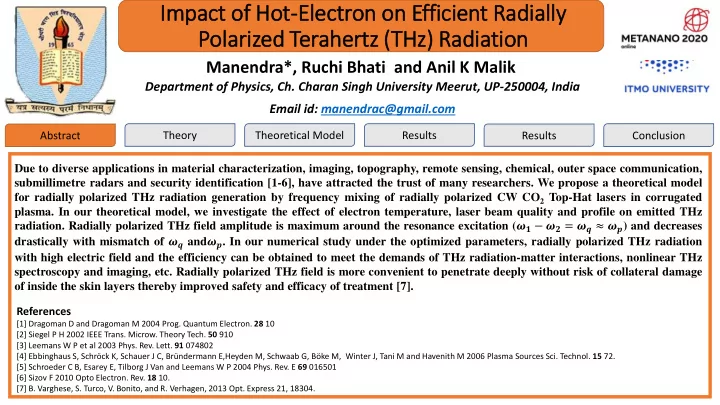
Due to diverse applications in material characterization, imaging, topography, remote sensing, chemical, outer space communication, submillimetre radars and security identification [1-6], have attracted the trust of many researchers. We propose a theoretical model for radially polarized THz radiation generation by frequency mixing of radially polarized CW CO2 Top-Hat lasers in corrugated

  • plasma. In our theoretical model, we investigate the effect of electron temperature, laser beam quality and profile on emitted THz
  • radiation. Radially polarized THz field amplitude is maximum around the resonance excitation (𝝏𝟐 − 𝝏𝟑 = 𝝏𝒓 ≈ 𝝏𝒒) and decreases

drastically with mismatch of 𝝏𝒓 and𝝏𝒒. In our numerical study under the optimized parameters, radially polarized THz radiation with high electric field and the efficiency can be obtained to meet the demands of THz radiation-matter interactions, nonlinear THz spectroscopy and imaging, etc. Radially polarized THz field is more convenient to penetrate deeply without risk of collateral damage

  • f inside the skin layers thereby improved safety and efficacy of treatment [7].
slide-2
SLIDE 2

Manendra*, Ruchi Bhati and Anil K Malik

Im Impact of

  • f Hot-Electron on
  • n Efficient Ra

Radiall lly Pol

  • larized Terahertz (TH

(THz) Ra Radiation

Lab symbolics

Abstract Theory Theoretical Model Results Results Conclusion

Introduction

THz radiation are electromagnetic waves situated between the infrared and microwave regions of the spectrum. The THz frequency range is defined as the region of the electromagnetic spectrum in the range of 100 GHz (3 mm) to 10 THz (30 μm), which is between the millimeter and infrared frequencies. The THz band has been called by several names, such as sub-millimeter, far infrared, and near- millimeters wave. The active investigations of the terahertz spectral region. Terahertz (THz) radiation is generally defined as the These properties can be summarized as follows: 1.Penetration: The wavelength of THz radiation is longer than the infrared wavelength; hence, THz waves have less scattering and better penetration depths (in the range of cm) compared to infrared ones (in the range of μm). Therefore, dry and non-metallic materials are transparent in this range but are opaque in the visible spectrum. 2.Resolution: THz waves have shorter wavelengths in comparison to the microwave ones; this gives a better spatial imaging resolution. 3.Safety: The photon energies in the THz band are much lower than X-rays. Therefore, THz radiation is non-ionizing. 4.Spectral fingerprint: Inter- and intra-vibrational modes of many molecules lie in THz range FIG: Schematic diagram showing the location of THz band in the electromagnetic spectrum At 1 THz, the radiated signal has the following characteristics:

  • Wavelength: 300 μm in free space
  • Period: 1 ps,
  • Photon energy: 4.14 meV

References

[8] TONOUCHI M 2007 Nat. Photonics 1, 97. [9] Ferguson B and Zhang X 2002 Nat. Mater. 1, 26.

slide-3
SLIDE 3

Manendra*, Ruchi Bhati and Anil K Malik

Im Impact of

  • f Hot-Electron on
  • n Efficient Ra

Radiall lly Pol

  • larized Terahertz (TH

(THz) Ra Radiation

Lab symbolics

Abstract Theory Theoretical Model Results Results Conclusion

Schematic of THz radiation generation

FIG.: Schematic of THz radiation generation by Triangular (top hat like) lasers in the ripple density hot Plasma. 𝐹

𝑘 𝑠, 𝑨 = ൞ Ƹ

𝑠𝐹0 1 − 𝑠 a0

𝑡

𝑓𝑗 𝑙𝑘𝑨−𝜕𝑘𝑢 𝑥ℎ𝑓𝑠𝑓 𝑠 a0 < 1, 𝑝𝑢ℎ𝑓𝑠𝑥𝑗𝑡𝑓

➢ Laser Profile j=1,2

References [10] Manendra et al. Phys. Plasmas 27, 023108 (2020)

C𝐗 𝑫𝑷𝟑 Laser profile

FIG.: Laser electric field distribution of pump lasers along x and y directions. The laser beam width 𝑏0 = 50𝜈𝑛when the laser field profile index (a) s =1, (b) s = 2, (c) s = 3, (d) s = 4.

slide-4
SLIDE 4

Manendra*, Ruchi Bhati and Anil K Malik

Im Impact of

  • f Hot-Electron on
  • n Efficient Ra

Radiall lly Pol

  • larized Terahertz (TH

(THz) Ra Radiation

Lab symbolics

Abstract Theory Theoretical Model Results Results Conclusion

Ԧ 𝑔

pon(𝑠, 𝑨) = 𝑓2 𝐹0 2

2𝑛 𝜕1𝜕2 1 − 𝑠 a0

𝑡

2𝑡 a0 𝑠 a0

𝑡−1

Ƹ 𝑠 − 𝑗𝑙′ 1 − 𝑠 a0

𝑡

ẑ 𝑓𝑗 𝑙′𝑨−𝜕′𝑢

𝐹THz 𝐹0

=

𝑜𝜈 𝑜0 𝑡 ω2 1−

vth 2 c2

vth 2 c2 𝜕𝑞 2 𝜕𝑞 2 𝑤2 ∗

2𝜕1a0 ω2 1−

vth 2 c2

−𝜕𝑞

2 2

𝑠 a0 𝑡−1

1 −

𝑠 a0 𝑡

where v2

∗ = 𝑓𝐹02 𝑛𝑗𝜕2 𝑑𝑙𝜈 𝜕𝑞 = 𝜕 𝜕𝑞

1 −

𝜕𝑞

2

𝜕2 1−

vth 2 c2

1/2

− 1 .

➢ Pondermotive Force ➢ Normalized Terahertz Field ➢ Phase Matching Condition Phase matching Condition and Resonance Terahertz (THz Radiation) Generation

References

[10] Manendra et al. Phys. Plasmas 27, 023108 (2020)

slide-5
SLIDE 5

Manendra*, Ruchi Bhati and Anil K Malik

Im Impact of

  • f Hot-Electron on
  • n Efficient Ra

Radiall lly Pol

  • larized Terahertz (TH

(THz) Ra Radiation

Lab symbolics

Abstract Theory Theoretical Model Results Results Conclusion

𝜃 = 𝑜𝜈

2𝜕𝑞 4 𝑤2 ∗ 2 ω2 1 − vth 2

c2 − vth

2

c2 𝜕𝑞

2 2

8𝑜0

2𝜕1 2a0 2 ω2 1 − vth 2

c2 − 𝜕𝑞

2 2

) 𝑡2(𝑡 + 1)(2𝑡 + 1 4𝑡 − 1)(3𝑡 − 1)(2𝑡 − 1

➢ Efficiency of scheme is calculated using energy densities of pumped lasers and THz radiation.

THz conversion efficiency THz Field distribution

References

[10] Manendra et al. Phys. Plasmas 27, 023108 (2020)

slide-6
SLIDE 6

Manendra*, Ruchi Bhati and Anil K Malik

Im Impact of Hot-Ele lectron on Efficient Radia ially Pola larized Terahertz (THz) Radia iation

Lab symbolics

  • r author photo

Department of Physics, Ch. Charan Singh University Meerut, UP-250004, India Email id: manendrac@gmail.com

Abstract Theory Theoretical Model Results Results Conclusion

In this theoretical model predicts that nonlinear mixing of bicolor radially polarized lasers with top-hat (s >1) laser field envelopes in density modulated hot plasma excites very high intensity (normalized electric field ≈ GV/m) radially polarized THz waves in the forward direction. ➢ THz field profile and amplitude strongly depend on the laser envelope parameters, which can be tuned with the help of laser profile parameter s. ➢ THz field in the case of resonant frequencies is much higher than that in the case of off-resonant frequencies. ➢ THz amplitude increases with electron temperature without affecting the resonance condition. ➢ The location of the THz field peak and field distribution depends only on the laser profile parameter and are independent

  • f the electron temperature.

➢ Artificial density modulation in plasma helps in achieving phase matching. For high electron temperature, small λ𝜈 is needed to obtain phase matching. ➢ THz conversion efficiency increases fivefold with an increase in electron thermal velocity from v𝑢ℎ = 0 to v𝑢ℎ = 0.2c. ➢ THz conversion efficiency of 10% is predicted for optimized laser and plasma parameters.