
SLIDE 1
Horizon 2020 This project is co-funded by
HRCP Photonics approaches for THz coms Second Towards TeraHertz - - PowerPoint PPT Presentation
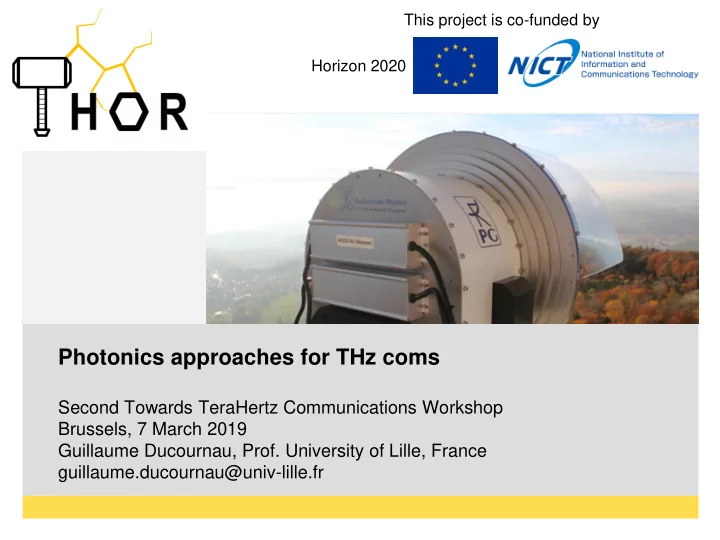
This project is co-funded by Horizon 2020 HRCP Photonics approaches for THz coms Second Towards TeraHertz Communications Workshop Brussels, 7 March 2019 Guillaume Ducournau, Prof. University of Lille, France guillaume.ducournau@univ-lille.fr
Horizon 2020 This project is co-funded by
ThorProject.eu
Guillaume Ducournau | Photonic approaches for THz communications | Brussels, 7 March 2019| 2/29
Context Photomixers, Tx/Rx Some systems Project Exemples Conclusions/challenges
ThorProject.eu
Guillaume Ducournau | Photonic approaches for THz communications | Brussels, 7 March 2019| 3/29
Fluidmesh.com
Fixed points for THz Tx/Rx: optical fibers can be coupled to deliver/collect the BW to the antennas (concept of RAU, Remote Antenna Unit) THz
Massive data + Beyond 5G + urban cases: > 100 user/cell Needs Tbps/cell + Fast cell-to-cell links!
B: bandwidth S/N = signal/noise C = capacity (bit/s) RADIO: Small B, High S/N (MIMO, RF performances) THz: High Bandwidth, limited RF performances (power)
ThorProject.eu
Guillaume Ducournau | Photonic approaches for THz communications | Brussels, 7 March 2019| 4/29
Direct (not easy) or mixing (low power) for modulation But active devices on the way
« No source land »
(tunable, very easy to modulated) low power
(power = ok , but generally requires external modulation of the THz beam)
Optical fibers (1.55 µm)
1 THz 1 ps 300 µm 4,1 meV 49 K
ThorProject.eu
Guillaume Ducournau | Photonic approaches for THz communications | Brussels, 7 March 2019| 5/29
fB = F2 - F1
I=s.Popt
Laser 1, F1 Laser 2, F2 ASE THz noise Optical signals (modulated) P F fB x bit/s x Hz Optical Noise
THz 1,55 µm
What is already used in optical fibers => THz can leveraged on that!! Photodiodes (UTC-PD, SiPho PD Ge, …) / Photoconductor (LT-GaAs, InGaAs, ErAs, …)
device, effciency
ThorProject.eu
Guillaume Ducournau | Photonic approaches for THz communications | Brussels, 7 March 2019| 6/29
2 families: Photodiodes (ex. UTC-PD) and Photoconductors (PC)
Uni-travelling carrier PD UTC-PD, = 1.5 µm p absorbing layer (not PIN) Most simple Low-temperature grown GaAs PC LTG-GaAs PC, = 0.8 µm / Short-carrier lifetime
h
ThorProject.eu
Guillaume Ducournau | Photonic approaches for THz communications | Brussels, 7 March 2019| 7/29
2×UTC-PD integrated (module): 1.2 mW @ 300 GHz (20 mA/PD @ -3.9 V) TW-UTC: 110 µW @ 300 GHz
[Song et al., IEEE MWCL (2012)] [Wun et al., IEEE PTL (2014)] [Rouvalis et al., IEEE MTT (2012)]
emission
TTST2017.
RCE-UTC-PD: 0.8 mW @ 300 GHz NBUTC-PD: 0.67 mW @ 260 GHz Flip-chip on AlN
ThorProject.eu
Guillaume Ducournau | Photonic approaches for THz communications | Brussels, 7 March 2019| 8/29
SoTA on UTC-PD: mW level, key point / optical driving power!
[18] Rouvalis, E. et al. Opt. Express 18, 11105–10 (2010). [20] J.M. Wun, et al. IEEE Photonics and Technology Letters, 26(4) :pp. 2462–2464, 2014. [29] A. Wakatsuki et al., 2008 33rd International Conference on Infrared, Millimeter and Terahertz Waves, Pasadena, CA, 2008, pp. 1-2. doi: 10.1109/ICIMW.2008.4665566
Science and Technology, vol. 7, no. 6, pp. 800- 807, Nov. 2017.
Typical power from utc-pd
need more!
Illumination
RCE-UTC: resonant cavity enhanced UTC-PD Nano grid
ThorProject.eu
Guillaume Ducournau | Photonic approaches for THz communications | Brussels, 7 March 2019| 9/29
The photodiodes/photoconductors could be a good « driver » of integrated amplifier, other active structures… However, interconnexion losses using several technologies… to be investigated Future systems: integrated/co-designed
integration (if PD only)…
interconnections, integration of different technologies
ThorProject.eu
Guillaume Ducournau | Photonic approaches for THz communications | Brussels, 7 March 2019| 10/29
Up to THz 1 mW @ 300 G (UTC-PD) > 10 mW @ 300 G (PA) 20-40 GHz Oscillators Good phase noise + Be carefull to phase noise… +
20.log(N) degradation from reference Use combs + stabilized lines
4.5 THz BW (C-band) 1535- 1565 nm TWT amp? High power, Less signal integrity BW of the TWT? Good power, High signal integrity*
I/Q Mixer, SHM The ‘famous’ Mach- Zehnder modulator Amp
photodiodes
ThorProject.eu
Guillaume Ducournau | Photonic approaches for THz communications | Brussels, 7 March 2019| 11/29
OOK = amplitude modulation P/P0
Modulated laser Spectral efficiency = Data-rate/BW The spectrum
Voltage
MACH ZEHNDER MODULATOR (MZM) Discrete or integrated (SiPho PIC, …) BW
ThorProject.eu
Guillaume Ducournau | Photonic approaches for THz communications | Brussels, 7 March 2019| 12/29
X Gbit/s X Gbit/s 2X Gbit/s
THz-QPSK
UTC-PD
1
pilot Access network, P2P back-haul 1-Pol 225
THz domain Optical domain Fiber optics technologies
ThorProject.eu
Guillaume Ducournau | Photonic approaches for THz communications | Brussels, 7 March 2019| 13/29
THz-QPSK
UTC-PD Baseband PIN-PD
1
pilot Optical fiber core networks Access network, P2P back-haul 1-Pol Multi , 2-Pol 225
Optical domain THz domain
Optical QPSK
Optical QPSK
Fopt~ 193 THz WDM channels 10-40 Gbit/s (25 GHz spacing) 250 275 300 Carrier freq (GHz) Mobile Rx
WDM
signals
Advantages:
Frequency aglity Re-use of the spectrum Dynamic allocation
ThorProject.eu
Guillaume Ducournau | Photonic approaches for THz communications | Brussels, 7 March 2019| 14/29
(Schottky).
Need to be investigated towards « seamless integration »
Optics -> THz -> Optics
structure has to be adapted)
to be optimized for 1.55 µm)
Peytavit et al., Appl. Phys. Lett. 103, 201107 (2013). 32 dB conv. Gain @ 100 GHz
Less studies on photonics based Rx!
ThorProject.eu
Guillaume Ducournau | Photonic approaches for THz communications | Brussels, 7 March 2019| 15/29
15
fIF
fB = 2 - 1 homodyne (fIF=0) if fr = fB
Current
Voltage
fr
fB
28 dB @ 300 GHz Wideband, scalable beyond 1THz
Optical injection O/T conversion using silicon
66 dB conv losses at Rx. Silicon based
ThorProject.eu
Guillaume Ducournau | Photonic approaches for THz communications | Brussels, 7 March 2019| 16/29
[Modified from Wikipedia]
Indoor THz beam control, alignment of P2P links…
Easy to get multi- feed (low optical losses) + adjusting the relative phases
Challenges:
interconnections, array fab (yield), polarization control…
Should consider integrated optics (SiPho might help) Beam forming phase delay in opt domain?
ThorProject.eu
Guillaume Ducournau | Photonic approaches for THz communications | Brussels, 7 March 2019| 17/29
0,1 1 10 100 1000 1 10 100 1000
[22] More distance More data-rate [17] [19] [18] [21] [20] [23] [24] [25]
Photonics Tx Electronics Tx
[6] [26] [17]
Data rate (Gbps) Distance (m)
Electronics is pulling the distance Photonics is pushing the data-rate
More compact systems for future… So far, the compactness is not scaling for decrease of wavelenght… Mastering simple schemes for Tx/Rx locking With moderately-sized antennas (ie not > 50 dBi); Highest schemes/complexity of mod. scheme: photonic-based Tx usually
ThorProject.eu
Guillaume Ducournau | Photonic approaches for THz communications | Brussels, 7 March 2019| 18/29
[23] S. Koening et al., Wireless sub-THz communication system with high data rate, Nature Photonics volume 7, pages 977–981 (2013), doi:10.1038/nphoton.2013.275
Photonic-based Tx (UTC-PD) ‘Off-line’ DSP: meaning that signal is recorded, then processed Future system with (almost) non latency should leverage on ASIC/real-time/FPGA capabilities Solid-state Rx (electronic) 3 carriers in same emitter (Not straightforward to do that in electronic, single device…)
240 GHz band / 100 Gbit/s using several carriers
ThorProject.eu
Guillaume Ducournau | Photonic approaches for THz communications | Brussels, 7 March 2019| 19/29
[17] T. Nagatsuma et al., Real-time 100-Gbit/s QPSK transmission using photonics-based 300-GHz-band wireless link, 2016 IEEE International Topical Meeting on Microwave Photonics (MWP), Long Beach, CA, 2016, pp. 27-30, doi: 10.1109/MWP.2016.7791277.
Optical comb, driven by reference F0 => 12.F0 Phase noise of 300 GHz carrier = 20.log(12) + Lc(F0) + Need to correct relative phase fluctuations Same LO than Tx
Tx Rx
Source = UTC-PD
300 GHz band, 100 Gbit/s, real-time, QPSK, 2016
ThorProject.eu
Guillaume Ducournau | Photonic approaches for THz communications | Brussels, 7 March 2019| 20/29
300 GHz band single carrier, 100 Gbit/s, QAM-16 2018
Linear photomixer (UTC photodiode)
ThorProject.eu
Guillaume Ducournau | Photonic approaches for THz communications | Brussels, 7 March 2019| 21/29
photodiodes + fiber technologies);
Next years THz coms R&D
Silicon industry (photonics & analog RF)
ThorProject.eu
Guillaume Ducournau | Photonic approaches for THz communications | Brussels, 7 March 2019| 22/29
Frequency 220-260 GHz THz source up to1 mW / packaged TWT power amplifier Gain > 30 dB Power: 3-4 W Antenna 50 dBi (high gain) > 20 dBi, beam-steering capable (indoor) Receiver (direct) Zero bias detector Schottky 1 kV/W Rx bandwidth (GHz) 40 GHz, including baseband amplifier Modulation ASK (real-time) 40 Gbit/s Link budget (outdoor) 140 dB (1 km) 40 dB with 50 dBi antennas
Increase the range of THz links: combination of photonic approaches and TWTA 30 GHz of BW combining power and efficient modulation (thanks to optically driven sources)
Photonics
ThorProject.eu
Guillaume Ducournau | Photonic approaches for THz communications | Brussels, 7 March 2019| 23/29
Datas: QPSK or QAM-16 Modulator Optical feed Optical fiber LNA, Mixer, I/Q
300 GHz link
THz receiver Solid-state Transistor based Antenna
Point-to-point (Back-haul targetted)
TERASO SONIC 100+ Gbit/s all-european- technology based wireless link
Antenna UTC-PD
(B)
+ Signal processing
I Q
PD
TERASONIC: Beyond 100 Gbit/s using combined technologies Increase the range of THz links: combination of photonic approaches and electronic based
FR-Prof. G. Ducournau DE-Prof. I. Kallfass
ThorProject.eu
Guillaume Ducournau | Photonic approaches for THz communications | Brussels, 7 March 2019| 24/29
Point to point transmission system thanks to up conversion of E/V- band MODEMs Super heterodyne architecture:
devices: wideband up- conversion to THz bands
ThorProject.eu
ThorProject.eu
Guillaume Ducournau | Photonic approaches for THz communications | Brussels, 7 March 2019| 25/29
DEMO-1 validated in Nov. 2018 by merging skills of Japanese and European teams
16QAM / 56 Gbps data-rate transmission. DEMO 2 and 3: increase the range using TWT
https://www.youtube.com/watch?v=U1zatU6Gfbk
ThorProject.eu
ThorProject.eu
Guillaume Ducournau | Photonic approaches for THz communications | Brussels, 7 March 2019| 26/29
Use the photonics: bandwidth OK, BUT… need power… photonics to be combined with active devices. If limited power/distance + compact/density required (kiosk, data-center) => simple links using SiPho is possible (decrease the cost + industrial foundries in Europe available!) Arrays of Photonic devices has to be investigated: smart solution for beam-steering Photonics = technological enabler (driver)=> has to be used where it is relevant:
scenarios?)
systems Every system also need integration! Need to think about THz generic interconnexions…
ThorProject.eu
Guillaume Ducournau | Photonic approaches for THz communications | Brussels, 7 March 2019| 27/29
ITN MITEPHO
« WITH » project: CNRS and IMEP-LAHC RIKEN, Tohokhu Univ, OSAKA Univ 2010-2013
UM2, LAHC.
« WITH », « OSMOTUS », « COM’TONIQ »
CPER PHOTONICS FOR SOCIETY (2016-2020)
TERALINKS project
ThorProject.eu
Guillaume Ducournau | Photonic approaches for THz communications | Brussels, 7 March 2019| 28/29
This project has received funding from Horizon 2020, the European Union’s Framework Programme for Research and Innovation, under grant agreement No. 814523. ThoR has also received funding from the National Institute of Information and Communications Technology in Japan (NICT).
ThorProject.eu