Biological Sensing Biological Sensing via via THz Circular - - PowerPoint PPT Presentation

biological sensing biological sensing via via thz
SMART_READER_LITE
LIVE PREVIEW

Biological Sensing Biological Sensing via via THz Circular - - PowerPoint PPT Presentation

Biological Sensing Biological Sensing via via THz Circular Dichroism THz Circular Dichroism http://www.isa isa.au. .au.dk dk/SR/UV1/ /SR/UV1/cd cd- -spectroscopy.html spectroscopy.html http://www. WHAT??? WHAT??? We shine light


slide-1
SLIDE 1

Biological Sensing Biological Sensing via via THz Circular Dichroism THz Circular Dichroism

http://www. http://www.isa isa.au. .au.dk dk/SR/UV1/ /SR/UV1/cd cd-

  • spectroscopy.html

spectroscopy.html

slide-2
SLIDE 2

WHAT??? WHAT???

  • We shine light through stuff…

We shine light through stuff…

http://www. http://www.astbury astbury. .leeds leeds.ac. .ac.uk uk/gallery/ /gallery/tly tly.gif .gif http://school.discovery.com/clipart/clip/ http://school.discovery.com/clipart/clip/flashlte flashlte.html .html

slide-3
SLIDE 3

Still to Come Still to Come

  • The Experiment

The Experiment

– Biological Sensing

– Why Circular Dichroism? – Why Terahertz? – Research Approach – Developing the Spectrometer – Conclusion

  • Background

Background

– – Light as an Electric Field Light as an Electric Field – – Polarized Light Polarized Light – – Chirality Chirality – – Circular Dichroism Circular Dichroism

  • Acknowledgements
slide-4
SLIDE 4

Background

slide-5
SLIDE 5

Light as an Electric Field

  • The human eye detects electromagnetic waves (a moving

The human eye detects electromagnetic waves (a moving electric field) and interprets wave frequency and amplitude electric field) and interprets wave frequency and amplitude as color and intensity. as color and intensity.

http://www. http://www.jb jb.man.ac. .man.ac.uk uk/distance/ /distance/strobel strobel/light/ /light/lighta lighta. .htm htm

slide-6
SLIDE 6

Polarized Light

  • Linearly Polarized Light

The electric field exists in a The electric field exists in a constant plane constant plane, while , while changing magnitude changing magnitude periodically. periodically.

slide-7
SLIDE 7

Polarized Light

  • Circularly Polarized Light

The electric field remains The electric field remains constant in magnitude constant in magnitude, while , while changing direction changing direction periodically. periodically.

slide-8
SLIDE 8

Chirality

  • A chiral object has no plane of symmetry.
  • An achiral object has a plane of symmetry.

http:// http://cwx cwx. .prenhall prenhall.com/ .com/bookbind bookbind/ /pubbooks pubbooks/bruice2/chapter4/deluxe.html /bruice2/chapter4/deluxe.html http://www. http://www.answersingenesis answersingenesis.org/docs/3992.asp .org/docs/3992.asp

slide-9
SLIDE 9

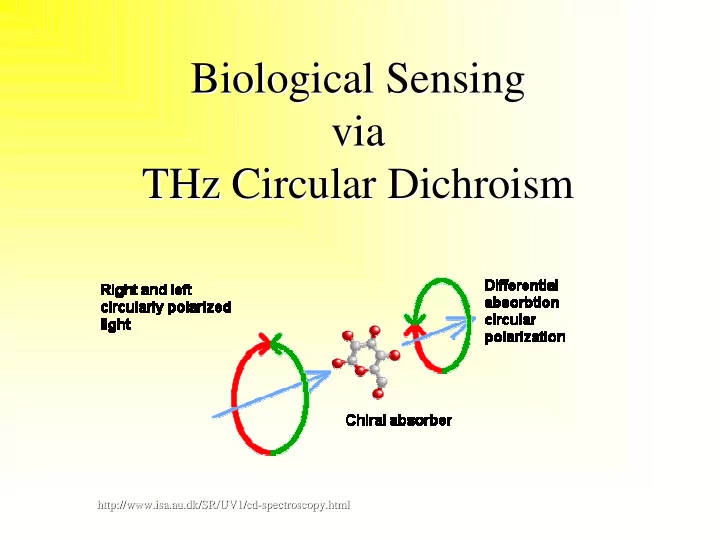
Circular Dichroism

http://www. http://www.isa isa.au. .au.dk dk/SR/UV1/ /SR/UV1/cd cd-

  • spectroscopy.html

spectroscopy.html

  • Chiral (asymmetric) objects are unequally sensitive to left and

right circularly polarized light.

  • An object that absorbs the two circular polarizations differently

will give a CD signal.

  • Circular dichroism is a term that describes this sensitivity.
slide-10
SLIDE 10

The Experiment

slide-11
SLIDE 11

Biological Sensing Biological Sensing

  • Must distinguish between biological and

abiological materials

  • Species specific characterization

– Biological materials exist in enantiomeric excess (a single handedness is dominant). – Abiological materials exist in enantiomeric equality. – Each biological material exhibits unique spectral features.

–These spectral features provide a potential “fingerprint” for biopolymers.

slide-12
SLIDE 12

Why Why Circular Circular Dichroism Dichroism? ?

  • Sensitive to net left versus right sample chirality

– CD could provide life detection! 100% 0% 50% 50%

http:// http://cwx cwx. .prenhall prenhall.com/ .com/bookbind bookbind/ /pubbooks pubbooks/bruice2/chapter4/deluxe. /bruice2/chapter4/deluxe. html html

Biological systems Biological systems Non Non-

  • Biological systems

Biological systems

  • Eliminates artifacts and background absorbances of non-

biological materials. – Allows for potential species specific spectral analysis in the

presence of non-biological absorbers.

slide-13
SLIDE 13

Why Terahertz?

  • Visible light stimulates electronic transitions that

are symmetric (yield no net CD signal).

– These transitions respond equally to left and right circular polarizations.

  • THz radiation tends to excite overall vibrational

modes.

– Dynamic modes of oscillation respond differently to left versus right circular polarizations. Visible light shakes bonds, THz shakes the entire molecule.

slide-14
SLIDE 14
  • Before we can investigate the THz spectral features of biological

specimen using CD we must first develop the spectrometer.

Parabolic Mirror Pyroelectric Detector Gunn Oscillator Collimator Lens Quartz WavePlate Iris Sample holder Parabolic Mirror Reference Detector Beam Splitter Reference Beam

Research Approach

First unsuccessful optical setup.

slide-15
SLIDE 15
  • First unsuccessful optical setup.

– Focusing lens too thick. – Undesirable waveplate behavior.

  • Close to the lens the beam converges

accounting for the increasing intensity.

  • Farther away from the lens the beam

diverges accounting for decreasing intensity.

Intensity vs. Position (along beam axis y=k) with Collimator

0.2 0.25 0.3 0.35 0.4 0.45 0.5 0.55 0.6 6 8 10 12 14 16 18

position (cm) intensity (mV) Source Horn close to Wave Plate

2.5 3 3.5 4 4.5 5 90 180 270 360

Wave Plate Orientation (deg) Average Transmission (mV), 98 events

Source Horn close to Wave Plate

2.5 3.0 3.5 4.0 4.5 5.0 20 40 60 80 100

98 Independent Measurements Transmission (mV)

90 135 180 225 270 315 45
  • n*90 degrees, for n = 0, 1, 2, … represent the optical axes of the waveplate.
  • Minimizing the difference in transmission between the axes of the quartz is

crucial to the quality of circular polarization produced.

Developing the Spectrometer

Interpretation Gunn Oscillator Collimator lens

slide-16
SLIDE 16
  • The LabVIEW

programming environment is used to collect and process data.

  • We are currently using this experimental setup to examine the

relationship between source, waveplate, and detector.

Developing the Spectrometer

Gunn Oscillator Quartz WavePlate Pyroelectric Detector

slide-17
SLIDE 17

Conclusion

  • We will next explore several methods to improve

waveplate performance, such as:

– Introducing a small tilt in the plates orientation.

– This will alter the path length of the beam, potentially reducing the deconstructive interference due to internal reflections.

– Evaporate specialized thin films to the plates surface.

– These films are designed to reduce reflections.

  • Alternative methods to generate circular polarization may

need to be employed if we are unable to sufficiently minimize the difference in transmission between the waveplate axes.

  • More experiments are needed to discover the optimal

experimental setup.

slide-18
SLIDE 18

Acknowledgements

slide-19
SLIDE 19

Primary Investigators

  • Kevin

Kevin Plaxco Plaxco

– –University of California at Santa Barbara Department of Chemistr University of California at Santa Barbara Department of Chemistry y and Biochemistry and Biochemistry

  • Gerald

Gerald Ramian Ramian

– –University of California at Santa Barbara Institute for Quantum University of California at Santa Barbara Institute for Quantum Engineering, Science and Technology Engineering, Science and Technology

  • S. James Allen
  • S. James Allen

– –Institute for Quantum Engineering, Science and Technology Institute for Quantum Engineering, Science and Technology – –University of California at Santa Barbara Physics Department University of California at Santa Barbara Physics Department

  • Funding

Funding

– –NASA NASA – –United States Army United States Army

slide-20
SLIDE 20
  • RET Interns

–V. Chanyavanich –Ralph Reid

  • UCSB Physics graduate student

–Jing Xu

  • INSET Interns

INSET Interns

– –Matthew Matthew Crossley Crossley – –Ventura College, UC Santa Barbara Ventura College, UC Santa Barbara – –Frances Ho Frances Ho – –West Valley College West Valley College

slide-21
SLIDE 21

THE END

http://school.discovery.com/clipart/clip/ http://school.discovery.com/clipart/clip/flashlte flashlte.html .html

THANK THANK YOU YOU