
SLIDE 1
Probing and controlling spin dynamics with THz pulses
Charge Spin THz pulse Tobias Kampfrath
Freie Universität Berlin and FHI/Max Planck Society
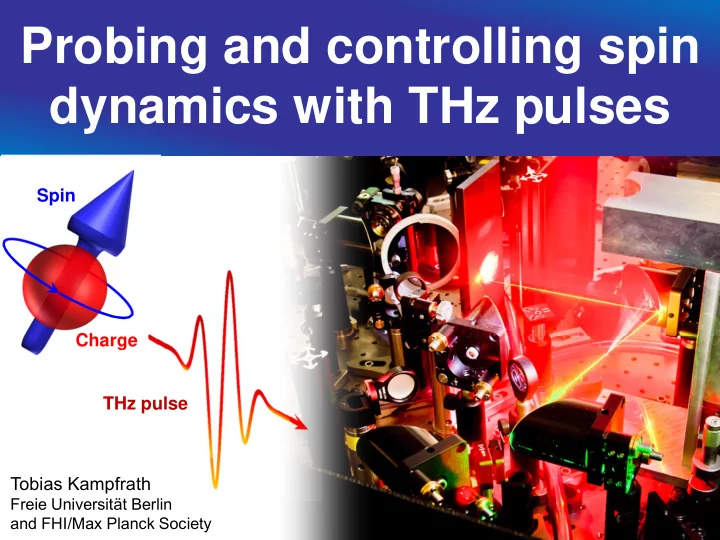
Probing and controlling spin dynamics with THz pulses Spin Charge - - PowerPoint PPT Presentation
Probing and controlling spin dynamics with THz pulses Spin Charge THz pulse Tobias Kampfrath Freie Universitt Berlin and FHI/Max Planck Society PhD students: organize your own symposium at the 2019 Spring Meeting of the German
Charge Spin THz pulse Tobias Kampfrath
Freie Universität Berlin and FHI/Max Planck Society
… at the 2019 Spring Meeting of the German Physical Society in Regensburg! ƒ Your chance to implement a symposium you always wanted to attend ƒ To get in personal contact with leading scientists at an early stage of your career How? ƒ Pick 1-5 colleagues as organization committee and fill out the online application
http://www.dpg-physik.de/dpg/gliederung/junge/profil/ateam/wissenschaftlich/tagungen/2019/phd-symposien/announcement.html
ƒ Timely topic related to magnetism ƒ Invite speakers, compile the program,
ƒ Deadline: October 15
Goal: reach speed of other information carriers, i.e. THz bandwidth
Light in fibers: >10 Tbit/s Electrons in a FET: ~1 THz cut-off
How to manipulate magnetic order ultrafast? Two approaches
spin dynamics
Spintronics: voltages in circuits Femtomagnetism: fs light fields
100 THz 1000 THz 0.01 THz DC
ƒ Bandwidth <10 GHz ƒ Force/torque × applied field
See e.g. Magnetism Roadmap (2017)
ƒ Freq. ~400 THz ⇑ Need rectification ƒ Force/torque × light intensity
Kirilyuk, Kimel, Rasing, Rev. Mod. Phys. (2010)
~
Terahertz gap 1…30 THz 4…120 meV
THz fields + magnetism = useful?
1) Reveal speed and initial elementary steps of spintronic effects E.g. spin-Hall, spin-Seebeck and GMR 2) New physics, new methods as THz coincides with many fundamental modes
1 THz ≙ 4 meV
+
Phonons Intraband transport
Hillenbrand et al., Nano Lett. (2008)
3) Reward for THz technology e.g. THz sources and modulators for spectroscopy and imaging How to get THz pulses?
Bound electron states: ƒ Cooper pairs ƒ Excitons
THz pulse
Nonlinear-
crystal
Rectified part of electron displacement
Reviews: Hoffmann, Fülöp, J. Phys. D (2011); Reimann, Rep. Prog. Phys. (2007)
the THz pulse? ~0.5…50 THz Nonlinear electron displacement ∝ ∝ 2nd harmonic + {envelope{2 Linear electron displacement Femtosecond pulse ~400 THz
Scan ellipticity of sampling pulse vs ⇑ Get THz electric field ()
Nonlinear-
crystal
Delay THz field
pulse
Wu, Zhang, APL (1995)
A typical THz pulse… Electrooptic effect: Change in refractive index ∝ ⇑ Crystal becomes birefringent
0.2
ƒ Duration down to 50 fs ƒ Peak fields up to ~30 MV/cm (~10 T) ƒ Detection of full transient field, threshold down to 1 V/m
How to control magnetic order by THz fields? Consider equation of motion of spins ƒ Tunable center frequency 0.5…50 THz, i.e. 2…200 meV ƒ But: gaps between 5 and 15 THz ZnTe
= + + × +
coupling Zeeman coupling to external field + other spins SO coupling to total electric field
Equation of motion of spin = − ×
Total effective field acting
is the handle to (ultrafast) control over magnetic order Start simple: Zeeman torque ƒ Directly by external fields , (↑Kim) ƒ Indirectly by modulation of coupling parameters (e.g. ) using light, currents, strain, heat, … (↑Kirilyuk, Kalashnikova) In Heisenberg- type magnet
Most natural stimulus: magnetic field
THz pulse ()
Zeeman torque
Most natural stimulus: magnetic field Most efficient coupling on resonance Larmor frequency ℏω = || Ferromagnets ƒ ω determined by anisotropy field ƒ ω/2 ≪ 1 THz ⇑ Conduct a THz-pump magnetooptic-probe experiment
ƒ Exchange causes additional repulsion ƒ ω/2 ∼ 1 THz
Sample: antiferromagnetic NiO ƒ Neel temperature 523 K ƒ Magnon ( = 0) at 1 THz
2/||
∝ ⋅ Detect Faraday rotation In the lab…
THz emitter Pump beam: generates the THz beam Parabolic mirror Sample Probe beam To detection of Faraday rotation Si
Incident magnetic pulse
Incident magnetic pulse Faraday response
⇑ Signature of = 0 magnon at 1 THz Oscillation at 1 THz, decay time ~40 ps Driven by electric or magnetic field component?
Driving force is magnetic (not electric) field Observation: Induced magnetization × driving field ƒ NiO is centrosymmetric ⇑ = 0 ƒ No linear magnetoelectric effect in centrosymmetric NiO
Is = possible?
Idea: use double pulses to control magnon amplitude
Second pulse after 6 cycles: amplifies magnon Second pulse after 6.5 cycles: switches magnon off
1 2 1 2
Kampfrath, Sell, Fiebig, Wolf, Huber et al., Nature Phot. (2011) Baierl, Kampfrath, Huber et al., PRL (2016)
THz spin control is feasible by the simple Zeeman torque of THz magnetic pulses Interesting application: THz magnon spectroscopy
Nishitani, Hangyo et al., APL (2010), PRB (2012) Kanda, Kuwata-Gonokami et al., Nature Comm. (2012)
ƒ Characterization of antiferromagnets ƒ Magnons probe ƒ Dynamics of following
Bowlan, Prasankumar et al., PRB (2016) Mikhaylovskiy, Kimel et al., Nature Comm. (2015)
ƒ Not easy with non-optical methods ƒ Many more opportunities with stronger THz fields: probe spin couplings
Electron
Ionic lattice Electron spins 3 MV/cm 1 T Spin-electron coupling
ƒ Mikhaylovskiy et al., Nature Phot. (2016) ƒ Bonetti, Dürr et al., PRL (2016)
Magnon-magnon coupling
ƒ Mukai, Hirori, Tanaka et al., New J Phys (2016) ƒ Bocklage et al., PRL (2015) ƒ Lu, Suemoto, Nelson et al., PRL (2017)
Spin-phonon coupling highly unexplored at >1 THz
How to probe coupling of spins and phonons?
Observation of new coherent coupling channels
ƒ Kubacka, Johnson, Staub et al., Science (2014) ƒ Nova, Cavalleri et al., Nature Phys. (2016)
How fast is spin-lattice equilibration? ⇑ Study model magnet YIG
Faraday probe: measures magnetic state Use an insulator ⇑ Electron orbital excitations are frozen out Optical phonon pump
Sample: ferrimagnet YIG ƒ Has two spin sublattices (a and d) ƒ Band gap of 2.8 eV ƒ Magnonic model material ~250 ps
Schreier et al., PRB (2013)
~1 µs
Xiao et al., PRB (2010)
~1 ps
Rezende et al., JMMM (2016)
Many open questions, e.g.: Time scale and mechanism of spin-phonon equilibration unknown Experiment ƒ Excite Fe-O lattice vibrations ƒ Probe spin dynamics from femtoseconds to microseconds Relevant for ƒ Magnetization switching ƒ Spin Seebeck effect
THz phonon pump
Bext (°100 mT) Detect Faraday rotation = +
Thin Solid Films (1984)
Pump on and off the phonon resonances
Transient Faraday rotation (%) Pump-probe delay (ps)
1 2 3 4 5 6 7
On-resonant Off-resonant
Surprisingly fast loss of magnetic order within ~1 ps: ƒ ~105 faster than lifetime of YIG’s zone-center magnons (FMR) ƒ Response speed is comparable to laser-excited metals
Absorption (arb. units) Frequency (THz) 20 25 30 35 Off- resonant On- resonant
Behavior on longer time scales?
Phonons
Ultrafast magnetic-
Full equilibration: deduced from temp.-dependence Heat flow to substrate: From simulations, different substrates
Faraday rotation (arb. untis) Time (ps) Time (ns) Time (λs) 2 4
200 400 600 200 400 600 800 in ~1 ps ~100 ns ~300 λs
Two very different time scales: interpretation?
Phonons
THz pump TO(Φ)
Spins
Spin angular momentum O2- () a-Fe3+ d-Fe3+ Δ() = Δ()
Maehrlein, Barker, Kampfrath et al., Science Adv. (2018)
Phonons Global equilibration: ~100 ns
THz pump TO(Φ)
Identical sublattice demagnetization in ~1 ps ⇑ Constrained state, lives ~10 ns Spins
Spin angular momentum Reveals spin-phonon equilibration in YIG: ƒ Transfer of energy: in ~1 ps ƒ …and angular momentum: ~100 ns
Maehrlein, Barker, Kampfrath et al., Science Adv. (2018)
spin dynamics How to launch and detect spin currents ultrafast? Idea: make use of spin-caloric effects
Metal film
A temperature gradient drives an electron current Ken-ichi Uchida (2008): In ferromagnets, the Seebeck current is spin-dependent
gradient
Hot Cold
Uchida, Saitoh et al., Nature (2008) Bauer, Saitoh, Wees, Nature Mat. (2013)
← and → electrons have very different transport properties
Fe film
Uchida, Saitoh et al., Nature (2008) Bauer, Saitoh, Wees, Nature Mat. (2013)
⇑ Spin-polarized current ← and → electrons have very different transport properties
Fe film
Temperature gradient
Hot Cold
Detection with the inverse spin Hall effect
A
Spin-orbit coupling deflects electrons ⇑ Transverse charge current ⇑ Spin-to-charge (S2C conversion
Saitoh et al., APL (2006)
Heavy metal Fe film
Temperature gradient
Hot Cold
How can we induce an imbalance as fast as possible?
A
fs pump pulse Technical challenge: ƒ Electric detection has cutoff at <50 GHz ƒ But expect bandwidth >10 THz
Heavy metal Fe film
Emission of electromagnetic pulse (~1 THz) ⇑ Measure THz emission from photoexcited FM|NM bilayers fs pump pulse
Heavy metal Fe film
Samples: polycrystalline films (labs of M. Kläui and M. Münzenberg) Pump pulses: from Ti:sapphire oscillator (10 fs, 800 nm, 2.5 nJ)
Kampfrath, Battiato, Münzenberg et al., Nature Nanotech. (2013)
A look in the lab…
Consistent with scenario spin transfer + ISHE +20 mT ext. field
Signal (10-5) Time (ps) 0.5 1
1 2 3
Fe Pt
Signal (10-5) Time (ps) 0.5 1
1 2 3
Fe Pt Fe
Further findings ƒ Signal × pump power ƒ THz electric field ] sample magnetization Need more evidence for the spin Hall scenario
Idea: vary nonmagnetic cap layer Ta vs Ir:
2 1
0.7 0.6 0.5 0.4 0.3 0.2 0.1 Timet (ps) Signal (arb. units) The inverse spin Hall effect is still operative at THz frequencies
Kampfrath, Battiato, Oppeneer, Freimuth, Mokrousov, Radu, Wolf, Münzenberg et al., Nature Nanotech. (2013) Fe Ir Fe Ta
1) Rapid material characterization regarding spin-to-charge conversion (S2C) 2) Generation of THz pulses Interesting applications:
YIG N Cramer, Seifert, Kampfrath, Kläui et al., Nano Lett. (2018)
N < Cu1-xIrx DC
THz emission strength correlates with DC S2C strength THz emission spectroscopy enables rapid material screening: estimate of the relative spin-Hall conductivity Idea: optimize materials and geometry to maximize the THz amplitude
Sasaki, Suzuki, Mizukami, APL (2017) Seifert et al., SPIN (2017), J. Phys. D (2018) YIG N
N < Cu1-xIrx DC THz
Cramer, Seifert, Kampfrath, Kläui et al., Nano Lett. (2018)
5 4 3 2 1 Time (ps) 4 3 2 1 THz signal (arb. units) Signal amplitude (arb. units) 1 0.8 0.6 0.4 0.2 16 12 8 4 Frequency (THz) ZnTe Standard: 0.3 mm ZnTe Spintronic emitter, unoptimized Reststrahlen gap
5 4 3 2 1 Time (ps) 4 3 2 1 THz signal (arb. units) Signal amplitude (arb. units) 1 0.8 0.6 0.4 0.2 16 12 8 4 Frequency (THz) ZnTe Spintronic emitter 70 samples later: spintronic trilayer emitter Standard: 0.3 mm ZnTe
More broadband, efficient and cheaper than standard emitters like ZnTe More features…
Seifert et al., Nature Photon. (2016)
Need better understanding for better performance What does the driving THz spin current look like? Upscaling yields 0.3 MV/cm field
Seifert, Kläui, Kampfrath et al., APL (2017)
Insensitive to pump wavelength
Papaioannou, Beigang et al., arXiV (2018) Herapath, Hendry et al. arXiv (2018)
Flexible substrates
Wu, Yang et al., Adv. Mat. (2016)
On-chip THz source
Weber, Kampfrath, Woltersdorf et al. (2018)
Time (ps) Voltage (mV)
Extremely fast bipolar response
8 6 4 2
Spin current (1029 )
1.2 0.8 0.4 0.0
Time t (ps)
Fe|Pt
Pt
THz Fe
Analysis not straightforward: two competing mechanisms of spin transport
Magnet F Pt Exchange coupling
By moving electrons Only possible in magnetic metals: “Spin-dependent Seebeck effect” (SDSE) By torque between adjacent spins Even possible for magnetic insulators: “Magnonic spin Seebeck effect” (SSE), “thermal spin pumping” Thus: measure magnetic metals vs insulators ƒ Reveal relative weight of the two spin-current contributions ƒ Insulators are potentially simpler to model
Magnet F Pt
Spin-dependent Seebeck effect
8 6 4 2
Spin current (1029 )
1.2 0.8 0.4 0.0
Time t (ps)
Fe|Pt
Pt
THz YIG is pump- transparent
Substitute Fe by insulating YIG ƒ Switch electron transport off ƒ Only spin torque possible
YIG
Spin-dependent Seebeck effect Magnonic spin Seebeck effect Fe↑Pt spin current } 103≥ YIG↑Pt spin current
8 6 4 2
Spin current (1029 )
1.2 0.8 0.4 0.0
Time t (ps)
8 6 4 2
Spin current (1029 )
1.2 0.8 0.4 0.0
Time t (ps) Rescaled by 1/500
Fe|Pt YIG|Pt What determines the dynamics of the magnon current YIG↑Pt ? ⇑ The Fe↑Pt spin current has a negligible torque contribution
8 6 4 2
Spin current (1029 )
1.2 0.8 0.4 0.0
Time t (ps) Pt electrons thermalize Cooling by lattice
The spin Seebeck current follows the electron temperature in Pt quasi-instantaneously ƒ Why is the spin-current formation so fast? ƒ Why does it rise with electron thermalization?
Seifert, Barker, Wolf, Kläui, Kampfrath et al., Nature Commun. (2018)
YIG|Pt
Lei et al., PRB 66, 245420 (2002) Caffrey et al., Microsc Thermoph Eng 9, 365 (2005)
Analytical modeling and simulations support the following picture…
N (Pt) F (YIG)
Kläui, Kampfrath et al., Nature Commun. (2018)
ƒ Pt spin is incident on interface: = 0 ƒ Reflected spin is aligned more parallel to : ⇈ (similar to STT)
N (Pt) F (YIG)
Kläui, Kampfrath et al., Nature Commun. (2018)
ƒ Pt spin is incident on interface: = 0 ƒ Reflected spin is aligned more parallel to : ⇈ (similar to STT) The spin current is × rate of reflection events × number of electron-hole pairs in Pt ⇑ rises when the photoexcited carriers multiply The response is quasi-instantaneous since ƒ Pt spins traverse the interface region in <5 fs ƒ YIG spins react without inertia Need thermalized electrons for large spin Seebeck effect
THz pulse
Electron
Ionic lattice Electron spins
Control over spins with THz-driven currents?
THz field
Electric writing with Ohmic contacts
CuMnAs ƒ Antiferromagnetic metal ƒ Locally broken inversion symmetry ⇑ Current induces staggered magnetic field
Wadley, Jungwirth et al., Science (2016)
Idea: drive a THz current, contact-free Electric writing with Ohmic contacts
Wadley, Jungwirth et al., Science (2016) Olejnik, Seifert, Kuzel, Sinova, Kampfrath, Jungwirth et al., Science Advances (2018)
Compare DC vs THz for same sample: probe with AMR
~
MHz voltage pulse
E
Free-space THz pulse Number of switched domains increases
Cyclic operation also possible
Olejnik et al., Science Advances (2018)
~ ~
(mς)
10
Time (min) Time (min) (mς)
10
Olejnik et al., Science Advances (2018)
What about driving phonons?
THz radiation is a useful tool to reveal and control spin dynamics
Charge Spin
ƒ THz fields can access elementary spin couplings (e.g. to phonons) ƒ Spin Hall and spin Seebeck effects are operative up to 10s of THz ƒ Studying ultrafast regime permits new insights into spin physics and new applications in THz photonics
THz pulse