Plan for second half of the course Lectures from Analytic - - PowerPoint PPT Presentation

plan for second half of the course
SMART_READER_LITE
LIVE PREVIEW

Plan for second half of the course Lectures from Analytic - - PowerPoint PPT Presentation

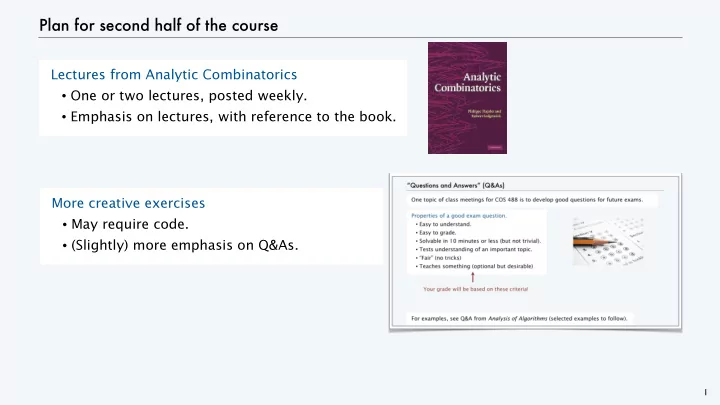
Plan for second half of the course Lectures from Analytic Combinatorics One or two lectures, posted weekly. Emphasis on lectures, with reference to the book. More creative exercises May require code. (Slightly) more emphasis on


slide-1
SLIDE 1

Plan for second half of the course

1

More creative exercises

  • May require code.
  • (Slightly) more emphasis on Q&As.

Lectures from Analytic Combinatorics

  • One or two lectures, posted weekly.
  • Emphasis on lectures, with reference to the book.
slide-2
SLIDE 2

AC basics Q&A 1

2

  • Q. Match each description on the left to 0 or 1 of the symbolic specifications on the right

(ODD denotes the set of odd numbers).

SEQODD(SEQ(Z )) SEQ(SEQODD(Z )) SEQ(Z ) SEQM (Z ) MSET(Z ) MSETODD(Z ) PSET(Z ) MSET(SEQODD(Z )) MSETODD(SEQ(Z ))

compositions compositions into M parts compositions into odd parts compositions into an odd number of parts compositions into distinct parts partitions partitions into M parts partitions into odd parts partitions into an odd number of parts partitions into distinct parts

slide-3
SLIDE 3

AC Basics Q&A 2: cyclic bitstrings

3

1 1 1 1 1 1 1 1 1 1 1 1 1 1 1 1 1 1 1 1

C1 = 2 C2 = 3 C3 = 4 C4 = 6

  • Def. A cyclic bitstring is a cyclic sequence of bits

1 1

C5 = 8

  • Q. How many N-bit cyclic bitstrings ?
slide-4
SLIDE 4

Q&A example: cyclic bitstrings

4

  • Q. How many N-bit cyclic bitstrings ?

One possibility

  • Solution is “easy”.
  • Create an exam question with appropriate hints.

Another possibility

  • Solution is “difficult” or “complicated”.
  • Figure out a way to simplify.
  • Or, think about a different problem.

1 1 1 1 1 1 1 1 1 1 1 1

C4 = 6

Third possibility

  • Problem you thought of is a “classic”.
  • Use OEIS.
slide-5
SLIDE 5
slide-6
SLIDE 6

1 1 1 1 1

C3 = 4

1

page 18

slide-7
SLIDE 7

page 64

slide-8
SLIDE 8

k 1 2 3 4 5 6 7 8 9

𝜒(k) 1 1 2 2 4 2 6 4 6

ln 1 1 − 2z = 2z 1 + (2z)2 2 + (2z)3 3 + (2z)4 4 + (2z)5 5 + . . . ln 1 1 − 2z2 = 2z2 1 + (2z2)2 2 + . . . ln 1 1 − 2z3 = 2z3 1 + (2z3)2 2 + . . . ln 1 1 − 2z4 = 2z4 1 + . . . ln 1 1 − 2z5 = 2z5 1 + . . .

slide-9
SLIDE 9

AC Basics Q&A 2

9

  • Q. How many cyclic bitstrings of length 10 ?

construction OGF

N(z) =

[z10]N(z) =

result

slide-10
SLIDE 10

AC Basics Q&A 3

10

  • Q. How many unimodal permutations of length n ?

constructions EGFs exact result

I = increasing perms D = decreasing perms U = unimodal perms

definitions

I = SET(Z)

D =

I(z) = ez U(z) =

D(z) =

U =

Un =

slide-11
SLIDE 11

AC Basics Q&A 4

11

  • Q. Mappings with every character appearing 2 or 0 times.

constructions EGF equations EGFs ~-approximation

Y = CY C(Z ? C)

M = SET(Y )

C(z) = z + 1 2zC(z)2

C = Z + Z ? SET2(C)

Y (z) = ln 1 1 − zC(z) M(z) = 1 1 − zC(z)

C(z) = 1 − √ 1 − 2z2 z

M(z) = 1 √ 1 − 2z2

[zn] f(z) (1 − z/ρ)α ∼ f(ρ) Γ(α)ρ−nnα−1

Γ 1 2

  • = √π

n! ∼ √ 2πn ⇣n e ⌘n (2n)![z2n]M(z) ∼ (2n)! 2n √πn

∼ 2 ⇣2n e ⌘2n