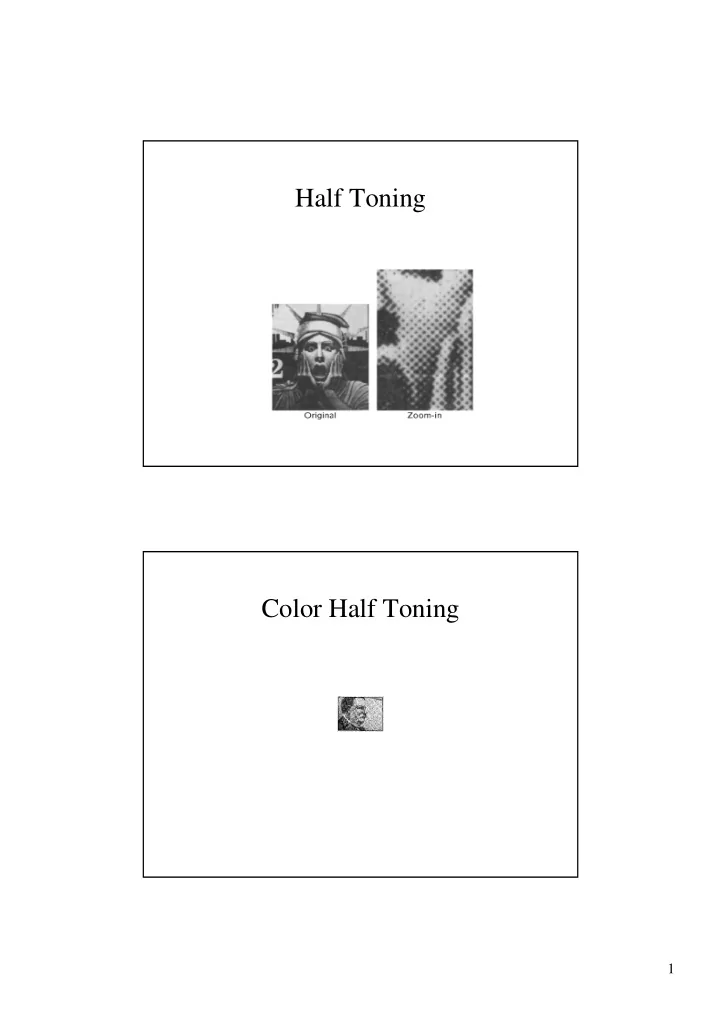
Half Toning Color Half Toning 1 Color Half Toning 2 Half Toning - - PDF document
Half Toning Color Half Toning 1 Color Half Toning 2 Half Toning Emulating 5 different levels (0) (1) (2) (3) (4) (0) (1) (2) (3) (0) (1) (2) (3) (4) Half Toning (2) (0) (1) (3) (4) (7) (5) (6) (8) (9) 10 levels 3 4
2
Color Half Toning
3
(0) (1) (2) (3) (4) (0) (1) (2) (3) (0) (1) (2) (3) (4)
Emulating 5 different levels
Half Toning
(0) (1) (2) (3) (4) (5) (6) (7) (8) (9)
Half Toning
10 levels
4
5
Dithering and Halftoning
Trade spatial for intensity resolution (works well for printing where dot printing is very high)
- Thresholding.
- Random dither; Robert’s algorithm
- Ordered dither
- Error diffusion
Your eye will average over an area
- Spatial Integration
6
Thresholding
Assume we want to quantize a gray-level image to a binary colormap. Map the upper half of the gray-level scale to white, and the lower half to black – a simple threshold operation, preformed independently at each pixel.
Thresholding.
Original image. Simple threshold.
n = 0.5 n= 0.7
) ) , ( ( ) , ( n y x v trunc y x v
- Errors are low spatial frequencies.
7
Robert’s Algorithm
- First add noise
- Then quantize
x i
1
r r + 1
Quantised to 1 Quantised to 0
)) , ( ) , ( ( ) , ( y x noise y x v K trunc y x v
- 1
- noise
Moves errors to higher spatial frequencies.
- > eye averages over an area.
Robert’s Algorithm
Moves low frequency (average error) to high frequency Pink(low), Blue (high), White(all) frequency noise
Pink Blue
8
The trouble with noise.
- Difficult to compute quickly.
- Not reproducible.
- Pre-compute pseudo-random function and
store in table.
- Small tiled patterns sufficient
9
Each pixel produces a quatization error The quality of the result may be improved by adjusting the threshold locally, so that adjacent pixels in small areas are quantized with different thresholds. This reduces the average local quantization
- error. Matrices of these threshold are called
dither matrices.
Dithering Comparison
10
Ordered Dithering
- Trade off spatial
resolution for intensity resolution.
- Use dither patterns.
- Can be represented as
a matrix.
Bayer Ordered Dither Patterns
11
Other possibilities.
9 4 8 6 1 2 5 7 3
For all Xpixels For all Ypixels v = approximate(x,y) i = x mod m j = y mod n if v >= M[i,j] then Set_Pixel(x,y, BLACK) else Set_Pixel(x,y, WHITE) The dithering matrix (3x3)
12
Dithering
9 4 8 6 1 2 5 7 3 9 4 8 6 1 2 5 7 3 9 4 8 6 1 2 5 7 3 9 4 8 6 1 2 5 7 3 9 4 8 6 1 5 7 3 2 5 5 4 4 4 2 2 2 2 2 3 3 3 3 6 8 4 4 4 4 2 2 8 3 8 8 9 9 9 8 8 7 7 7 7 6 4 2 4 4 2 2 1 2 2 2 3 3 8 4 4 9 4 8 6 1 2 5 7 3 1 1 1 1 1
Dithering mask Image Binary image
Comparison.
13
Floyd-Steinberg Error Diffusion
With this method, the average quatization error is reduced by propagating the error from each pixel to some of its neighbors in the scan order. Note that the error propagation weights must sum to one e
- 3e/8
- 3e/8
- e/4
Dither vs. Floyd-Steinberg
14
Set AccErr[] to zero; For each pixel in the image scanning from left to right: value= Pixel_value(x,y) + AccErr[x,y]; if (value > WHITE/2) { Set_pixel(x,y, WHITE); Error = value - WHITE; } else { Set_pixel(x,y, BLACK); Error = value - BLACK; } if scanning from left to right { AccErr[x+1, y] += 3/8 * Error; AccErr[x, y+1] += 3/8 * Error; AccErr[x+1,y+1] += 2/8 * Error; }