ROYAL DUTCH SHELL PLC SECOND QUARTER 2019 AND HALF YEAR RESULTS - - PDF document

royal dutch shell plc second quarter 2019 and half year
SMART_READER_LITE
LIVE PREVIEW

ROYAL DUTCH SHELL PLC SECOND QUARTER 2019 AND HALF YEAR RESULTS - - PDF document

ROYAL DUTCH SHELL PLC SECOND QUARTER 2019 AND HALF YEAR RESULTS AUGUST 1 ST 2019 SECOND QUARTER 2019 AND HALF YEAR RESULTS WEBCAST TO MEDIA AND ANALYSTS BY BEN VAN BEURDEN, CHIEF EXECUTIVE OFFICER OF ROYAL DUTCH SHELL PLC AND JESSICA UHL, CHIEF


slide-1
SLIDE 1

ROYAL DUTCH SHELL PLC SECOND QUARTER 2019 AND HALF YEAR RESULTS

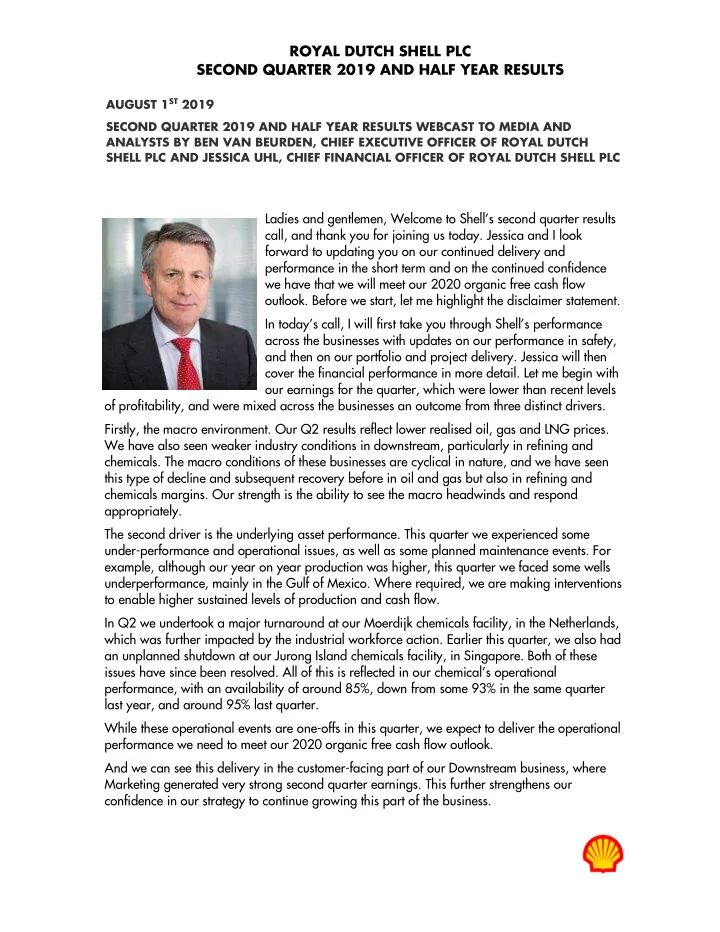
AUGUST 1ST 2019 SECOND QUARTER 2019 AND HALF YEAR RESULTS WEBCAST TO MEDIA AND ANALYSTS BY BEN VAN BEURDEN, CHIEF EXECUTIVE OFFICER OF ROYAL DUTCH SHELL PLC AND JESSICA UHL, CHIEF FINANCIAL OFFICER OF ROYAL DUTCH SHELL PLC

Ladies and gentlemen, Welcome to Shell’s second quarter results call, and thank you for joining us today. Jessica and I look forward to updating you on our continued delivery and performance in the short term and on the continued confidence we have that we will meet our 2020 organic free cash flow

  • utlook. Before we start, let me highlight the disclaimer statement.

In today’s call, I will first take you through Shell’s performance across the businesses with updates on our performance in safety, and then on our portfolio and project delivery. Jessica will then cover the financial performance in more detail. Let me begin with

  • ur earnings for the quarter, which were lower than recent levels
  • f profitability, and were mixed across the businesses an outcome from three distinct drivers.

Firstly, the macro environment. Our Q2 results reflect lower realised oil, gas and LNG prices. We have also seen weaker industry conditions in downstream, particularly in refining and

  • chemicals. The macro conditions of these businesses are cyclical in nature, and we have seen

this type of decline and subsequent recovery before in oil and gas but also in refining and chemicals margins. Our strength is the ability to see the macro headwinds and respond appropriately. The second driver is the underlying asset performance. This quarter we experienced some under-performance and operational issues, as well as some planned maintenance events. For example, although our year on year production was higher, this quarter we faced some wells underperformance, mainly in the Gulf of Mexico. Where required, we are making interventions to enable higher sustained levels of production and cash flow. In Q2 we undertook a major turnaround at our Moerdijk chemicals facility, in the Netherlands, which was further impacted by the industrial workforce action. Earlier this quarter, we also had an unplanned shutdown at our Jurong Island chemicals facility, in Singapore. Both of these issues have since been resolved. All of this is reflected in our chemical’s operational performance, with an availability of around 85%, down from some 93% in the same quarter last year, and around 95% last quarter. While these operational events are one-offs in this quarter, we expect to deliver the operational performance we need to meet our 2020 organic free cash flow outlook. And we can see this delivery in the customer-facing part of our Downstream business, where Marketing generated very strong second quarter earnings. This further strengthens our confidence in our strategy to continue growing this part of the business.

slide-2
SLIDE 2

ROYAL DUTCH SHELL PLC SECOND QUARTER 2019 AND HALF YEAR RESULTS

The third and final driver are the one-offs and unusual items that we have experienced this quarter, totalling around $500 million. For example, in Q2 we signed a Heads of Agreement with the government of Trinidad and Tobago, which will impact our earnings this quarter, and I will talk about this more later. We also have taken some provisions for tax and receivables, which will impact earnings in this quarter. Also, with our assets starting-up, depreciation will commence, and we will see increasing revenues as we progress through their ramp-up phase. Now onto our cash flow from

  • perations which for this quarter excluding working capital movements was $10.5 billion,

demonstrating continued good performance in cash delivery.We will talk later on how this demonstrates our ability to deliver the 2020 organic free cash flow outlook. As both Jessica and I highlighted at the Management Day in June, the foundations of our financial framework remain the same and we are pleased to announce the next $2.75 billion tranche of our share buyback programme. Moving onto our other strategic ambitions, for Shell to thrive through the energy transition and sustain our societal licence to operate, we must fulfil a number of commitments and one commitment for us is to keep in line with society as it strives to meet the goal of the Paris

  • Agreement. We must all play our part, so let me highlight a few of the milestones in this

quarter.In June, we signed an agreement to deliver the world’s first carbon-neutral cargoes of liquefied natural gas to both Tokyo Gas and GS Energy using nature-based carbon credits to compensate for the carbon-dioxide emissions generated by these cargoes.In early June, I attended the Vatican climate summit and agreed, in partnership with other leaders in the energy sector, the global investment community and other organisations to further support government-led carbon-pricing mechanisms through industry collaboration, to encourage low- carbon choices for society.So, progress on a number of fronts this quarter but before I give you more detail on our performance, first I want to focus on safety.Health, safety, security and the environment are of the utmost importance to Shell and it is with deep sadness that we report two fatalities in June – both at the Shell Auger Tension Leg Platform, in the US Gulf of Mexico. Two of our colleagues died during a routine and mandatory test of our lifeboat launch and retrieval capabilities. This was devastating news. Our sympathy and condolences go out to their families, friends and colleagues. This follows four other fatalities in Shell Operated Ventures this year – two contractors in our Upstream operations in Nigeria, and two employees at separate Downstream sites in the US. This is a terrible reminder of the importance of a relentless and uncompromising quest to improve our HSSE performance and ensure we all have in the front of our minds that Goal Zero is our goal zero harm to people and zero harm to the environment.Despite marked improvements in the industry as a whole, events like this show us how much further we all have to go. We must do better and we will. I have talked about our strategy and I have talked about how HSSE is vital to everything we do how we must never let up on our safety standards. Now, let me turn to the financial summary for the first half of this year. Our organic free cash flow for the first six months of this year was $9.6 billion, including around $2.9 billion negative working capital impact. There will naturally be differences quarter to quarter in our cash profile. But importantly, on a four-quarter rolling basis, our cash flow

slide-3
SLIDE 3

ROYAL DUTCH SHELL PLC SECOND QUARTER 2019 AND HALF YEAR RESULTS

performance is on track to deliver our 2020 organic free cash flow outlook, which remains

  • unchanged. Jessica will talk about this in more detail later.

Turning to share buybacks, we have now reached around $9.3 billion in total since the start of the programme in July 2018. This is in line with the progress we expect towards completing $25 billion of share buybacks by the end of 2020. Our first half 2019 earnings are around $8.8 billion at an average Brent price of $66 per

  • barrel. Shell’s return on average capital employed was 8.2% at the end of this quarter, with

gearing at 27.6%. Jessica will talk about the gearing increase a little later, which includes an additional negative impact of 0.4%, arising from IFRS 11 accounting interpretations. And finally, our year-to-date cash capital expenditure was around $11 billion, continuing our investment momentum within the expected range of $24-29 billion per annum in 2019 and 2020. I would now like to move on to some of our recent portfolio highlights. Our recent announcements show the continued progress we have made. We have previously said we would continue reshaping our refining portfolio, ensuring we focus on meeting the needs of our

  • customers. In April, we announced our divestment of the SASREF refinery in Saudi Arabia. We

also announced an agreement for the sale of the Martinez refinery in the US. Both of these deals are expected to close this year. We have also recently seen the completion of various

  • ther divestments – Greater Sunrise, and Caesar-Tonga in the Gulf of Mexico. And just

yesterday, we completed the divestment of our upstream assets in Denmark, for a consideration

  • f some $1.9 billion. These support our ambition to complete more than $5 billion of

divestments per year in 2019 and 2020. Shell’s strategy for its refining portfolio also includes continued investment, for longer-term value, efficiency and growth in the remaining assets. In the first half of the year, we successfully and safely completed several major planned turnarounds. At Pernis we piloted a digital-valve early warning system for the site’s crude distillation unit. Since it came online last year, this early warning system has identified potential issues that could have triggered unplanned

  • downtime. Instead, through this digital monitoring and subsequent preventative measures, this

was avoided. We are taking steps to introduce this technology to other sites including our Bukom refinery and Jurong Island chemicals manufacturing plant, both in Singapore. And we will roll it out thourought our portfolio. As mentioned earlier, in May, we signed a Heads of Agreement with the government of Trinidad and Tobago for enhanced LNG revenues to the country. This represents a significant achievement for both parties and paves the way for further development of the energy sector in Trinidad and Tobago. The agreement also helps us unlock key projects, currently in development, to supply more gas both into the domestic markets and into our Atlantic LNG facility for export. We have also taken the final investment decision on both Mero 2, a floating production storage and offloading vessel to be deployed at the Mero field in Brazil, and the Powernap tie-back in the Gulf of Mexico. These types of projects are expected to support our next phase of growth to 2025, and are excellent examples of how we are unlocking

  • pportunities while lowering costs. During the quarter, we also made progress on two
slide-4
SLIDE 4

ROYAL DUTCH SHELL PLC SECOND QUARTER 2019 AND HALF YEAR RESULTS

important projects: Prelude and Appomattox. I had the pleasure of recently being in Perth in Australia, for the official ceremony, marking Prelude going into operations. Prelude and Appomattox are two of the final large projects helping Shell achieve its 2020 organic free cash flow outlook, and Jessica will touch upon these later. In response to investor feedback on Management Day to better understand progress in our customer-facing businesses it is worth highlighting Global Commercial as a part of Shell that is helping us generate resilient cash flows, as we have seen this quarter. Our marketing business this quarter showed further growth in earnings, increasing around $200 million since the same quarter a year ago. In our marketing business, Global Commercial is our business-to-business

  • rganisation, which serves one million customers in 150 markets – and is growing. Global

Commercial comprises three businesses – Lubricants, Specialities – Bitumen and Sulphur – and

  • Aviation. All have unique scale, strength of brand and capabilities. Let me focus on a few

exciting innovations in Lubricants that we introduced in the last few months, demonstrating our ability to innovate across the energy system, transport and in digital. Lubricants is the largest business in Global Commercial. It has a global market share of 11%. To give you an idea of what this means, one in nine machines and engines is protected by Shell Lubricants. One example of the performance and protection we promise drivers is Helix 0W, our premium ultra-low viscosity engine oil, made from Shell’s GTL base oil from natural gas.This oil makes internal combustion engines more efficient and cleaner, improving fuel economy by up to 4%.This fully synthetic premium lubricant belongs to one of the fastest-growing categories of lubricants, reflecting high customer demand. A significant innovation for this quarter is the introduction of our new range of fluids developed specifically for electric vehicles. We call them Shell E-Fluids. It may not be obvious, but even electric vehicles need greases, transmission fluids and increasingly high-performing coolants.We launched our E-Fluids range at the Formula E Championship in Berlin in May. These products are designed to make electric vehicles perform better and make them more

  • efficient. Next to strong demand, we have two advantages in this field. First, our long-term

relationships with major car manufacturers across the world. And second, our investment in research and development, which enables us to work on new products, often co-engineered with car manufacturers, and allows us to bring them to scale in 150 markets. Global Commercial is a significant component of our Marketing growth. We are very happy with our progress, both in terms of products and services. Now, I would like to hand over to Jessica, who will talk you through the Q2 results in a little more detail. Thank you.

slide-5
SLIDE 5

ROYAL DUTCH SHELL PLC SECOND QUARTER 2019 AND HALF YEAR RESULTS

Thank you Ben, and welcome to everyone on the call today. I would like to start by reminding you that as I go through the results, they are prepared using the new IFRS 16 accounting

  • standard. For Q2, cash flow from operations excluding working

capital movements was $10.5 billion. This was at an average Brent price of $69 per barrel and a mixed price and margin environment, which is overall down from Q2 last year, particularly in gas, refining and chemicals. Our organic free cash flow for the quarter was $6.2 billion. This includes a positive working capital impact of some $0.6 billion. Earnings amounted to $3.5 billion and our return on average capital employed reached 8.2%. As Ben highlighted, refining and chemicals margins are weaker than we would have hoped. While we may see differences quarter to quarter in profitability, we continue to demonstrate progress towards ROACE of around 10% by the end of 2020. For Q2 2019, our gearing is 27.6%, or 23.0% on an IAS 17 basis, in line with what we expected from the IFRS 16 accounting change. This quarter we also saw additional lease liabilities recognised

  • n our balance sheet, based on the recent final decision of the IFRS Interpretations Committee.

The decision means that as operator, we should recognise the total liabilities, regardless of actual equity interest. For Shell, this required an incremental $1.4 billion of lease liabilities to be recognised on our balance sheet, resulting in a 0.4% increase to our gearing in Q2 2019. Our cash capital expenditure in the quarter was $5.3 billion, with the 2019 outlook within the range of $24-29 billion. Our share buyback programme is progressing with some $9.3 billion in shares purchased to date, since the start of the programme in July 2018. And the next tranche of up to $2.75 billion begins today. As Ben and I have said at our Management Day, we expect to complete $25 billion in share buybacks by the end of 2020, subject to further progress with debt reduction and oil price

  • conditions. So in short, this quarter we have seen challenging macro conditions, some
  • perational challenges as Ben has highlighted, and some one-offs all of which prevented us

from achieving the level of profitability we would like to see. In terms of cash, we have seen this quarter generate good cash flow from operations. We have also progressed in our project delivery commitments, which will add to our cash flows in the quarters to come. And of course subject to progress with debt reduction and oil price conditions, all of this progress supports our Management Day ambition of growing sustainable shareholder distributions. Now that we have seen the summary, let us turn to earnings in more detail. Q2 2019 earnings were down largely due to the weaker price and margin environment, which impacted each of our businesses, as seen on the chart. Earnings this quarter were $3.5 billion, some 26% lower than in Q2 2018. In our Integrated Gas business, total production was 3% lower compared with the second quarter 2018. This was mainly due to divestments and the transfer of the Salym asset from Integrated Gas to Upstream. This was partially offset by production from new wells in Australia and Trinidad and Tobago. LNG liquefaction volumes

slide-6
SLIDE 6

ROYAL DUTCH SHELL PLC SECOND QUARTER 2019 AND HALF YEAR RESULTS

increased by 2% compared with the second quarter 2018, benefiting from higher feed gas availability, and partly offset by divestments. Integrated Gas earnings were $1.7 billion, reflecting lower realised oil, gas and LNG prices and decreased production, when compared with the same quarter last year. Tax provisions and the Heads of Agreement with the government of Trinidad and Tobago, mentioned by Ben earlier, had a combined negative impact on our clean earnings of around $200 million in the quarter and are expected to lead to a cash outflow later in the year. In Upstream, earnings were approximately $1.3 billion reflecting lower oil and gas prices, higher depreciation from new field ramp-ups as well as increased receivables provisions, partly

  • ffset by increased volumes and lower taxation. Second quarter Upstream production

increased by 7%, compared with the same quarter a year ago. This was mainly due to higher production from our North American assets and, as mentioned earlier, the transfer of our Salym asset from Integrated Gas to Upstream. This production increase was partly offset by the impact of divestments. Without these portfolio impacts, production was up 6% over the same period. In Downstream, earnings were $1.3 billion in Q2 2019, down from $1.7 billion Q2 2018. This reflects lower realised base chemicals, intermediates and refining margins, partly offset by higher realised margins from our Retail business. In the Corporate segment, we have seen the additional impact of IFRS 16, with the interest recognition residing in this segment. Again, this is consistent with what was previously

  • communicated. And with a better understanding of IFRS 16 and tax impacts, we feel it is now

the right time to adjust our outlook for the Corporate segment which will now be $2.9 to $3.2 billion for the full year 2019. Now that we have discussed our Q2 earnings, let me turn to cash flow. Like our earnings, our Q2 2019 cash flows were also down largely due to the weaker price and margin environment, which impacted each of our businesses. This quarter our cash flow from operations, excluding working capital movements, amounted to $10.5 billion. This is $1.1 billion lower than in Q2 2018. In our Integrated Gas business, cash flow from operations in Q2 2019 was $3.4 billion. This includes positive working capital movements and the impact of IFRS 16. In Upstream, our cash flow from operations was $5.6 billion, slightly higher than in the same quarter last year. Like Integrated Gas, our Upstream cash flow from operations was helped by positive working capital and IFRS 16 impacts. In our Downstream business, our cash flow from operations was $2.4 billion, some $1.4 billion higher in Q2 2019 when compared with Q2 2018. This largely reflects the negative impact on working capital in Q2 2018, resulting from the higher inventory price and volume movements, as well as the positive impact in relation to the implementation of IFRS 16.

slide-7
SLIDE 7

ROYAL DUTCH SHELL PLC SECOND QUARTER 2019 AND HALF YEAR RESULTS

Now that we have compared this quarter with the same quarter last year, let us take a step back and see how we have been doing over a longer period. On this slide you can see across the extended period, that all significant financial trends are moving in the right direction.We have demonstrated continued delivery in the growth of our earnings and improvement of our

  • ROACE. Our cash flow from operations has more than doubled between 2016 and 2018, and

we plan to further increase this. A number of changes across the company have made these trends possible by focusing on high cash molecules across businesses. For example, we are reducing cost and improving outcomes by expanding our business operations in Manila, Kuala Lumpur, Chennai, Bangalore and Krakow. In these centres, we concentrate our HR, Finance and IT activities among others, and also our business processes. These changes are helping Shell to transform into a simpler company, delivering higher and more resilient cash flows and returns. Now looking at our gearing this was 27.6% at the end of Q2 2019, including the recent accounting impacts that I have previously discussed. Our intention is to get our gearing to around 25% by the end of 2020 post-IFRS 16 and by 2025, with our continued delivery, in the range of 15 to 25% through the cycle. While we will see changes from quarter to quarter, our performance over the last several quarters brings us closer to this ambition. This way, we plan to remain competitive through the cycle and ensure strong and sustainable shareholder distributions.We have previously stated that we are de-risking our cash flows, moving towards our 2020 organic free cash flow

  • utlook. It is worth reminding you how these connect to our 2020 outlook, as Ben highlighted
  • earlier. On a four-quarter rolling basis, we have generated some $26 billion of organic free

cash flow, at an average Brent price of $69 per barrel. This is adjusted for around $5 billion of working capital movements, and IFRS 16 impacts. To keep the view consistent, we then present all data on a $60 per barrel real term 2016 basis. This is again consistent with our Management Day view. Adjusting for this price would mean a reduction in our four-quarter rolling organic free cash flow of about $2 billion. At this oil price, assuming a stable price environment, we would not have been subject to the working capital movements we have seen to date. So, against this lower oil price, our organic free cash flow would have been around $24 billion.Taking into account the additional cash flow expected from new projects, and the IFRS 16 impact, we expect to see organic free cash flow within the range of $28 to $33 billion by the end of 2020.So, the message Ben and I reiterated at our Management Day event is unchanged that our 2020 organic free cash flow outlook remains in place and we have confidence in delivering these cash flows with the start-up of several key projects over the past few quarters. The remaining two large projects adding to the cash flow from operations from new projects, progressed further this quarter. Firstly, with Appomattox in the Gulf of Mexico, commencing its

  • production. We are very proud of this achievement. It is a project that is key for our Deep

Water business, one of our Core Upstream strategic themes. Appomattox was completed ahead of its scheduled start-up and around 40% under budget, since the final investment

  • decision. And with discoveries at Dover, Fort Sumter and Rydberg we can work to keep

Appomattox full for some time to come. And second, on June 11, the first LNG cargo sailed

slide-8
SLIDE 8

ROYAL DUTCH SHELL PLC SECOND QUARTER 2019 AND HALF YEAR RESULTS

from Prelude, our floating liquefied natural gas facility offshore Australia. This cargo was delivered to customers in Asia. As of today, Prelude has produced a total of 3 condensate cargoes, 1 LPG cargo, and 4 LNG cargoes demonstrating why it forms an integral part of our growing global Integrated Gas portfolio, and should provide LNG for the coming decades. So, let me summarise the quarter. In Q2, we delivered key milestones from our portfolio, such as the start-up of Appomattox and first LNG from Prelude and we continued to high-grade our portfolio, aligned with our intentions from our Management Day. This quarter we delivered resilient earnings growth in our customer-facing Marketing businesses, with good trading

  • results. We also experienced more challenging macro conditions across other parts of our

business and at the same time we did not reach the full potential of some of our assets. In both areas, we will respond appropriately to further strengthen and grow our cash flows from these assets. Finally, this quarter saw bookings in relation to various settlements, impacting our earnings. The key is to look at the overall trends and outlook and with the resilience of our Upstream and customer-facing businesses, and their ability to generate cash this supports the delivery of our 2020 outlook, which remains unchanged. With that, let’s go for your questions. Please could we have just one or two each, so everyone has the opportunity to ask a question. Thank you for your questions and for joining the call today. The third quarter results are scheduled to be announced on the 31st of October 2019, and Jessica will talk to you all then.

ROYAL DUTCH SHELL PLC AUGUST 1ST 2019 WWW.SHELL.COM/IR

slide-9
SLIDE 9

ROYAL DUTCH SHELL PLC SECOND QUARTER 2019 AND HALF YEAR RESULTS

DEFINITIONS AND CAUTIONARY NOTE

NOT FOR RELEASE, PRESENTATION, PUBLICATION OR DISTRIBUTION IN WHOLE OR IN PART IN, INTO OR FROM ANY JURISIDICTION WHERE TO DO SO WOULD CONSTITUTE A VIOLATION OF THE RELEVANT LAWS OF SUCH JURISDICTION. Gearing is defined as net debt (current and non-current debt less cash and cash equivalents, adjusted for the fair value of derivative financial instruments used to hedge foreign exchange and interest rate risks relating to debt, and associated collateral balances) as a percentage of total capital (net debt plus total equity). Free Cash Flow is defined as the sum of “Cash flow from operating activities” and “Cash flow from investing activities”. Cash flow from

  • perating activities excluding working capital movements is defined as “Cash flow from operating activities” less the

sum of the following items in the Consolidated Statement of Cash Flows: (i) (increase)/decrease in inventories, (ii) (increase)/decrease in current receivables, and (iii) increase/(decrease) in current payables. ROACE on a CCS basis excluding identified items is defined as the sum of CCS earnings excluding identified items for the current and previous three quarters, adjusted for after-tax interest expense, expressed as a percentage of the average capital employed for the same period. The after-tax interest expense is calculated using the effective tax rate for the same

  • period. Capital employed consists of total equity, current debt and non-current debt. Presented ROACE (return on

average capital employed) is ROACE on a CCS basis excluding identified items unless stated otherwise. Historical ROACE for individual segments presented as reported (not restated for Q1 2019 definition change). Earnings on a current cost of supplies basis (CCS earnings) is the income for the period, adjusted for the after-tax effect of oil-price changes on inventory. Presented earnings is CCS earnings attributable to shareholders excluding identified items unless stated otherwise. Basic CCS earnings per share is calculated by dividing CCS earnings attributable to shareholders by the average number of shares outstanding over the year. Presented earnings per share is basic CCS earnings per share excluding identified items unless stated otherwise. Cash capital expenditure was introduced with effect from January 1, 2019, comprising the following lines from the Consolidated Statement of Cash Flows: Capital expenditure, Investments in joint ventures and associates and Investments in equity securities. Reconciliations of the above non-GAAP measures are included in the Royal Dutch Shell plc Unaudited Condensed Interim Financial Report for the three and six-month periods ended June 30, 2019. This presentation contains the following forward-looking non-GAAP measures: Organic Free Cash Flow, Cash Capital Expenditure, Gearing, ROACE, Capital Employed and Divestments. We are unable to provide a reconciliation of the above forward-looking non-GAAP measures to the most comparable GAAP financial measures because certain information needed to reconcile the above non-GAAP measure to the most comparable GAAP financial measure is dependent on future events some which are outside the control of the company, such as oil and gas prices, interest rates and exchange rates. Moreover, estimating such GAAP measures consistent with the company accounting policies and the required precision necessary to provide a meaningful reconciliation is extremely difficult and could not be accomplished without unreasonable effort. Non-GAAP measures in respect of future periods which cannot be reconciled to the most comparable GAAP financial measure are calculated in a manner which is consistent with the accounting policies applied in Royal Dutch Shell plc’s financial statements. The presented 2020 outlook is an average for 2019-2021. All forward-looking numbers are on an IFRS 16 basis unless stated otherwise. 2020 presented organic free cash flow range of $28-33 billion is equivalent to $25-30 billion on an IAS 17 basis. 2020 presented cash capex range of $24-29 billion is equivalent to the previous outlook of $25- 30 billion capital investment on an IAS 17 basis. The companies in which Royal Dutch Shell plc directly and indirectly owns investments are separate legal entities. In this presentation “Shell”, “Shell Group” and “Royal Dutch Shell” are sometimes used for convenience where references are made to Royal Dutch Shell plc and its subsidiaries in general. Likewise, the words “we”, “us” and “our” are also used to refer to Royal Dutch Shell plc and its subsidiaries in general or to those who work for them. These terms are also used where no useful purpose is served by identifying the particular entity or entities. ‘‘Subsidiaries’’, “Shell subsidiaries” and “Shell companies” as used in this presentation refer to entities over which Royal Dutch Shell plc either directly or indirectly has control. Entities and unincorporated arrangements over which Shell has joint control are generally referred to as “joint ventures” and “joint operations”, respectively. Entities over which Shell has significant influence but neither control nor joint control are referred to as “associates”. The term “Shell interest” is used for convenience to indicate the direct and/or indirect

  • wnership interest held by Shell in an entity or unincorporated joint arrangement, after exclusion of all third-party

interest.

slide-10
SLIDE 10

ROYAL DUTCH SHELL PLC SECOND QUARTER 2019 AND HALF YEAR RESULTS

This presentation contains forward-looking statements (within the meaning of the U.S. Private Securities Litigation Reform Act of 1995) concerning the financial condition, results of operations and businesses of Royal Dutch Shell. All statements other than statements of historical fact are, or may be deemed to be, forward-looking statements. Forward-looking statements are statements of future expectations that are based on management’s current expectations and assumptions and involve known and unknown risks and uncertainties that could cause actual results, performance or events to differ materially from those expressed or implied in these statements. Forward- looking statements include, among other things, statements concerning the potential exposure of Royal Dutch Shell to market risks and statements expressing management’s expectations, beliefs, estimates, forecasts, projections and

  • assumptions. These forward-looking statements are identified by their use of terms and phrases such as “aim”,

“ambition”, ‘‘anticipate’’, ‘‘believe’’, ‘‘could’’, ‘‘estimate’’, ‘‘expect’’, ‘‘goals’’, ‘‘intend’’, ‘‘may’’, ‘‘objectives’’, ‘‘outlook’’, ‘‘plan’’, ‘‘probably’’, ‘‘project’’, ‘‘risks’’, “schedule”, ‘‘seek’’, ‘‘should’’, ‘‘target’’, ‘‘will’’ and similar terms and phrases. There are a number of factors that could affect the future operations of Royal Dutch Shell and could cause those results to differ materially from those expressed in the forward-looking statements included in this presentation, including (without limitation): (a) price fluctuations in crude oil and natural gas; (b) changes in demand for Shell’s products; (c) currency fluctuations; (d) drilling and production results; (e) reserves estimates; (f) loss of market share and industry competition; (g) environmental and physical risks; (h) risks associated with the identification of suitable potential acquisition properties and targets, and successful negotiation and completion of such transactions; (i) the risk of doing business in developing countries and countries subject to international sanctions; (j) legislative, fiscal and regulatory developments including regulatory measures addressing climate change; (k) economic and financial market conditions in various countries and regions; (l) political risks, including the risks of expropriation and renegotiation of the terms of contracts with governmental entities, delays or advancements in the approval of projects and delays in the reimbursement for shared costs; and (m) changes in trading conditions. No assurance is provided that future dividend payments will match or exceed previous dividend

  • payments. All forward-looking statements contained in this presentation are expressly qualified in their entirety by

the cautionary statements contained or referred to in this section. Readers should not place undue reliance on forward-looking statements. Additional risk factors that may affect future results are contained in Royal Dutch Shell’s Form 20-F for the year ended December 31, 2018 (available at www.shell.com/investor and www.sec.gov). These risk factors also expressly qualify all forward-looking statements contained in this presentation and should be considered by the reader. Each forward-looking statement speaks only as of the date of this presentation, August 1,

  • 2019. Neither Royal Dutch Shell plc nor any of its subsidiaries undertake any obligation to publicly update or revise

any forward-looking statement as a result of new information, future events or other information. In light of these risks, results could differ materially from those stated, implied or inferred from the forward-looking statements contained in this presentation. We may have used certain terms, such as resources, in this presentation that the United States Securities and Exchange Commission (SEC) strictly prohibits us from including in our filings with the

  • SEC. U.S. investors are urged to consider closely the disclosure in our Form 20-F, File No 1-32575, available on the

SEC website www.sec.gov.