
SLIDE 1
18/11/19 CEPC WS@IHEP 1
Physics requirement studies: Higgs measurements &
- thers
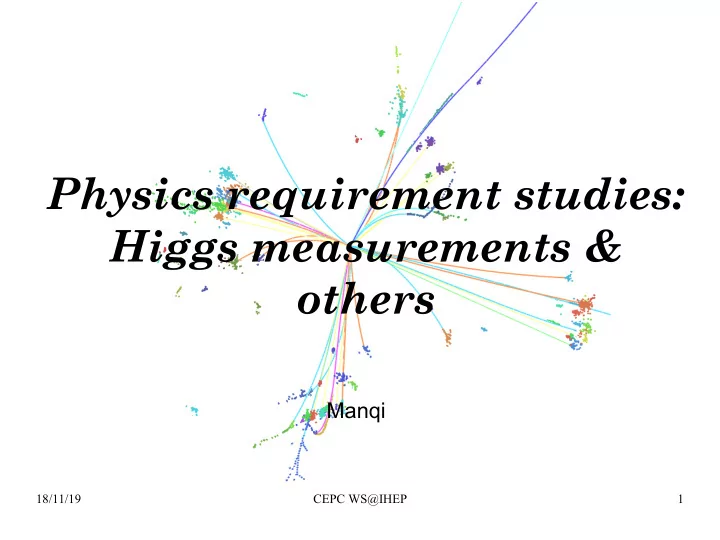
Physics requirement studies: Higgs measurements & others Manqi - - PowerPoint PPT Presentation
Physics requirement studies: Higgs measurements & others Manqi 18/11/19 CEPC WS@IHEP 1 Science at CEPC-SPPC Tunnel ~ 100 km CEPC (90 250 GeV) Higgs factory: 1M Higgs boson Absolute measurements of Higgs boson width
18/11/19 CEPC WS@IHEP 1
18/11/19 CEPC WS@IHEP 2
–
Higgs factory: 1M Higgs boson
–
Z & W factory: 6E11 Z boson
–
Flavor factory: b, c, tau and QCD studies
–
Direct search for new physics
–
Complementary Higgs measurements to CEPC g(HHH), g(Htt)
–
...
18/11/19 CEPC WS@IHEP 3
Detector: To reconstruct all the physics objects with high efficiency, purity & resolution Homogenous & Stable enough to control the systematic This talk quantifies the requirement/key questions of Jet reconstruction at CEPC/ILC
18/11/19 CEPC WS@IHEP 4
18/11/19 CEPC WS@IHEP 5
–
Track Momentum: Higgs recoil mass from μμH; μ(H→μμ).
–
Photon: μ(H→γγ)
–
Hadronic event
– μ(vvH, H→bb); – μ(qqH, H→inv); – μ(qqH, H→tautau);
–
Tau factory...
–
Flavor & QCD...
18/11/19 CEPC WS@IHEP 6
0.9% 0.65%
δσ(ZH)/σ(ZH) = 0.5% δg(HZZ)/g(HZZ) = 0.25%
0.9% 1.5%
Zhenxing Chen & Yacine Haddad
18/11/19 CEPC WS@IHEP 7
Note: Higgs mass is more accurately measured From Model-dependent analysis, which is used In the analysis show in the right side
Preliminary
18/11/19 CEPC WS@IHEP 8
the signal strength measurement
Preliminary
18/11/19 CEPC WS@IHEP 9
14% of statistic term is adequate to 1% constant term
Preliminary
18/11/19 CEPC WS@IHEP 10
–
0 jets: 3%: Z→ll, vv (30%); H→0 jets (~10%, ττ, μμ, γγ, γZ/WW/ZZ→leptonic)
–
2 jets: 32%
–
4 jets: 55%
–
6 jets: 11%
18/11/19 CEPC WS@IHEP 11
–
Measurement: TGC, Afb, etc
–
Background control
–
Calibration & in-situ monitoring
–
Di-photon events;
–
bhabha, ττ, μμ;
–
ee→qq(γ) (ISR return & full energy)
–
WW/ZZ→semi-leptonic
–
Single W/Z events
–
WW/ZZ→Full hadronic
–
ZH→qq+(bb, cc, gg)
18/11/19 CEPC WS@IHEP 12
–
Identify the hadronic system & calculate its visible mass
–
At 2-jets event: the visible mass is the mass of the intermediate boson
–
At fixed c.m.s. energy, the recoil mass of hadronic system is mostly determined by the visible mass.
–
Essential for differential measurements
–
Essential for identifying the right combination of jets – the color singlet – for physics event with jet number > 2
–
The jet clustering can induce significant uncertainties
18/11/19 CEPC WS@IHEP 13
Assuming BR(H→inv) = 10%
Preliminary σ(vvH, H→bb) σ(qqH, H→inv) σ(qqH, H→ττ)
resolution of vvH, H→gg events
–
Free of Jet Clustering
–
Be applied directly to the Higgs analyses
BMR = 2% 4% 6% 8%
σ(vvH, H→bb)
2.3% 2.6% 3.0% 3.4%
σ(vvH, H→inv)
0.38% 0.4% 0.5% 0.6%
σ(qqH, H→ττ)
0.85% 0.9% 1.0% 1.1%
18/11/19 CEPC WS@IHEP 14
recoil mass to separate the ZZ bkg
H→non jet final state
Assuming BR(H->inv) = 10%
If the BMR degrades from 4% to 6/8%: the Higgs invisible measurement degrades by 20/50%
Dan Yu
18/11/19 CEPC WS@IHEP 15
WW
–
Intrinsic boson mass/width
–
Jet confusion from color single reconstruction – jet clustering & pairing
–
Detector response
18/11/19 CEPC WS@IHEP 16
with ee-kt, and paired according to chi2
–
Intrinsic boson mass/width - lower limit: Overlapping ratio of 13%
–
+ Jet confusion – Genjet: Overlapping ratio of 53%
–
+ Detector response – Recojet: Overlapping ratio of 58%
18/11/19 CEPC WS@IHEP 17
18/11/19 CEPC WS@IHEP 18
from high energy pi-0 (up-to 30 GeV)
18/11/19 CEPC WS@IHEP 19
Higgs recoil at μμH: 2*baseline resolution is adequate with current beam energy spread H→μμ: 2*baseline leads to 40% degrading Closer > Lighter > Resolution More accurately: BMR<4% Color-Singlet identification for events with Number of Jets > 4 A critical value of 14% statistical term is Identified with 1% constant term
Separation: able to separate photons decayed from 30 GeV pi-0. Leptons: Isolated, high-energy ones with acceptance: eff*purity > 99% Inside jet: need further quantification – benchmark analysis Kaon: need further quantification
18/11/19 CEPC WS@IHEP 20
qualitative requirements are re-evaluated on the Higgs benchmarks, a minor update is concluded with respect to the CDR (in blue)
–
Tracker: How about degrading the requirement by 100%?
–
ECAL: Stochastic term of 14% is adequate to 1% constant term
–
Jet: BMR < 4% is required & Color-Singlet identification calls for innovative algorithm development
–
Differential measurement (angular resolution of jet, MET)
–
Physics with Z→tautau (at Z pole) requires an efficient separation of photons decayed from 30 GeV pi-0, and 3-prong decay tau
–
Object identification in jets: Kaon, lepton, and hadron decay products identification
18/11/19 CEPC WS@IHEP 21
18/11/19 CEPC WS@IHEP 22
Calorimeter
–
+ TPC (ILD-like, Baseline)
–
+ Silicon tracking (SiD-like)
–
Wire Chamber + Dual Readout Calorimeter
https://indico.ihep.ac.cn/event/6618/ https://agenda.infn.it/conferenceOtherViews.py?view=standard&confId=14816
18/11/19 CEPC WS@IHEP 23
Generators (Whizard & Pythia) Data format & management (LCIO & Marlin) Simulation (MokkaC) Digitizations Tracking PFA (Arbor) Single Particle Physics Objects Finder (LICH) Composed object finder (Coral) Tau finder Jet Clustering (FastJet) Jet Flavor Tagging (LCFIPLus) Event Display (Druid) General Analysis Framework (FSClasser) Fast Simulation (Delphes + FSClasser)
CEPC-SIMU-2017-001, CEPC-SIMU-2017-002, (DocDB id-167, 168, 173)
18/11/19 CEPC WS@IHEP 24
resolution -> per mille level mass resolution for H->mumu
18/11/19 CEPC WS@IHEP 25
BDT method using 4 classes of 24 input discrimination variables.
Test performance at: Electron = E_likeness > 0.5 ; Muon = Mu_likeness > 0.5 Single charged reconstructed particle, for E > 2 GeV: lepton efficiency > 99.5% && Pion mis id rate ~ 1%
https://link.springer.com/article/10.1140/epjc/s10052-017-5146-5 CEPC-DocDB-id:148, Eur. Phys. J. C (2017) 77: 591
18/11/19 CEPC WS@IHEP 26
Highly appreciated in flavor physics @ CEPC Z pole TPC dEdx + ToF of 50 ps At inclusive Z pole sample:
Conservative estimation gives efficiency/purity of 91%/94% (2-20 GeV, 50% degrading +50 ps ToF) Could be improved to 96%/96% by better detector/DAQ performance (20% degrading + 50 ps ToF)
CEPC-DocDB-id: 172 https://arxiv.org/abs/1803.05134
18/11/19 CEPC WS@IHEP 27
Critical energy to separate an evenly decay π0: 30 GeV
See Hang Zhao's talk
18/11/19 CEPC WS@IHEP 28
1.7/2.5% is achieved in the Higgs to di-photon final states with simplified/baseline geometry
could be efficiently corrected (Preliminary) See Yuqiao Shen's talk
18/11/19 CEPC WS@IHEP 29
–
Leptonic environments: i.e, llττ(ZZ/ZH), vvττ(ZZ/ZH/WW), Z→ττ;
–
Jet environments: i.e, ZZ/ZH→qqττ, WW→qqvτ;
Ph.D thesis: D. Yu, reconstruction of leptonic objects at e+e- Higgs factory ...Counting #Photon/Track... ...Checking Vertex Impact... Cone Based Algorithm!
18/11/19 CEPC WS@IHEP 30
TAURUS (Tau ReconstrUction toolS): an overall efficiency*purity higher than 70% is achieved for qqττ, and qqτv events
See Zhigang Wu's talk
18/11/19 CEPC WS@IHEP 31
Z pole sample:
– B-tagging:
eff/purity = 80%/90%
– C-tagging:
eff/purity = 60%/60%
evaluated
https://agenda.linearcollider.org/event/7645/contributions/40124/
18/11/19 CEPC WS@IHEP 32
–
Identify the hadronic system & calculate its visible mass
–
At 2-jets event: the visible mass is the mass of the intermediate boson
–
At fixed c.m.s. energy, the recoil mass of hadronic system is mostly determined by the visible mass.
–
Essential for differential measurements
–
Essential for identifying the right combination of jets – the color singlet – for physics event with jet number > 2
–
The jet clustering can induce significant uncertainties
18/11/19 CEPC WS@IHEP 33
–
σ(vvH, H→bb)
–
σ(qqH, H→inv)
–
σ(qqH, H→tautau)
clustering algorithms, see Peizhu Lai's presentation yesterday
https://agenda.linearcollider.org/event/8217/contributions/44662/
18/11/19 CEPC WS@IHEP 34
fully hadronic decay Higgs
procedure to control the effect of ISR photon, neutrinos generated in Higgs decay, and detector acceptance
18/11/19 CEPC WS@IHEP 35
18/11/19 CEPC WS@IHEP 36
18/11/19 CEPC WS@IHEP 37
https://agenda.linearcollider.org/event/8217/contributions/44662/
18/11/19 CEPC WS@IHEP 38
–
1st, σ(ZH) (~g2(HZZ)), σ(ZH, H→ZZ) (~g4(HZZ)/Γtotal)
–
2nd, σ(ZH, H→bb), σ(ZH, H→WW), σ(ZH), σ(vvH|w fusion, H→bb), (bb can be replaced by X)
–
The 2nd method dominant the accuracy
from the Higgsstrahlung ones with vvH final state: rely on the recoil mass against the Higgs (and the Higgs direction).
Hao Liang
18/11/19 CEPC WS@IHEP 39
BMR = 4% BMR = 10%
If the BMR degrades from 4% to 6/8%: the Higgs width measurement degrades by 20/40% improves to 2%: the width measurement will improve by 15%
18/11/19 CEPC WS@IHEP 40
recoil mass to separate the ZZ bkg
H→non jet final state
Assuming BR(H->inv) = 10%
If the BMR degrades from 4% to 6/8%: the Higgs invisible measurement degrades by 20/50%
Dan Yu
18/11/19 CEPC WS@IHEP 41
accuracy by more than a factor of 2: BMR < 4% is crucial
Preliminary
18/11/19 CEPC WS@IHEP 42
Assuming BR(H→inv) = 10%
Preliminary σ(vvH, H→bb) σ(qqH, H→inv) σ(qqH, H→ττ)
resolution of vvH, H→gg events
–
Free of Jet Clustering
–
Be applied directly to the Higgs analyses
BMR = 2% 4% 6% 8%
σ(vvH, H→bb)
2.3% 2.6% 3.0% 3.4%
σ(vvH, H→inv)
0.38% 0.4% 0.5% 0.6%
σ(qqH, H→ττ)
0.85% 0.9% 1.0% 1.1%
18/11/19 CEPC WS@IHEP 43
–
Sub detector responses
–
Confusions
18/11/19 CEPC WS@IHEP 44
Fast simulation reproduces the full simulation results, factorize/quantifies different impacts Same cleaning condition as in the Full simulation applied Early phase of modeling/tuning
18/11/19 CEPC WS@IHEP 45
Time/pattern recognition may help a lot, in identify the charged cluster fragmentations without arise the threshold for the neutral hadron significantly...
18/11/19 CEPC WS@IHEP 46
WW
–
Intrinsic boson mass/width
–
Jet confusion from color single reconstruction – jet clustering & pairing
–
Detector response
18/11/19 CEPC WS@IHEP 47
with ee-kt, and paired according to chi2
–
Intrinsic boson mass/width - lower limit: Overlapping ratio of 13%
–
+ Jet confusion – Genjet: Overlapping ratio of 53%
–
+ Detector response – Recojet: Overlapping ratio of 58%
18/11/19 CEPC WS@IHEP 48
Equal mass condition |M12 – M34| < 10 GeV: At the cost of half the statistic, the overlapping ratio can be reduced from 58%/53% to 40%/27% for the Reco/Genjet
18/11/19 CEPC WS@IHEP 49
18/11/19 CEPC WS@IHEP 50
The CEPC Baseline could separate efficiently the WW-ZZ with full hadronic final state. Critical to develop color singlet reconstruction: improve from the naive Jet clustering & pairing. Quantified by differential overlapping ratio. Control of ISR photon/neutrinos from heavy flavor jet is important.
https://arxiv.org/abs/1812.09478
18/11/19 CEPC WS@IHEP 51
18/11/19 CEPC WS@IHEP 52
Z pole sample:
– B-tagging:
eff/purity = 80%/90%
– C-tagging:
eff/purity = 60%/60%
evaluated
https://agenda.linearcollider.org/event/7645/contributions/40124/
18/11/19 CEPC WS@IHEP 53
LEPTON JET FLAVOR
PHOTON KAON BMR JER
TAU
18/11/19 CEPC WS@IHEP 54
Clear Higgs Signature in all SM decay modes Massive production of the SM background (2 fermion and 4 fermions) at the full Simulation level Right corner: di-tau mass distribution at qqH events using collinear approximation
18/11/19 CEPC WS@IHEP 55
https://arxiv.org/pdf/1810.09037.pdf
18/11/19 CEPC WS@IHEP 56
–
Higgs:
–
EW: boost by at least 1 order of magnitude
–
Rich program on Flavor physics
–
High efficiency/accuracy reconstruction of all key physics objects
–
Clear Higgs signature in all SM Higgs decay modes
–
Clear distinguish between the Signal and SM backgrounds
–
Fulfills the physics requirements of the CEPC Higgs operation
18/11/19 CEPC WS@IHEP 57
–
Physics Potential study:
–
Detector design & optimization:
especially the integration & systematic controls
–
Software, Reconstruction, Algorithms, Analysis tools...
18/11/19 CEPC WS@IHEP 58
matching), we uses BMR and full hadronic WW-ZZ overlapping ratio
–
The recoil mass of di-jet system is an important observable to separate the signal from major backgrounds (ZZ, ZH)
–
BMR decomposition: At the CEPC baseline reconstruction: mainly limited by hadronic shower fragmentation, may potentially be improved using time information - better algorithms – need further quantification...
event: need better algorithms.
–
Clear consensus, and need further collaboration with QCD/pheno-theory!...
18/11/19 CEPC WS@IHEP 59
18/11/19 CEPC WS@IHEP 60
–
Boost the hadronic system back to its rest frame
–
Divide into 2 hemisphere with a plane perpendicular to the thrust, each identified as a jet
(applicable only to 2 jet state)
the full hadronic WW/ZZ study): up to 20% improvement in Jet Angular/Energy Resolution
18/11/19 CEPC WS@IHEP 61
–
Higgs factory: 1M Higgs boson
–
Z & W factory: 100M W Boson, 100B – 1 Tera Z boson
–
Flavor factory: b, c, tau and QCD studies
–
Direct search for new physics
–
Complementary Higgs measurements to CEPC g(HHH), g(Htt)
–
...
18/11/19 CEPC WS@IHEP 62
Observables: Higgs mass, CP, σ(ZH), event rates ( σ(ZH, vvH)*Br(H→X) ), Diff. distributions Derive: Absolute Higgs width, branching ratios, couplings
18/11/19 CEPC WS@IHEP 63
Observables: Higgs mass, CP, σ(ZH), event rates ( σ(ZH, vvH)*Br(H→X) ), Diff. distributions Derive: Absolute Higgs width, branching ratios, couplings
18/11/19 CEPC WS@IHEP 64
Detector: To reconstruct all the physics objects with high efficiency, purity & resolution Homogenous & Stable enough to control the systematic This talk quantifies the requirement/key questions of Jet reconstruction at CEPC/ILC
18/11/19 CEPC WS@IHEP 65
Calorimeter
–
+ TPC (ILD-like, Baseline)
–
+ Silicon tracking (SiD-like)
–
Wire Chamber + Dual Readout Calorimeter
https://indico.ihep.ac.cn/event/6618/ https://agenda.infn.it/conferenceOtherViews.py?view=standard&confId=14816
18/11/19 CEPC WS@IHEP 66
LEPTON JET FLAVOR
PHOTON KAON BMR JER
TAU
18/11/19 CEPC WS@IHEP 67
Generators (Whizard & Pythia) Data format & management (LCIO & Marlin) Simulation (MokkaC) Digitizations Tracking PFA (Arbor) Single Particle Physics Objects Finder (LICH) Composed object finder (Coral) Tau finder Jet Clustering (FastJet) Jet Flavor Tagging (LCFIPLus) Event Display (Druid) General Analysis Framework (FSClasser) Fast Simulation (Delphes + FSClasser)
CEPC-SIMU-2017-001, CEPC-SIMU-2017-002, (DocDB id-167, 168, 173)
18/11/19 CEPC WS@IHEP 68 σ(vvH)*Br(H→bb) Br(H→ττ) Br(H→WW)
σ(ZH) measurements
Br(H→μμ)
Br(H→γγ) (Asimov)