
SLIDE 1
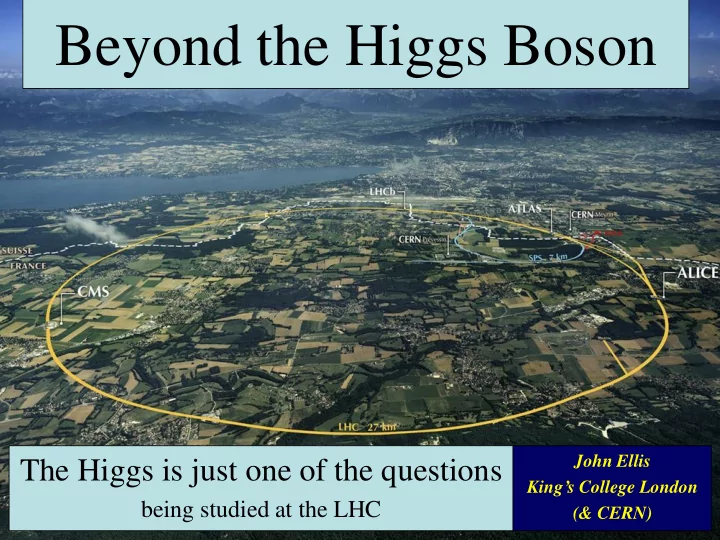
Beyond the Higgs Boson
The Higgs is just one of the questions
being studied at the LHC
John Ellis King’s College London (& CERN)
Beyond the Higgs Boson John Ellis The Higgs is just one of the - - PowerPoint PPT Presentation
Beyond the Higgs Boson John Ellis The Higgs is just one of the questions King s College London being studied at the LHC (& CERN) Beyond the Higgs Boson John Ellis The Higgs is just one of the questions King s College London being
The Higgs is just one of the questions
being studied at the LHC
John Ellis King’s College London (& CERN)
The Higgs is just one of the questions
being studied at the LHC
John Ellis King’s College London (& CERN)
The ‘Standard Model’ of Particle Physics
Proposed byAbdus Salam, Glashow and Weinberg Tested by experiments at CERN Perfect agreement between theory and experiments in all laboratories
The matter particles
The ‘Standard Model’
The fundamental interactions
Gravitation electromagnetism weak nuclear force strong nuclear force
= Cosmic DNA Where does mass come from?
Summary of the Standard Model
gauge interactions matter fermions Yukawa interactions Higgs potential Now direct evidence
Status of the Standard Model
accelerator data
(LEP et al) only if there is a ‘Higgs boson’
Higgs boson weighing < ~ 180 GeV
mass? flavour? unification?
Combining the Information from Direct Searches and Indirect Data
mH = 125 ± 10 GeV
Gfitter collaboration
Open Questions beyond the Standard Model
due to a Higgs boson?
LHC LHC LHC LHC LHC
At what Energy is the New Physics?
A lot accessible to the LHC Some accessible only via astrophysics & cosmology Dark matter Origin of mass
Where do the masses come from ?
Newton: Weight proportional to Mass Einstein: Energy related to Mass Neither explained origin of Mass
Are masses due to Higgs boson? (the physicists’ Holy Grail)
Think of a Snowfield
Skier moves fast: Like particle without mass e.g., photon = particle of light Snowshoer sinks into snow, moves slower: Like particle with mass e.g., electron Hiker sinks deep, moves very slowly: Particle with large mass The LHC will look for the snowflake: The Higgs Boson
Introduction
Standard Model Particles:
Years from Proposal to Discovery
The (NG)AEBHGHKMP Mechanism
The only one who mentioned a massive scalar boson
Nambu EB, GHK and Higgs
Spontaneous symmetry breaking: massless Nambu- Goldstone boson ‘eaten’ by gauge boson ‘eaten’ by gauge boson
Accompanied by massive particle
EB, GHK
A Phenomenological Profile
A Simulated Higgs Event @ LHC
Astronomers tell us that most of the matter in the universe is invisible We will look for it with the LHC
Dark Matter in the Universe
Astronomers say that most of the matter in the Universe is invisible Dark Matter ‘Supersymmetric’ particles ? We shall look for them with the LHC
Dark Matter in the Universe
Classic Dark Matter Signature
Missing transverse energy carried away by dark matter particles
General Interest in Antimatter Physics
Physicists cannot make enough for Star Trek or Dan Brown!
How do Matter and Antimatter Differ?
Dirac predicted the existence of antimatter: same mass
electric charge, … Discovered in cosmic rays Studied using accelerators Matter and antimatter not quite equal and opposite: WHY? Why does the Universe mainly contain matter, not antimatter?
Experiments at LHC and elsewhere looking for answers
How to Create the Matter in the Universe?
present in unified theories not yet seen by experiment
Possible in the decays of heavy particles
Sakharov Will we be able to calculate using laboratory data?
300,000 years 3 minutes 1 micro- second 1 pico- second Formation
Formation
Formation
& neutrons Appearance
Appearance
Appearance
… but he never succeeded
Unification via extra dimensions of space?
Unify all the Fundamental Interactions: Einstein’s Dream …
Would vanish instantly Eat up the entire Earth? Will LHC experiments create black holes?
The Large Hadron Collider (LHC)
Proton- Proton Collider 7 TeV + 7 TeV
1,000,000,000 collisions/second
Primary targets:
Also collisions of Lead ions
Vista General del LHC y sus Experimentos
27km in circumference ~ 100m deep
General View of LHC & its Experiments
ATLAS: Higgs and supersymmetry CMS: Higgs and supersymmetry ALICE: Primordial cosmic plasma LHCb: Matter-antimatter difference
Higgs Production at the LHC
A la recherche du Higgs perdu … Many production modes measurable if Mh ~ 125 GeV
– gluon + gluon → Higgs → γγ
Higgs Decay Branching Ratios
Many decay modes measurable if Mh ~ 125 GeV
Is the Higgs Boson finally being Revealed?
Mass Higgsteria
July 4th 2012 The discovery of a new particle
Unofficial Combination of Higgs Search Data from March 6th
Is this the Higgs Boson? No Higgs here! No Higgs here!
Theoretical Constraints on Higgs Mass
low-energy scale Λ due to renormalization
due to t quark drives quartic coupling < 0 at some scale Λ → vacuum unstable
Degrassi, Di Vita, Elias-Miro, Giudice, Isodori & Strumia, arXiv:1205.6497
Instability @ 1010 – 1013 GeV
Vacuum Instability in the Standard Model
lifetime >> age of the Universe
Degrassi, Di Vita, Elias-Miro, Giudice, Isodori & Strumia, arXiv:1205.6497
The Particle Higgsaw Puzzle
Is LHC finding the missing piece? Is it the right shape? Is it the right size?
Elementary Higgs or Composite?
<0|H|0> ≠ 0
condensate
superconductivity
needed mt > 200 GeV New technicolour force?
precision electroweak data? Cut-off Λ ~ 1 TeV with Supersymmetry?
e.g., cutoff Λ = 10 TeV
Higgs as a Pseudo-Goldstone Boson
Loop cancellation mechanism Supersymmetry Little Higgs ‘Little Higgs’ models (breakdown of larger symmetry)
Couplings resemble Higgs of Standard Model
the Standard Model predictions
JE & Tevong You, arXiv:1303.3879
Global Analysis of Higgs-like Models
JE & Tevong You, arXiv:1303.3879
b bbar τ τ γ γ W W Z Z Global
No evidence for deviation from SM
It Walks and Quacks like a Higgs
JE & Tevong You, arXiv:1303.3879
Global fit
[1] = JE & Tevong You, arXiv:1303.3879
Today we believe that “Beyond any reasonable doubt, it is a Higgs boson.” [1]
http://www.nobelprize.org/nobel_prizes/physics/laureates/2013/a dvanced-physicsprize2013.pdf
Without Higgs …
… there would be no atoms
– massless electrons would escape at the speed of light
… there would be no heavy nuclei … weak interactions would not be weak
– Life would be impossible: everything would be radioactive
Its existence is a big deal!
– Should be < 130 GeV in simple models
– Should be within few % of SM values
“Classic” missing-energy search
Multiple searches including b, leptons
p-value of simple models < 10%
2012
20/fb
Scan of CMSSM
Update of Buchmueller et al: arXiv:1207.3715
5
1
20/fb
2012
CMSSM
Favoured values of gluino mass significantly above pre-LHC, > 2 TeV
Update of Buchmueller, JE et al: arXiv:1207.3715
Gluino mass Reach of LHC at High luminosity
5
1
χ2
20/fb
2012
CMSSM
Favoured values of squark mass: ~ 2000 GeV or more
Update of Buchmueller, JE et al: arXiv:1207.3715
Squark mass Reach of LHC at High luminosity
A Vision for the 21st Century
350 GeV Circular e+e- collider 100 TeV proton-proton collider
Conversation with Mrs Thatcher: 1982
What do you do? Think of things for the experiments to look for, and hope they find something different Wouldn’t it be better if they found what you predicted? Then we would not learn so much!