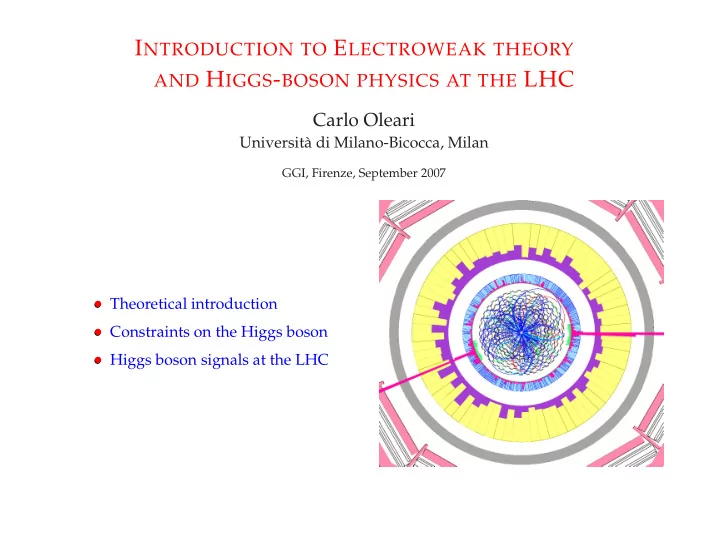
SLIDE 1 INTRODUCTION TO ELECTROWEAK THEORY
AND HIGGS-BOSON PHYSICS AT THE LHC
Carlo Oleari
Universit` a di Milano-Bicocca, Milan
GGI, Firenze, September 2007
- Theoretical introduction
- Constraints on the Higgs boson
- Higgs boson signals at the LHC
SLIDE 2 The Standard Model (SM)
- A quick introduction to non-Abelian gauge theories: many formulae but
they will look familiar! – QED – Yang-Mills theories – Electroweak interactions
- Spontaneous symmetry breaking and mass generation: the Higgs boson
- Theoretical bounds on the mass of the Higgs boson
- Experimental bounds on the mass of the Higgs boson
Exercise: Please, do the exercises! You will be given all the elements to solve them.
Carlo Oleari Introduction to EW theory and Higgs boson physics at the LHC 1
SLIDE 3 Abelian gauge theory: QED
We start with a Lagrangian (density)
L0 = ¯
ψ(x) (i∂ / − m) ψ(x) invariant under a GLOBAL U(1) symmetry (θ is constant) ψ(x)
→
eiqθψ(x) ∂µψ(x)
→
eiqθ∂µψ(x) From Noether’s theorem, there is a conserved current: Jµ(x) = q ¯ ψ(x)γµψ(x)
= ⇒
∂µ Jµ(x) = 0 To gauge this theory, we promote the GLOBAL U(1) symmetry to local symmetry: ψ(x)
→
eiqθ(x)ψ(x) ∂µψ(x)
→
eiqθ(x)∂µψ(x) + iqeiqθ(x)ψ(x)∂µθ(x)
Carlo Oleari Introduction to EW theory and Higgs boson physics at the LHC 2
SLIDE 4 Covariant derivative
Invent a new derivative Dµ such that ψ(x)
→
eiqθ(x)ψ(x) = U(x) ψ(x) Dµψ(x)
→
eiqθ(x)Dµψ(x) = U(x)Dµψ(x) i.e. both ψ(x) and Dµψ(x) transform the same way under the U(1) local symmetry Dµ ≡ ∂µ + iqAµ where Aµ transforms under the local gauge symmetry as Aµ → Aµ − ∂µθ(x) The commutator of the covariant derivatives gives the electric and the magnetic fields, i.e. the field strength tensor F
µν(x) = 1
iq [Dµ, Dν] = 1 iq [∂µ + iqAµ, ∂ν + iqAν] = ∂µAν(x) − ∂νAµ(x) F
µν is invariant under a gauge transformation.
Carlo Oleari Introduction to EW theory and Higgs boson physics at the LHC 3
SLIDE 5 From global to local symmetry
From
L0 = ¯
ψ(x) (i∂ / − m) ψ(x) invariant under GLOBAL U(1), to
L1 =
¯ ψ(x) (iD / − m)ψ(x)
=
¯ ψ(x) (i∂ / − m)ψ(x) − q ¯ ψ(x)γµψ(x)Aµ(x) invariant under LOCAL U(1) and interpret Aµ(x) as the photon field and Jµ = q ¯ ψγµψ as the electromagnetic current. The only missing ingredient is the kinetic term for the photon field
L2 = L1 − 1
4 F
µν(x)Fµν(x)
L2 cannot contain a term proportional to AµAµ (a mass term for the photon field) since this term
is not gauge invariant under the local U(1) Aµ → Aµ − ∂µθ(x)
Carlo Oleari Introduction to EW theory and Higgs boson physics at the LHC 4
SLIDE 6 Non-Abelian (Yang-Mills) gauge theories
The starting point is a Lagrangian of free or self-interacting fields, that is symmetric under a GLOBAL symmetry
Lψ(ψ, ∂µψ)
where ψ = ψ1 . . . ψn = multiplet of a compact Lie group G The Lagrangian is symmetric under the transformation ψ →ψ′ = U(θ)ψ U(θ) = exp(igTaθa) unitary matrix UU† = U†U = 1 If U is unitary, the Ta are hermitian, and are called group generators (they “generate” infinitesimal transformation around the unity U(θ) = 1 + igTaθa + O
If U ∈ SU(N) matrix (unitary and det U = 1), then there are N2 − 1 traceless, hermitian generators Ta = λa/2.
Exercise: Show this.
SLIDE 7 Gauging the symmetry
The generators satisfy the relation
= i f abcTc
and the f abc are called the structure functions of the group G. The starting hypothesis is that L is invariant under G
Lψ(ψ, ∂µψ) = Lψ(ψ′, ∂µψ′)
ψ′ = U(θ)ψ Gauging the symmetry means to allow the parameters θa to be function of the space-time coordinates θa →θa(x) so that =
⇒ U → U(x)
U(x) = 1 + igTaθa(x) + O
Carlo Oleari Introduction to EW theory and Higgs boson physics at the LHC 6
SLIDE 8 From ∂µ → Dµ
We obtain a LOCAL invariant Lagrangian if we make the substitution
Lψ(ψ, ∂µψ) → Lψ(ψ, Dµψ)
Dµ = ∂µ − igAa
µ(x)Ta ≡ ∂µ − igAµ(x)
with the transformation properties ψ(x)
→
U(x) ψ(x) =
Dµ
→
U(x)Dµψ(x) = U(x)DµU−1(x) U(x) ψ(x) i.e. the covariant derivative must transform as Dµ → U(x)DµU−1(x) implying Aa
µ → Aa µ + ∂µθa(x) + g f abcAb µθc + O(θ2)
We can build a kinetic term for the Aa
µ fields from
F
µν = Fa µν Ta = i
g [Dµ, Dν] with Fa
µν = ∂µAa ν − ∂νAa µ + g f abcAb µAc ν
which transforms homogeneously under a local gauge transformation F
µν → UF µνU−1
= ⇒
Fa
µνFµν a
≡ Tr F
µνFµν → Tr UF µνU−1 UFµνU−1 = Tr F µνFµν
where Fa
µνFµν a
is gauge invariant (Fa
µν in not singularly gauge-invariant).
SLIDE 9 The Lagrangian for gauge and matter field
Gauge invariant Yang-Mills (YM) Lagrangian for gauge and matter fields
LYM = −1
4 Fa
µνFµν a
+ Lψ(ψ, Dµψ)
where Dµ
=
∂µ − igAa
µTa
Fa
µν
=
∂µAa
ν − ∂νAa µ + g f abcAb µAc ν
=
i f abcTc
Carlo Oleari Introduction to EW theory and Higgs boson physics at the LHC 8
SLIDE 10 Remarks on Yang-Mills theories
µAµ a for the gauge bosons are NOT gauge invariant!
No mass term is allowed in the Lagrangian. Gauge bosons of (unbroken) YM theories are massless.
µνFµν a
=
ν − ∂νAa µ + g f abcAb µAc ν
a − ∂νAµ a + g fabcAµ b Aν c
Lagrangian, we have cubic and quartic gauge boson self interactions
- gauge invariance, Lorentz structure and renormalizability (absence of higher powers of
fields and covariant derivatives in L) determines gauge-boson/matter couplings and gauge-boson self interaction
- if G =SUc(N = 3) and the fermion are in triplets,
ψ = ψred ψblue ψgreen = ψ1 ψ2 ψ3 we have the QCD Lagrangian and N2 − 1 = 8 gauge bosons = gluons.
Exercise: Derive the form of the three- and four-gluon vertex starting from gauge invariance, Lorentz structure and renormalizability of the Lagrangian.
SLIDE 11 Electroweak sector
From experimental facts (charged currents couple only with left-handed fermions, the existence
- f a massless photon and a neutral Z. . . ), the electroweak group is chosen to be SU(2)L× U(1)Y.
ψL ≡ 1 2(1 − γ5)ψ ψR ≡ 1 2(1 + γ5)ψ ψ = ψL + ψR LL ≡ 1 2(1 − γ5) νe e = νeL eL νeR ≡ 1 2(1 + γ5)νe eR ≡ 1 2(1 + γ5)e
- SU(2)L: weak isospin group. Three generators =
⇒ three gauge bosons: W1, W2 and W3.
The generators for doublets are Ta = σa/2, where σa are the 3 Pauli matrices (when acting on the gauge singlet eR and νR, Ta ≡ 0), and they satisfy
= iǫabcσc.
The gauge coupling will be indicated with g.
- U(1)Y: weak hypercharge Y. One gauge boson B with gauge coupling g′.
One generator (charge) Y(ψ), whose value depends on the corresponding field.
SLIDE 12 Gauging the symmetry: fermionic Lagrangian
Following the gauging recipe (for one generation of leptons. Quarks work the same way)
Lψ = i ¯
LL D / LL + i ¯ νeR D / νeR + i ¯ eR D / eR where Dµ = ∂µ − igWµ
i Ti − ig′ Y(ψ)
2 Bµ Ti = σi 2
Ti = 0 i = 1, 2, 3
Lψ ≡ Lkin + LCC + LNC Lkin =
i ¯ LL ∂ / LL + i ¯ νeR ∂ / νeR + i ¯ eR ∂ / eR
LCC =
g W1
µ ¯
LL γµ σ1 2 LL + g W2
µ ¯
LL γµ σ2 2 LL = g
√
2 W+
µ ¯
LL γµ σ+ LL + g
√
2 W−
µ ¯
LL γµ σ− LL
=
g
√
2 W+
µ ¯
νL γµ eL + g
√
2 W−
µ ¯
eL γµ νL
LNC =
g 2 W3
µ [ ¯
νeL γµ νeL − ¯ eL γµ eL] + g′ 2 Bµ
νeL γµ νeL + ¯ eL γµ eL)
+Y(νeR) ¯
νeR γµ νeR + Y(eR) ¯ eR γµ eR
W±
µ =
1
√
2
µ ∓ iW2 µ
2
SLIDE 13 Electroweak unification
LNC =
g 2 W3
µ [ ¯
νeL γµ νeL − ¯ eL γµ eL] + g′ 2 Bµ
νeL γµ νeL + ¯ eL γµ eL)
+Y(νeR) ¯
νeR γµ νeR + Y(eR) ¯ eR γµ eR
µ nor Bµ can be interpreted as the photon field Aµ, since they couple to neutral fields.
Ψ ≡ νeL eL νeR eR
T3 ≡
1/2
−1/2
Y ≡
Y(L) Y(L) Y(νeR) Y(eR)
LNC = g ¯
Ψγµ T3 Ψ W3
µ + g′ ¯
Ψ γµ Y 2 Ψ Bµ
Carlo Oleari Introduction to EW theory and Higgs boson physics at the LHC 12
SLIDE 14 Weak mixing angle
We perform a rotation of an angle θW, the Weinberg angle, in the space of the two neutral gauge fields (W3
µ and Bµ). We use an orthogonal transformation in order to keep the kinetic terms
diagonal in the vector fields Bµ
=
Aµ cosθW − Zµ sinθW W3
µ
=
Aµ sinθW + Zµ cosθW so that
LNC = ¯
Ψγµ
Y
2
Ψγµ
Y
2
We can identify Aµ with the photon field provided eQ = g sinθW T3 + g′ cosθW
Y
2
Q = electromagnetic charge
The weak hypercharges Y appear only through the combination g′ Y. We use this freedom to fix Y(L) = −1
Carlo Oleari Introduction to EW theory and Higgs boson physics at the LHC 13
SLIDE 15 Weak mixing angle
With this choice, the doublet of left-handed leptons gives
- eQ = g sinθW T3 + g′ cosθW Y
2
g 2 sinθW − g′ 2 cosθW
−e = − g
2 sinθW − g′ 2 cosθW so that g sinθW = g′ cosθW = e and
Q = T3 + Y
2 Gell-Mann–Nishijima formula. From this formula we have Y(νeR) = 0 and Y(eR) = −2. Notice that the right-handed neutrino has zero charge, zero hypercharge and it is in a SU(2) singlet: it does not take part in electroweak interactions.
Exercise: Verify that, with the previous hypercharge assignments, one can generate the correct electromagnetic current.
Carlo Oleari Introduction to EW theory and Higgs boson physics at the LHC 14
SLIDE 16 The neutral current
LNC =
¯ Ψγµ
Y
2
Ψγµ
Y
2
=
e ¯ ΨγµQΨ Aµ + ¯ ΨγµQZΨ Zµ where QZ is a diagonal matrix given by
QZ =
e cosθW sinθW
Show this.
We can proceed, in a similar way, with quarks (see more later) Qi
L =
uL dL , cL sL , tL bL ui
R = uR, cR, tR
di
R = dR, sR, bR
Carlo Oleari Introduction to EW theory and Higgs boson physics at the LHC 15
SLIDE 17 Fermion fields of the SM and gauge quantum numbers
SU(3) SU(2) U(1)Y Q = T3 + Y
2
Qi
L =
uL dL cL sL tL bL 3 2
1 3 2 3
− 1
3
ui
R =
uR cR tR 3 1
4 3 2 3
di
R =
dR sR bR 3 1
− 2
3
− 1
3
Li
L =
νeL eL νµL µL ντL τL 1 2
−1 −1
ei
R =
eR µR τR 1 1
−2 −1
νi
R =
νeR νµR ντR 1 1
SLIDE 18 Electroweak gauge-boson sector
Gauge invariance and renormalizability completely determine the kinetic terms for the gauge bosons
LYM = −1
4 BµνBµν − 1 4Wa
µνWµν a
Bµν
=
∂µBν − ∂νBµ Wa
µν
=
∂µWa
ν − ∂νWa µ + gǫabc Wb,µ Wc,ν
The gauge symmetry does NOT allow any mass terms for W± and Z. Mass terms for gauge bosons
Lmass = 1
2 m2
A Aµ Aµ
are not invariant under a gauge transformation Aµ → U(x)
g ∂µ
However, the gauge bosons of weak interactions are massive (short range of weak interactions).
SLIDE 19 Symmetries and conservation laws
To any continuous symmetry of the Lagrangian we can associate a conservation law and a conserved current. Noether’s theorem: if, without using the equation of motion, one can show that the Lagrangian density changes by a total divergence under and infinitesimal transformation φ → φ + δφ ∼ φ + i δθ φ
jk φk
δL (φ, ∂φ) = δθ ∂µKµ δS = 0 then Jµ = δL δ ∂µφδφ − Kµ is conserved ∂µ Jµ = 0 Important consequences ✓ Q =
x, t) is conserved (dQ/dt = 0) and is a Lorentz scalar ✓ After canonical quantization, i δθ [Q,φ] = δφ, hence Q generates the symmetry acting on the fields
SLIDE 20 Symmetries in quantum field theories
Two ways of realizing symmetries in a QFT. Suppose we have a charge Q (obtained from Noether’s theorem) that commutes with the Hamiltonian [Q, H] = 0. Then
[Q, H] = 0
Q|0 = 0 The spectrum falls in explicit multiplets of the symmetry group (the vacuum |0 is the state
- f lowest energy)
- Nambu–Goldstone
[Q, H] = 0
Q|0 = 0 The symmetry is not manifest in the spectrum. There is a third way too: the anomalous symmetries. In this case, the classical theory respects the symmetry, that is violated by quantum fluctuations ∂µ Jµ = 0 + O(¯ h) As we have stressed up to now, another important distinction is between global and local symmetries.
SLIDE 21 Spontaneous symmetry breaking
A symmetry is said to be spontaneously broken when the vacuum state is not invariant exp (i δθ a ta) |0 = |0
= ⇒
Qa|0 = 0 This condition is equivalent to the existence of some set of fields operators φk with non-trivial transformation property under that symmetry transformation, and non-vanishing vacuum expectation values
0|φk|0 = vk = 0
Proof If the set of fields φj transforms non-trivially φj →
jk φk ∼ φj + i δθ a ta jk φk
= φj + i δθa
Qa,φj
- Taking the expectation value on the vacuum
ta
jk 0|φk|0 = 0|
|0= 0
⇐ ⇒
Qa|0 = 0
Carlo Oleari Introduction to EW theory and Higgs boson physics at the LHC 20
SLIDE 22 Spontaneous symmetry breaking
Observations
- Experimentally, the space is isotropic, so φk must be a scalar, otherwise its
vacuum expectation value would be frame-dependent.
- Experimentally, the space is homogeneous, so that 0|φk|0 is a constant.
In fact, if the vacuum state is invariant under translations
0|φk(x)|0 = 0|eiPx φk(0)e−iPx|0 = 0|φk(0)|0
- φk is not necessarily an elementary field
Carlo Oleari Introduction to EW theory and Higgs boson physics at the LHC 21
SLIDE 23 Spontaneous symmetry breaking in the SM
✓ Experimentally, the weak bosons have masses. ✓ The only way to introduce masses for the W and Z vector bosons, without spoiling unitarity and renormalizability, is spontaneous breaking of the gauge symmetry. ✓ The simplest way is through the (minimal) Higgs mechanism.
Carlo Oleari Introduction to EW theory and Higgs boson physics at the LHC 22
SLIDE 24 Spontaneous symmetry breaking in the SM
We give mass to the gauge bosons through the Higgs mechanism: generate mass terms from the kinetic energy term of a scalar doublet field Φ that undergoes a broken-symmetry process. Introduce a complex scalar doublet: four scalar real fields (why will become clear later) Φ
=
φ+ φ0 , Y(Φ) = 1
LHiggs = (DµΦ)†(DµΦ) − V
=
∂µ − igWµ
i
σi 2 − ig′ Y(Φ) 2 Bµ V
−µ2Φ†Φ + λ
2 , µ2, λ > 0 Notice the “wrong” mass sign.
) V(|Φ
+|
Φ | , | | Φ
+
| Φ
0|
| µ <0
2
µ>0
2
v/ 2
V
- Φ†Φ
- is SU(2)L×U(1)Y symmetric.
- The reason why Y(Φ) = 1 is not to break electric-charge conservation.
- Charge assignment for the Higgs doublets is done according to Q = T3 + Y/2.
SLIDE 25 Spontaneous symmetry breaking
The potential has a minimum in correspondence of
|Φ|2 = µ2
2λ ≡ v2 2 All these minimum configurations (ground states) are connected by gauge transformations, that change the phase of the complex field Φ, without affecting its modulus. v is called the vacuum expectation value (VEV) of the neutral component of the Higgs doublet. When the system chooses one of the minimum configura- tions, this configuration is no longer symmetric under the the gauge symmetry. This is called spontaneous symmetry breaking. The Lagrangian is still gauge invariant and all the prop- erties connected with that (such that current conservation) are still there!
6 q ) V ( )
SLIDE 26 Expanding Φ around the minimum Φ = φ+ φ0 = φ+
1
√
2 [v + H(x) + iχ(x)]
= 1
√
2 exp iσiθi(x) v v + H(x) We can rotate away the fields θi(x) by an SU(2)L gauge transformation Φ(x) → Φ′(x) = U(x)Φ(x) = 1
√
2 v + H(x) where U(x) = exp
v
This gauge choice is called unitary gauge, and is equivalent to absorbing the Goldstone modes θi(x). Three would-be Goldstone bosons “eaten up” by three vector bosons (W±, Z) that acquire
- mass. This is why we introduced a complex scalar doublet (four elementary fields).
The vacuum state can be chosen to correspond to the vacuum expectation value Φ0 = 1
√
2 0 v
Carlo Oleari Introduction to EW theory and Higgs boson physics at the LHC 25
SLIDE 27 SU(2)L× U(1)Y → U(1)em
We can easily verify that the vacuum state breaks the gauge symmetry. A state ˜ Φ is invariant under a symmetry operation exp(igTaθa) if exp(igTaθa) ˜ Φ = ˜ Φ This means that a state is invariant if (just expand the exponent) Ta ˜ Φ = 0 For the SU(2)L× U(1)Y case we have σ1Φ0
=
0 1 1 v/
√
2 = v/
√
2 = 0 broken σ2Φ0
=
0
−i
i v/
√
2 = −iv/
√
2 = 0 broken
Carlo Oleari Introduction to EW theory and Higgs boson physics at the LHC 26
SLIDE 28 SU(2)L× U(1)Y → U(1)em
σ3Φ0
=
1
−1
v/
√
2 =
−v/ √
2 = 0 broken YΦ0
=
Y(Φ) v/
√
2 = +1 v/
√
2 = 0 broken But, if we examine the effect of the electric charge operator ˆ Q = Y/2 + T3 on the (electrically neutral) vacuum state, we have (Y(Φ) = 1) ˆ QΦ0 = 1 2 (σ3 + Y) Φ0 = 1 2 Y(Φ) + 1 Y(Φ) − 1 Φ0 = 1 v/
√
2 = 0 the electric charge symmetry is unbroken!
Carlo Oleari Introduction to EW theory and Higgs boson physics at the LHC 27
SLIDE 29 Consequences for the scalar field H
The scalar potential V
2 expanded around the vacuum state Φ(x) = 1
√
2 v + H(x) becomes V = 1 2
H2 + λvH3 + λ 4 H4 − λ 4 v4
- the scalar field H gets a mass
m2
H = 2λv2
- there is a term of cubic and quartic self-coupling.
- a constant term: the cosmological constant (irrelevant in the Standard Model)
ρH ≡ λ 4 v4 = v2m2
H
8
SLIDE 30 Cosmological constant
Up to now, we don’t have a theory of gravitation. Gravitational interactions are commonly introduced by replacing ∂µ by an appropriate derivative Dµ, containing the gravitation field gµν ≡ ηµν +κhµν ηµν ≡
1
−1 −1 −1
Furthermore, the Lagrangian must be given the overall factor
- − det(gµν). At this point, the
addition of a constant to the Lagrangian is of physical consequence. The coefficient of the term that contains no other field dependence other than
cosmological constant. Rµν − 1 2 gµνR + Cgµν = −8πGNTµν where Rµν is the curvature tensor, and Tµν is the energy-matter tensor. A non-zero value implies that a curved Universe in the absence of energy-matter. The cosmological constant defines the curvature of the vacuum.
Carlo Oleari Introduction to EW theory and Higgs boson physics at the LHC 29
SLIDE 31 Cosmological constant
Experimentally the Universe is known to be very flat, with a very tiny vacuum energy density ρvac ≤ 10−46 GeV4 Inserting the current experimental lower bound for the Higgs boson mass, mH ≥ 114 GeV, and the value of v = 246.22 GeV (see more later), we find ρH ≥ 108 GeV4 some 54 order of magnitude larger than the upper bound inferred from the cosmological constant! The smallness of the cosmological constant needs to be explained. Either we must find a separate principle to zero the vacuum energy density of the Higgs field, or we may suppose that a proper quantum theory of gravity, in combination with the other interactions, will resolve the puzzle of the cosmological constant. The vacuum energy problem must be an important clue. But to what?
Carlo Oleari Introduction to EW theory and Higgs boson physics at the LHC 30
SLIDE 32 Kinetic terms
DµΦ
=
i
σi 2 − ig′ 1 2 Bµ 1
√
2 v + H(x)
=
1
√
2 ∂µH − i 2
√
2 g Wµ
3
Wµ
1 − iWµ 2
Wµ
1 + iWµ 2
−Wµ
3
+ g′Bµ v + H
=
1
√
2 ∂µH − i 2(v + H) g
1 − iWµ 2
3 + g′Bµ
=
1
√
2 ∂µH − i 2
v gvWµ+
−v
(DµΦ)† DµΦ = 1
2∂µH∂µH + gv 2 2 Wµ+W−
µ + 1
2
v2 4 ZµZµ 1 + H v 2
Exercise: Show this.
SLIDE 33 Consequences
- The W and Z gauge bosons have acquired masses
m2
W = g2v2
4 m2
Z =
v2 4
=
m2
W
cos2 θW From the measured value of the Fermi constant GF GF
√
2
=
2
√
2 2 1 m2
W
= ⇒
v =
√
2GF
≈ 246.22 GeV
- the photon stays massless
- HWW and HZZ couplings from 2H/v term (and HHWW and HHZZ couplings from H2/v2
term)
LHVV = 2m2
W
v W+
µ W−µH + m2 Z
v ZµZµH ≡ gmwW+
µ W−µH + 1
2 gmZ cosθW ZµZµH Higgs coupling proportional to mass
- tree-level HVV (V = vector boson) coupling requires VEV!
Normal scalar couplings give Φ†ΦV or Φ†ΦVV couplings only.
SLIDE 34
Fermion mass generation
A direct mass term is not invariant under SU(2)L or U(1)Y gauge transformation m f ¯ ψψ = m f ( ¯ ψRψL + ¯ ψLψR) Generate fermion masses through Yukawa-type interactions terms
LYukawa = −Γ ij
d ¯
Q′ i
L Φd′ j R − Γ ij∗ d
¯ d′ i
RΦ†Q′ j L
−Γ ij
u ¯
Q′ i
L Φcu′ j R + h.c.
−Γ ij
e ¯
Li
LΦej R + h.c.
−Γ ij
ν ¯
Li
LΦcν j R + h.c.
Φc = iσ2Φ∗ = 1
√
2 v + H(x) where Q′, u′ and d′ are quark fields that are generic linear combination of the mass eigenstates u and d and Γu, Γd and Γe are 3 × 3 complex matrices in generation space, spanned by the indices i and j.
LYukawa is Lorentz invariant, gauge invariant and renormalizable, and therefore it can (actually it
must) be included in the Lagrangian. Notice: neutrino masses can be implemented via the Γν term. Since mν ≈ 0, we neglect it.
SLIDE 35 Expanding around the vacuum state
In the unitary gauge we have ¯ Q′ i
L Φ d′ j R
=
u′ i
L
¯ d′ i
L
v+H
√
2
d′ j
R = v + H
√
2 ¯ d′ i
L d′ j R
¯ Q′ i
L Φc u′ j R
=
u′ i
L
¯ d′ i
L
v+H
√
2
u′ j
R = v + H
√
2 ¯ u′ i
L u′ j R
and we obtain
LYukawa = −Γ ij
d
v + H
√
2 ¯ d′ i
L d′ j R − Γ ij u
v + H
√
2 ¯ u′ i
L u′ j R − Γ ij e
v + H
√
2 ¯ ei
L ej R + h.c.
= −
u ¯
u′ i
L u′ j R + Mij d ¯
d′ i
L d′ j R + Mij e ¯
ei
L ej R + h.c.
1 + H v
√
2
Carlo Oleari Introduction to EW theory and Higgs boson physics at the LHC 34
SLIDE 36 A little help from linear algebra
Theorem: For any generic complex squared matrix C, there exist two unitary matrices U, V such that D = U† C V is diagonal with real positive entries
Carlo Oleari Introduction to EW theory and Higgs boson physics at the LHC 35
SLIDE 37 Diagonalizing Mf
Using the previous theorem, we know that we can diagonalize the matrix Mf (f = u, d, e) with the help of two unitary matrices, U f
L and U f R
L
† Mf U f
R = diagonal with real positive entries
For example:
(Uu
L)† Mu Uu R =
mu mc mt
L
† Md Ud
R =
md ms mb
Carlo Oleari Introduction to EW theory and Higgs boson physics at the LHC 36
SLIDE 38 Mass terms
We can make the following change of fermionic fields f ′
Li =
L
f ′
Ri =
R
LYukawa = − ∑
f ′,i,j
¯ f ′ i
L Mij f f ′ j R
v
= − ∑
f ,i,j
¯ f i
L
L
† Mf U f
R
f j
R
v
= −∑
f
m f ¯ fL fR + ¯ fR fL 1 + H v
- We succeed in producing fermion masses and we got a fermion-antifermion-Higgs coupling
proportional to the fermion mass.
- Notice that the fermionic field redefinition preserves the form of the kinetic terms in the
Lagrangian ( ¯ ψ / ∂ ψ = ¯ ψR / ∂ ψR + ¯ ψL / ∂ ψL invariant for left and right field unitary transformation).
- The Higgs Yukawa couplings are flavor diagonal: no flavor changing Higgs interactions.
SLIDE 39 Mass diagonalization and charged current interaction
The charged current interaction is given by e
√
2 sinθW ¯ u′ i
L /
W+ d′ i
L + h.c.
After the mass diagonalization described previously, this term becomes e
√
2 sinθW ¯ ui
L
L)† Ud L
W+dj
L + h.c.
and we define the Cabibbo-Kobayashi-Maskawa matrix VCKM VCKM = (Uu
L)† Ud L
- VCKM is a complex not diagonal matrix and then it mixes the flavors of the different quarks.
- For N flavour families, VCKM depends on (N − 1)2 parameters. (N − 1)(N − 2)/2 of them
are complex phases. For N = 3 there is one complex phase and this implies violation of the CP symmetry (first observed in the K0- ¯ K0 system in 1964).
- It is a unitary matrix and the values of its entries must be determined from experiments.
Carlo Oleari Introduction to EW theory and Higgs boson physics at the LHC 38
SLIDE 40 Feynman rules for Higgs couplings
H f f
−i
m f v
H Wµ
+
Wν
H Zµ Zν
i g
1 cosθW mZ gµν
Within the Standard Model, the Higgs couplings are almost completely constrained. The only free parameter (not yet measured) is the Higgs mass m2
H = 2λv2
SLIDE 41 Constraints on the Higgs boson mass
We have found that the Higgs boson mass is related to the value of the quartic Higgs coupling λ
LHiggs = (DµΦ)†(DµΦ) − V
- Φ†Φ
- V
- Φ†Φ
- = −µ2Φ†Φ + λ
- Φ†Φ
2 leads to m2
H = 2λv2
So far we have measured neither mH nor λ
= ⇒
no direct experimental information. This raises several questions
- Can we get rid of the Higgs boson by setting mH = ∞ and λ = ∞? Can we eliminate the
Higgs boson from the SM?
- Does consistency of the SM as a renormalizable field theory provide constraints?
- Is there indirect information on mH, e.g. from precision observables and loop effects?
Carlo Oleari Introduction to EW theory and Higgs boson physics at the LHC 40
SLIDE 42 The perturbative unitary bound
A very severe constraint on the Higgs boson mass comes from unitarity of the scattering amplitude. unitarity ⇐
⇒ probability
and probability is the link between the theoretical calculations and reality! Considering the elastic scattering of longitudinally polarized Z bosons ZLZL → ZLZL
M = −m2
H
v2
s − m2
H
+
t t − m2
H
+
u u − m2
H
Z limit
where s, t and u are the usual Mandelstam variables. The perturbative unitary bound on the J = 0 partial amplitude takes the form
|M0|2 =
16π m2
H
v2 2
< 1 = ⇒
mH <
3 v ≈ 1 TeV More restrictive bounds (∼ 800 GeV) are obtained with other scattering processes, such as ZLWL → ZLWL
SLIDE 43 The perturbative unitary bound
If the bound is respected, weak interactions remain weak at all energies, and perturbation theory is everywhere reliable. If the bound is violated, perturbation theory breaks down, and weak interactions among W±, Z and H become strong on the 1 TeV scale.
Carlo Oleari Introduction to EW theory and Higgs boson physics at the LHC 42
SLIDE 44 Running of λ
The one-loop renormalization group equation (RGE) for λ(µ) is dλ(µ) d logµ2 = 1 16π2
8 g4 + 3 16
−3h4
t − 3λg2 − 3
2λ
+ 6λh2
t
mt = htv
√
2 m2
H = 2λv2
This equation must be solved together with the one-loop RGEs for the gauge and Yukawa couplings, which, in the Standard Model, are given by
dg(µ) d logµ2
=
1 32π2
6 g3
d logµ2
=
1 32π2 41 6 g′3 dgs(µ) d logµ2
=
1 32π2
s
d logµ2
=
1 32π2 9 2 h3
t −
s + 9
4 g2 + 17 12 g′2
- ht
- here gs is the strong interaction coupling constant, and the MS scheme is adopted.
SLIDE 45
Solutions for λ(µ)
Solving this system of coupled equations with the initial condition λ (mH) = m2
H
2v2
SLIDE 46 Lower bound for mH: vacuum stability
It can be shown that the requirement that the Higgs potential be bounded from below, even after the inclusion of radiative corrections, is fulfilled if λ(µ) stays positive, at least up to a certain scale µ ≈ Λ, the maximum energy scale at which the theory can be considered reliable (use effective action). ✗ This limit is extremely sensitive to the top-quark mass. ✓ The stability lower bound can be relaxed by allowing metastability
Carlo Oleari Introduction to EW theory and Higgs boson physics at the LHC 45
SLIDE 47 Upper bound for mH: triviality bound
For large values of the Higgs boson mass, the coupling λ(µ) grows with increasing µ, and eventually leaves the perturbative domain (λ <
∼ 1): the solution has a singular-
ity in µ , known as the Landau singularity. For the theory to make sense up to a scale Λ, we must ask λ(µ) <
∼ 1 (or something similar), for µ ≤ Λ.
Neglecting gauge and Yukawa coupling, we have λ(µ2) = λ(m2
H)
1 −
3 4π2 λ(m2 H) log µ2 m2
H
singular when µ2 ≈ Λ2
L ≡ m2 H exp
3λ
H
H
has an upper scale Λ of validity.
- Λ → ∞ for pure scalar theory pos-
sible only if λ(m2
H) ≡ 0, i.e. no
scalar self-coupling
= ⇒
free or “trivial” theory
SLIDE 48
Higgs boson mass bounds
Riesselmann, hep-ph/9711456
Notice the small window 150 GeV < mH < 180 GeV, where the theory is valid up to the Planck scale MPlanck = (¯ hc/GNewton)1/2 ≈ 1.22 × 10¹⁹ GeV.
SLIDE 49 Hierarchy, naturalness and fine tuning
Apart from the considerations made up to now, the SM must be considered as an effective low-energy theory: at very high energy new phenomena take place that are not described by the SM (gravitation is an obvious example) =
⇒ other scales have to be considered.
Why the weak scale (∼ 102 GeV) is much smaller than other relevant scales, such as the Planck mass (≈ 1019 GeV) or the unification scale (≈ 1016 GeV) (or why the Planck scale is so high with respect to the weak scale =
⇒ extra dimensions)?
This is the hierarchy problem. And this problem is especially difficult to solve in the SM because of the un-naturalness of the Higgs boson mass. As we have seen and as the experimental data suggest, the Higgs boson mass is of the same
- rder of the weak scale. However, it’s not naturally small, in the sense that there is no
approximate symmetry that prevent it from receiving large radiative corrections. As a consequence, it naturally tends to become as heavy as the heaviest degree of freedom in the underlying theory (Planck mass, unification scale).
Carlo Oleari Introduction to EW theory and Higgs boson physics at the LHC 48
SLIDE 50 Toy model
Two scalars interacting through the potential V(ϕ, Φ) = m2 2 ϕ2 + M2 2 Φ2 + λ 4!ϕ4 + σ 4!Φ4 + δ 4ϕ2Φ2 which is the most general renormalizable potential, if we require the symmetry under ϕ → −ϕ and Φ → − Φ. We assume that M2 ≫ m2. Let’s check if this hierarchy is conserved at the quantum level. Compute the one-loop radiative corrections to the pole mass m2 m2
pole = m2(µ2) + λm2
32π2
µ2 − 1
32π2
µ2 − 1
- where the running mass m2(µ2) obeys the RGE
dm2(µ2) d logµ2 = 1 32π2
Corrections to m2 proportional to M2 appear at one loop. One can choose µ2 ≈ M2 to get rid of them, but they reappear through the running of m2(µ2).
Carlo Oleari Introduction to EW theory and Higgs boson physics at the LHC 49
SLIDE 51 Toy model, cont’d
The only way to preserve the hierarchy m2 ≪ M2 is carefully choosing the coupling constants λm2 ≈ δM2 and this requires fixing the renormalized coupling constants with and unnaturally high accuracy λ δ ≈ m2 M2 This is what is usually called the fine tuning of the parameters. The same happens if the theory is spontaneously broken (m2 < 0, M2 ≫ |m2| > 0). Therefore, without a suitable fine tuning of the parameters, the mass of the scalar Higgs boson naturally becomes as large as the largest energy scale in the theory. And this is related to the fact that no extra symmetry is recovered when the scalar masses vanish, in contrast to what happens to fermions, where the chiral symmetry prevents the dependence from powers of higher scales, and gives a typical logarithmic dependence.
Carlo Oleari Introduction to EW theory and Higgs boson physics at the LHC 50
SLIDE 52 Solutions to the naturalness problem?
Leaving the toy model and back to the Standard Model, the corrections to m2
H due to a top-quark
loop is given by δm2
H = 3GFm2 t
√
2π2 Λ2 ≈ (0.27Λ)2 where we are assuming that the scale Λ that characterizes non-standard physics acts as a cut-off for the loop momentum. So, how can we prevent these large corrections to the Higgs boson mass?
- SUperSYmmetry offers a solution to the naturalness problem: exploiting the fact that
fermion loops contribute with an overall minus sign (because of Fermi statistics), SUSY balances the contributions of fermion and boson loops. In the limit of unbroken SUSY, in which the masses of bosons are degenerate with those of their fermion counterparts, the cancellation is exact. If the supersymmetry is broken (as it must be in our world), the contribution of the integrals may still be acceptably small if the fermion-boson mass splittings ∆M are not too large. The condition that g2∆M2 be “small enough” leads to the requirement that superpartner masses be less than about 1 TeV.
SLIDE 53 Solutions to the naturalness problem?
- A second solution is offered by theories of dynamical symmetry breaking
such as technicolor. In technicolor models, the Higgs boson is compos- ite, and new physics arises on the scale of its binding, ΛTC ≃ O (1 TeV). Thus the effective range of integration is cut off, and mass shifts are under control.
- A third possibility is that the gauge sector becomes strongly interacting.
This would give rise to WW resonances, multiple production of gauge bosons, and other new phenomena at energies of 1 TeV or so.
Carlo Oleari Introduction to EW theory and Higgs boson physics at the LHC 52
SLIDE 54 Constraints from precision data
α
=
1 4π g2g′2 g2 + g′2 = 1 137.03599976(50) GF
=
1
√
2v2 = 1.16637(1) × 10−5 GeV−2 mZ
=
1 2
- g2 + g′2 v = 91.1875(21) GeV ,
where the uncertainty is given in parentheses. The value of α is extracted from low-energy experiments, GF is extracted from the muon lifetime, and mZ is measured from e+e− annihilation near the Z mass. We can express mW as m2
W =
1 sin2 θW πα
√
2GF where sin2 θW = 1 − m2
W
m2
Z
Carlo Oleari Introduction to EW theory and Higgs boson physics at the LHC 53
SLIDE 55 Clues to the Higgs boson mass
From the sensitivity of electroweak observables to the mass of the top quark, we are able to measure its mass, even without directly producing it
W W t b Z Z t t
These quantum corrections alter the link between W and Z boson masses m2
W =
1 sin2 θW (1 − ∆ρ) πα
√
2GF ∆ρ(top) ≈ − 3GF 8π2√ 2 1 tan2 θW m2
t
The strong dependence on m2
t accounts for the precision of the top-quark mass estimates derived
from electroweak observables.
Carlo Oleari Introduction to EW theory and Higgs boson physics at the LHC 54
SLIDE 56 The Higgs boson quantum corrections are typically smaller than the top-quark corrections, and exhibit a more subtle dependence on mH than the m2
t dependence of the top-quark corrections.
H + H
∆ρ(Higgs) = 11GFm2
Z cos2 θW
24
√
2π2 log
H
m2
W
- Since mZ has been determined at LEP to 23 ppm, it is interesting to examine the dependence of
mW upon mt and mH. Indirect measurements of mW and mt (solid line) Direct measurements of mW and mt (dotted line) mt = 170.9 ± 1.8 GeV mW = 80.398 ± 0.025 GeV both shown as one-standard-deviation regions.
80.3 80.4 80.5 150 175 200 mH [GeV] 114 300 1000
mt [GeV] mW [GeV]
68% CL ∆α LEP1 and SLD LEP2 and Tevatron (prel.)
The indirect and direct determinations are in reasonable agreement and both favor a light Higgs boson, within the framework of the SM.
SLIDE 57 Summary of EW precision data
Measurement Fit |Omeas−Ofit|/σmeas
1 2 3 1 2 3
∆αhad(mZ) ∆α(5) 0.02758 ± 0.00035 0.02768 mZ [GeV] mZ [GeV] 91.1875 ± 0.0021 91.1875 ΓZ [GeV] ΓZ [GeV] 2.4952 ± 0.0023 2.4957 σhad [nb] σ0 41.540 ± 0.037 41.477 Rl Rl 20.767 ± 0.025 20.744 Afb A0,l 0.01714 ± 0.00095 0.01645 Al(Pτ) Al(Pτ) 0.1465 ± 0.0032 0.1481 Rb Rb 0.21629 ± 0.00066 0.21586 Rc Rc 0.1721 ± 0.0030 0.1722 Afb A0,b 0.0992 ± 0.0016 0.1038 Afb A0,c 0.0707 ± 0.0035 0.0742 Ab Ab 0.923 ± 0.020 0.935 Ac Ac 0.670 ± 0.027 0.668 Al(SLD) Al(SLD) 0.1513 ± 0.0021 0.1481 sin2θeff sin2θlept(Qfb) 0.2324 ± 0.0012 0.2314 mW [GeV] mW [GeV] 80.398 ± 0.025 80.374 ΓW [GeV] ΓW [GeV] 2.140 ± 0.060 2.091 mt [GeV] mt [GeV] 170.9 ± 1.8 171.3
Better estimates of the SM Higgs boson mass are obtained by combining all available data. Summary of electroweak precision measure- ments (status winter 2007) are given on LEP- EWWG page http://lepewwg.web.cern.ch/LEPEWWG
Exercise: Derive the slope of the lines of constant Higgs mass of the previous slide and compare numerically with the plot.
SLIDE 58 Blue band plot
The indication for a light Higgs boson becomes somewhat stronger when all the electroweak ob- servables are examined. mH = 76+33
−24 GeV
Including theory uncertainty mH < 144 GeV
(95%CL)
Direct search limit from LEP mH > 114.4 GeV
(95%CL)
But the χ2 of the fit is very bad! χ2/dof
=
25.4/15 χ2/dof
=
16.8/14 without NuTeV 1 2 3 4 5 6 100 30 300
mH [GeV] ∆χ2
Excluded
Preliminary
∆αhad = ∆α(5)
0.02758±0.00035 0.02749±0.00012
Theory uncertainty
mLimit = 144 GeV
SLIDE 59 Up to now. . .
Peter W. Higgs, University of Edinburgh
⇐ =
Only unambiguous example of
(D. Froidevaux, HCP School, 2007)
SLIDE 60 Final remarks
The Standard Model is not the whole story Open questions ✗ gravity ✗ neutrino masses and oscillations (heavy sterile neutrinos + see-saw mechanism) ✗ dark matter/dark energy ✗ baryogenesis
Carlo Oleari Introduction to EW theory and Higgs boson physics at the LHC 59
SLIDE 61 Higgs boson at the LHC
Two steps
- Production of the Higgs boson
- Detection of the decay products of the Higgs
boson and identification of the events
SLIDE 62 Production Modes
g p t H p X X p V H p V q q
Gluon fusion Weak-Boson Fusion
V p H q p _ q p H _ p t t
Higgs Strahlung t¯ tH
Carlo Oleari Introduction to EW theory and Higgs boson physics at the LHC 61
SLIDE 63 Total cross sections at the LHC
σ(pp → H + X) [pb]
√s = 14 TeV
NLO / NNLO MRST
gg → H (NNLO) qq → Hqq qq
_' → HW
qq
_ → HZ
gg/qq
_ → tt _H (NLO)
MH [GeV]
10
10
10
10
1 10 10 2 100 200 300 400 500 600 700 800 900 1000
[Kr¨ amer (’02)]
t t t H
q q V H V
W q H q _ , Z q t _ t q _ H
SLIDE 64 Branching fractions of the SM Higgs
H W+,Z,t,b...τ+,g,γ W-,Z,t,b...τ-,g,γ
100 10
–5
10
–4
10
–3
10
–2
10
–1
10 bb τ τ gg Z Z
0Z 0
W
+ + –
µ µ γ γ γ
+ –
W
–
ss cc t t 150 200 250 Higgs Mass (GeV) Branching Ratio 300 350 400 [hep-ex/0106056] Exercise: compute, at leading order, Γ(H → f ¯ f) and Γ(H → VV). More challenging (one-loop integral) Γ(H → gg) and Γ(H → γγ). [Spira (hep-ph/9705337)]
SLIDE 65 Total decay width
Γ(H) [GeV] MH [GeV] 50 100 200 500 1000 10
10
10
1 10 10 2
[Spira and Zerwas]
Carlo Oleari Introduction to EW theory and Higgs boson physics at the LHC 64
SLIDE 66 Inclusive search channels
H → γγ invariant-mass peak, for mH < 150 GeV
H → ZZ∗ → ℓ+ℓ−ℓ+ℓ− for mH ≥ 130 GeV and mH = 2mW.
H → W+W− → ℓ+ ¯ νℓ−ν for 140 GeV ≤ mH ≤ 200 GeV
Carlo Oleari Introduction to EW theory and Higgs boson physics at the LHC 65
SLIDE 67 H →γγ
H g g γ γ W/t t
✗ BR(H →γγ) ≈ 10−3 ✗ large backgrounds from q ¯ q → γγ and gg →γγ ✓ but CMS and ATLAS will have excellent photon-energy resolution (order of 1%) Look for two isolated photons.
Carlo Oleari Introduction to EW theory and Higgs boson physics at the LHC 66
SLIDE 68 H →γγ
✓ σγj ∼106σγγ with large uncertainties ✓ we can at most misidentify 1 jet in 103 ✓ we need an efficiency ǫγ ∼ 80% to get σγj+jj ≪ σγγ
Carlo Oleari Introduction to EW theory and Higgs boson physics at the LHC 67
SLIDE 69 H →γγ
✓ Look for a narrow γγ invariant mass peak ✓ extrapolate background into the signal region from sidebands.
Carlo Oleari Introduction to EW theory and Higgs boson physics at the LHC 68
SLIDE 70
✓ 1 fb−1 ✓ cut-based analysis ✓ discovery with less than 30 fb−1 ✓ assumes ECAL intercalibration, for which 10 fb−1 are needed ✓ optimized analysis: assumes perfect under- standing of detector. Uses Neural Net
CMS PTDR
SLIDE 71 H → ZZ → ℓ+ℓ−ℓ+ℓ−
The gold-plated mode
H g g l+ l- l+ l- Z Z
✓ This is the most important and clean search mode for 2mZ < mH < 600 GeV. ✓ continuum, limited, irreducible back- ground from q ¯ q → ZZ ✗ small BR(H → ℓ+ℓ−ℓ+ℓ−) ≈ 0.15% (even smaller when mH < 2mZ)
Carlo Oleari Introduction to EW theory and Higgs boson physics at the LHC 70
SLIDE 72 H → ZZ → ℓ+ℓ−ℓ+ℓ−
✓ invariant mass of the charged leptons fully reconstructed
m4e (GeV/c2) 100 110 120 130 140 150 160 170 180 190 200 Events for 100 fb-1 / 2 GeV/c2 5 10 15 20 25
H → ZZ* → 4e CMS, 100 fb-1
mH = 130 GeV/c2 mH = 150 GeV/c2 mH = 170 GeV/c2 b + Zb t ZZ* + t
For mH ≈ 0.6-1 TeV, use the “silver-plated” mode H → ZZ → ν ¯ νℓ+ℓ− ✓ BR(H → ν ¯ νℓ+ℓ−) = 6 BR(H → ℓ+ℓ−ℓ+ℓ−) ✓ the large ET missing allows a measurement of the transverse mass
Carlo Oleari Introduction to EW theory and Higgs boson physics at the LHC 71
SLIDE 73
H → ZZ →µ+µ−µ+µ−
with 30 fb−1 ✓ mH measured with 0.1 ÷ 5% precision ✓ production cross section known at 30% precision
SLIDE 74 H → WW → ℓ+ ¯ νℓ−ν
H g g ν l- l+ ν W- W+
✓ No reconstruction of clear mass peak. Measure the transverse mass with a Jaco- bian peak at mH mT =
T /
ET (1 − cos (∆Φ)) ✓ Exploit ℓ+ℓ− angular correlations ✗ Background and signal have similar shape =
⇒ must know the background
normalization precisely
ATLAS TDR
100 200 300 50 100 150 200 250
mT (GeV) Events / 5 GeV
mH = 170 GeV integrated luminosity = 20 fb−1
SLIDE 75
✓ best channel for mH ∼ 160 - 170 GeV ✓ systematic uncertainty 10 - 20% ✓ mH can be determined to 2 - 2.5 GeV ✓ production cross section known at ∼ 10%
SLIDE 76 Associated production search channels
tH → t¯ tb¯ b for mH < 120 –130 GeV
in vector-boson fusion (VBF) The particles produced in association with the Higgs boson are the trigger of the event.
Carlo Oleari Introduction to EW theory and Higgs boson physics at the LHC 75
SLIDE 77 t¯ tH → t¯ tb¯ b
5 10 15 20 25 50 100 150 200 250 300 minv(j,j) [GeV/c2] events / 10 GeV/c2
CMS
Lint = 30 fb-1 k = 1.5
- gen. mH: 115 GeV/c2
- const. : 13.63 ± 3.76
mean : 110.3 ± 4.14 sigma : 14.32 ± 3.70
✓ ht = t¯ tH Yukawa coupling =
⇒ measure h2
t BR(H → b¯
b) ✗ must know the background normalization precisely ✗ it has been shown recently that this channel is no longer feasible
SLIDE 78
Weak Boson Fusion
p V H p V q q
W W H
mH > 120 GeV
τ+ − τ H
mH < 140 GeV
γ γ W H
mH < 150 GeV
_ b b H
mH < 140 GeV
[Eboli, Hagiwara, Kauer, Plehn, Rainwater, Zeppenfeld . . . ] [Mangano, Moretti, Piccinini, Pittau, Polosa (’03)]
These measurements can be performed at the LHC with statistical accuracies on the measured cross sections times decay branching ratios, σ× BR, of order 10% (sometimes even better).
SLIDE 79 VBF signature
p p J1 J2 µ+ e- ϕ
θ1 θ2
J1 J2 µ+ e- ∆ϕjj ϕ η η = 1 2 log 1 + cosθ 1 − cosθ
Characteristics:
- energetic jets in the forward and backward directions (pT > 20 GeV)
- large rapidity separation and large invariant mass of the two tagging jets
- Higgs decay products between tagging jets
- Little gluon radiation in the central-rapidity region, due to colorless W/Z exchange
(central jet veto: no extra jets with pT > 20 GeV and |η| < 2.5)
SLIDE 80 Statistical and systematic errors at LHC
- QCD/PDF uncertainties
- ±5% for Weak Boson
Fusion
sion
uncertainties
SLIDE 81
Higgs discovery potential with 30 fb−1
2003 no K-factors 2006 K-factors included Full mass range can already be covered after a few years at low luminosity. Vector-boson fusion channels play an important role at low mass!
SLIDE 82 ATLAS and CMS combined
Luminosity required for a 5σ discovery or a 95% CL exclusion
- ∼ 5 fb−1 needed to achieve a 5 σ
discovery (well-understood and cali- brated detector)
- < 1 fb−1 needed to set a 95% CL limit
SLIDE 83 Conclusions
More can be said about:
- Higgs boson couplings to bosons and fermions
- Higgs boson spin measurement from decay products and jet-
angular correlations in VBF and gluon fusion
- CP properties
- Higgs boson self couplings
- SUSY Higgs bosons
- . . .
Carlo Oleari Introduction to EW theory and Higgs boson physics at the LHC 82