Physician Alignment and Engagement Workgroup (8:00 10:00) June 4, - - PDF document

physician alignment and engagement workgroup 8 00 10 00
SMART_READER_LITE
LIVE PREVIEW

Physician Alignment and Engagement Workgroup (8:00 10:00) June 4, - - PDF document

All Payer Hospital System Modernization Physician Alignment and Engagement Workgroup (8:00 10:00) June 4, 2014, 8:00 am to 10:00 am Health Services Cost Review Commission Conference Room 100, 4160 Patterson Ave, Baltimore, MD 21215 Meeting


slide-1
SLIDE 1

ALL MEETING MATERIALS ARE AVAILABLE AT THE MARYLAND ALL­PAYER HOSPITAL SYSTEM MODERNIZATION TAB AT HSCRC.MARYLAND.GOV

All Payer Hospital System Modernization

Physician Alignment and Engagement Workgroup (8:00 – 10:00)

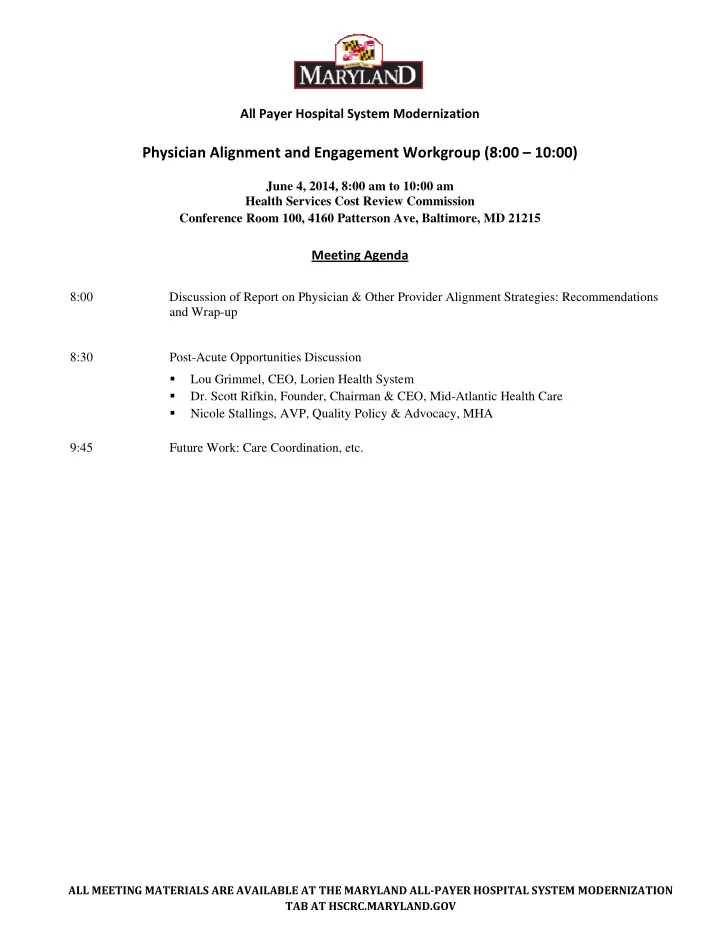
June 4, 2014, 8:00 am to 10:00 am Health Services Cost Review Commission Conference Room 100, 4160 Patterson Ave, Baltimore, MD 21215

Meeting Agenda

8:00 Discussion of Report on Physician & Other Provider Alignment Strategies: Recommendations and Wrap-up 8:30 Post-Acute Opportunities Discussion

  • Lou Grimmel, CEO, Lorien Health System
  • Dr. Scott Rifkin, Founder, Chairman & CEO, Mid-Atlantic Health Care
  • Nicole Stallings, AVP, Quality Policy & Advocacy, MHA

9:45 Future Work: Care Coordination, etc.

slide-2
SLIDE 2
slide-3
SLIDE 3

All Payors Model / Compound Fraction

?

slide-4
SLIDE 4

Simplest Form

slide-5
SLIDE 5

Hospitals in Maryland

Source: mdh2e.org

45 Hospitals in MD

slide-6
SLIDE 6

Hospitals in Maryland

45 Hospitals in MD

slide-7
SLIDE 7

Nursing Homes in Maryland

233 Nursing Homes in MD

slide-8
SLIDE 8

Skilled Nursing the “BRIDGE” to recovery

Higher acuity requires increasing physician involvement

Skilled Nursing Facility

(Transitional & Chronic Care)

Hospital

Assisted Living Facility (ALF)

Home & Community Based Srvcs

(HCBS)

Hospital DRGs and Managed Care Payors driving shorter LOS & quicker sicker discharges State waivers will drive existing lower acuity residents to HCBS Less frail with financial means attempting to “age in place” in ALFs

HOME HOME HOME

slide-9
SLIDE 9

Current SNF Sales Model

slide-10
SLIDE 10
slide-11
SLIDE 11
slide-12
SLIDE 12
slide-13
SLIDE 13

Definition of a Hospitalist

Source: HospitalMedicine.UCSD.edu

slide-14
SLIDE 14

Hospitalist The term hospitalist was first coined by Robert Wachter and Lee Goldman in a 1996 New England Journal

  • f Medicine article.

The iPhone was first introduced in 2007.

slide-15
SLIDE 15

Skilled Nursing the “BRIDGE” to recovery

Higher acuity requires increasing physician involvement

Skilled Nursing Facility

(Transitional & Chronic Care)

Hospital

Assisted Living Facility (ALF)

Home & Community Based Srvcs

(HCBS)

State waivers will drive existing lower acuity residents to HCBS Less frail with financial means attempting to “age in place” in ALFs

HOME HOME HOME

Physician Connection

(ist)

slide-16
SLIDE 16

“Hospitalist” SNF Connect Model

  • Coordinating Care for the growing number of patients

historically cared for on hospital medical/surgical floors and are now be referred to SNF’s

  • Verbal hand-off reporting from Acute Care to SNF to

ensure smooth transition.

  • Hospitalist daily rounds with case management team
  • Twice a week rounds include Rehab., Nursing and

Dietician representatives

  • Bi- Weekly meetings with acute care Hospitalists group to

give a greater understanding of what can be managed in SNF

slide-17
SLIDE 17

Opportunities for Hospitalist Involvement in SNF’s

  • 1. Medical Director
  • 2. Resident at Risk meeting (weekly) this is when falls, weight

loss, decline in conditions, decline in skin integrity and hospitalizations are reviewed.

  • 3. Utilization Review (PPS weekly) this reviews the

appropriateness of stay and continuing care and setting discharge dates.

  • 4. Monthly QA/QI (monthly) this is the committee where trends

are identified and plans for improvement are developed.

slide-18
SLIDE 18

University of Maryland Harford Memorial Hospital Lorien Havre de Grace Citizens Care & Rehabilitation Forest Hill Health and Rehabilitation Lorien Bel Air Bel Air Health and Rehabilitation Lorien Riverside Upper Chesapeake Medical Center Denotes 5 Mile Radius

Map of Harford County

slide-19
SLIDE 19

Broader Trend?

  • Catholic Health Initiatives- entering the insurance

business with plans developed by its newly acquired Arkansas insurance company.

  • Sutter Health- expanding existing health plan and

seeking a new license to contract directly with employers.

  • North Shore LIJ Health System- projects their 2014

health plan will encompass 25,000 members.

Source: The Advisory Board Company

slide-20
SLIDE 20

Ascension Health

  • Largest non-profit health care provider in the

country.

  • Negotiating acquisition of an insurance

company.

  • A move of “significant escalation” in

hospitals’ shift into the insurance business.

Source: The Advisory Board Company

slide-21
SLIDE 21

Mid-Atlantic Health Care’s vision to create an independent strategic network of providers committed to reducing potentially avoidable acute care stays

6/2/14 Confidential & Proprietary. Do not copy or distribute without the expressed approval of NPH. 1

NPH

NPH

Nation tional P Post-Acut cute Healt lthca hcare

slide-22
SLIDE 22

Nati ation

  • nal

al P Pos

  • st-Ac

Acute Heal ealthcar care e

 Created as an independent company from

Maryland’s largest locally owned SNF operator

  • Mid-Atlantic Health Care – 3400 beds, 18 facilities

in Maryland, Pennsylvania, and Delaware.

 Scott Rifkin, MD, Board Chair – Managing

Member of Mid-Atlantic Health Care

 Rick Grindrod, CEO

NPH

NPH

slide-23
SLIDE 23

Nati ation

  • nal

al P Pos

  • st-Ac

Acute Heal ealthcar care e

 Managing the participation of 209 SNFs &

12HHA’s in 19 States in the CMS Bundled Payment for Care Improvement Initiative.

 Managing MAHCs BPCI program in

Pennsylvania – Five facilities went live January 1, 2014.

 Building Post-Acute SNF Networks in PA and

Maryland – In contracting but not live.

NPH

NPH

slide-24
SLIDE 24

Nati ation

  • nal

al P Pos

  • st-Ac

Acute Heal ealthcar care e

 Philadelphia properties have decreased

readmissions from 45% to 18%.

 Maryland properties have decreased

readmission rates from 24% to 12% or less.

 Live with BPCI in PA.  Well funded and supported with the

infrastructure and financial resources of MAHC.

NPH

NPH

slide-25
SLIDE 25

NPH P Propo

  • posal Con
  • ncep

cept

 NPH will work with SNF operators to create a

Maryland equivalent of the Bundled Payment program.

  • SNF operators will not be limited to MAHC.

 Each specific arrangement will involve one or

more SNFs and one or more hospitals

 Reduce readmissions and reduce potentially

avoidable hospitalization

 Contribute to meeting new Medicare Waiver

Test

slide-26
SLIDE 26

NPH NPH Pr Proposal Sp Spec ecif ifics

 NPH will create strategic partnerships with

SNFs and hospitals to take risk for an episode

  • f care for specified DRGs.

 Initial focus on a subset of DRGs identified as

preventable hospital utilization

 Each identified DRGs will be addressed with

specific clinical protocols and programs to reduce preventable hospital utilization.

 These programs will include diversion from

the hospital to SNFs when medically appropriate.

slide-27
SLIDE 27

NPH NPH Pr Proposal Sp Spec ecif ifics

 Specific Clinical Conditions to be considered:

  • Congestive Heart Failure
  • COPD
  • UTI
  • Pneumonia
  • Others
slide-28
SLIDE 28

NPH NPH Pr Proposal Sp Spec ecif ifics

 The Hospital-SNF partnership will request a

waiver from the three-day prior hospital admission rule subject to conditions.

 Involved SNFs will agree to strict QA and

Utilization Management.

 Appropriate patients will be diverted from the

ER to the SNFs.

slide-29
SLIDE 29

Th Three D e Day Rule le Waiver er

 Only for Hospital-SNF partnerships.  Only with SNF agreeing to UM and QA.  Only with the hospital agreeing to participate.  Maintained only with a decrease in total

costs, total hospital days, and SNF LOS.

 Maintained only with one-to-one SNF for

hospital day substitution.

slide-30
SLIDE 30

 NPH and its partners are willing to take full

risk on bundles that are based in the actual experience of that hospital-SNF partnership.

  • Risk on admissions from the SNF
  • Risk on re-admissions from the SNF
  • Risk on hospital costs form the community when a

three day waiver is part of the program.

03/6/14 Confidential & Proprietary. Do not copy or distribute without the expressed approval of NPH. 10

Ris Risk

slide-31
SLIDE 31

Gainsh insharing ing

 Hospital and SNF gainsharing based on the

total system cost savings.

 Hospitals will share some negotiated savings

with participating SNFs.

slide-32
SLIDE 32

Pr Program Suc Success ess M Metr tric ics

 Lower total cost to the system for these

patients.

 Lower total hospital days for these patients  Better than day for day substitution of SNF

LOS for hospital LOS.

 SNFs to agree to general utilization

management and a reduction in average LOS for their skilled population.

 Quality outcome measures that demonstrate

equal or improved quality outcomes

slide-33
SLIDE 33

Post-Acute Opportunities

Nicole Stallings

Assistant Vice President Maryland Hospital Association

slide-34
SLIDE 34

Readmission Reduction Playbook

2

slide-35
SLIDE 35

3

slide-36
SLIDE 36

Care Transitions Steering Committee

slide-37
SLIDE 37

SNF Driver Diagram

5

Reduce SNF Readmissions by 30% Hospital-SNF communications Hospitals implement warm handoffs SNF-focused information transfer with feedback 100% MOLST for all patients d/c to SNF SNF-Hospital communications INTERACT NH- Hospital Form SNF-Hospital Networking INTERACT Transfer Checklist SNF-based practice improvement STOPANDWATCH SBAR Data, readmission reviews

slide-38
SLIDE 38

Physician Alignment and Engagement Future Work Plan

June 4, 2014

slide-39
SLIDE 39

2

HSCRC Model Development and Implementation Timeline

  • Hospital global

model

  • Population-

based

  • Preparation for

Phase 2 focus

  • n total care

model and costs

Short Term (2014) Mid-Term (2015-2017) Long Term (2016- Beyond)

slide-40
SLIDE 40

3

HSCRC Public Engagement Short Term Process Phases

 Phase 1:

 Fall 2013: Advisory Council - recommendations on broad

principles

 January 2014- July 2014: Workgroups

 Four workgroups convened  Focused set of tasks needed for initial policy making of

Commission

 Majority of recommendations needed by July 2014

 Phase 2: July 2014 – July 2015

 Always anticipated longer-term implementation activities  July Workgroup reports to address proposed future work

plan

 Advisory Council reconvening

slide-41
SLIDE 41

4

Public Engagement Process Accomplishments

 Engaged broad set of stakeholders in HSCRC policy

making and implementation of new model

 4 workgroups and 6 subgroups  85 workgroup appointees  Consumers, Employers, Providers, Payers, Hospitals

 Established processes for transparency and

  • penness

 Diverse membership  Educational phase of process  Call for Technical White Paper Shared Publically  Access to information  Opportunity for comment

slide-42
SLIDE 42

5

Role of Workgroups

 Purpose of Workgroups is to encourage broad input

from informed stakeholders

 Commission decision making is better informed with

robust input from stakeholders

 Workgroups identify areas where there is consensus

as well as areas where there are differences of

  • pinion

 Non-voting groups

slide-43
SLIDE 43

6

Current Process, Looking Forward

 Aggressive work plans needed to meet deliverable

schedule

 Time and resource intensive for HSCRC and stakeholders  Staff driven work plans and leadership needed for tight

timelines

 Coordination among groups sometimes challenging  Subgroups effective strategy to address more technical topics

and coordination among groups

 Looking ahead to next phase:

 Less frequent meetings would allow more time for analysis and

review between meetings

 Ad hoc subgroups effective in engaging stakeholders in

development of implementation plans

 Work plan may require different configuration of workgroups  Opportunity to engage stakeholders to lead different initiatives  More focus on outreach and education about new model

slide-44
SLIDE 44

7

Physician Alignment and Engagement Remaining Tasks

Early Fall Tasks

  • Further Develop Maryland

specific ACO-like option

  • Coordinate with Stakeholder

led alignment efforts

  • Monitor progress on

physician re-contracting from volume to value

  • Outreach and Education Plan

Fall/Winter Tasks

  • Care Coordination
  • Post Acute/LTC Coordination
  • Evidence Based Care
  • Tort Reform/Cost of

Defensive Medicine

slide-45
SLIDE 45

8

Next Steps

 Finalize Reports for July  Staff planning and analysis  Fall – Take up remaining tasks