Phonons I - Crystal Vibrations Continued (Kittel Ch. 4) View of - - PowerPoint PPT Presentation

phonons i crystal vibrations continued kittel ch 4
SMART_READER_LITE
LIVE PREVIEW

Phonons I - Crystal Vibrations Continued (Kittel Ch. 4) View of - - PowerPoint PPT Presentation

Phonons I - Crystal Vibrations Continued (Kittel Ch. 4) View of triple axis neutron scattering facility at National Research Council of Canada http://neutron.nrc.ca/welcome.htm Physics 460 F 2006 Lect 9 1 Outline Examples in higher


slide-1
SLIDE 1

Physics 460 F 2006 Lect 9 1
Phonons I - Crystal Vibrations Continued (Kittel Ch. 4)

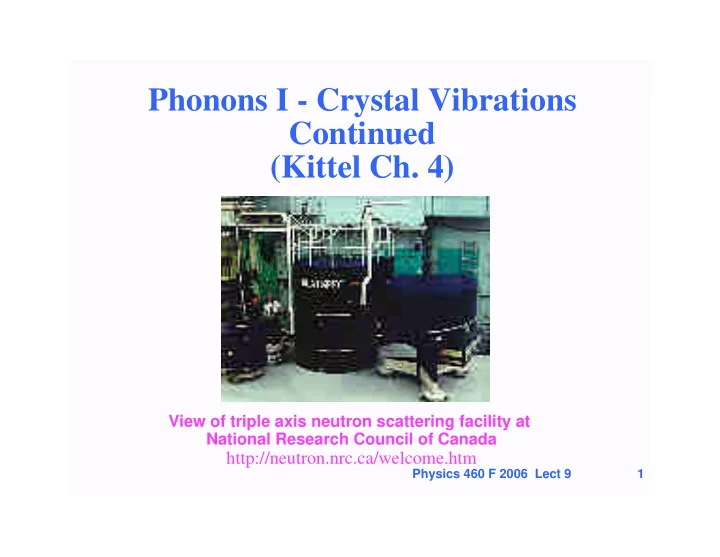
View of triple axis neutron scattering facility at National Research Council of Canada

http://neutron.nrc.ca/welcome.htm

slide-2
SLIDE 2

Physics 460 F 2006 Lect 9 2

Outline

  • Examples in higher dimensions
  • How many modes are there?
  • Quantization and Phonons
  • Experimental observation by inelastic scattering
  • (Read Kittel Ch 4)
slide-3
SLIDE 3

Physics 460 F 2006 Lect 9 3

Energy due to Displacements

  • The energy of the crystal changes if the atoms are

displaced.

  • Analogous to springs between the atoms
  • Suppose there is a spring between each pair of atoms

in the chain. For each spring the change is energy is: ∆E = ½ C (un+1 – un )2

a

un un+1

  • Note: There are no linear terms if we consider small

changes u from the equilibrium positions

C = “spring constant” Notation in Kittel More later on this From last lecture

slide-4
SLIDE 4

Physics 460 F 2006 Lect 9 4

What determines the “spring constant”

  • The energy of the crystal changes if the atoms are

displaced – because the atoms are bound together!

  • Example: Atoms in a line with binding of each pair of

atoms that depends of the distance φ (| Rn+1 – Rn |)

  • For each bond the change is energy is:

∆E = ½ φ’’ (un+1 – un )2 = ½ C (un+1 – un )2

a

un un+1

  • Examples: Coulomb, Van der Waals attraction,

replusive terms, etc. given before

C = “spring constant”

φ’’ = second

derivative

  • f φ (r)
slide-5
SLIDE 5

Physics 460 F 2006 Lect 9 5

Vibration waves in 2 or 3 dimensions

Vector dot product - same for all atoms in plane perpendicular to k

k

  • Newton’s Law: M d2 un / dt2 = Fn
  • General Solution:

un(t) = ∆u exp(ik . Rn - iωt) Consider the motion to be vibrations of planes of atoms

  • Like a chain in
  • ne dimension!

From last lecture

slide-6
SLIDE 6

Physics 460 F 2006 Lect 9 6

Vibration waves in 2 or 3 dimensions

  • Easier to see with planes vertical and k vector horizontal
  • Then Newton’s equations become

M d2 un / dt2 = Fn = Ceff [ un-1 + un-1 - 2 un]

  • Each plane can move

in three directions –

  • ne longitudinal and

two transverse

k

Like one dimension!

  • But the effective spring

constant Ceff is different for each mode How do we find Ceff ?

slide-7
SLIDE 7

Physics 460 F 2006 Lect 9 7

Central Forces

  • For Central Forces the depends only on the distance

between the atoms

  • The energy per atom is

E = (1/2(1/N) Σnm φnm (| Rn - Rn+m |) = E0 + (1/4N) Σnm φnm ′′ (∆| Rn - Rn+m |) 2 + ….

  • The force Fn is along the

direction of the neighbor

  • The length changes only for

displacements un+m- un along the direction of the neighbor R0

n

R0

n+m

un+m- un Fn θn Note angle θi depends on neighbor i

slide-8
SLIDE 8

Physics 460 F 2006 Lect 9 8

Geometric factors for Central Forces

  • We will consider waves with each atom displaced in

the same direction – for simplicity – then we always need the force in the direction of the motion Fn||

  • Fs|| = - Σi φi′′ [cos( θn ) ] 2 |un+m- un|

R0

n

R0

n+m

un+m- un Fn θn Note angle θi depends on neighbor i Fs|| θn Geometric factor depends on neighbor i

slide-9
SLIDE 9

Physics 460 F 2006 Lect 9 9

Vibration waves in 2 or 3 dimensions

  • Newton’s equations

M d2 un / dt2 = Fn = Ceff [ un+1 + un-1 - 2 un]

k

For each type of motion, Ceff = Σi φi′′ [cos( θi ) ] 2 where θi is the angle between the displacement vector and the direction to neighbor i For one atom per cell the resulting dispersion curve is ωk = 2 (Ceff / M ) 1/2 |sin (ka/2)|

slide-10
SLIDE 10

Physics 460 F 2006 Lect 9 10

Example – fcc with nearest-neighbor pair potential φ(r)

X y z

k Consider waves with k in x direction Longitudinal motion in x direction Each atom has 4 neighbors in each of the two neighboring planes with cos(θ)2 = ½

Ceff = 4 φi′′/2 ωk = 23/2 (φi′′/M )1/2 |sin (ka/2)|

slide-11
SLIDE 11

Physics 460 F 2006 Lect 9 11

Example – fcc with nearest-neighbor pair potential φ(r)

X y z

k Consider waves with k in x direction Transverse motion in y direction Each atom has 2 neighbors in each of the two neighboring planes with cos(θ)2 = ½ and 2 neighbors with cos(θ) = 0

Ceff = 2 φi′′/2 ωk = 2 (φi′′/M )1/2 |sin (ka/2)|

slide-12
SLIDE 12

Physics 460 F 2006 Lect 9 12

Waves traveling in x direction in fcc crystal with one atom per cell

π/a

ωk

3 Acoustic modes Each has ω ~ k at small k k

In the case of nearest neighbor forces, the longitudinal ωk is higher than the transverse ωk by the factor 21/2

In this case the two transverse modes are “degenerate”, i.e., they have the same frequency

slide-13
SLIDE 13

Physics 460 F 2006 Lect 9 13

Oscillations in general 3 dimensional crystal with N atoms per cell

π/a

ωk

3 Acoustic modes Each has ω ~ k at small k k 3 (N -1) Optic Modes −π/a

slide-14
SLIDE 14

Physics 460 F 2006 Lect 9 14

Quantization of Vibration waves

  • Max Planck - The beginning of quantum

mechanics in 1901

  • There were observations and experimental facts

that showed there were serious issues that classical mechanics failed to explain

  • One was radiation – the laws of classical

mechanics predicted that light radiated from hot bodies would be more intense for higher frequency (blue and ultraviolet) – totally wrong!

  • Planck proposed that light was emitted in

“quanta” – units with energy E = h ν = ω

  • Planck’s constant h --- “h bar” = = h/2π
  • The birth of quantum mechanics
  • Applies to all waves!

h h

slide-15
SLIDE 15

Physics 460 F 2006 Lect 9 15

Quantization of Vibration waves

  • Each independent harmonic oscillator has quantized

energies: en = (n + 1/2) hν = (n + 1/2) ω

  • We can use this here because we have shown that

vibrations in a crystal are independent waves, each labeled by k (and index for the type of mode - 3N indices in a 3 dimen. crystal with N atoms per cell)

  • Since the energy of an oscillator is 1/2 kinetic and 1/2

potential, the mean square displacement is given by (1/2) M ω2 u2 = (1/2) (n + 1/2) hω where M and u are appropriate to the particular mode (e.g. total mass for acoustic modes, reduced mass for

  • ptic modes , ….)

h

slide-16
SLIDE 16

Physics 460 F 2006 Lect 9 16

Quantization of Vibration waves

  • Quanta are called phonons
  • Each phonon carries energy ω
  • For each independent oscillator (i.e., for each

independent wave in a crystal), there can be any integer number of phonons

  • These can be viewed as particles
  • They can be detected experimentally as creation or

destruction of quantized particles

  • Later we will see they can transport energy just like a

gas of ordinary particles (like molecules in a gas). h

slide-17
SLIDE 17

Physics 460 F 2006 Lect 9 17

Inelastic Scattering and Fourier Analysis

  • The in and out waves have the form:

exp( i kin. r - i ωint) and exp( i kout. r - i ωoutt)

  • For elastic scattering we found that diffraction
  • ccurs only for kin - kout = G
  • For inelastic scattering the lattice planes are

vibrating and the phonon supplies wavevector kphonon and frequency ωphonon d λ kin kout

slide-18
SLIDE 18

Physics 460 F 2006 Lect 9 18

Inelastic Scattering and Fourier Analysis

  • Result:
  • Inelastic diffraction occurs for

kin - kout = G ± kphonon ωin - ωout = ± ωphonon or Εn - Εout = ± hωphonon kin ωin kout ωout kphonon ωphonon

Create or destroy quanta

  • f vibrational energy
slide-19
SLIDE 19

Physics 460 F 2006 Lect 9 19

Experimental Measurements of Dispersion Curves

  • Dispersion curves ω as a function of k are measured

by inelastic diffraction

  • If the atoms are vibrating then diffraction can occur

with energy loss or gain by scattering particle

  • In principle, can use any particle - neutrons from a

reactor, X-rays from a synchrotron, He atoms which scatter from surfaces, …...

slide-20
SLIDE 20

Physics 460 F 2006 Lect 9 20

Experimental Measurements of Dispersion Curves

  • Neutrons are most useful for vibrations

For λ ~ atomic size, energies ~ vibration energies BUT requires very large crystals (weak scattering)

  • X-ray - only recently has it been possible to have

enough resolution (meV resolution with KeV X-rays!)

  • “Triple Axis” - rotation of sample and two

monochrometers

Neutrons or X-rays with broad range

  • f energies

Single crystal monchrometer Sample selected energy in Single crystal monchrometer Detector selected energy out

slide-21
SLIDE 21

Physics 460 F 2006 Lect 9 21

Experimental Measurements of Dispersion Curves

  • Alternate approach for Neutrons

Use neutrons from a sudden burst, e.g., at the new “spallation” source at Oak Ridge (Largest science project in the US this century!)

  • Measure in and out energies by “time of flight”

Burst of neutrons at measured time (broad range of energies) Sample Mechanical chopper selects velocity, i.e., energy of neutrons Detector Timing at detector selects energy of scattered neutrons

slide-22
SLIDE 22

Physics 460 F 2006 Lect 9 22

More on Phonons as Particles

  • Quanta are called phonons, each with energy hω
  • k can be interpreted as “momentum”
  • What does this mean?

NOT really momentum - a phonon does not change the total momentum of the crystal But k is “conserved” almost like real momentum - when a phonon is scattered it transfers “k” plus any reciprocal lattice vector, i.e., ∑ kbefore = ∑ kafter + G

  • Example : scattering of particles

kin = kout + G ± kphonon where + means a phonon is created, - means a phonon is destroyed

slide-23
SLIDE 23

Physics 460 F 2006 Lect 9 23

Summary

  • Normal modes of harmonic crystal:

Independent oscillators labeled by wavevector k and having frequency ωk

  • The relation ωk as a function of k is called a dispersion

curve - 3N curves for N atoms/cell in 3 dimensions

  • Quantized energies (n + 1/2) h ωk
  • Can be viewed as particles that can be created or

destroyed - each carries energy and “momentum”

  • “Momentum” conserved modulo any G vector
  • Measured directly by inelastic diffraction - difference in

in and out energies is the quantized phonon energy

  • Neutrons, X-rays, …..
slide-24
SLIDE 24

Physics 460 F 2006 Lect 9 24

Next time

  • Phonon Heat Capacity
  • One of the early mysteries solved by quantum

mechanics - obey Bose-Einstein Statistics

  • Density of states of phonons
  • Debye and Einstein Models
  • (Read Kittel Ch 5)