
Craig James, Chief Economist Twitter: @CommSec
Produced by Commonwealth Research based on information available at the time of publishing. We believe that the information in this report is correct and any opinions, conclusions or recommendations are reasonably held or made as at the time of its compilation, but no warranty is made as to accuracy, reliability or completeness. To the extent permitted by law, neither Commonwealth Bank of Australia ABN 48 123 123 124 nor any of its subsidiaries accept liability to any person for loss or damage arising from the use of this report. The report has been prepared without taking account of the objectives, financial situation or needs of any particular individual. For this reason, any individual should, before acting on the information in this report, consider the appropriateness of the information, having regard to the individual’s objectives, financial situation and needs and, if necessary, seek appropriate professional advice. In the case of certain securities Commonwealth Bank of Australia is or may be the only market maker. This report is approved and distributed in Australia by Commonwealth Securities Limited ABN 60 067 254 399 a wholly owned but not guaranteed subsidiary of Commonwealth Bank of Australia. This report is approved and distributed in the UK by Commonwealth Bank of Australia incorporated in Australia with limited liability. Registered in England No. BR250 and regulated in the UK by the Financial Conduct Authority (FCA). This report does not purport to be a complete statement or summary. For the purpose of the FCA rules, this report and related services are not intended for private customers and are not available to them. Commonwealth Bank of Australia and its subsidiaries have effected or may effect transactions for their own account in any investments or related investments referred to in this report.
Economics | October 14 2019
Petrol slides; Credit card debt still falling
Weekly petrol prices; Credit/debit cards
Petrol: According to the Australian Institute of Petroleum, the national average price of unleaded petrol fell by 6.6 cents a litre last week, down from a 5-month high of 152.7 cents a litre to 146.1 cents a litre. It was the biggest weekly fall in 9½ months. Prices in Sydney, Melbourne and Brisbane are approaching lows in their petrol discounting cycles. The Adelaide petrol discounting cycle has just ended and unleaded petrol prices are near $1.70 a litre. Credit cards: The average credit card balance hit a 19-month low of $3,161.11 in August, down 1.8 per cent
- n a year ago.
Card purchases: By value, the sum of credit & debit card purchases rose by 0.2 per cent in August, the weakest gain in three months. Card purchases were up 5.5 per cent on the year. Smoothed annual growth (12 month average) fell to a record (15-year) low of 5.7 per cent. China trade: Imports in September were 8.5 per cent down on a year ago (forecast -5.2 per cent). Exports fell 3.2 per cent as expected. And the trade surplus rose from $34.83 billion to $39.65bn (forecast $33.3bn).
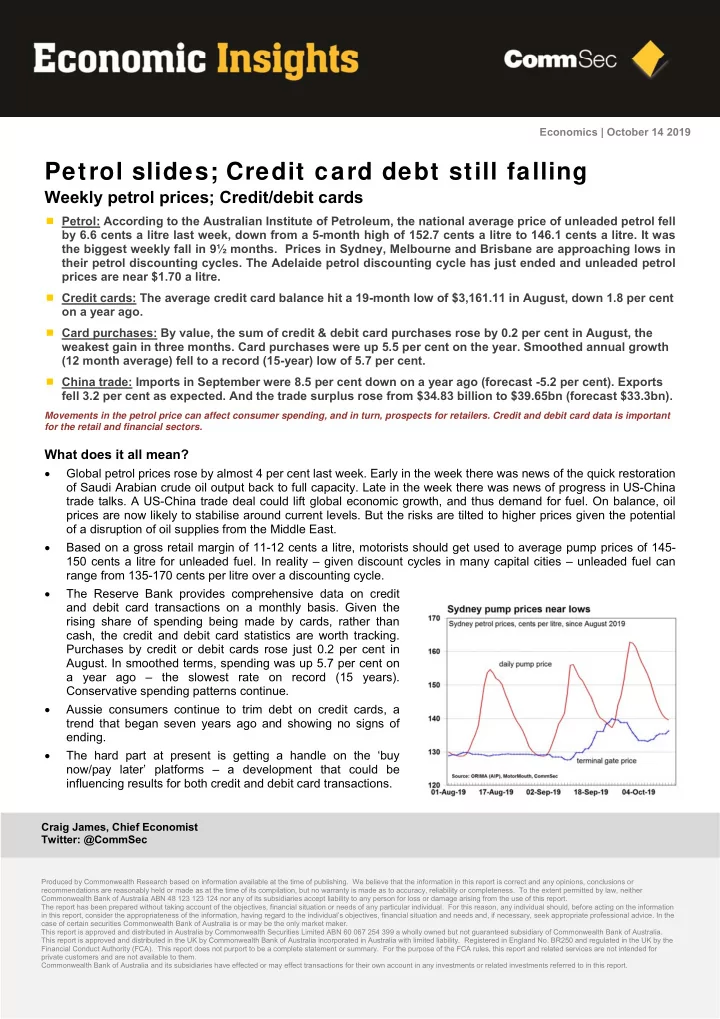
Movements in the petrol price can affect consumer spending, and in turn, prospects for retailers. Credit and debit card data is important for the retail and financial sectors.
What does it all mean?
Global petrol prices rose by almost 4 per cent last week. Early in the week there was news of the quick restoration
- f Saudi Arabian crude oil output back to full capacity. Late in the week there was news of progress in US-China
trade talks. A US-China trade deal could lift global economic growth, and thus demand for fuel. On balance, oil prices are now likely to stabilise around current levels. But the risks are tilted to higher prices given the potential
- f a disruption of oil supplies from the Middle East.
Based on a gross retail margin of 11-12 cents a litre, motorists should get used to average pump prices of 145- 150 cents a litre for unleaded fuel. In reality – given discount cycles in many capital cities – unleaded fuel can range from 135-170 cents per litre over a discounting cycle. The Reserve Bank provides comprehensive data on credit and debit card transactions on a monthly basis. Given the rising share of spending being made by cards, rather than cash, the credit and debit card statistics are worth tracking. Purchases by credit or debit cards rose just 0.2 per cent in
- August. In smoothed terms, spending was up 5.7 per cent on